Counterparty Credit Risk in Banks: CAIIB Risk Management Guide
Most candidates walk into the CAIIB Risk Management elective comfortable with loan defaults and then lose marks the moment a derivative appears in the question. Counterparty credit risk in banks is not just credit risk with a new label — the exposure is uncertain, it moves with the market, and it can run in either direction between the two parties. This guide covers where it arises, how the exposure is measured, how it is mitigated, and the specific traps the examiner keeps setting.
🎯 What Counterparty Credit Risk Actually Is
Counterparty credit risk (CCR) is the risk that the party on the other side of a transaction defaults before the final settlement of the transaction's cash flows. It sits at the junction of credit risk and market risk, which is exactly why it gets its own treatment in the Basel framework and its own questions in the paper.
Counterparty credit risk in banks arises in four families of transactions:
- OTC derivatives — interest rate swaps, forward rate agreements, currency swaps, options written and bought.
- Repos and reverse repos and other securities financing transactions (SFTs).
- Long settlement transactions, where settlement is contractually deferred well beyond market convention.
- Margin lending against securities.
Two features make it different from a term loan. First, the exposure is bilateral: on an interest rate swap, whether you or the counterparty is "in the money" depends on where rates have moved, so either side can end up as the exposed party. Second, the exposure is stochastic — it is not a drawn amount you can read off the ledger, but a mark-to-market value that changes daily and could be far larger tomorrow.
The chapter on derivatives and risk management is the natural companion here: you cannot size a counterparty exposure without first knowing how the underlying contract is valued. The same logic underpins credit default swaps in Indian banks, where the protection buyer carries counterparty risk on the protection seller precisely when protection is most needed.
💡 Exam Tip: If a question describes a risk that only crystallises when both a market move and a default occur, it is testing counterparty credit risk — not plain credit risk and not plain market risk.
📊 Traditional Credit Risk vs Counterparty Credit Risk
Supervisors treat counterparty credit risk in banks as a hybrid exposure, and the cleanest way to fix that in memory is a dimension-by-dimension comparison. Almost every objective question on this topic is a disguised test of one row in the table below.
| Dimension | Traditional (lending) credit risk | Counterparty credit risk |
|---|---|---|
| Direction of exposure | One-way — only the lender is exposed | Bilateral — either party can be in the money |
| Exposure amount | Known: outstanding balance plus undrawn commitment | Uncertain: driven by market prices until settlement |
| Typical products | Term loans, cash credit, bills, guarantees | OTC derivatives, repos, SFTs, long settlement trades |
| Exposure measure | Outstanding amount, or notional × credit conversion factor | Replacement cost plus potential future exposure |
| Main mitigants | Collateral, guarantees, covenants | Netting agreements, daily margining, central clearing |
| Additional capital charge | None beyond the credit risk charge | A separate CVA capital charge on OTC derivatives |
Two rows deserve extra attention. The exposure amount row explains why regulators insist on add-ons rather than a simple mark-to-market figure — a swap worth zero today can be worth crores in a year. The additional capital charge row is the one candidates forget: a bank running OTC derivatives holds capital twice over, once for default risk and once for credit valuation adjustment.
Working through the regulatory capital and capital adequacy chapter alongside this table is worth doing in one sitting, because the CCR charge is simply another input into the same risk-weighted assets denominator.
🧮 Measuring the Exposure: Replacement Cost, PFE and EPE
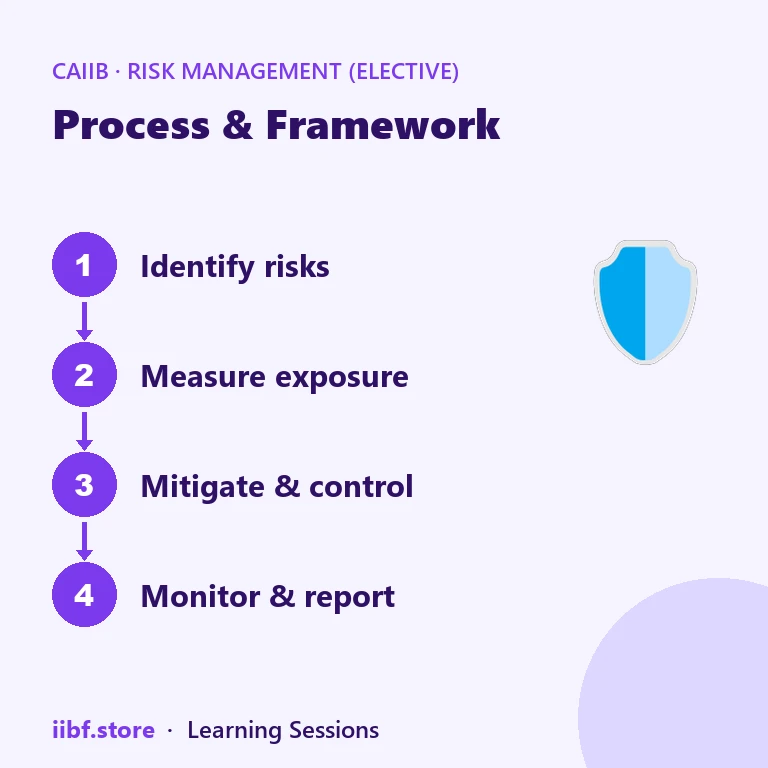
The measurement of counterparty credit risk in banks starts with one identity. Under the Current Exposure Method (CEM), the credit equivalent amount of an OTC derivative is:
Credit equivalent amount = Current replacement cost (marked to market, floored at zero) + Potential future exposure (PFE) add-on
Replacement cost is what it would cost to replace the contract today, floored at zero when the contract is out of the money for the bank. The PFE add-on is a percentage of notional principal that grows with residual maturity and varies by underlying — interest rate contracts carry the smallest add-ons, equity and commodity contracts the largest. That amount, times the counterparty's risk weight, gives risk-weighted assets.
The internal model vocabulary
Internal Model Method banks model a distribution of future exposures instead of a single add-on:
- Expected Exposure (EE) — average exposure at a future date.
- Expected Positive Exposure (EPE) — time-weighted average of EE over the horizon.
- Effective EPE — EPE on a non-decreasing exposure path, so short-dated rollover risk is not understated.
- Peak exposure — a high percentile of the distribution, used for internal limits.
Exposure at default under that method is alpha × Effective EPE, with a supervisory alpha of 1.4. Basel replaced CEM internationally with the Standardised Approach for Counterparty Credit Risk (SA-CCR); for Indian applicability check the current RBI Master Circular on Basel III Capital Regulations. Separately, the credit valuation adjustment (CVA) charge capitalises mark-to-market losses from deteriorating counterparty creditworthiness — not outright default. The simulation machinery is the same one behind value at risk models.
⚠️ Common Mistake: Candidates add the negative mark-to-market of an out-of-the-money contract as a negative number. Replacement cost is floored at zero contract by contract unless a legally enforceable netting agreement permits offsetting.
🛡️ Mitigating Counterparty Credit Risk in Banks
Mitigating counterparty credit risk in banks rests on four pillars, each with its own supervisory conditions.
1. Close-out netting. An enforceable ISDA master agreement lets a bank offset positive and negative mark-to-market values with the same counterparty, collapsing many contracts into one net claim. Capital relief is allowed only where the bank holds a legal opinion that the netting is enforceable in the relevant jurisdiction — the exam loves this condition.
2. Margining. A Credit Support Annex makes the out-of-the-money party post collateral. Variation margin settles the current mark-to-market daily; initial margin covers potential future exposure during the close-out period. RBI's 2024 Master Direction on margining for non-centrally cleared OTC derivatives sets out the Indian requirements.
3. Central clearing. Where a trade is novated to a qualifying central counterparty (QCCP) — in India, the Clearing Corporation of India — the CCP becomes buyer to every seller and seller to every buyer. Trade exposures to a QCCP attract a concessional 2% risk weight and are exempt from the CVA charge. Central clearing relocates the risk to the CCP and its default waterfall; it does not remove it.
4. Limits and wrong-way risk controls. General wrong-way risk exists when exposure rises with the same macro factors that raise the counterparty's default probability. Specific wrong-way risk is worse: exposure is directly correlated with the counterparty's own credit quality, the classic case being collateral made up of the counterparty's own paper. It turns toxic when a corporate borrower's hedge fails — see unhedged foreign currency exposure. For the governance layer above all four pillars, read the operational risk and integrated risk chapter.
📌 Remember: Netting reduces exposure, margining reduces the residual, and central clearing relocates it. None of the three converts a derivative into a risk-free asset.
📎 Always cross-check the current text of the governing circular on the Reserve Bank of India website before you rely on it in the exam hall or at your desk.
🧠 Practice MCQs: Counterparty Credit Risk
Q1. Under the Current Exposure Method, the credit equivalent amount of an OTC derivative contract is: (a) Notional principal multiplied by the counterparty risk weight (b) Current replacement cost floored at zero, plus a potential future exposure add-on (c) Expected loss plus unexpected loss over one year (d) Initial margin plus variation margin posted to date
Answer: (b) — CEM adds a maturity-and-underlying based PFE add-on to the mark-to-market replacement cost, which is floored at zero.
Q2. Which feature most clearly distinguishes counterparty credit risk from traditional lending credit risk? (a) It uses a probability of default estimate (b) It applies only to retail portfolios (c) The exposure amount is uncertain and driven by market prices, and the risk runs in both directions (d) It attracts no regulatory capital charge
Answer: (c) — CCR exposure is stochastic and bilateral, unlike a loan where the drawn amount is known and only the lender is exposed.
Q3. Specific wrong-way risk arises when: (a) Collateral is denominated in a currency different from the exposure (b) The netting agreement is not legally enforceable (c) Exposure increases with general macroeconomic factors (d) Exposure to a counterparty is positively correlated with that counterparty's own probability of default
Answer: (d) — the textbook illustration is collateral consisting of securities issued by the counterparty itself or its group.
Q4. Under the Basel III framework, trade exposures of a bank to a qualifying central counterparty (QCCP) attract a risk weight of: (a) 0% (b) 2% (c) 20% (d) 100%
Answer: (b) — the concessional 2% risk weight is the incentive designed to push standardised OTC derivatives towards central clearing.
Q5. The credit valuation adjustment (CVA) capital charge is intended to capture: (a) Mark-to-market losses from a deterioration in the creditworthiness of derivative counterparties (b) Losses from back-office settlement failures (c) Banking book losses from adverse interest rate movements (d) Losses on physical commodity inventory
Answer: (a) — CVA capitalises valuation losses short of outright default, which is why it sits on top of the default risk charge.
Want chapter-wise mock tests with 100+ MCQs? Start practising free →
❓ Frequently Asked Questions
Is counterparty credit risk a banking book or trading book exposure?
It cuts across both. The default risk charge on derivative and SFT exposures is computed under the credit risk framework regardless of where the position is booked, while the underlying instrument itself may sit in the trading book for market risk purposes.
How is settlement risk different from counterparty credit risk?
Settlement risk is the risk that a counterparty fails to deliver on the settlement date after the bank has already paid — a short, sharp exposure to the full principal. Counterparty credit risk covers the period before final settlement, where the exposure is the replacement cost of the contract, not the principal.
Does clearing through a CCP eliminate counterparty credit risk?
No. It replaces bilateral exposures with an exposure to the clearing corporation, backed by margins, a default fund and a loss waterfall. The residual is small enough to justify a 2% risk weight on trade exposures to a QCCP, but it is not zero.
Which CAIIB paper tests counterparty credit risk?
It appears in the Risk Management elective and again in BFM, usually attached to a derivatives or capital adequacy question. Expect numerical questions on the CEM computation and conceptual questions on netting, margining and wrong-way risk.
Exam questions on counterparty credit risk in banks reward candidates who can separate three things: the exposure measure, the capital charge, and the mitigant. Get the CEM identity and the QCCP treatment automatic, revise the wrong-way risk definitions the night before, and this becomes a scoring topic instead of a guessing one. Reinforce it with the live-class walkthrough in CAIIB Risk Management Class 4, browse more revision notes on the Risk Management elective blog hub, and if you are pairing this with the Central Banking elective, the operational side of RBI's role shows up in the clean note policy of RBI. Ready to lock in the full syllabus? Start with the CAIIB course and work chapter by chapter.
Practice this topic
Take a free mock test, download chapter PDFs, or watch a video class — all included on iibf.store.
Keep reading