Credit Conversion Factor in Basel Norms: IIBF RM Guide
Every non-fund based facility a bank sanctions — a letter of credit, a bank guarantee, an undrawn loan commitment — sits off the balance sheet until it is drawn, yet it still carries real default risk. The credit conversion factor in Basel norms is the mechanism that turns these off-balance-sheet exposures into an on-balance-sheet equivalent so they can be risk-weighted and capitalised like any funded loan. For the IIBF Risk Management exam, this is one of the more calculation-heavy topics in the capital adequacy portion, and examiners like testing the bucket a specific instrument falls into. This article walks through the CCF categories, the calculation chain from notional exposure to risk-weighted assets, and where candidates typically go wrong.
📊 What a Credit Conversion Factor Actually Does
A Credit Conversion Factor (CCF) is a percentage that RBI's Basel III capital adequacy framework assigns to a category of off-balance-sheet item, used to estimate what fraction of that commitment is likely to be drawn and exposed to default before it matures or expires. Multiplying the notional (face) value of the facility by its CCF gives the credit equivalent amount — the figure that then gets risk-weighted, exactly as a funded advance would be.
The logic exists because a Rs 10 crore undrawn cash credit limit does not carry the same expected loss as a Rs 10 crore term loan already disbursed; some portion may never be drawn, or may be cancelled before draw-down. CCFs calibrate that difference so capital held against non-fund exposures reflects their real risk rather than their full face value. This sits inside the same framework covered under regulatory capital and capital adequacy, where CCF-adjusted exposures feed directly into the risk-weighted assets denominator of the capital ratio.
💡 Exam Tip: CCF converts exposure amount, not risk weight. The credit equivalent amount still needs a separate counterparty risk weight applied afterward to arrive at RWA.
📋 The CCF Buckets Under RBI's Basel Framework
RBI's Basel III capital regulations group off-balance-sheet non-market-related items into broad CCF bands rather than assigning a unique percentage to every product. At the top, direct credit substitutes — financial guarantees and standby letters of credit that back a customer's financial obligation — attract a 100% CCF, since the bank is effectively on the hook for the full amount the moment the underlying obligor defaults.
Trade-related contingent items sit lower down: a short-term, self-liquidating documentary letter of credit backed by underlying goods typically attracts a lower CCF than a financial guarantee, reflecting its lower likelihood of full draw-down. Loan commitments are banded by tenor and cancellability — commitments that are unconditionally cancellable by the bank at any time without notice can carry a 0% CCF, while fixed-term undrawn commitments carry a positive CCF that generally increases with original maturity.
The table below summarises the broad bands candidates need to recognise; exact percentages for specific product variants should always be checked against the current RBI master circular in force at exam time.
| CCF Band | Typical Off-Balance-Sheet Item | Draw-Down Likelihood | Full Face-Value Risk? |
|---|---|---|---|
| 100% | Direct credit substitutes, financial guarantees, standby LCs | High — bank effectively stands in for the obligor | ✅ |
| 50% | Longer-tenor undrawn commitments, note issuance facilities | Moderate | ❌ |
| 20% | Short-term trade LCs, self-liquidating trade contingencies | Lower — backed by underlying goods | ❌ |
| 0% | Commitments unconditionally cancellable without notice | Effectively nil | No |
🔄 From CCF to Risk-Weighted Assets: The Calculation Chain
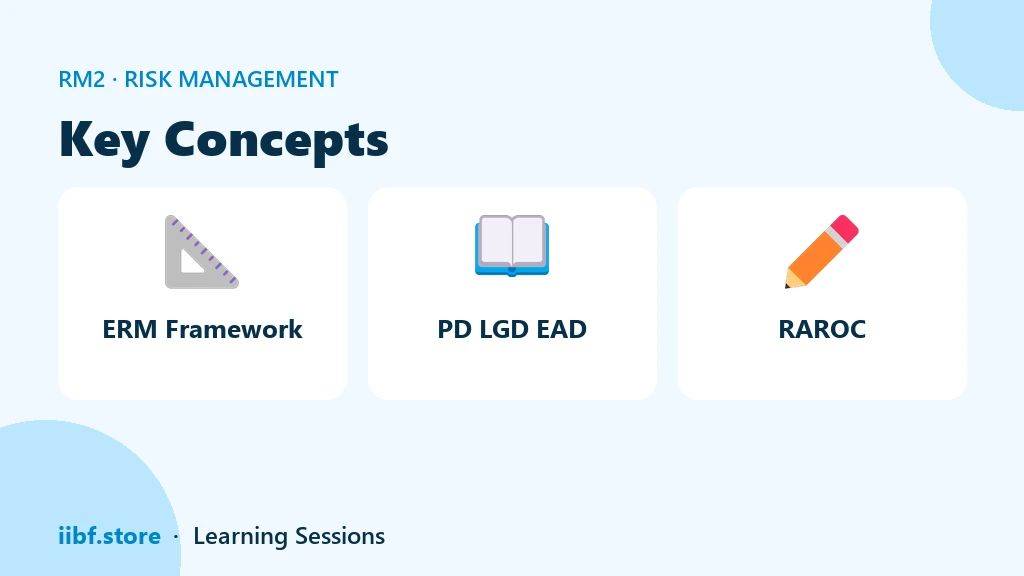
The full chain runs in two distinct steps, and exam questions often test whether candidates can keep them separate. Step one: Credit Equivalent Amount = Notional Exposure × CCF. Step two: Risk-Weighted Asset = Credit Equivalent Amount × Counterparty Risk Weight, where the risk weight depends on the borrower's external rating, exposure class, or the standardised risk-weight table applicable under the current framework.
For example, an unrated corporate guarantee of Rs 5 crore at a 100% CCF produces a credit equivalent of Rs 5 crore; applying a 100% risk weight for an unrated corporate then produces Rs 5 crore of RWA. Change either the CCF band or the counterparty risk weight, and the capital charge changes proportionately — which is exactly why examiners like combining both steps in a single numerical question.
This two-step logic is why banks that need to understand where their broader regulatory capital obligations come from should first revisit why do banks need regulation — capital adequacy rules exist precisely to ensure off-balance-sheet promises are backed by real, risk-sensitive capital, not left uncapitalised simply because no cash has moved yet.
🤝 Netting, Guarantees and Real-World CCF Situations
CCF applies to non-derivative, non-market-related off-balance-sheet items such as guarantees and commitments. Derivative exposures follow a different exposure-measurement path — current and potential future exposure, often reduced through legally enforceable netting arrangements — a distinct topic covered in the piece on bilateral netting of derivatives. Candidates sometimes wrongly apply CCF logic to a derivatives netting question, so keeping the two exposure types separate matters for the exam.
A practical scenario worth knowing: if a bank has issued a financial guarantee on behalf of a borrower and that borrower's account later moves into insolvency resolution, the guarantee can get invoked once a public announcement under CIRP confirms the account is under the resolution process, converting the off-balance-sheet exposure into an actual funded claim overnight — which is exactly the scenario CCF-based capital was set aside to absorb in the first place.
Banks using internal models for capital planning also validate their standardised CCF-based numbers against internally modelled exposure estimates, an approach explored further in the article on Monte Carlo simulation in risk management.
📌 Remember: CCF only tells you how much of an off-balance-sheet exposure to convert. It does not, by itself, tell you the risk weight — that is a separate, counterparty-specific step.

⚠️ Common Mistakes Candidates Make on CCF Questions
The most frequent error is skipping the credit-equivalent step entirely and applying the risk weight directly to the notional exposure — this overstates or understates RWA depending on whether the CCF was below or above 100%. Always convert first, then risk-weight.
A second common mistake is mixing up commitment tenor bands — treating a long-dated undrawn term loan commitment the same as a short-term, unconditionally cancellable overdraft limit. The cancellability and original maturity of the facility, not just its product name, decide the CCF band.
A third mistake is forgetting that CCF assignments and the exposures they generate are reviewed as part of the bank's overall capital adequacy assessment during the supervisory review and evaluation process, not just calculated once and forgotten — supervisors do check whether off-balance-sheet items have been bucketed correctly.
⚠️ Common Mistake: Assuming every letter of credit gets the same CCF. The band depends on whether it is a trade-related, self-liquidating LC or a financial/standby LC acting as a credit substitute.
🧠 Practice MCQs: Credit Conversion Factor in Basel Norms
Q1. A Credit Conversion Factor is applied to convert: (a) a funded loan into an off-balance-sheet item (b) an off-balance-sheet exposure into a credit equivalent amount (c) a risk weight into a capital ratio (d) a guarantee into a derivative
Answer: (b) — CCF converts an off-balance-sheet notional exposure into a credit equivalent amount before risk-weighting.
Q2. Which off-balance-sheet item typically attracts the highest CCF band? (a) an unconditionally cancellable overdraft limit (b) a short-term self-liquidating trade LC (c) a direct credit substitute such as a standby letter of credit (d) a facility with no draw-down history
Answer: (c) — Direct credit substitutes carry the highest CCF since the bank effectively stands in for the obligor's full obligation.
Q3. After computing the credit equivalent amount, the next step to arrive at RWA is to: (a) apply the counterparty's risk weight (b) apply the CCF a second time (c) subtract the notional exposure (d) report it directly as capital
Answer: (a) — RWA equals the credit equivalent amount multiplied by the applicable counterparty risk weight, a separate step from the CCF conversion.
Q4. A commitment that the bank can cancel unconditionally at any time without notice typically attracts a CCF of: (a) 100% (b) 50% (c) 20% (d) 0%
Answer: (d) — Unconditionally cancellable commitments carry effectively nil draw-down likelihood and can attract a 0% CCF.
Q5. CCF-based exposure measurement primarily applies to: (a) derivative exposures measured via netting arrangements (b) non-derivative off-balance-sheet items such as guarantees and commitments (c) fully funded term loans (d) equity investments
Answer: (b) — CCF applies to non-derivative, non-market-related off-balance-sheet items; derivatives follow a separate exposure-measurement approach.
Want chapter-wise mock tests with 100+ MCQs? Start practising free →
FAQs on Credit Conversion Factors
What is the difference between CCF and risk weight?
CCF converts the notional off-balance-sheet exposure into a credit equivalent amount. Risk weight is then applied to that credit equivalent amount based on the counterparty's rating or exposure class to arrive at risk-weighted assets.
Does CCF apply to derivative contracts?
No. CCF applies to non-derivative, non-market-related off-balance-sheet items like guarantees and loan commitments. Derivatives use a separate exposure-measurement approach that can incorporate netting.
Why do unconditionally cancellable commitments get a lower CCF?
Because the bank can withdraw the facility at any time without notice, the realistic likelihood of the full amount being drawn and exposed to default is very low, so regulators permit a lower, sometimes nil, conversion factor.
Is the CCF the same for every letter of credit?
No. A trade-related, self-liquidating documentary LC backed by underlying goods typically attracts a lower CCF than a financial or standby LC that functions as a direct credit substitute for the customer's obligation.
Credit conversion factors are a small but calculation-heavy piece of the capital adequacy puzzle, and IIBF exam questions frequently combine the CCF step with a risk-weight step in the same numerical problem. For more study material tagged to this subject, browse the risk management article hub, and for the current regulatory framework, refer to the Reserve Bank of India's guidance on Basel III capital adequacy norms. Ready to practise the full calculation chain? Attempt a free mock test and work through CCF-to-RWA numericals under exam conditions.
Practice this topic
Take a free mock test, download chapter PDFs, or watch a video class — all included on iibf.store.
Keep reading