Credit Line on UPI: A Complete IIBF Digital Banking Guide
A credit line on UPI lets a bank-approved borrower draw pre-sanctioned credit straight through a UPI app, turning everyday QR and P2M payments into a borrowing rail rather than a pure debit rail. For IIBF Digital Banking candidates this is one of the newest additions to the retail lending toolkit, and examiners increasingly test the mechanics, eligible lenders, and risk safeguards around it rather than just the definition. This guide walks through how the facility works, who can offer it, how it differs from a card or personal loan, and the exam angles you must not miss. Before going further, it helps to revisit the basics in Overview of Digital Banking, which frames where lending-linked UPI features sit inside the broader digital banking syllabus.
🏦 What a Credit Line on UPI Actually Is
Traditionally, UPI only worked as a "pay from" instrument linked to a savings or current account balance. RBI changed this by permitting banks to link a pre-sanctioned credit line — essentially an approved borrowing limit — as the funding account behind a UPI handle. The customer opens the linked bank's app or any UPI app enabled by that bank, accepts the terms of the credit line, and can then scan-and-pay or send money using that borrowed limit instead of their own deposit balance. Repayment follows the schedule the bank sets, often monthly, and interest applies only on the amount actually drawn, similar to how a credit card works but routed entirely through UPI rails instead of a card network.
The facility was designed to extend affordable, short-tenure credit to users who transact heavily on UPI but may not qualify for or want a full credit card. Only banks — not non-bank prepaid wallets — are currently permitted to extend credit lines over UPI, and each bank decides its own eligibility, limit, and pricing policy within RBI's broad framework. This distinction between bank-only issuance and the wider PPI ecosystem is a favourite trick question in IIBF papers, so note it carefully alongside the related ATMs chapter, which covers other bank-channel access points for comparison.
💡 Exam Tip: Remember that a credit line on UPI is issued by a bank against a pre-sanctioned limit — it is NOT the same as linking a credit card to UPI, even though both ultimately create a "borrow and pay" experience.
⚙️ How the Facility Works End-to-End
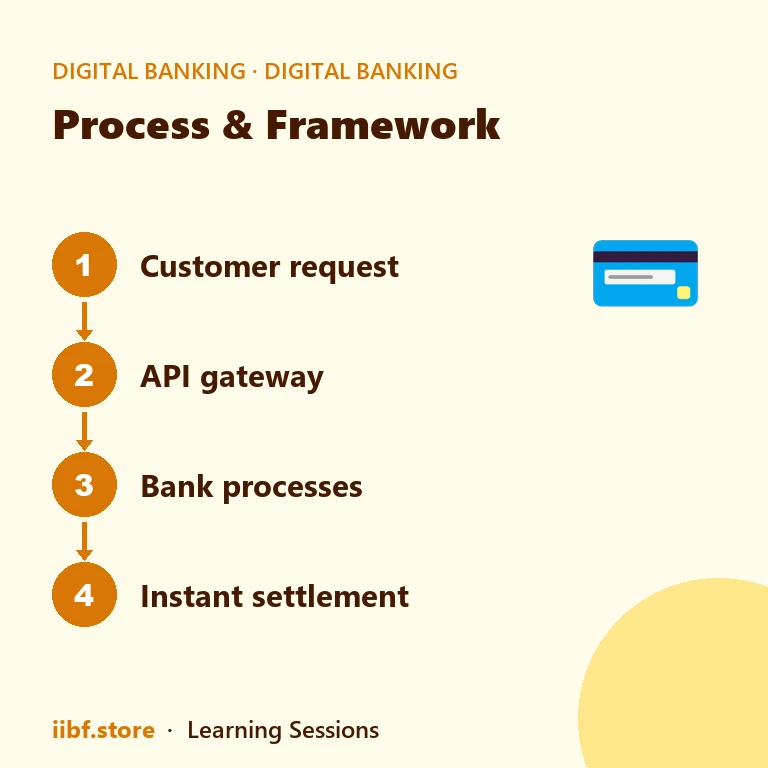
The flow begins with the bank underwriting a customer and sanctioning a limit based on income, credit bureau data, and existing relationship depth. Once sanctioned, the customer links this credit line as a funding source inside a UPI app, much like linking a savings account, and the app displays it as a separate payment option at checkout. Every transaction debits the credit line rather than the deposit account, and the bank's core banking and UPI switch settle the merchant payment instantly while recording the draw-down against the customer's limit.
Interest-free periods, minimum-due structures, and late-payment charges mirror standard unsecured retail lending practice, and the bank must comply with the RBI's Digital Lending Guidelines on disclosure, consent, and recovery conduct even though the credit itself moves over UPI rails. Because the underlying obligation is a loan, NPA classification, provisioning, and interest income recognition follow normal prudential norms — not the lighter treatment applied to pure payment instruments. This lending-versus-payment distinction is exactly the kind of nuance the Retail Banking - Digital Banking Class 12 session drills into, so revisit it if the provisioning angle feels shaky.
⚠️ Common Mistake: Candidates often assume a credit line on UPI is interest-free forever because "it feels like using my own money." It is a credit facility — interest, fees, and default consequences apply exactly as they would on any bank loan.
🔐 Risk Controls and Regulatory Guardrails
Because a payment rail is now also a lending channel, RBI layered in specific safeguards. Banks must run full KYC and creditworthiness checks before sanction — there is no bypassing standard lending due diligence just because disbursal happens through UPI. Limits, tenure, and pricing must be transparently disclosed inside the linked app before the first draw-down, and the customer must be able to view outstanding dues, due dates, and available headroom at any time, not just at statement generation.
From a systemic-risk lens, examiners must also connect this topic to over-leverage concerns: because UPI transactions are frictionless and habitual, regulators worry that credit lines could encourage impulsive borrowing at the point of a ₹200 tea-stall payment just as easily as a planned purchase. Banks are expected to build behavioural nudges, spending caps, and cooling-off triggers to manage this, and internal audit plus the Reserve Bank's supervisory teams review drawdown patterns periodically. Grounding this in the wider consumer-protection push covered under Financial Inclusion helps connect the dots between access and responsible-lending obligations.
📌 Remember: A credit line on UPI must be visibly disclosed as a "borrow" option distinct from the customer's own account balance at the moment of payment — silent auto-selection of credit over deposit funds is not permitted.
📊 Credit Line on UPI vs Other Retail Credit Options
Positioning this facility against a credit card and a personal loan is a common comparative question in Digital Banking papers. The table below captures the practical differences examiners expect you to know.
| Feature | Credit Line on UPI | Credit Card | Personal Loan |
|---|---|---|---|
| Issued only by banks | ✅ | ❌ (NBFCs also issue) | ❌ (NBFCs also issue) |
| Usable at any UPI QR/P2M point | ✅ | ❌ (card network only) | ❌ |
| Revolving, pay-as-you-draw structure | ✅ | ✅ | ❌ (lump sum, fixed EMI) |
| Needs a physical or virtual card | ❌ | ✅ | ❌ |
| Underwritten as a loan (KYC + credit check) | ✅ | ✅ | ✅ |
The takeaway examiners look for: a credit line on UPI combines the underwriting discipline of a personal loan with the transaction convenience of a card, but strips out the physical instrument and the card-network dependency entirely, settling instead over the UPI switch.
🧭 Adoption, Bank Participation, and Exam Relevance
Since RBI first permitted the linkage, several public and private sector banks have progressively enabled credit lines on UPI through their own apps and through major third-party UPI apps, subject to each bank's own commercial rollout timeline. Adoption has been gradual because banks must upgrade core systems, align collections processes, and train relationship teams before opening the feature broadly, and NPCI must certify the technical integration for each participating bank. For exam purposes, remember that availability is bank-specific and opt-in — it is not a default feature on every UPI handle.
From a career and syllabus standpoint, this topic sits at the intersection of digital payments and retail lending, making it a favourite for scenario-based questions that ask you to classify a transaction, identify the applicable regulatory framework, or spot a compliance gap in a hypothetical bank's rollout. Reviewing Mobile Banking alongside this section reinforces how app-based delivery channels are evaluated together in the syllabus, and pairs well with the related discussion in prepaid payment instruments, which explains why PPIs remain excluded from offering this particular credit feature.
🧠 Practice MCQs: Credit Line on UPI
Q1. A credit line on UPI can currently be issued by which entity? (a) Any KYC-verified PPI wallet (b) Only banks with a pre-sanctioned limit (c) NPCI directly to consumers (d) Any fintech app registered with RBI
Answer: (b) — Only banks may extend a pre-sanctioned credit line as a funding source over UPI; PPIs and non-bank entities are not permitted to do so.
Q2. How does a transaction using a credit line on UPI settle? (a) It debits the customer's savings account first (b) It draws against the sanctioned credit limit via the bank's UPI-linked account (c) It is billed once a year like a subscription (d) It requires a separate physical card
Answer: (b) — The payment draws down the pre-approved credit limit through the bank's UPI-linked account, not the customer's own deposit balance.
Q3. Which regulatory framework governs disclosure and recovery conduct for a credit line on UPI? (a) Prepaid Payment Instrument Master Directions only (b) RBI's Digital Lending Guidelines (c) SEBI investor protection norms (d) No specific framework applies
Answer: (b) — Because the facility is a loan, it falls under RBI's Digital Lending Guidelines covering disclosure, consent, and fair recovery practices.
Q4. Compared to a personal loan, how does a credit line on UPI differ structurally? (a) It disburses as a one-time lump sum with fixed EMIs (b) It is a revolving, pay-as-you-draw facility usable at UPI QR/P2M points (c) It can only be used for education expenses (d) It does not require any credit assessment
Answer: (b) — Unlike a lump-sum personal loan, it revolves like a credit line and can be spent transaction-by-transaction wherever UPI is accepted.
Q5. What must a bank ensure before a customer's first draw-down on a credit line on UPI? (a) Nothing beyond app installation (b) Transparent disclosure of limit, pricing, and dues, plus completed KYC and credit checks (c) A minimum six-month banking relationship only (d) A co-signer on every transaction
Answer: (b) — Full KYC, creditworthiness assessment, and upfront disclosure of terms are mandatory before any draw-down is permitted.
Want chapter-wise mock tests with 100+ MCQs? Start practising free →
Frequently Asked Questions
Is a credit line on UPI the same as linking a credit card to UPI?
No. A credit line on UPI is a separate pre-sanctioned bank facility linked directly as a UPI funding source, while a linked credit card routes payments through the card network even though both appear inside a UPI app.
Do non-bank UPI apps or wallets offer their own credit line on UPI?
No. Only banks are currently permitted to sanction and extend a credit line on UPI; third-party apps merely provide the interface for a bank-issued facility.
Does interest apply on every credit line on UPI transaction?
Interest applies based on the bank's terms, typically after any interest-free period lapses or if the minimum due is not repaid on time, similar to standard unsecured credit products.
Why is this topic important for the IIBF Digital Banking exam?
It tests whether candidates can distinguish a payment instrument from a lending product, and correctly map the applicable RBI regulatory framework, both frequent themes in exam scenarios.
Mastering the credit line on UPI framework rounds out your understanding of how India's payment rails are increasingly doubling as lending channels — a trend the IIBF Digital Banking exam expects candidates to track closely. According to the RBI's official UPI FAQs, the central bank continues to expand permissible use cases for UPI beyond simple payments, and staying current with such circulars (cross-referenced against IIBF's exam guidelines) will serve you well beyond the exam hall. For a broader view of how retail credit and digital payment products are converging, see our related coverage of ONDC banking integration and open banking in India. Browse more subject notes on the Digital Banking tag hub, catch up on other exam topics at the iibf.store blog, and when you're ready to test yourself, take a free chapter-wise mock at iibf.store/tests or explore the full JAIIB and CAIIB course tracks to keep your preparation on schedule.
Prefer revising from a printed book?
Chapter-wise books with MCQs after every chapter — minimal pages, complete coverage, delivered anywhere in India. Every book has a free sample to read first.
90 pages · 150 MCQs
Learning Sessions · Ashish Sir
132 pages · 225 MCQs
Learning Sessions · Ashish Sir
188 pages · 435 MCQs
Learning Sessions · Ashish Sir
117 pages · 236 MCQs
Learning Sessions · Ashish Sir
Learning Sessions · Ashish Sir
118 pages · 299 MCQs
Learning Sessions · Ashish Sir
Learning Sessions · Ashish Sir
Learning Sessions · Ashish Sir
Learning Sessions · Ashish Sir
115 pages · 255 MCQs
Learning Sessions · Ashish Sir
Learning Sessions · Ashish Sir
334 pages · 936 MCQs
Learning Sessions · Ashish Sir
Learning Sessions · Ashish Sir
115 pages · 344 MCQs
Learning Sessions · Ashish Sir
107 pages · 240 MCQs
Learning Sessions · Ashish Sir
Learning Sessions · Ashish Sir
131 pages · 672 MCQs
Learning Sessions · Ashish Sir
221 pages · 831 MCQs
Learning Sessions · Ashish Sir
128 pages · 524 MCQs
Learning Sessions · Ashish Sir
107 pages · 445 MCQs
Learning Sessions · Ashish Sir
148 pages · 478 MCQs
Learning Sessions · Ashish Sir
151 pages · 465 MCQs
Learning Sessions · Ashish Sir
148 pages · 375 MCQs
Learning Sessions · Ashish Sir
216 pages · 895 MCQs
Learning Sessions · Ashish Sir
109 pages · 300 MCQs
Learning Sessions · Ashish Sir
104 pages · 360 MCQs
Learning Sessions · Ashish Sir
82 pages · 297 MCQs
Learning Sessions · Ashish Sir
151 pages · 600 MCQs
Learning Sessions · Ashish Sir
98 pages · 282 MCQs
Learning Sessions · Ashish Sir
Quick quiz on this topic
5 exam-style questions from our free test bank — check yourself before you move on.
Practice this topic
Take a free mock test, download chapter PDFs, or watch a video class — all included on iibf.store.
Keep reading