Guide to cross-border insolvency under IBC: Sections 234 and Part Z
When a defaulting corporate debtor parks aircraft in Amsterdam, keeps receivables in Dubai and runs a marketing subsidiary in Singapore, an Indian lender quickly discovers the limits of a purely domestic statute. That gap is exactly what cross-border insolvency under IBC is meant to close — and, as matters stand in 2026, it closes it only partly. The Insolvency and Bankruptcy Code, 2016 carries just two enabling provisions on foreign assets and foreign proceedings, both effectively dormant, while a fuller UNCITRAL-based chapter still sits in draft. For candidates writing the IIBF certification in IBC, and for officers on a bank's recovery desk, this is high-yield and highly practical ground.
⚖️ Why Foreign Assets Break a Domestic Resolution
The Code was built on the assumption that the corporate debtor, its assets, its creditors and its adjudicating authority all sit inside one jurisdiction. The moratorium under Section 14 binds Indian proceedings; the resolution professional takes control of the debtor's property; the committee of creditors votes on a plan. Each of those steps quietly assumes territorial reach.
Move one material asset offshore and the machinery starts slipping. An Indian moratorium does not automatically restrain a creditor from attaching a warehouse in Rotterdam or arresting a vessel in Singapore, because a foreign court owes no obligation to an Indian order unless its own law or a treaty tells it to. Equally, a foreign liquidator holding a claim against an Indian company has no clear statutory doorway into the NCLT. The result is a race to the assets: whoever moves first in whichever forum captures value, and the pooled distribution the Code promises collapses into a scramble.
For lenders this is not theoretical. Consortium exposures to airlines, shipping companies, pharmaceutical exporters, IT services groups and steel traders routinely sit against offshore inventory, escrowed export proceeds or shares in overseas step-down subsidiaries. Understanding how the Code evolved from the older, fragmented recovery statutes helps explain why the drafters left this piece unfinished — the study note on the evolution of the Insolvency and Bankruptcy Code traces that history, and it pairs well with the older credit recovery laws for banks that the Code consolidated.
📜 Sections 234 and 235: The Present Statutory Route
The Code's answer to foreign elements is contained in two short sections placed near the end of the statute. Section 234 empowers the Central Government to enter into agreements with the governments of other countries for enforcing the provisions of the Code, and to notify by order that the Code will apply to assets or property of a corporate debtor situated in that country, subject to the terms of that agreement. Section 235 works alongside it: where the resolution professional, liquidator or bankruptcy trustee believes that assets of the debtor are located in a country with which such a reciprocal arrangement exists, an application may be made to the adjudicating authority, which may issue a letter of request to a court or authority in that country to deal with the assets.
Read together, the design is bilateral and reciprocity-driven. Nothing happens unless India first signs a country-specific agreement and notifies it. In practice that step has not materialised, so the two sections have remained largely unused and give the resolution professional no dependable tool. Even where a letter of request is issued, it is a request — the foreign court decides what weight to give it under its own private international law, and there is no obligation of recognition, no timeline and no guaranteed stay.
Three structural weaknesses are worth memorising: the route needs a treaty that does not exist; it is one-way, offering no doorway for a foreign representative to approach the NCLT; and it is asset-focused rather than proceeding-focused, so it cannot coordinate two live insolvencies. The structure of the IBC chapter places these sections in context within the larger scheme.
💡 Exam Tip: Remember the pair as "234 = agreement, 235 = letter of request". Examiners often flip the two, or attach the letter of request to Section 234.
🌍 Draft Part Z and the UNCITRAL Model Law
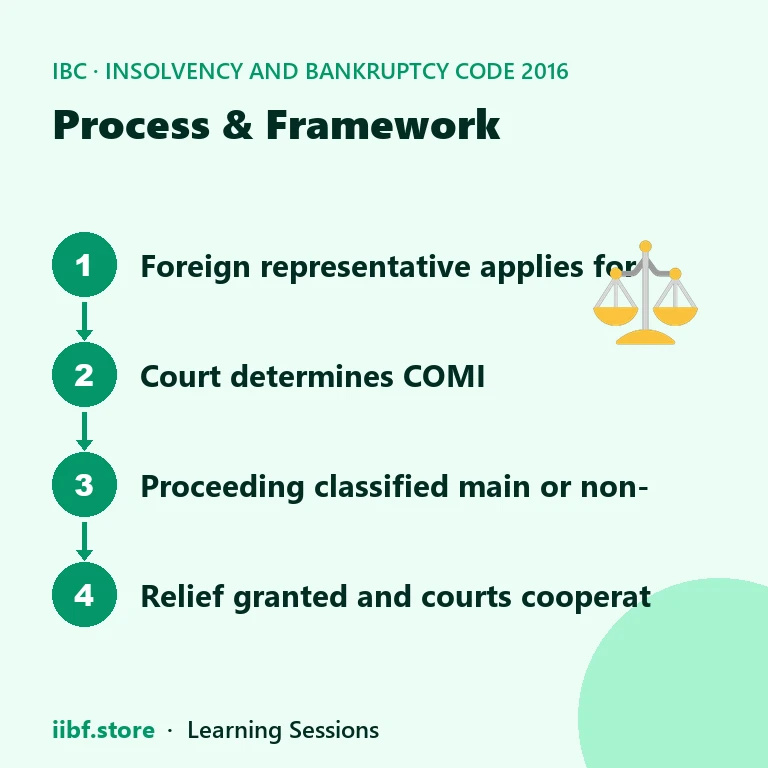
The intended replacement is the UNCITRAL Model Law on Cross-Border Insolvency, 1997, which has been adopted in some form by a large number of jurisdictions including the United Kingdom, Singapore, Japan, South Africa and the United States (as Chapter 15 of its Bankruptcy Code). The Insolvency Law Committee recommended adopting it for India in 2018, and a draft chapter — universally referred to as Part Z — was placed in the public domain, refined by a later expert committee and circulated by the Ministry of Corporate Affairs for consultation. It has not yet been enacted, so treat its content as proposed law and verify the current position before quoting it as operative.
The Model Law rests on four pillars, and this four-way split is the single most examinable idea in the whole topic. Access gives a foreign representative direct standing to apply to the domestic court. Recognition lets the court classify a foreign proceeding as main or non-main after a short, largely procedural hearing. Relief attaches consequences to that classification. Cooperation and coordination impose a duty on courts and insolvency professionals to communicate directly and to run concurrent proceedings sensibly.
The philosophy is often described as modified universalism: one lead proceeding drives the restructuring, other jurisdictions assist it, but each retains a public-policy exception and can protect local creditors. Comparative treatment appears in the bankruptcy laws cross-country experience chapter, which is worth reading before attempting objective questions on foreign regimes.
| Aspect | Sections 234 & 235 (present) | Draft Part Z (Model Law) |
|---|---|---|
| Source of authority | Bilateral agreement notified by Central Government | Statutory chapter within the Code itself |
| Country-specific treaty needed? | ✅ Yes — nothing works without it | ❌ No — applies to notified countries generally |
| Foreign representative can approach NCLT directly | ❌ No standing | ✅ Direct access on recognition application |
| Effect of recognition | Discretionary; foreign court decides on request | Main proceeding attracts moratorium-type relief; non-main is discretionary |
| Court-to-court cooperation | ❌ Not provided for | ✅ Express duty to cooperate and coordinate |
| Status in August 2026 | On the statute book, no arrangement notified | ❌ Draft; not yet enacted |
🧭 COMI, Main Proceedings and Non-Main Proceedings
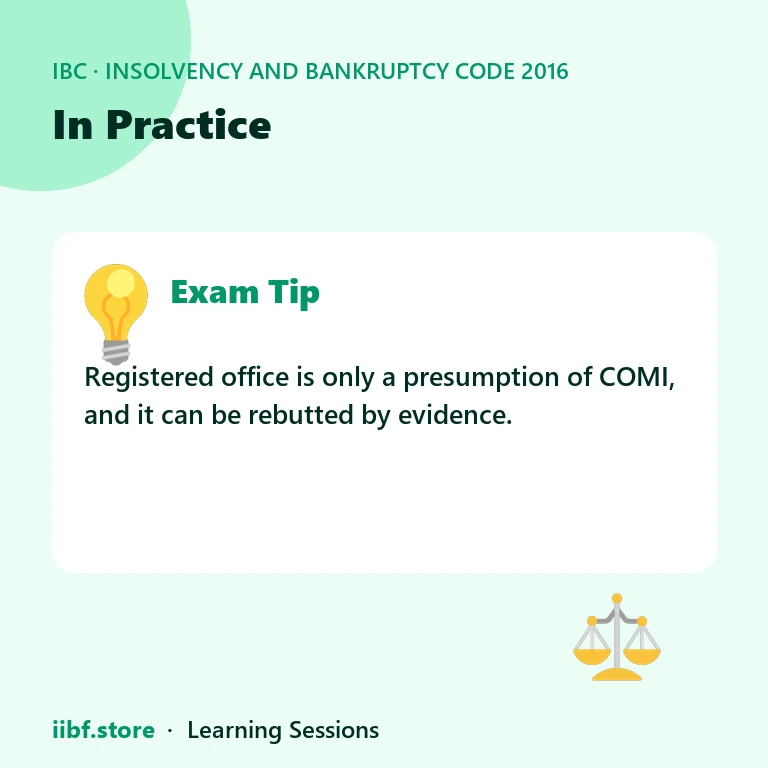
Recognition under the Model Law turns on a single factual question: where is the debtor's centre of main interests, or COMI? The Model Law presumes, in the absence of proof to the contrary, that the COMI is the place of the debtor's registered office. That presumption is rebuttable, and courts across jurisdictions test it against factors visible to third parties — where head-office functions are actually performed, where treasury and management decisions are taken, where the workforce sits, where creditors believed they were dealing.
A proceeding opened in the COMI jurisdiction is a foreign main proceeding. A proceeding opened where the debtor merely has an establishment — a place of operations with non-transitory economic activity and human means — is a foreign non-main proceeding. If there is neither COMI nor an establishment, the proceeding does not qualify for recognition at all, however genuine it may be.
The classification then drives relief. Recognition as a main proceeding brings automatic consequences of a moratorium character: a stay on actions against the debtor and on transfers of its assets. Recognition as non-main brings nothing automatically; the domestic court may grant discretionary relief where it is needed to protect assets or creditor interests. Interim relief before the recognition order is also available in urgent cases, again at the court's discretion.
Draft Part Z proposes to import this architecture largely intact, with carve-outs for public policy and, importantly, an expected exclusion of financial service providers, who follow their own route — the note on the insolvency of financial service providers explains that separate track.
⚠️ Common Mistake: Assuming registered office always decides COMI. It is only a presumption, and it can be rebutted by evidence of where the debtor's real head-office functions are carried on.
✈️ Jet Airways: India's First Cross-Border Protocol
The Jet Airways matter is the standard case study because it forced Indian tribunals to solve the problem without a statutory framework. Insolvency proceedings were commenced against the airline in India before the NCLT, while a Dutch court had already declared the airline bankrupt in the Netherlands after a European creditor moved there, and a Dutch administrator was appointed and sought to assert rights over the estate.
Because Sections 234 and 235 could not be invoked — there was no notified agreement with the Netherlands — the appellate tribunal took a pragmatic route. It permitted the Indian resolution professional and the Dutch administrator to negotiate a joint cross-border insolvency protocol, which was then placed before it for approval. In substance the protocol treated India as the centre of main interests and the Indian proceeding as the main proceeding, with the Dutch proceeding cooperating as a non-main one. It set out how information would be shared, how the Dutch administrator could attend committee meetings as an observer without voting, and how claims and assets would be dealt with so that the Indian resolution process was not derailed.
Two lessons matter for the exam and for practice. First, cooperation is achievable by consent even without enabling legislation, but it depends entirely on the willingness of both estates and costs time the Code's tight timelines do not allow. Second, an ad hoc protocol cannot bind third parties or non-participating creditors. For a lender, that argues for early legal advice on where offshore assets sit — and for tightening documentation before default, in the same spirit that interim finance under IBC is negotiated with priority protections built in upfront.
📌 Remember: Jet Airways produced India's first cross-border insolvency protocol by consent and appellate approval — not by operation of Section 234 or Section 235.
🎯 What to Carry Into the Exam Hall
Compress the topic into five anchors. One: the Code's foreign-element provisions are Sections 234 and 235, and they are reciprocity-based and effectively dormant. Two: the proposed replacement is Draft Part Z, modelled on the UNCITRAL Model Law on Cross-Border Insolvency, 1997, and still awaiting enactment. Three: the Model Law's four pillars are access, recognition, relief, and cooperation and coordination. Four: recognition depends on COMI, presumed to be the registered office, splitting proceedings into main and non-main with automatic and discretionary relief respectively. Five: Jet Airways is the precedent for a consent-based protocol in the absence of statute.
Because this area is genuinely in flux, examiners tend to ask about principles rather than dates. Keep an eye on official updates through the IIBF news and updates page, and revise the related topics together — recovery officers who understand insolvency also carry it into audit work, which is why a paper such as concurrent audit in banks overlaps more than it appears. More material on this paper is collected on the IBC 2016 topic hub, and guarantee-side exposure is covered in the note on personal guarantors under IBC. Ready to test yourself properly? Take a full chapter-wise mock on the CAIIB and certification course page before your next attempt.
🧠 Practice MCQs: Cross-Border Insolvency
Q1. Which pair of sections of the Insolvency and Bankruptcy Code, 2016 deals with agreements with foreign countries and letters of request to foreign authorities? (a) Sections 234 and 235 (b) Sections 227 and 228 (c) Sections 60 and 61 (d) Sections 238 and 239
Answer: (a) — Section 234 enables bilateral agreements with foreign governments and Section 235 enables a letter of request in respect of assets abroad.
Q2. Under the UNCITRAL Model Law framework, a foreign proceeding opened in the jurisdiction where the debtor has its centre of main interests is classified as a: (a) foreign non-main proceeding (b) ancillary proceeding (c) foreign main proceeding (d) parallel domestic proceeding
Answer: (c) — COMI determines the main proceeding; an establishment elsewhere supports only a non-main proceeding.
Q3. In the absence of proof to the contrary, the centre of main interests of a corporate debtor is presumed to be its: (a) place of largest asset concentration (b) registered office (c) place of business of its principal lender (d) place of incorporation of its holding company
Answer: (b) — the registered office presumption is rebuttable by evidence of where head-office functions are actually carried on.
Q4. The cross-border protocol between the Indian resolution professional and the Dutch administrator in the Jet Airways matter was approved by the: (a) National Company Law Tribunal, New Delhi (b) Reserve Bank of India (c) Supreme Court of India (d) National Company Law Appellate Tribunal
Answer: (d) — the appellate tribunal permitted and approved the joint protocol, as Sections 234 and 235 could not be invoked.
Q5. Draft Part Z, proposed for insertion into the Code, is based principally on the: (a) European insolvency regulation (b) UNCITRAL Model Law on Cross-Border Insolvency, 1997 (c) UNCITRAL Legislative Guide alone (d) direct adoption of the US Chapter 15 statute
Answer: (b) — Part Z adapts the 1997 Model Law, which several jurisdictions including the United States have enacted in their own form.
Want chapter-wise mock tests with 100+ MCQs? Start practising free →
Are Sections 234 and 235 of the IBC being used in practice?
Very little. Both depend on the Central Government first entering into and notifying a reciprocal agreement with the relevant country. In the absence of such notified arrangements, resolution professionals cannot rely on them, and letters of request under Section 235 remain a request rather than an enforceable order abroad.
What is the difference between a foreign main and a foreign non-main proceeding?
A main proceeding is opened where the debtor has its centre of main interests, and its recognition brings automatic moratorium-type relief. A non-main proceeding is opened where the debtor only has an establishment, and any relief there is at the discretion of the recognising court.
Has Draft Part Z been enacted into the Code?
Not as of this writing. Part Z has been recommended by expert committees and circulated for public consultation, but it needs an amendment to the Code to come into force. Verify the current position from the Ministry of Corporate Affairs and IBBI before quoting it as operative law.
Why is the Jet Airways protocol important for bankers?
It showed that an Indian insolvency and a foreign insolvency can be coordinated by a consent-based protocol approved by the tribunal even without enabling legislation. For lenders it is a reminder to map where offshore assets and guarantees sit well before an account slips into default.
Source and further reading: IBBI and the Indian Institute of Banking & Finance.
Quick quiz on this topic
5 exam-style questions from our free test bank — check yourself before you move on.
Practice this topic
Take a free mock test, download chapter PDFs, or watch a video class — all included on iibf.store.