Interim Finance Under IBC: Priority, Approval and Lender Comfort
When a corporate debtor enters corporate insolvency resolution process, the lights cannot simply go off while the committee of creditors decides its fate. Salaries, raw material bills, statutory dues and basic operations still need cash — and that is exactly where interim finance under IBC steps in. Interim finance is the working-capital lifeline that keeps a distressed company running as a going concern during CIRP, and it sits at the centre of one of the more technical but exam-heavy areas of the Insolvency and Bankruptcy Code, 2016. For JAIIB and CAIIB candidates, understanding its definition, approval chain and repayment priority is non-negotiable.
📊 What Section 5(15) Defines as Interim Finance
Section 5(15) of the Insolvency and Bankruptcy Code, 2016 defines interim finance as any financial debt raised by the resolution professional during the corporate insolvency resolution process period, along with any other debt notified for this purpose by the central government. The definition is deliberately narrow: it only covers money borrowed specifically during the CIRP window that opens on the insolvency commencement date and closes with approval of a resolution plan or an order of liquidation.
This narrow drafting matters because interim finance is not just any loan to the corporate debtor. A pre-existing working capital facility sanctioned before CIRP began is not interim finance, even if drawn during the process. Only debt raised by, or under the authority of, the resolution professional after CIRP begins qualifies. IBBI as insolvency regulator has issued detailed CIRP Regulations that operationalise how this fresh borrowing is documented, disclosed to the committee of creditors, and reflected in the information memorandum for prospective resolution applicants. You can review the primary regulatory framework directly at ibbi.gov.in.
Section 5(13), which defines insolvency resolution process costs, folds interim finance and the interest payable on it into that cost bucket. That linkage is what eventually gives interim finance its first-priority ranking in the waterfall, discussed later in this article.
🏦 Why a Company Under CIRP Still Needs Fresh Funding
The moment CIRP begins, a moratorium under Section 14 freezes recoveries, suits and asset transfers against the corporate debtor. But the moratorium does not freeze the business itself — the resolution professional is duty-bound under Section 20 to manage operations as a going concern. A factory that stops production, a service company that cannot pay vendors, or an airline that grounds its fleet loses value every single day, and that erodes what is eventually left for creditors.
Existing lenders are usually unwilling, or contractually restrained, from extending fresh credit to an account already tagged as under insolvency. Working capital limits are frequently frozen or withdrawn precisely when the corporate debtor needs liquidity most. This funding gap is what interim finance under IBC is designed to bridge — new money, raised specifically for the CIRP period, to pay employees, critical suppliers, insurance premiums and other running costs until a resolution plan is approved or the process concludes.
Time pressure adds urgency. The CIRP timeline under IBC runs on a statutory clock, and a cash-starved corporate debtor that cannot sustain operations through that window becomes a much weaker asset for resolution applicants to bid on. Interim finance therefore protects enterprise value, not just liquidity — a going concern with continuing revenue almost always fetches a materially better resolution plan than a business that has been mothballed mid-process. For candidates, this is the practical "why" behind a fairly dry statutory definition, and it links directly to commencement of CIRP mechanics tested elsewhere in the syllabus.
✅ CoC Approval and the Resolution Professional's Powers
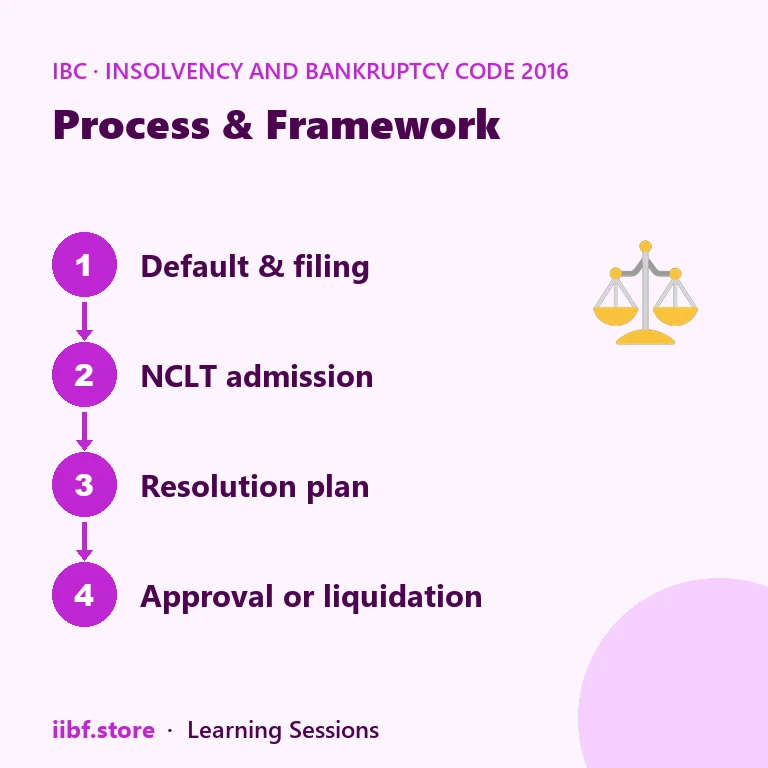
Raising interim finance is not left entirely to the resolution professional's discretion. Section 28(1) lists "raise any interim finance" among the actions of the resolution professional that require the prior approval of the committee of creditors, by a vote of not less than sixty-six percent of voting share. This is a deliberate check: interim finance dilutes what remains for existing creditors if the corporate debtor eventually fails to revive, so the very creditors bearing that risk must sign off on it.
💡 Exam Tip: Section 28 actions need CoC approval by a 66% voting-share threshold — interim finance sits on this list alongside creating security interests and changes to the capital structure.
In practice, the interim resolution professional or resolution professional identifies the funding gap, approaches potential lenders — often existing promoters, group companies, stressed-asset funds or specialised interim finance providers — and places the terms before the committee of creditors for approval. The roles and duties of IRP and RP extend to negotiating tenure, interest rate, and any security to be offered, but the final commercial decision always rests with the committee. Once approved, the resolution professional executes the facility on the corporate debtor's behalf and reports utilisation in periodic disclosures.
This CoC gatekeeping role is one reason interim finance is used sparingly and only where genuinely necessary — it is not a routine source of working capital, but a last-resort bridge sanctioned by the very stakeholders who will bear the consequences if the resolution fails.
🥇 First Priority in the Section 53 Waterfall
If a resolution plan is not approved and the corporate debtor slides into liquidation, Section 53 lays down the strict order in which liquidation proceeds are distributed, once claims verification under IBC has fixed the admitted claim amounts across categories. The very first item — ranking above even secured financial creditors and workmen's dues — is the cost of the insolvency resolution process and liquidation process, paid in full before anything else is disbursed. Because Section 5(13) folds interim finance and the interest due on it into insolvency resolution process costs, interim finance providers stand at the head of the queue.
This first-priority ranking is the single biggest reason interim finance is bankable at all. A lender extending fresh credit to a company already under insolvency accepts real risk, and the law compensates for that by placing repayment ahead of secured financial creditors who may have been owed money for years. The table below summarises where interim finance sits relative to other claims in the waterfall.
| Priority Rank | Category of Claim | Interim Finance Included |
|---|---|---|
| 1 | Insolvency resolution process and liquidation process costs | ✅ |
| 2 | Workmen's dues (24 months) and secured creditor dues, pari passu | No |
| 3 | Unsecured financial creditors and other employee dues (12 months) | No |
| 4 | Government dues, remaining debt, equity and preference shareholders | ❌ |
Note the ranking is about priority of payment, not certainty of full recovery — first priority only helps if there is enough value in the liquidation estate to begin with, a nuance candidates often miss.
🔒 Security Over Unencumbered Assets and Why Lenders Still Hesitate
To make interim finance more attractive, the resolution professional — again with committee of creditors approval — can offer security over any unencumbered assets of the corporate debtor, assets not already charged to existing lenders. This mirrors the logic banks use in secured lending generally: just as a lender enforcing security under the SARFAESI Act enforcement of security interest route relies on a clean charge over collateral, an interim finance provider wants an unencumbered asset pool, or at least a clearly ranked charge, to fall back on if the statutory priority under Section 53 alone feels too remote.
⚠️ Common Mistake: Candidates often assume interim finance is always unsecured because it is "new" money. It can be, and often is, secured over unencumbered assets once the committee of creditors approves the charge.
Despite this priority and the security cushion, lenders remain cautious. Interim finance is repaid only if a resolution plan actually gets approved within the CIRP timeline, or if liquidation proceeds are sufficient once the process concludes — both outcomes are uncertain at the time the money is disbursed. Litigation around admissibility of claims, delays in approvals from the National Company Law Tribunal, and extensions to the CIRP period all push out the repayment horizon and increase the effective cost of capital.
Commercial banks also face internal constraints: regulatory provisioning norms and credit-risk appetite make it difficult to justify fresh exposure to an account already classified as stressed, even with first-priority comfort. In practice, interim finance is dominated by promoters, group entities, asset reconstruction companies and specialised stressed-asset funds rather than mainstream scheduled banks, which keeps the market thin and pricing high.
🎯 Practise Before Your Next JAIIB or CAIIB Attempt
Interim finance under IBC sits at the intersection of three exam-favourite themes — statutory definitions, committee of creditors' approval powers, and the Section 53 waterfall — which is exactly why examiners return to it repeatedly. Anchor your revision around the Section 5(15) definition, the Section 28 approval requirement, and the first-priority ranking, and the rest of the topic falls into place. For deeper background, revisit Chapter 4 - Structure of the IBC and the broader Insolvency and Bankruptcy Code 2016 chapter set.
Ready to test yourself? Attempt chapter-wise mock questions on the IIBF test series and track how well you can distinguish interim finance from ordinary CIRP costs.
🧠 Practice MCQs: Interim Finance Under IBC
Q1. Under Section 5(15) of the IBC, 2016, "interim finance" refers to: (a) any loan sanctioned to the corporate debtor before CIRP began (b) financial debt raised by the resolution professional during the CIRP period, and such other debt as notified (c) equity infusion by the resolution applicant after plan approval (d) working capital limit renewed by existing bankers during CIRP
Answer: (b) — Section 5(15) restricts interim finance to debt raised by the resolution professional during the CIRP period, plus any other debt notified for the purpose, not pre-CIRP facilities or post-approval equity.
Q2. Approval to raise interim finance during CIRP must come from: (a) the National Company Law Tribunal before disbursement (b) the corporate debtor's board of directors (c) the committee of creditors, under Section 28(1), by not less than 66% voting share (d) the Insolvency and Bankruptcy Board of India directly
Answer: (c) — Section 28(1) lists raising interim finance among resolution professional actions needing prior committee of creditors approval by a 66% voting-share threshold.
Q3. In the Section 53 liquidation waterfall, interim finance dues are recovered: (a) after workmen's dues but before secured creditors (b) as part of insolvency resolution process costs, ranking first (c) along with unsecured financial creditors (d) only after government dues are cleared
Answer: (b) — Section 5(13) includes interim finance and interest on it within insolvency resolution process costs, which Section 53 pays first, ahead of every other claim category.
Q4. Security for interim finance can be created over: (a) assets already charged to existing secured lenders, without their consent (b) unencumbered assets of the corporate debtor, with committee of creditors approval (c) assets of the resolution applicant's holding company (d) personal assets of the resolution professional
Answer: (b) — The resolution professional, with committee of creditors approval, may offer unencumbered assets of the corporate debtor as security for interim finance.
Q5. Which of the following best explains why banks remain hesitant to extend interim finance despite its first-priority ranking? (a) IBC prohibits banks from acting as interim finance providers (b) Repayment depends on an uncertain resolution outcome and provisioning norms discourage fresh exposure to a stressed account (c) Interim finance carries the lowest priority in the Section 53 waterfall (d) The Reserve Bank of India caps interim finance interest rates at the repo rate
Answer: (b) — First priority only helps if resolution succeeds or liquidation value suffices; repayment-timing risk and internal provisioning norms keep mainstream banks cautious.
Want chapter-wise mock tests with 100+ MCQs? Start practising free →
What section of the IBC defines interim finance?
Section 5(15) of the Insolvency and Bankruptcy Code, 2016 defines interim finance as financial debt raised by the resolution professional during the CIRP period, along with any other debt notified for the purpose by the central government.
Does interim finance need committee of creditors approval?
Yes. Section 28(1) lists raising interim finance among the actions a resolution professional can take only with the prior approval of the committee of creditors, by a vote of not less than 66% of voting share.
Where does interim finance rank if the company goes into liquidation?
It ranks first. Section 5(13) includes interim finance and interest on it within insolvency resolution process costs, and Section 53 pays these costs in full before any other class of claim is touched.
Can interim finance be secured against the corporate debtor's assets?
Yes. With committee of creditors approval, the resolution professional can offer unencumbered assets of the corporate debtor as security to interim finance providers, which improves lender comfort on an otherwise risky exposure.
Quick quiz on this topic
5 exam-style questions from our free test bank — check yourself before you move on.
Practice this topic
Take a free mock test, download chapter PDFs, or watch a video class — all included on iibf.store.