Pre-packaged insolvency resolution process under IBC: PPIRP for MSMEs
The pre-packaged insolvency resolution process is the only route under the Insolvency and Bankruptcy Code, 2016 where the corporate debtor stays in the driver's seat and files its own insolvency application. Inserted as Chapter III-A (Sections 54A to 54P) by the IBC (Amendment) Act, 2021, it was built for MSMEs whose businesses lose value the moment management is displaced. For IIBF candidates, this chapter is a reliable source of questions because almost every parameter — who may file, the approval percentage, the day count — differs from a normal CIRP.
🏭 Where PPIRP sits inside the IBC
Chapter III-A was added between the corporate insolvency chapter and the liquidation chapter, and it borrows heavily from both. If you are revising the overall architecture, read this alongside the chapter on the structure of the IBC, because the examiner often tests whether you can place a section in the right Part and Chapter.
The design problem PPIRP solves is simple. A full CIRP displaces the promoter, hands the business to a resolution professional, publicises the default and typically runs for the better part of a year. For a small manufacturing unit or trading firm, that publicity alone destroys supplier credit and order books. The value the bank hopes to recover evaporates before a resolution applicant even bids.
So the Code offers a middle path: a largely consensual, pre-negotiated arrangement stitched together before the application is filed, then blessed by the Adjudicating Authority so that it binds dissenting creditors and enjoys the protection of a statutory moratorium. It is "pre-packaged" precisely because the base resolution plan already exists on the day the process commences.
📌 Remember: PPIRP is a debtor-initiated process. A financial creditor or operational creditor cannot file under Section 54C — they can only file for CIRP under Sections 7 or 9.
📋 Section 54A eligibility: the gate most cases never clear
Section 54A is a checklist, and every condition must be satisfied on the date of filing. Bankers should be able to recite it:
- MSME status. The corporate debtor must be a micro, small or medium enterprise classified under Section 7(1) of the MSMED Act, 2006. A large company simply cannot use this route.
- Default threshold. The Central Government has notified a minimum default of Rs 10 lakh for PPIRP, far below the Rs 1 crore threshold that applies to CIRP under Section 4.
- No recent insolvency history. The debtor must not have undergone a PPIRP, or completed a CIRP, during the three years immediately preceding the filing.
- Not already in process. It must not be undergoing a CIRP, and no liquidation order under Section 33 should be in force.
- Section 29A eligibility. The corporate debtor must itself be eligible to submit a resolution plan. Section 240A relaxes clauses (c) and (h) of Section 29A for MSMEs, which is why an MSME promoter whose account has slipped into NPA can still propose the base plan.
- Shareholder and creditor buy-in. A special resolution of members (or three-fourths of the partners) must approve the filing, and at least 66% in value of the unrelated financial creditors must approve both the proposal and the name of the proposed resolution professional.
That last requirement is the practical bottleneck. Related-party financial creditors are excluded from the count, so a promoter cannot manufacture consent through group companies. The banks that actually hold the exposure must sign off before anything is filed.
⚠️ Common Mistake: Candidates write "Rs 1 crore" for the pre-packaged insolvency resolution process because that is the CIRP figure. The notified PPIRP threshold is Rs 10 lakh — the Code permits the Government to notify anything from Rs 1 lakh upward for this chapter.
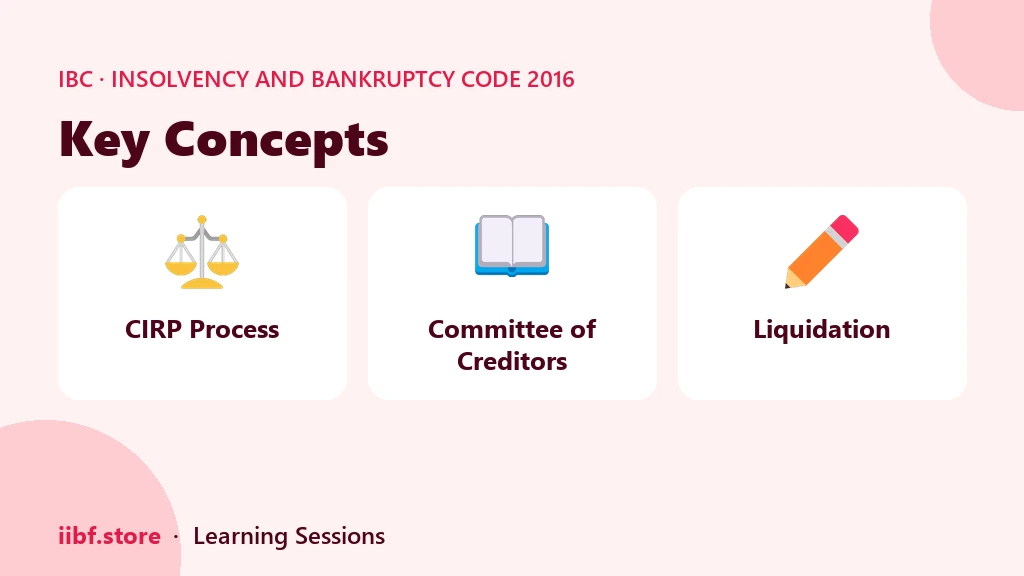
⚙️ The mechanics: base plan, debtor-in-possession, Swiss challenge
Once the Adjudicating Authority admits the application, the corporate debtor must hand over the list of claims and the preliminary information memorandum within two days of the pre-pack commencement date. The committee of creditors is then constituted on the basis of those claims, exactly as in a CIRP.
Management stays with the board
Section 54H is the philosophical heart of the chapter: management of the affairs of the corporate debtor continues to vest in its board of directors or partners. The resolution professional supervises, monitors, verifies claims, runs the CoC and reports — a very different job from the takeover role described in the chapter on the roles and duties of IRP and RP in a normal CIRP. Where there is fraud or gross mismanagement, the CoC may vote by 66% and ask the Adjudicating Authority to vest management in the RP instead.
The base plan and the challenge
The corporate debtor submits a base resolution plan with the application. If that plan does not impair any claim owed to operational creditors, the CoC may approve it straight away with a 66% vote. If it does impair operational creditors' claims — or if the CoC simply is not satisfied — the resolution professional must invite competing plans from prospective resolution applicants.
That competition is the Swiss challenge. Rival plans are evaluated against declared criteria, the best one is selected, and the base plan proponent is given a chance to improve. A competing plan displaces the base plan only if it is significantly better; otherwise the debtor's own plan survives. The final plan still needs 66% of the CoC's voting share, and the Adjudicating Authority must then approve it under Section 54L.
💡 Exam Tip: Link the impairment test to your operational-creditor revision. "No impairment of operational creditor claims" is the switch that decides whether a Swiss challenge is triggered at all.
⏱️ Timeline and moratorium: the numbers to memorise
The Adjudicating Authority must admit or reject a Section 54C application within 14 days. On admission it declares a moratorium, appoints the resolution professional and orders a public announcement under Section 54E. The moratorium applies the familiar Section 14 protections — no suits, no recovery, no enforcement of security interest, no transfer of assets — which is why a lender's SARFAESI Act enforcement of security interest action against the corporate debtor freezes the moment the pre-pack commences.
After that, two clocks run:
- 90 days from the pre-pack commencement date for the resolution professional to submit the CoC-approved plan to the Adjudicating Authority.
- 120 days as the outer limit for completion of the entire process, leaving the Adjudicating Authority 30 days to pass its order.
Compare that with the 180 + 90 day structure and the 330-day outer limit you revised for the CIRP timeline under IBC. If no plan is approved within 90 days, the RP must apply for termination of the pre-pack. The CoC may also vote by 66% to terminate, or to convert the matter into a full CIRP under Section 54-O where the debtor is otherwise eligible. Termination without an approved plan can push the debtor towards the outcomes covered in liquidation and voluntary liquidation.
Section 11A settles the race between processes: where a PPIRP application is filed within 14 days of a pending CIRP application against the same debtor, the Adjudicating Authority disposes of the pre-pack application first. Funding during the process follows the same priority logic you studied for interim finance under IBC.
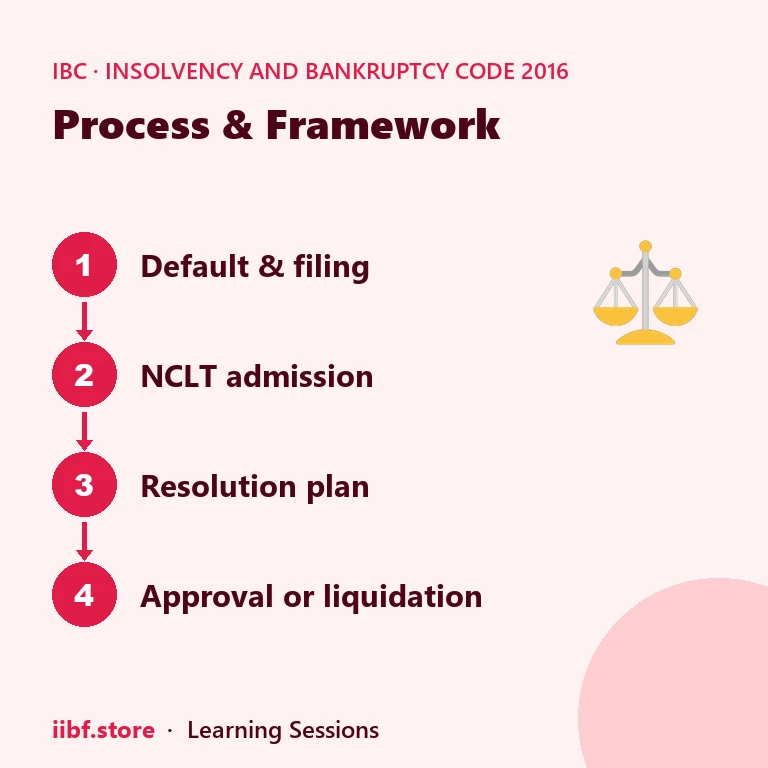
📊 PPIRP versus CIRP at a glance
Side-by-side comparison is the format IIBF favours for this topic, so learn the row headings as much as the answers.
| Parameter | PPIRP (Chapter III-A) | CIRP (Chapter II) |
|---|---|---|
| Who may file | Corporate debtor only, Section 54C | FC, OC or corporate debtor — Sections 7, 9, 10 |
| Eligible debtor | MSME under Section 7(1), MSMED Act | Any corporate person |
| Minimum default | Rs 10 lakh (notified) | Rs 1 crore |
| Who runs the company | Existing board / partners ✅ (debtor-in-possession) | Existing board displaced ❌ (RP in control) |
| Prior creditor consent needed | ✅ 66% in value of unrelated financial creditors | ❌ None required before filing |
| Plan already on the table at admission | ✅ Base resolution plan filed with application | ❌ Plans invited after admission via EoI |
| Timeline | 90 days to submit + 30 days for AA order; 120 days outer limit | 180 + 90 days; 330 days including litigation |
| Moratorium | Section 14 protections via Section 54E | Section 14 on admission |
| CoC approval threshold | 66% of voting share | 66% of voting share |
Note the one row that is identical — the 66% CoC threshold. Questions frequently offer 51%, 75% or 90% as distractors on both sides. For the admission stage itself, revise the chapter on initiation of CIRP so the two filing routes do not blur together in the exam hall.
📉 Why uptake of the pre-packaged insolvency resolution process has been low
Despite a well-drafted chapter, admissions under Chapter III-A have remained a tiny fraction of CIRP admissions since 2021. Several reasons come up repeatedly in IIBF and IBBI commentary, and they make excellent short-note questions.
- The 66% pre-consent is hard to assemble. By the time an MSME is in default, its lenders are dealing with an NPA. Getting two-thirds of unrelated financial creditors in value to sign a pre-negotiated plan, often across banks with different provisioning positions, is slow.
- Vigilance caution. Public sector bankers approving a haircut on a plan proposed by the very promoter who defaulted face internal scrutiny. A court-run competitive process feels safer to sign off on than a pre-negotiated one.
- Debtor-in-possession distrust. Creditors are not comfortable leaving management with the promoter, even with an RP supervising and Section 67A penalising fraudulent conduct during the process.
- Cost versus ticket size. Professional fees, valuation and NCLT costs are not proportionately smaller for a Rs 2 crore exposure than for a Rs 200 crore one.
- Competing options. Lenders often prefer restructuring under the RBI's prudential framework, or enforcement, or settlement with guarantors — an angle covered in the note on personal guarantors under IBC.
- Awareness and capacity. Many eligible MSMEs simply do not know the route exists, and NCLT bandwidth remains stretched.
For an exam answer, pair one legal reason (the 66% consent gate) with one behavioural reason (creditor discomfort with debtor-in-possession) and one commercial reason (cost versus recovery). That structure earns full marks. More IBC notes are collected on the Insolvency and Bankruptcy Code 2016 tag hub.
🧠 Practice MCQs: PPIRP under Chapter III-A
Q1. What is the notified minimum amount of default for initiating a pre-packaged insolvency resolution process? (a) Rs 1 lakh (b) Rs 10 lakh (c) Rs 50 lakh (d) Rs 1 crore
Answer: (b) — The Central Government notified Rs 10 lakh for PPIRP, against Rs 1 crore for CIRP under Section 4.
Q2. Within how many days of the pre-pack commencement date must the resolution professional submit the CoC-approved resolution plan to the Adjudicating Authority? (a) 30 days (b) 45 days (c) 60 days (d) 90 days
Answer: (d) — Section 54D requires submission within 90 days, with the whole process to be completed in 120 days.
Q3. What minimum approval of unrelated financial creditors, in value, is required before a corporate debtor files under Section 54C? (a) 66% (b) 51% (c) 75% (d) 90%
Answer: (a) — At least 66% in value of unrelated financial creditors must approve the filing and the proposed resolution professional.
Q4. During a PPIRP, who manages the affairs of the corporate debtor? (a) The interim resolution professional (b) The committee of creditors directly (c) The existing board of directors or partners, under RP supervision (d) An administrator appointed by the NCLT
Answer: (c) — Section 54H keeps management with the board or partners; the RP supervises, and management can be vested in the RP only on a 66% CoC vote and an NCLT order.
Q5. What is the outer limit for completion of the pre-packaged insolvency resolution process? (a) 90 days (b) 120 days (c) 180 days (d) 330 days
Answer: (b) — 120 days from the pre-pack commencement date: 90 days for the plan plus 30 days for the Adjudicating Authority's order.
Want chapter-wise mock tests with 100+ MCQs? Start practising free →
❓ Frequently Asked Questions
Can a bank file a PPIRP application against a defaulting MSME borrower?
No. Only the corporate debtor can file under Section 54C. A lender's role is to grant or withhold the 66% approval that the debtor needs before filing, and thereafter to vote in the committee of creditors.
Is the promoter of an MSME barred by Section 29A from proposing the base resolution plan?
Usually not. Section 240A disapplies clauses (c) and (h) of Section 29A for MSME corporate debtors, so a promoter whose account is classified as an NPA or who has given a guarantee can still submit a plan, provided no other disqualification applies.
What happens if the committee of creditors rejects the base resolution plan?
The resolution professional invites competing plans from prospective resolution applicants. If no plan secures 66% CoC approval within 90 days, the RP applies for termination, and the creditors may instead resolve by 66% to move the debtor into a full CIRP under Section 54-O.
Does the moratorium in a pre-pack stop SARFAESI action?
Yes. Section 54E applies the Section 14 moratorium, which bars enforcement of security interest under the SARFAESI Act against the corporate debtor's assets for the duration of the process.
The pre-packaged insolvency resolution process rewards precise recall: debtor-initiated, MSME-only, Rs 10 lakh default, 66% unrelated financial creditor consent, base plan plus Swiss challenge, 90 + 30 days inside a 120-day cap. Fix those six anchors and you can answer almost any PPIRP question, including the comparison-table variety. Work through the full IBC question bank on our chapter-wise mock tests, and keep the CIRP chapters open alongside — examiners love to test the two processes against each other.
Quick quiz on this topic
5 exam-style questions from our free test bank — check yourself before you move on.
Practice this topic
Take a free mock test, download chapter PDFs, or watch a video class — all included on iibf.store.