Currency Futures and Options Hedging: CAIIB BFM Guide (2026)
For candidates preparing for CAIIB Bank Financial Management, currency futures and options hedging is one of the most scored-but-misunderstood topics in the treasury and forex section. Banks and corporates use these exchange-traded and OTC derivatives to lock in exchange rates and protect margins against rupee volatility, and IIBF examiners routinely test the mechanics, margining, and payoff differences between the two instruments. This guide breaks down currency futures and options hedging the way it actually appears in the exam — definitions, formulas, contract specifications, and worked comparisons — so you walk into the test paper with the numbers memorised, not just the concepts.
💱 What Are Currency Futures and Options?
A currency future is a standardised, exchange-traded contract to buy or sell a fixed quantity of one currency against another at a pre-agreed rate on a specified future date. In India, currency futures trade on the NSE, BSE and MCX-SX in pairs like USD-INR, EUR-INR, GBP-INR and JPY-INR, with contracts cleared through a central counterparty that guarantees settlement. A currency option, by contrast, gives the buyer the right but not the obligation to buy (call) or sell (put) the underlying currency pair at a fixed strike rate on or before expiry, in exchange for an upfront premium paid to the option writer. Both instruments fall under the broader umbrella of exchange rate risk management that candidates first encounter while studying exchange rates and forex business, where spot, forward and merchant rates are introduced before derivatives are layered on top.
The core distinction examiners love to test: a futures contract is a symmetric obligation — both parties are locked in and must settle regardless of where the market moves — while an option is asymmetric, capping the buyer's downside at the premium paid while preserving unlimited upside. This asymmetry is exactly why currency futures and options hedging strategies are chosen differently depending on whether a bank wants a fixed, certain outcome or wants to keep upside open while insuring against a bad move.
📈 How Currency Futures Work: Contracts, Margins and Settlement
Exchange-traded USD-INR futures on Indian exchanges are typically quoted in lots of USD 1,000, with tick size of 0.25 paise and settlement in Indian rupees on a cash basis — there is no physical delivery of foreign currency. Contracts are available for near-month and subsequent months up to twelve months, and the exchange fixes a final settlement price based on the RBI reference rate on the last trading day, which is two working days prior to the last business day of the expiry month.
Every position attracts an initial margin (typically 1.75–3% of contract value depending on volatility bands) plus daily mark-to-market margin, since exchanges use daily settlement to eliminate credit risk between counterparties. This margining structure differs sharply from an over-the-counter forward booked with a bank: futures require daily cash flow through margin calls, while a forward has no interim cash movement until maturity. Exporters and importers who want a hedge without tying up daily margin capital often prefer OTC forwards or facilities routed through their bank's trade finance desk, a mechanism candidates study in facilities for importers and exporters.
💡 Exam Tip: If a question asks which instrument has daily cash flow implications, the answer is always futures (due to mark-to-market margining), not options or OTC forwards.
🎯 Currency Options: Calls, Puts and Premium Mechanics
A currency call option buyer profits when the underlying currency appreciates beyond the strike plus premium paid; a put option buyer profits when it depreciates below the strike minus premium. The option premium itself has two components — intrinsic value (the immediate exercise value, if any) and time value (which decays as expiry approaches, a phenomenon known as time decay). RBI permits resident individuals and corporates with genuine underlying exposure to buy currency options on exchanges or from authorised dealer banks, but writing (selling) options is generally restricted to banks and specified categories to control systemic risk.
For a bank managing its own book, currency futures and options hedging is often combined: a bank may buy a put option to protect against rupee depreciation on an import book while simultaneously running offsetting futures positions to manage smaller, more predictable exposures cheaply. Because option premiums are non-refundable, many treasuries evaluate hedge cost against a "worst acceptable rate" framework rather than trying to hedge every rupee of exposure.
⚠️ Common Mistake: Students often assume the option seller (writer) also has limited risk like the buyer. In reality, the option writer's loss is theoretically unlimited (for a call) or very large (for a put), while only the buyer's loss is capped at the premium.
⚖️ Futures vs Options: Choosing the Right Hedge
Choosing between the two is a recurring CAIIB BFM scenario question. Futures suit hedgers who want certainty and are comfortable giving up upside, while options suit hedgers who want insurance against adverse moves but wish to participate if the market moves favourably. The table below summarises the comparison examiners expect candidates to know cold.
| Feature | Currency Futures | Currency Options |
|---|---|---|
| Obligation to settle | ✅ Mandatory for both parties | ❌ Only the writer is obligated |
| Upfront cost | ❌ No premium (only margin) | ✅ Premium paid upfront |
| Daily mark-to-market margin | ✅ Yes | ❌ No (buyer pays premium once) |
| Upside participation if market moves favourably | ❌ Locked at contract rate | ✅ Buyer can let option lapse |
| Maximum loss for the hedger (buyer side) | ❌ Unlimited (symmetric) | ✅ Capped at premium paid |
| Traded on exchange | ✅ Yes (NSE/BSE/MCX-SX) | ✅ Yes, also available OTC |
📌 Remember: Futures give price certainty at zero premium but full obligation; options give flexibility at the cost of a non-refundable premium — this trade-off is the crux of most exam questions on this topic.
🏦 Practical Hedging Strategies for Banks and Corporates
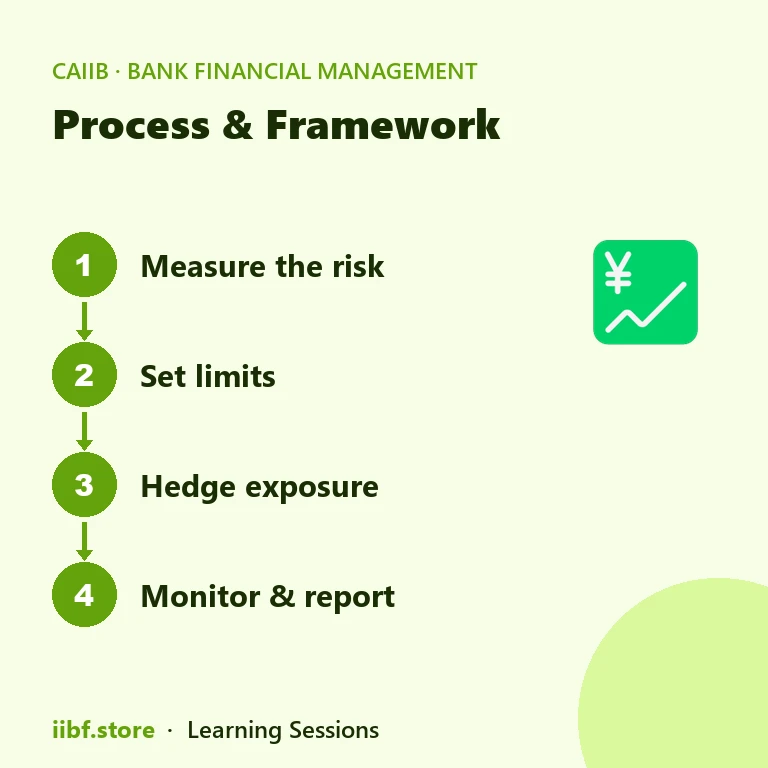
An exporter expecting USD receivables in three months can either sell USD-INR futures to lock the conversion rate, or buy a USD put option to protect against rupee appreciation while retaining upside if the dollar strengthens further. An importer with a USD payable typically buys futures or a call option to guard against rupee depreciation. Banks themselves run active derivatives books to manage the net open position (NOP) that arises from customer forex deals, treasury trading, and cross-currency balance sheet mismatches — the same NOP limits candidates encounter when studying integrated treasury operations and capital charges under Basel III capital adequacy norms, since unhedged currency exposure attracts capital charges.
Cross-currency hedges (say EUR-USD exposure hedged via EUR-INR and USD-INR legs) and layered hedging (partial coverage in tranches as a shipment date approaches) are advanced strategies examiners bring up in case-study questions. A well-prepared candidate should also revisit related instruments — forex exchange arithmetic for cross-rate and premium/discount calculations, forward rate agreements in banking for interest-rate side hedging, and interest rate swaps to see how currency and interest-rate hedges are frequently combined in cross-currency swap structures. Together these form the full derivatives module tested under BFM's Bank Financial Management syllabus.
🧠 Practice MCQs: Currency Futures and Options Hedging
Q1. On Indian exchanges, USD-INR currency futures are cash-settled based on which reference rate on the last trading day? (a) LIBOR (b) SOFR (c) RBI reference rate (d) Bank's own quoted rate
Answer: (c) — Final settlement uses the RBI reference rate published on the last trading day of the contract.
Q2. Which statement correctly distinguishes a currency futures contract from a currency option? (a) Both are optional for the buyer (b) Futures require daily mark-to-market margin, options do not (c) Options require daily mark-to-market margin, futures do not (d) There is no difference in obligation
Answer: (b) — Futures are marked to market daily and attract margin calls; the option buyer only pays a one-time premium.
Q3. An exporter wants downside protection against rupee appreciation but still wants to benefit if the dollar strengthens. The most suitable hedge is: (a) Sell USD futures (b) Buy a USD put option (c) Do nothing (d) Buy a USD call option
Answer: (b) — A put option protects against an adverse (appreciating rupee) move while letting the exporter benefit if the dollar strengthens, since the option can simply lapse.
Q4. The maximum possible loss for the buyer of a currency call option is limited to: (a) Unlimited loss (b) The strike price (c) The premium paid (d) The notional contract value
Answer: (c) — An option buyer's downside is capped at the premium paid; only the option writer carries unlimited/large potential loss.
Q5. In India, who is generally NOT permitted to write (sell) currency options under RBI regulations? (a) Authorised dealer banks (b) Specified financial institutions (c) Retail individuals and general corporates (d) RBI itself
Answer: (c) — Writing currency options is restricted mainly to banks and specified categories to control systemic risk; retail individuals and general corporates can only buy options for genuine exposure.
Want chapter-wise mock tests with 100+ MCQs? Start practising free →
❓ Frequently Asked Questions
What is the main purpose of currency futures and options hedging for banks?
It allows banks and corporates to lock in or insure against exchange rate movements on foreign currency receivables, payables, and trading positions, reducing earnings volatility from forex swings.
Are currency futures traded in India settled by physical delivery?
No. Exchange-traded currency futures on NSE, BSE and MCX-SX in India are cash-settled in rupees based on the RBI reference rate; there is no physical exchange of foreign currency.
Why would a hedger choose an option over a future despite the premium cost?
An option caps the maximum loss at the premium paid while still allowing the buyer to benefit if the market moves favourably, whereas a future locks in a fixed rate with no upside participation.
Who can write currency options in India?
Under RBI norms, writing (selling) currency options is generally restricted to authorised dealer banks and specified financial institutions, not retail individuals or general corporates.
🚀 Master Currency Derivatives Before Exam Day
Currency futures and options hedging questions in CAIIB BFM reward candidates who can quote exact margin percentages, settlement mechanics, and payoff asymmetries rather than vague definitions. Revisit the comparison table above until the futures-versus-options trade-offs are automatic, then reinforce the concepts with timed practice. Attempt a full chapter-wise mock on CAIIB forex and treasury topics today to see exactly where your recall gaps are before the real exam.
Prefer revising from a printed book?
Chapter-wise books with MCQs after every chapter — minimal pages, complete coverage, delivered anywhere in India. Every book has a free sample to read first.
151 pages · 465 MCQs
Learning Sessions · Ashish Sir
148 pages · 478 MCQs
Learning Sessions · Ashish Sir
148 pages · 375 MCQs
Learning Sessions · Ashish Sir
216 pages · 895 MCQs
Learning Sessions · Ashish Sir
109 pages · 300 MCQs
Learning Sessions · Ashish Sir
104 pages · 360 MCQs
Learning Sessions · Ashish Sir
82 pages · 297 MCQs
Learning Sessions · Ashish Sir
151 pages · 600 MCQs
Learning Sessions · Ashish Sir
98 pages · 282 MCQs
Learning Sessions · Ashish Sir
131 pages · 672 MCQs
Learning Sessions · Ashish Sir
221 pages · 831 MCQs
Learning Sessions · Ashish Sir
128 pages · 524 MCQs
Learning Sessions · Ashish Sir
107 pages · 445 MCQs
Learning Sessions · Ashish Sir
132 pages · 225 MCQs
Learning Sessions · Ashish Sir
188 pages · 435 MCQs
Learning Sessions · Ashish Sir
117 pages · 236 MCQs
Learning Sessions · Ashish Sir
Learning Sessions · Ashish Sir
118 pages · 299 MCQs
Learning Sessions · Ashish Sir
Learning Sessions · Ashish Sir
Learning Sessions · Ashish Sir
Learning Sessions · Ashish Sir
115 pages · 255 MCQs
Learning Sessions · Ashish Sir
Learning Sessions · Ashish Sir
334 pages · 936 MCQs
Learning Sessions · Ashish Sir
Learning Sessions · Ashish Sir
115 pages · 344 MCQs
Learning Sessions · Ashish Sir
107 pages · 240 MCQs
Learning Sessions · Ashish Sir
90 pages · 150 MCQs
Learning Sessions · Ashish Sir
Learning Sessions · Ashish Sir
Quick quiz on this topic
5 exam-style questions from our free test bank — check yourself before you move on.
Practice this topic
Take a free mock test, download chapter PDFs, or watch a video class — all included on iibf.store.