Computer Insecurity in Banking: An IIBF Guide (2026)
For every bank employee preparing for the IIBF Prevention of Cyber Crime certificate, understanding computer insecurity in banking is the foundation on which every fraud-prevention control is built. Before you can defend a core banking system, an ATM switch or a mobile-banking app, you must first grasp why computers are insecure by design — the gaps in hardware, software, networks and human behaviour that attackers routinely exploit to steal money and data.
Insecurity is not an accident; it is the natural state of any complex system until it is deliberately hardened. Weak passwords, unpatched operating systems, misconfigured servers, careless insiders and un-encrypted data channels all widen the attack surface of a bank. This guide breaks down the concept into exam-ready blocks, links each idea to the underlying study chapters, and finishes with practice MCQs modelled on the real question paper.
🔍 What "Computer Insecurity" Really Means
Computer insecurity is the condition in which an information system is vulnerable to unauthorised access, modification, disclosure or destruction of data. It arises whenever the confidentiality, integrity or availability (the classic CIA triad) of a system can be compromised. In a bank, a single insecure endpoint — a teller's PC running an outdated browser — can become the entry point for a fraud that drains crores from customer accounts.
The root causes are well documented in the IIBF syllabus: buggy software, default or shared credentials, absent input validation, poor network segmentation and, above all, human error. Attackers do not need to "break" strong cryptography; they simply find the weakest link. To study these gaps in depth, work through the Computer Insecurity chapter, which maps each vulnerability class to a real banking scenario. Understanding these fundamentals is closely tied to the wider discipline of Cyber Crime and Fraud Management study material that the certificate expects you to master.
💡 Exam Tip: Remember the CIA triad — Confidentiality, Integrity, Availability. Nearly every "what is compromised?" MCQ maps the attack to one of these three pillars.
🕳️ The Main Sources of Vulnerability
Vulnerabilities in a banking environment cluster into four families. Technical flaws include unpatched software, buffer overflows and weak encryption. Configuration flaws include default passwords, open ports and excessive user privileges. Physical flaws include unattended terminals and unsecured server rooms. Finally, human flaws — the largest category — cover weak passwords, credential sharing and susceptibility to manipulation, the very ground on which social engineering tactics in banking operate.
The channels through which these weaknesses are exploited — email, web, removable media, mobile apps and third-party networks — are examined in the Channels of Cyber Crimes chapter. A recurring exam theme is that insecurity multiplies at the boundaries: wherever two systems connect, a new weakness appears. This is why fraudsters increasingly target the seam between a customer's phone and the bank, as seen in SIM swap fraud prevention cases.
⚠️ Common Mistake: Candidates assume strong technology alone secures a bank. In reality, over 80% of breaches begin with a human or configuration error, not a cryptographic break.
🧑💻 Who Exploits Insecurity — The Threat Actors
Not all attackers are the same, and the exam expects you to distinguish them. White-hat hackers are ethical testers hired to find flaws. Black-hat hackers exploit them for gain. Grey-hats sit in between, probing without permission but without clear malice. Beyond outsiders, the most dangerous threat is often the insider — a disgruntled employee or a careless contractor with legitimate access. The typology is detailed in the Computer Hackers chapter.
Under the Information Technology Act, 2000, unauthorised access is punishable: Section 43 imposes civil liability with compensation, while Section 66 makes dishonest or fraudulent access a criminal offence punishable by up to three years' imprisonment or a fine up to five lakh rupees. Identity theft (Section 66C) and cheating by personation using a computer resource (Section 66D) carry similar penalties — vital when an exploited insecurity leads to financial loss and customer disputes over customer liability for unauthorised transactions.
🛡️ Hardening: Turning Insecurity into Security
Reducing computer insecurity is a layered discipline often called "defence in depth". No single control is enough; banks stack multiple safeguards so that if one fails, another holds. The core countermeasures — patch management, least-privilege access, multi-factor authentication, network segmentation, encryption in transit and at rest, and continuous logging — are covered in the Computer Fraud Protection chapter.
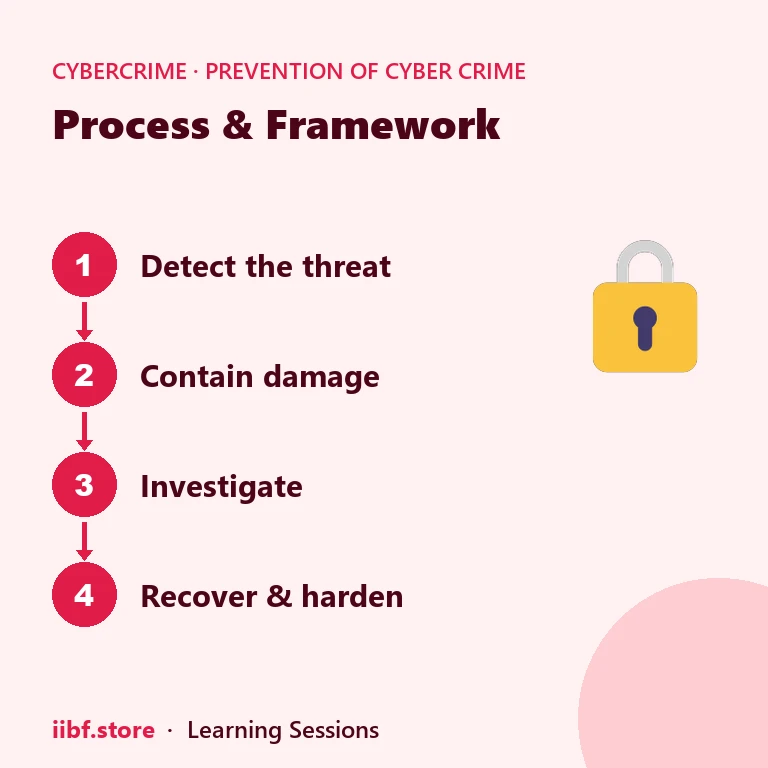
The Reserve Bank of India's Cyber Security Framework (2016) mandates a board-approved cyber security policy, a Security Operations Centre (SOC), and prompt incident reporting to the RBI and to CERT-In (India's national computer emergency response team). Under CERT-In's 2022 directions, cyber incidents must be reported within six hours of detection — a rule tested repeatedly in the certificate exam. Explore the RBI's current stance through the Prevention of Cyber Crime resource hub for the latest circulars and enforcement updates.
📌 Remember: The RBI framework is proportionate — larger, more digitally-exposed banks fall under stricter baseline controls, but every regulated entity must maintain a board-approved cyber policy and report incidents to CERT-In within 6 hours.
📊 Insecurity vs Security Posture: A Quick Comparison
The table below summarises how a bank moves from an insecure to a secure posture across the controls most frequently examined. Use it as a last-minute revision aid before the paper.
| Control Area | Insecure State | Secure (Hardened) State | Exam-Critical? |
|---|---|---|---|
| Authentication | Single shared password | Multi-factor authentication (MFA) | ✅ |
| Patching | Unpatched, end-of-life OS | Timely, tested patch cycle | ✅ |
| Access rights | All users are admins | Least-privilege / role-based access | ✅ |
| Data channels | Plaintext transmission | TLS encryption in transit | ✅ |
| Incident response | No plan, delayed reporting | SOC + CERT-In report within 6 hrs | ✅ |
| Convenience over safety | Firewall disabled for speed | Firewall tuned, not disabled | ❌ |
Notice the final row: disabling a control "for convenience" is exactly how insecurity creeps back in. The methods attackers use to abuse such gaps are catalogued in the Cyber Crime Methods chapter. To pressure-test your recall, try a timed set on our free mock tests before exam day.
🧠 Practice MCQs: Computer Insecurity in Banking
Q1. Which three properties form the CIA triad that computer insecurity threatens? (a) Cost, Integrity, Access (b) Confidentiality, Integrity, Availability (c) Control, Identity, Authorisation (d) Confidentiality, Identity, Audit
Answer: (b) — The CIA triad stands for Confidentiality, Integrity and Availability, the three core security properties.
Q2. Under the IT Act, 2000, which section makes dishonest or fraudulent unauthorised access a criminal offence? (a) Section 43 (b) Section 65 (c) Section 66 (d) Section 72
Answer: (c) — Section 66 criminalises dishonest/fraudulent acts covered by Section 43, with up to three years' imprisonment or fine.
Q3. Per CERT-In's 2022 directions, within how many hours of detection must a cyber incident be reported? (a) 2 hours (b) 6 hours (c) 24 hours (d) 72 hours
Answer: (b) — CERT-In directions require reporting notified cyber incidents within 6 hours of detection.
Q4. Which category of vulnerability accounts for the largest share of banking breaches? (a) Cryptographic breaks (b) Hardware failure (c) Human and configuration error (d) Natural disasters
Answer: (c) — Human error and misconfiguration, not cryptographic defeat, cause the majority of breaches.
Q5. "Defence in depth" primarily means: (a) Using one very strong firewall (b) Stacking multiple layered controls so failure of one is contained (c) Encrypting only the database (d) Relying on staff vigilance alone
Answer: (b) — Defence in depth layers multiple independent controls so a single failure does not breach the system.
Want chapter-wise mock tests with 100+ MCQs? Start practising free →
❓ Frequently Asked Questions
Is computer insecurity the same as a cyber attack?
No. Computer insecurity is the underlying weakness or vulnerability in a system, while a cyber attack is the act of exploiting that weakness. Insecurity is the condition; the attack is the event.
Which RBI framework governs bank cyber security?
The RBI Cyber Security Framework issued in 2016 mandates a board-approved cyber security policy, a Security Operations Centre, and prompt incident reporting to the RBI and CERT-In.
What is the CERT-In incident reporting deadline?
Under CERT-In's April 2022 directions, notified cyber incidents must be reported within six hours of noticing or being brought to notice.
Does the IT Act punish only outsiders?
No. Sections 43 and 66 apply to any person accessing a computer resource without authorisation, including insiders who exceed their legitimate access rights.
Mastering computer insecurity in banking gives you the vocabulary and the mental model that the entire Prevention of Cyber Crime certificate builds upon — from threat actors and channels to hardening and incident response. Revise the linked chapters, drill the MCQs, and lock in the RBI and CERT-In timelines. When you are ready to test yourself under exam conditions, jump into the CAIIB and certificate course or take a free practice test today.
Prefer revising from a printed book?
Chapter-wise books with MCQs after every chapter — minimal pages, complete coverage, delivered anywhere in India. Every book has a free sample to read first.
132 pages · 225 MCQs
Learning Sessions · Ashish Sir
188 pages · 435 MCQs
Learning Sessions · Ashish Sir
117 pages · 236 MCQs
Learning Sessions · Ashish Sir
Learning Sessions · Ashish Sir
118 pages · 299 MCQs
Learning Sessions · Ashish Sir
Learning Sessions · Ashish Sir
Learning Sessions · Ashish Sir
Learning Sessions · Ashish Sir
115 pages · 255 MCQs
Learning Sessions · Ashish Sir
Learning Sessions · Ashish Sir
334 pages · 936 MCQs
Learning Sessions · Ashish Sir
Learning Sessions · Ashish Sir
115 pages · 344 MCQs
Learning Sessions · Ashish Sir
107 pages · 240 MCQs
Learning Sessions · Ashish Sir
90 pages · 150 MCQs
Learning Sessions · Ashish Sir
Learning Sessions · Ashish Sir
131 pages · 672 MCQs
Learning Sessions · Ashish Sir
221 pages · 831 MCQs
Learning Sessions · Ashish Sir
128 pages · 524 MCQs
Learning Sessions · Ashish Sir
107 pages · 445 MCQs
Learning Sessions · Ashish Sir
148 pages · 478 MCQs
Learning Sessions · Ashish Sir
151 pages · 465 MCQs
Learning Sessions · Ashish Sir
148 pages · 375 MCQs
Learning Sessions · Ashish Sir
216 pages · 895 MCQs
Learning Sessions · Ashish Sir
109 pages · 300 MCQs
Learning Sessions · Ashish Sir
104 pages · 360 MCQs
Learning Sessions · Ashish Sir
82 pages · 297 MCQs
Learning Sessions · Ashish Sir
151 pages · 600 MCQs
Learning Sessions · Ashish Sir
98 pages · 282 MCQs
Learning Sessions · Ashish Sir
Practice this topic
Take a free mock test, download chapter PDFs, or watch a video class — all included on iibf.store.