Documentation and creation of charge: CCP Exam Guide 2026
A sanctioned loan is only half a banker's job. The other half is making sure the bank can actually enforce its claim if the borrower stops paying — and that depends entirely on the creation of charge over the security offered. For the Certified Credit Professional (CCP) exam, this is one of the highest-yield areas: the syllabus expects you to know which charge suits which asset, how it is documented, where it must be registered, and what happens when any of those steps is skipped. This guide walks through documentation and creation of charge the way an examiner tests it — definitions, statutes, registration timelines, and the mistakes that cost marks.
🔐 What "Charge" Means in Bank Lending
A charge is the right a lender acquires over a borrower's asset as security for a debt. It is not ownership — the bank does not become the owner of the machinery or the flat it finances. It acquires an enforceable interest that lets it realise the asset and apply the proceeds towards the outstanding dues, ahead of unsecured creditors.
Indian banking practice recognises five principal modes of creating security interest, each drawn from a different statute:
- Pledge — bailment of goods as security, governed by Section 172 of the Indian Contract Act, 1872. Possession moves to the bank (or its agent/godown keeper), ownership stays with the pledger.
- Hypothecation — a charge on movable property where possession stays with the borrower. It is statutorily defined in the SARFAESI Act, 2002, and is the workhorse of working capital lending against stock and book debts.
- Mortgage — transfer of an interest in immovable property, defined in Section 58 of the Transfer of Property Act, 1882. The Act lists six kinds, of which simple mortgage, mortgage by deposit of title deeds (equitable mortgage) and English mortgage dominate bank practice.
- Lien — the banker's general lien under Section 171 of the Indian Contract Act, 1872, allowing retention of securities already in the bank's possession for a general balance of account.
- Assignment — transfer of an actionable claim such as a life insurance policy or receivable, under Section 130 of the Transfer of Property Act, 1882.
Choosing among these is not a formality. It follows directly from the nature of the borrower and the facility, which is why the CCP paper links this topic to types of borrowers and types of credit facilities and to the broader principles of lending.
💡 Exam Tip: Possession is the fastest way to tell pledge from hypothecation. If the bank holds the goods, it is a pledge; if the borrower trades with them and merely submits stock statements, it is hypothecation.
📊 Comparing the Modes of Charge
Examiners love a matrix question here — "which of the following does NOT require possession", or "which charge applies to book debts". Fix the following comparison in memory and most such questions answer themselves.
| Mode of charge | Asset type | Possession with bank? | Governing law | ROC filing if borrower is a company |
|---|---|---|---|---|
| Pledge | Movable goods, shares, gold | ✅ Yes | Indian Contract Act, 1872 (S.172) | ✅ Yes |
| Hypothecation | Stock, book debts, vehicles, plant | ❌ No | SARFAESI Act, 2002 | ✅ Yes |
| Mortgage | Immovable property | ❌ No | Transfer of Property Act, 1882 (S.58) | ✅ Yes |
| Lien (general) | Securities already held | ✅ Yes | Indian Contract Act, 1872 (S.171) | ❌ No (arises by operation of law) |
| Assignment | Actionable claims, LIC policies | ❌ No | Transfer of Property Act, 1882 (S.130) | ✅ Yes |
Two refinements are worth carrying into the exam hall. First, a fixed charge attaches to an identified asset, while a floating charge hovers over a changing pool such as inventory and only crystallises into a fixed charge on default, winding up, or cessation of business — which is precisely why hypothecation of stock is a floating charge in substance. Second, where several lenders share the same security, the documentation must state whether they rank pari passu or as first and second charge holders, and a second charge requires a no-objection certificate from the first charge holder. That mechanic underpins multiple-banking and credit delivery arrangements.
📝 Documentation: Execution, Stamping and Limitation
Documents convert a sanction into an enforceable contract, and the CCP paper tests the sequence more than the paperwork itself. The standard set includes the loan agreement, demand promissory note, hypothecation or pledge deed, mortgage deed or memorandum of deposit of title deeds, guarantee deed where a third-party guarantor exists, and board resolutions or partnership authority letters proving the signatory's competence.
Three legal filters decide whether those documents will survive a courtroom:
- Stamping — stamp duty is levied under the Indian Stamp Act, 1899, at rates notified by each state. Duty must be paid before or at the time of execution. An unstamped or insufficiently stamped instrument is inadmissible in evidence, and while deficiency can often be cured by paying duty plus penalty, that is an avoidable, expensive detour.
- Registration — under the Registration Act, 1908, a simple or English mortgage deed must be registered with the sub-registrar. An equitable mortgage created by deposit of title deeds in a notified town does not require registration, which is why it remains the preferred route for speed and cost.
- Limitation — the Limitation Act, 1963, generally allows three years from the date of default to sue on a loan document and twelve years to enforce a mortgage. Limitation is revived by a written acknowledgment of debt or by part payment, which is why banks obtain balance confirmation letters at regular intervals.
Execution discipline matters too: documents must be signed by the person legally competent to bind the entity, dated correctly (never before sanction), completed in full with no blanks, and witnessed where the law requires it. For a foundational refresher on the paperwork itself, see this walkthrough of loan documentation requirements in banking.
⚠️ Common Mistake: Treating stamping and registration as the same thing. Stamping is a tax on the instrument; registration is public notice of the transaction. A deed can be correctly stamped and still unenforceable against third parties because it was never registered.
🏛️ Registering the Charge: ROC and CERSAI
Creating a charge is not enough — it must be made public so that later lenders and liquidators are put on notice. Two registries do that work in India, and confusing them is a classic exam trap.
Registrar of Companies (ROC). Where the borrower is a company or LLP, Section 77 of the Companies Act, 2013, requires the charge to be registered with the ROC in Form CHG-1 (CHG-9 for debentures) within thirty days of creation. Delayed filing is permitted within further windows on payment of additional and ad valorem fees, and the registrar issues a certificate of registration in Form CHG-2. The consequence of failure is severe: an unregistered charge is not taken into account by the liquidator or other creditors in insolvency, effectively demoting a secured lender to unsecured status. On repayment, satisfaction of charge is filed in Form CHG-4, typically within thirty days.
CERSAI. The Central Registry of Securitisation Asset Reconstruction and Security Interest of India was set up under Chapter IV of the SARFAESI Act, 2002. Every bank must file details of security interests — most importantly equitable mortgages — on the CERSAI portal. Because the registry is searchable, it prevents the classic fraud of depositing photocopied or duplicate title deeds with several banks against the same property. Unlike ROC filing, CERSAI registration applies to all borrowers, not just companies, and searching CERSAI before disbursement is now a standard pre-sanction control.
You can read the statutory framework directly on the Reserve Bank of India website, and confirm the paper-wise coverage on the IIBF official site. Charge creation also feeds into how a proposal is scored — see our guides to credit rating and to non-fund based credit facilities, where counter-indemnities and cash margins carry their own security documentation.
📌 Remember: ROC registration answers "who else has a claim on this company?" CERSAI answers "is this property already mortgaged anywhere in India?" Both must be checked; neither substitutes for the other.
🔎 Post-Disbursement Control and Enforcement
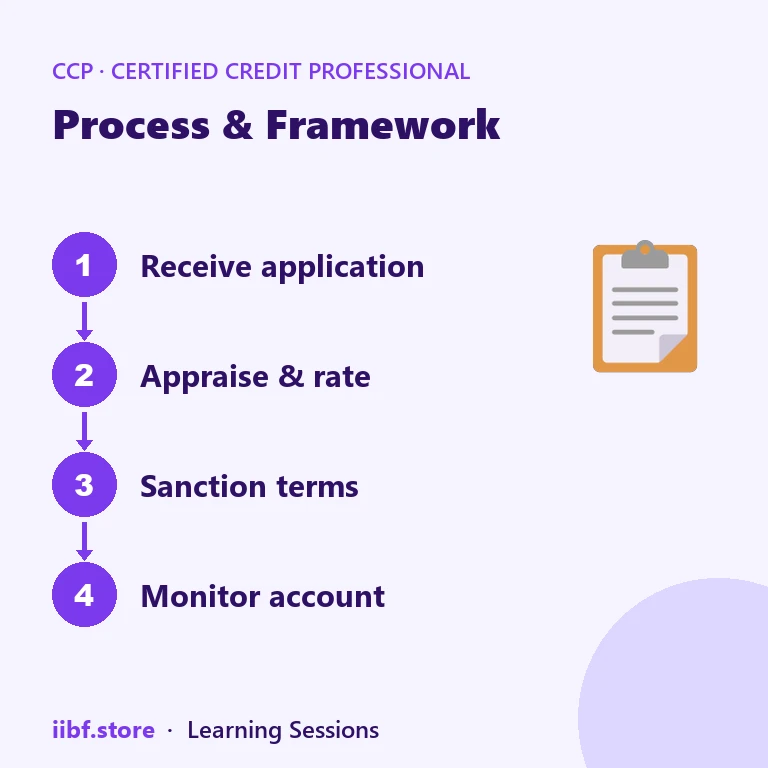
A perfected charge only holds value if it is monitored. Hypothecated stock must be inspected and reconciled with stock statements, insurance policies must be kept alive with the bank's name endorsed as loss payee, title deeds must be held in safe custody with periodic verification, and balance confirmations must be obtained to protect limitation. Slippage in any of these converts a "secured" advance into a paper claim — which is exactly how accounts drift through the SMA classification norms into non-performing territory.
When enforcement becomes necessary, the mode of charge determines the route. A pledgee can sell the pledged goods after reasonable notice under the Contract Act. A secured creditor holding hypothecation or mortgage over an eligible asset can invoke the SARFAESI Act, 2002 — issuing a demand notice under Section 13(2) and, on non-compliance, taking possession under Section 13(4). Agricultural land and certain small dues are outside SARFAESI's reach, so recovery may instead run through a Debts Recovery Tribunal or, for corporate debtors, the Insolvency and Bankruptcy Code, 2016. In every one of these forums, the first document the opposing counsel attacks is the charge documentation — badly drafted or unregistered security is the single most common reason a bank's claim is diluted.
For more CCP-focused material across appraisal, monitoring and recovery, browse the Certified Credit Professional article hub.
🧠 Practice MCQs: Creation of Charge
Q1. Under which statute is a pledge governed? (a) Transfer of Property Act, 1882 (b) Indian Contract Act, 1872 (c) SARFAESI Act, 2002 (d) Companies Act, 2013
Answer: (b) — Pledge is bailment of goods as security under Section 172 of the Indian Contract Act, 1872.
Q2. Within how many days of creation must a company ordinarily register a charge with the ROC under Section 77 of the Companies Act, 2013? (a) 15 days (b) 21 days (c) 30 days (d) 90 days
Answer: (c) — The base period is thirty days from creation, with delayed filing permitted only on payment of additional fees.
Q3. Which charge is created without transferring possession of movable goods to the bank? (a) Pledge (b) Hypothecation (c) Lien (d) Set-off
Answer: (b) — In hypothecation the borrower retains possession and continues to deal with the goods.
Q4. CERSAI was established under which enactment? (a) Companies Act, 2013 (b) Registration Act, 1908 (c) SARFAESI Act, 2002 (d) RBI Act, 1934
Answer: (c) — The Central Registry was set up under Chapter IV of the SARFAESI Act, 2002, to record security interests.
Q5. A floating charge over hypothecated stock becomes fixed when it: (a) is registered (b) crystallises on default or winding up (c) is stamped (d) is insured
Answer: (b) — Crystallisation on default, winding up or cessation of business converts a floating charge into a fixed charge.
Want chapter-wise mock tests with 100+ MCQs? Start practising free →
❓ Frequently Asked Questions
Is an equitable mortgage weaker than a registered mortgage?
No. An equitable mortgage created by deposit of title deeds in a notified town is fully enforceable and avoids registration cost, though a registered mortgage gives stronger public notice and is preferred for high-value or disputed titles.
What happens if a charge is not registered with the ROC?
The charge is not taken into account by the liquidator or other creditors in insolvency proceedings. The loan itself remains recoverable as a debt, but the bank effectively loses its secured status.
Does CERSAI registration apply to individual borrowers?
Yes. CERSAI covers security interests created by all borrowers, including individuals and firms, unlike ROC filing which applies only to companies and LLPs.
Can a bank take a second charge on an asset already charged to another lender?
Yes, with a no-objection certificate from the first charge holder, and the ranking — second charge or pari passu — must be clearly recorded in the documents and in the registry filings.
🎯 Conclusion
Charge creation is where credit judgement meets law. Pick the wrong mode for the asset, miss the stamp duty, skip the ROC or CERSAI filing, or let limitation lapse, and an otherwise sound advance becomes unenforceable at the worst possible moment. For the CCP exam, anchor your revision on four questions for every security: which mode of charge, which statute, which registry, and within what timeline. Then reinforce it with practice — take chapter-wise CCP mock tests at iibf.store/tests and turn these rules into reflexes before exam day.
Prefer revising from a printed book?
Chapter-wise books with MCQs after every chapter — minimal pages, complete coverage, delivered anywhere in India. Every book has a free sample to read first.
188 pages · 435 MCQs
Learning Sessions · Ashish Sir
132 pages · 225 MCQs
Learning Sessions · Ashish Sir
117 pages · 236 MCQs
Learning Sessions · Ashish Sir
Learning Sessions · Ashish Sir
118 pages · 299 MCQs
Learning Sessions · Ashish Sir
Learning Sessions · Ashish Sir
Learning Sessions · Ashish Sir
Learning Sessions · Ashish Sir
115 pages · 255 MCQs
Learning Sessions · Ashish Sir
Learning Sessions · Ashish Sir
334 pages · 936 MCQs
Learning Sessions · Ashish Sir
Learning Sessions · Ashish Sir
115 pages · 344 MCQs
Learning Sessions · Ashish Sir
107 pages · 240 MCQs
Learning Sessions · Ashish Sir
90 pages · 150 MCQs
Learning Sessions · Ashish Sir
Learning Sessions · Ashish Sir
131 pages · 672 MCQs
Learning Sessions · Ashish Sir
221 pages · 831 MCQs
Learning Sessions · Ashish Sir
128 pages · 524 MCQs
Learning Sessions · Ashish Sir
107 pages · 445 MCQs
Learning Sessions · Ashish Sir
148 pages · 478 MCQs
Learning Sessions · Ashish Sir
151 pages · 465 MCQs
Learning Sessions · Ashish Sir
148 pages · 375 MCQs
Learning Sessions · Ashish Sir
216 pages · 895 MCQs
Learning Sessions · Ashish Sir
109 pages · 300 MCQs
Learning Sessions · Ashish Sir
104 pages · 360 MCQs
Learning Sessions · Ashish Sir
82 pages · 297 MCQs
Learning Sessions · Ashish Sir
151 pages · 600 MCQs
Learning Sessions · Ashish Sir
98 pages · 282 MCQs
Learning Sessions · Ashish Sir
Quick quiz on this topic
5 exam-style questions from our free test bank — check yourself before you move on.
Practice this topic
Take a free mock test, download chapter PDFs, or watch a video class — all included on iibf.store.