360 Degree Feedback in Banks: CAIIB HRM Complete Guide
Think of your last annual appraisal. Your Branch Manager filled a form, your Regional Office moderated it, and you got a grade. Nobody asked your team, your colleagues in the neighbouring department, or the customers you serve every day. That blind spot is exactly what 360 degree feedback in banks tries to fix, and it is why IIBF lists it by name in the CAIIB Human Resources Management elective.
If you are preparing for HRM after branch hours, this guide gives you the concept, the process, the problems and the way the exam asks it. Read it once, then attempt the practice questions at the end.
Where 360 degree feedback sits in the CAIIB HRM syllabus
In the current IIBF syllabus for the CAIIB electives, the Human Resources Management paper lists Performance Management under Module B (Building an HR Strategy). The topics named together are: Performance Management System (PMS), Performance Appraisal System, 360-Degree Appraisal, Competency Mapping and Key Result Areas (KRAs). You can verify this on the official IIBF syllabus document. Always check the IIBF website for the latest revision before your exam cycle, and follow iibf.org.in for the official schedule.
The way the syllabus groups these five items tells you how to study them. A PMS is the whole yearly cycle. Appraisal is the rating step inside it. KRAs say what you are measured on. Competency mapping says which skills and behaviours the role needs. And 360-degree appraisal is one method of collecting the evidence. Learn them as one connected chain, not five separate definitions. If you are doing the full paper, the CAIIB Human Resources Management elective course covers the whole of Module B in sequence.
What is 360 degree feedback?
360 degree feedback, also called multi-rater feedback, is a method in which an employee is assessed not only by the immediate boss but by people all around the employee: the reporting officer, peers, subordinates, sometimes internal customers from other departments and external customers, and the employee through self-rating. The "360" is a picture of a full circle of viewpoints.
In a traditional bank appraisal, the only voice that counts is the superior's. In 360 degree feedback in banks, the same person is rated by several groups on the same set of behaviours, and the results are combined into one report. The idea is that a person who looks excellent from above may look very different from beside or below, and that the gap is useful information.
The key concepts to remember
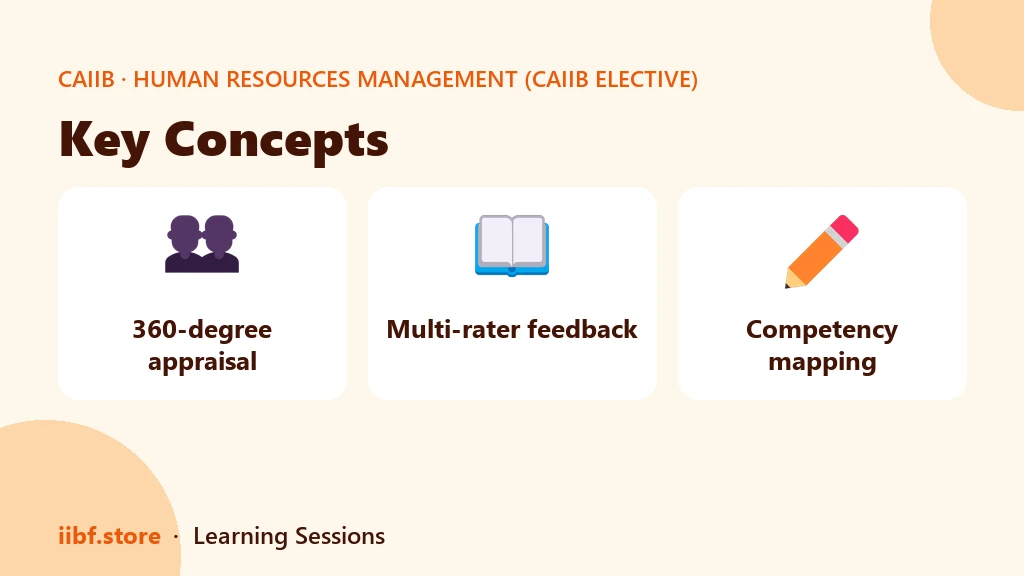
- Multi-rater input: feedback comes from several rater groups, not one.
- Behaviour-focused: raters comment on observable behaviours and competencies, not on personality.
- Confidential: individual ratings from peers and subordinates are merged so that no single rater can be identified.
- Developmental first: most organisations use it to help people grow, and are cautious about using it directly for pay and promotion decisions.
- Linked to competencies: the questionnaire is built from the competency map and KRAs of the role.
Who rates whom: the rater groups
A good way to remember the circle is to picture a Branch Manager at the centre. Every group that touches that manager's work sees a different slice of it.
| Rater group | Example in a bank | What they can judge best |
|---|---|---|
| Self | The Branch Manager | Own intent, effort and self-awareness |
| Superior | Regional Head | Target delivery, compliance, results |
| Peers | Other Branch Managers | Cooperation, knowledge sharing, reliability |
| Subordinates | Officers and clerks in the branch | Coaching, fairness, delegation, communication |
| Internal customers | Credit or operations department | Quality and timeliness of work handed over |
| External customers | Key borrowers and depositors | Service attitude and responsiveness |
Notice the pattern: the superior sees the result, the subordinates see the leadership style. The most interesting insights come from the difference between self-rating and other ratings. A manager who rates self as excellent in communication while subordinates rate the same item low has a clear development need, and that gap is the heart of the method.
How 360 degree feedback differs from the traditional appraisal
IIBF likes comparison questions, so keep this table ready.
| Point | Traditional appraisal | 360 degree feedback |
|---|---|---|
| Source of rating | Reporting and reviewing officers | Superior, peers, subordinates, customers and self |
| Direction | Top-down | All-round |
| Main purpose | Evaluation, rewards, promotion | Development, self-awareness, behaviour change |
| Risk of single-person bias | High | Reduced because many views are averaged |
| Confidentiality | Usually limited | Essential for honest ratings |
| Cost and effort | Low | Higher: more raters, more forms, more analysis |
One related point students mix up: appraisal and feedback are not the same thing. Appraisal is a formal judgement for a period. Feedback is continuous information that helps the person improve. 360 degree feedback in banks is closer to feedback in spirit, even when a bank adds it to the appraisal cycle.
Step by step: how a bank runs a 360 degree feedback exercise
The process below is the standard sequence described in HRM textbooks. The exact details differ from one organisation to another, so in the exam focus on the logic of each step.
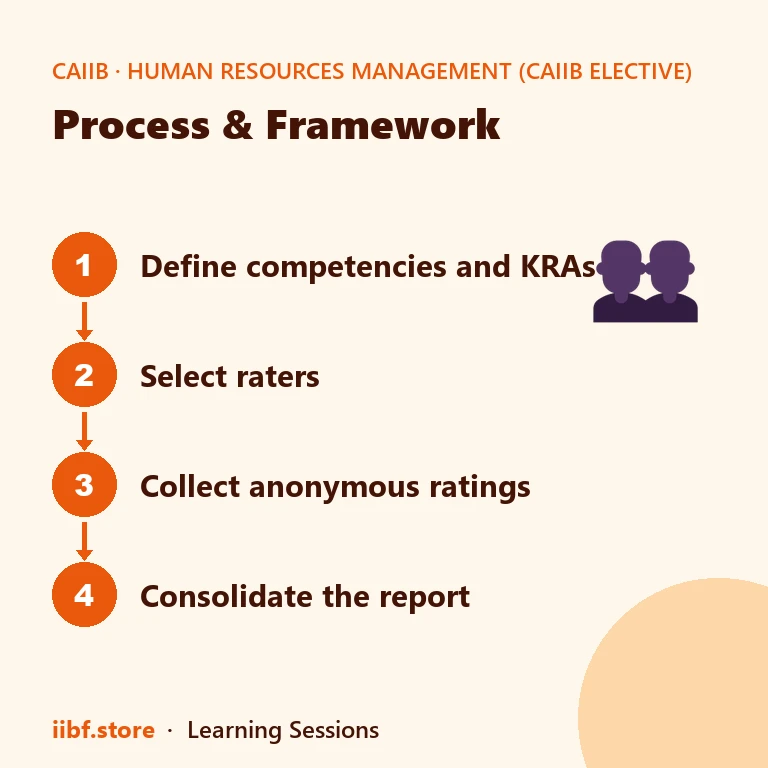
- Define what will be measured. Start from the competency map and the KRAs of the role. A Credit Officer and a Relationship Manager need different questionnaires.
- Select the raters. The employee and the supervisor together choose a balanced group. A minimum number of raters per group is kept so that individual answers cannot be traced back.
- Collect ratings anonymously. Raters score each behaviour on a scale and may add written comments. Anonymity is what makes subordinates willing to be honest.
- Consolidate into a report. Scores are averaged by rater group and compared with the self-rating. The report highlights strengths, blind spots and hidden strengths.
- Give feedback and agree an action plan. A trained facilitator or HR professional discusses the report. The employee prepares a development plan, often linked to training nominations.
Strengths, blind spots and hidden strengths
When the report compares self-ratings with the ratings of others, three patterns appear. A strength is where both self and others rate high. A blind spot is where you rate yourself higher than others do. A hidden strength is where others rate you higher than you rate yourself. A bank manager who is too modest about technical knowledge would discover a hidden strength; one who believes team communication is perfect while the team disagrees has a blind spot. This vocabulary appears often in HRM discussions, so learn it.
A worked example from a branch
Suppose a Senior Manager in a mid-sized bank has met every business target for three years and always gets a top grade from the Regional Office. The bank introduces 360 degree feedback in banks as a development tool for managers about to be considered for larger branches.
The report arrives. The superior rates the manager very high on target delivery. Peers rate cooperation as average. The subordinates rate delegation and listening low, and written comments say that officers are afraid to report errors. The manager's own self-rating on team communication was the highest score of all.
Under the old system, this manager would simply have been promoted on the numbers. With the report in hand, the HR department can see a risk: a high-performing individual who may be creating a closed, fearful branch culture, which in banking is also a compliance and fraud-detection risk, because staff who fear their boss hide mistakes. The development plan then includes a leadership programme and a six-month follow-up review. This is the practical value you should be able to explain in a descriptive answer.
Benefits and limitations
Benefits
- Reduces the influence of one superior's personal liking or dislike.
- Improves self-awareness, especially for managers who get little upward feedback.
- Encourages teamwork and customer orientation because peers and customers are also raters.
- Gives HR objective input for training needs and succession and talent planning.
Limitations and rater errors
- Halo effect: one good quality influences all the other ratings.
- Leniency or strictness: rater gives everyone high or low scores.
- Central tendency: rater stays in the middle of the scale to avoid taking a stand.
- Recency effect: recent events outweigh the full period.
- Collusion or revenge rating: friends inflate scores, or an unhappy subordinate lowers them.
- Feedback fatigue: too many forms to fill reduces quality.
Public sector and private banks alike have large hierarchies and transfer cycles. Because of that, a rater may not have worked with the employee long enough to judge fairly, which is another reason many banks use 360 degree feedback in banks for development and leadership programmes rather than as the only basis for promotion.
How IIBF tests this topic
Questions on performance management are usually conceptual and scenario-based. Typical patterns are:
- Identify the method from a description ("feedback gathered from superiors, peers, subordinates and customers").
- Choose the main objective: development rather than only evaluation.
- Spot the rater error from a short situation.
- Match items in the PMS chain: KRA, competency map, appraisal, feedback.
- Choose the correct condition for success: confidentiality and trained raters.
Common traps
- Do not say 360 degree feedback is feedback from the boss only; that is the traditional method.
- Do not confuse KRAs (what is expected) with competencies (how it is achieved).
- Do not claim it is always linked to pay. It is mostly developmental, and the link to rewards is cautious.
For more practice, the CAIIB HRM printed book with chapter-wise MCQs and the CAIIB mock tests let you test this topic against exam-style options.
Practice question 1
In 360 degree feedback, which of the following is NOT normally a source of rating? (a) Peers (b) Subordinates (c) The employee's family members (d) Customers. The answer is (c). The raters are those who see the employee's work: superiors, peers, subordinates, internal and external customers and the employee as self-rater. Family members have no view of work behaviour.
Practice question 2
A rater gives all ten employees a score of 3 on a scale of 1 to 5 to avoid deciding. This is: (a) halo effect (b) central tendency (c) recency effect (d) leniency. The answer is (b). Central tendency means clustering ratings around the middle. Leniency would be giving everyone high scores, and the halo effect is one trait colouring all ratings.
Practice question 3
The main reason for keeping individual ratings from subordinates anonymous is: (a) to reduce HR workload (b) to encourage honest feedback (c) to avoid appraisal altogether (d) to reduce training cost. The answer is (b). Subordinates will not rate a superior frankly if they fear being identified.
Quick revision points
- IIBF syllabus: 360-Degree Appraisal sits under Performance Management in Module B of the HRM elective.
- Raters: self, superior, peers, subordinates, internal and external customers.
- Purpose: mainly development and self-awareness; evaluation use needs care.
- Process: define competencies and KRAs, select raters, collect anonymously, consolidate, give feedback and plan action.
- Patterns: strength, blind spot, hidden strength.
- Rater errors: halo, leniency, strictness, central tendency, recency, collusion.
- Success needs confidentiality, trained facilitators and top management support.
If you want a plan that covers the full paper, offers are listed on the CAIIB offer page.
Frequently asked questions
What is 360 degree feedback in banks?
It is a multi-rater method in which an employee is rated by the superior, peers, subordinates, customers and self on the same competencies, and the ratings are combined into one confidential report used mainly for development.
Is 360-degree appraisal in the CAIIB HRM syllabus?
Yes. The IIBF syllabus for the HRM elective lists 360-Degree Appraisal under Performance Management in Module B, along with PMS, performance appraisal, competency mapping and KRAs.
How is 360 degree feedback different from a normal appraisal?
A normal appraisal is top-down and mostly evaluative. 360 degree feedback collects views from all directions and is mostly developmental, so it gives a broader and less single-person-dependent picture.
Which rater errors should I remember for the exam?
Halo effect, leniency and strictness, central tendency, recency effect and collusion are the usual ones. Learn one-line definitions of each.
Why must ratings be anonymous?
Subordinates and peers give honest ratings only when they are sure their individual answers will not be traced. Anonymity protects both the rater and the quality of the data.
Conclusion
For a banker, 360 degree feedback in banks is more than an HR fashion. It is a way to see the gap between how you think you lead and how your branch experiences you. For the exam, remember the rater groups, the five-step process, the comparison with traditional appraisal, and the rater errors. Link it back to KRAs and competency mapping, and you will handle both direct and scenario questions on performance management with confidence. Keep revising the chain: KRA, competency, rating, feedback, action plan.
Prefer revising from a printed book?
Chapter-wise books with MCQs after every chapter — minimal pages, complete coverage, delivered anywhere in India. Every book has a free sample to read first.


















































Quick quiz on this topic
5 exam-style questions from our free test bank — check yourself before you move on.
Practice this topic
Take a free mock test, download chapter PDFs, or watch a video class — all included on iibf.store.
Keep reading