Agriculture Infrastructure Fund Scheme: Guide for CAIIB Rural Banking
A farmer producer company in your district walks into the branch. It wants to build a cold store and a sorting line, but its balance sheet is thin and it has no property to mortgage. As a rural branch officer you have probably faced this exact conversation. The agriculture infrastructure fund scheme (AIF) is the Government of India answer to it, and it is a favourite area for CAIIB Rural Banking questions because it combines interest subvention, credit guarantee and a long repayment tenure in one product.
In this article we go through the agriculture infrastructure fund scheme the way a senior colleague would explain it: what it is, who can borrow, what the bank actually does, a worked example, a comparison table and the traps that appear in exams. Every figure below was checked on the official AIF portal run by the Department of Agriculture and Farmers Welfare.
What is the agriculture infrastructure fund scheme?
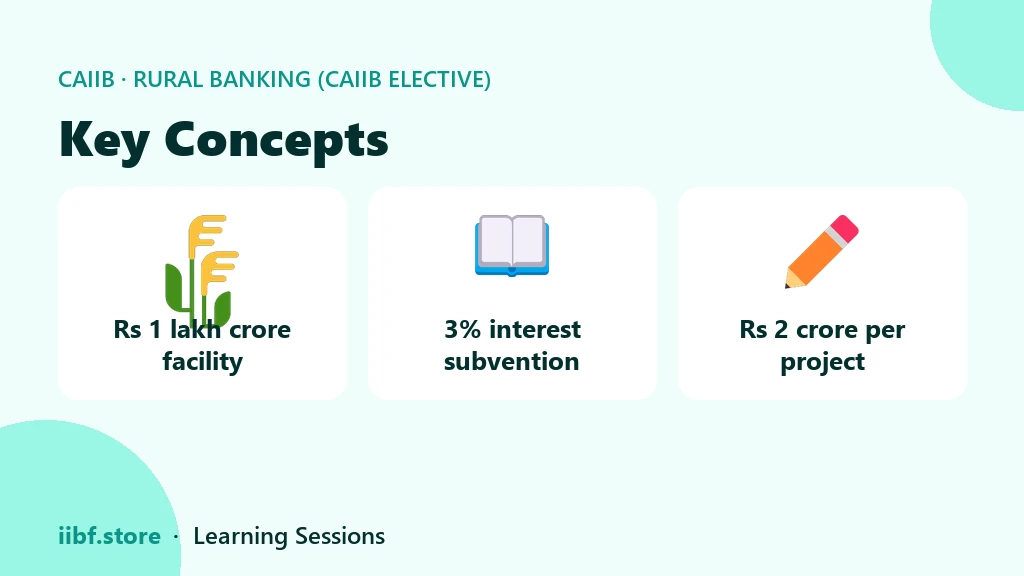
The agriculture infrastructure fund scheme is a Central Sector financing facility of Rs 1 lakh crore, administered through the Department of Agriculture and Farmers Welfare. Its purpose is to mobilise medium to long term debt for post-harvest management infrastructure and viable farming assets. In plain words, it helps the countryside build the warehouses, cold chains, sorting and grading units and processing facilities that reduce wastage after harvest.
The scheme does not lend money itself. Loans are sanctioned by participating lending institutions, which include commercial banks, cooperative banks, Regional Rural Banks, Small Finance Banks, NCDC and NBFCs. The government supports the borrower in two ways: interest subvention, and credit guarantee cover for eligible loans. You can read the official description on the AIF portal of the Department of Agriculture and Farmers Welfare.
Why bankers should care
For a banker the scheme matters for three reasons. First, it creates a genuinely bankable pipeline of agri projects that would otherwise be seen as risky. Second, the credit guarantee reduces the collateral burden, which is the usual reason rural proposals stall. Third, the loans count towards agricultural lending, so they connect directly to what you study in priority sector lending and the agricultural credit delivery chapters.
Who can borrow under the agriculture infrastructure fund scheme?
The official FAQ lists the following as eligible beneficiaries:
- Farmers, Farmer Producer Organisations (FPOs) and federations of FPOs
- Primary Agricultural Credit Societies (PACS), Marketing Cooperative Societies, Multipurpose Cooperative Societies, and state and national federations of cooperatives
- Self Help Groups, federations of Self Help Groups and Joint Liability Groups
- Agri-entrepreneurs and start-ups
- Agricultural Produce Market Committees and state agencies
- Central, state or local body sponsored Public-Private Partnership projects
Note the trap here. Public sector undertakings are not directly eligible, although a project sponsored by them under a PPP arrangement can be. Exam writers like to slip a PSU into the options.
Limit on number of projects
A private entity such as a farmer, agri-entrepreneur or start-up can take up to 25 projects, in different locations. The portal states that this ceiling does not apply to state agencies, national and state federations of cooperatives, federations of FPOs or federations of SHGs. Each project is treated separately for the benefits.
Key features: subvention, tenure, moratorium and guarantee
This is the section to memorise. The official FAQ and portal give these terms:
- Interest subvention: 3% per annum on loans up to Rs 2 crore. For larger loans the subvention is limited to Rs 2 crore per project in one location.
- Interest rate: for loans up to Rs 2 crore the interest rate is capped at 9%. Above Rs 2 crore, banks may charge market-driven rates beyond the subvented amount.
- Repayment: 7 years, including a moratorium of a minimum of 6 months and a maximum of 2 years.
- Credit guarantee: loans up to Rs 2 crore are eligible for credit guarantee cover, and the government pays the guarantee fee for a maximum of 7 years.
The government's own scheme portal on myScheme adds that the interest subvention is available for a maximum of seven years including the moratorium period. In other words, the 7 years is a shared clock: a longer moratorium does not extend the subvention period.
If you are building your wider foundation on agricultural lending, the full CAIIB Rural Banking elective course places this scheme alongside the credit delivery system, NABARD refinance and priority sector norms so that the links are clear.
Which projects are eligible?
The portal divides eligible projects into two groups. Knowing the grouping helps you answer classification questions quickly.
Post-harvest management projects
These include supply chain services such as e-marketing platforms, warehouses and silos, cold stores and cold chains, packaging units, assaying units, sorting and grading units, logistics facilities such as reefer vans, ripening chambers, farm residue and waste management infrastructure, and primary processing. Integrated primary and secondary processing is also covered.
Viable farming assets
This group includes organic input production such as vermicomposting, compressed biogas plants, bio stimulant units, smart and precision agriculture infrastructure, nurseries, tissue culture, seed processing, custom hiring centres for farm machinery, honey processing, polyhouses and greenhouses, hydroponic, vertical and aeroponic farming, mushroom farming, and projects under PM-KUSUM components such as standalone solar pumps. The full, current list is on the eligible projects page.
What is not eligible
Standalone secondary processing units are not eligible. Items such as tractors and non-refrigerated logistics vehicles are not eligible for individual farmers. A very common exam trap is to treat any processing unit as eligible: only primary processing, or secondary processing integrated with primary processing, qualifies.
How the loan moves: step by step
The scheme runs through an online single window with a Project Management Unit that helps applicants with project preparation. From the banker's side the journey looks like this.
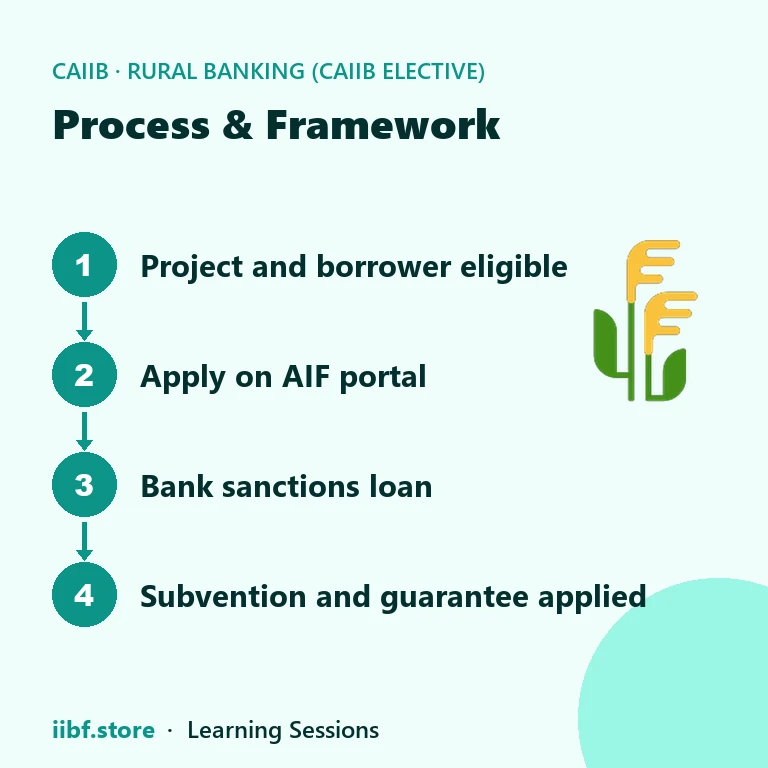
- Check the borrower and the project. Is the applicant on the eligible list, and is the asset in the eligible project list?
- Application on the AIF portal. The borrower applies online, and the proposal is routed to the lending institution you work for.
- Appraisal and sanction. The bank appraises technical feasibility, market linkage and repayment capacity as for any term loan, then sanctions.
- Subvention and guarantee. For eligible loans up to Rs 2 crore the credit guarantee cover is availed and the 3% interest subvention is claimed through the scheme mechanism.
- Disbursement and repayment. Repayment is over 7 years including the moratorium.
For regular practice on questions that test this chapter, the CAIIB mock tests are a convenient way to see how examiners frame such facts.
Worked example from a rural branch
Suppose an FPO applies for a project consisting of a warehouse and a sorting unit. Let us look at two situations to see how the Rs 2 crore ceiling works.
Case A: project loan of Rs 1.5 crore
The loan is within Rs 2 crore, so the 3% subvention applies to the whole loan, the interest rate is capped at 9%, and the loan is eligible for credit guarantee cover. The FPO can plan its moratorium anywhere from 6 months up to 2 years, with the total tenure at 7 years.
Case B: project loan of Rs 5 crore
Here the subvention is limited to the first Rs 2 crore of the loan. The balance Rs 3 crore carries interest at a market-driven rate. The guarantee cover and the capped interest rate are tied to loans up to Rs 2 crore, so the officer must explain this blended cost clearly to the borrower at the sanction stage.
The table below summarises the difference for your revision of the agriculture infrastructure fund scheme.
| Feature | Loan up to Rs 2 crore | Loan above Rs 2 crore |
|---|---|---|
| Interest subvention | 3% per annum on the loan | 3% limited to Rs 2 crore per project |
| Interest rate | Capped at 9% | Market-driven beyond subvented amount |
| Credit guarantee | Eligible; fee paid by government up to 7 years | Scheme cover is stated for loans up to Rs 2 crore |
| Repayment | 7 years including moratorium | 7 years including moratorium |
| Moratorium | 6 months to 2 years | 6 months to 2 years |
How IIBF tests the agriculture infrastructure fund scheme
In the CAIIB Rural Banking elective, examiners usually test this scheme in three ways: a direct fact (the subvention rate, the ceiling, the tenure), an eligibility screen (which applicant or which project is outside the scheme) and a comparison with other agricultural schemes. The common errors are mixing up the 3% subvention here with other interest subvention schemes for crop loans, and assuming the Rs 2 crore ceiling applies to the loan amount rather than to the subvention and guarantee.
Also be careful with the word moratorium. In the AIF it is part of the 7 years, not an addition to it.
Practice MCQs
Q1. Under the agriculture infrastructure fund scheme, interest subvention of 3% per annum is available on loans up to: (a) Rs 50 lakh (b) Rs 1 crore (c) Rs 2 crore (d) Rs 10 crore. The answer is (c). For larger loans the subvention is limited to Rs 2 crore per project.
Q2. The maximum repayment period under the scheme, including moratorium, is: (a) 3 years (b) 5 years (c) 7 years (d) 15 years. The answer is (c). The moratorium ranges from 6 months to 2 years and sits inside this 7 years.
Q3. Which one of the following is not eligible under the scheme? (a) Cold store (b) Warehouse (c) Sorting and grading unit (d) Standalone secondary processing unit. The answer is (d). Only primary processing, or secondary processing integrated with primary processing, is covered.
Quick revision points
- Financing facility of Rs 1 lakh crore through banks and other lenders; Department of Agriculture and Farmers Welfare is the administrator.
- 3% interest subvention, with a ceiling of Rs 2 crore per project in one location.
- Interest rate capped at 9% for loans up to Rs 2 crore.
- Repayment of 7 years including a moratorium of 6 months to 2 years.
- Credit guarantee for loans up to Rs 2 crore; government pays the fee for up to 7 years.
- Up to 25 projects for a private entity, in different locations.
- Standalone secondary processing, and PSUs directly, are not eligible.
For a printed reference with chapter-wise questions, the Rural Banking printed book helps you revise the whole elective, and you can see current CAIIB pricing and campaign offers on the CAIIB offer page. Free chapter notes are available in the free material section.
Frequently asked questions
What is the agriculture infrastructure fund scheme?
It is a Rs 1 lakh crore Central Sector financing facility that helps fund post-harvest infrastructure and viable farming assets through banks and other lenders, with interest subvention and credit guarantee support.
How much interest subvention does the scheme give?
3% per annum on loans up to Rs 2 crore. For bigger loans, the subvention is limited to Rs 2 crore per project in one location.
What is the repayment period and moratorium?
Repayment is over 7 years including a moratorium of a minimum of 6 months and a maximum of 2 years.
Can PACS and FPOs borrow under the scheme?
Yes. PACS, FPOs, federations of FPOs, Self Help Groups, Joint Liability Groups, farmers, agri-entrepreneurs and start-ups are among the eligible beneficiaries listed on the portal.
Is a standalone secondary processing unit eligible?
No. Standalone secondary processing units are not eligible, though secondary processing integrated with primary processing is covered for projects sanctioned on or after 29 August 2024.
Conclusion
The agriculture infrastructure fund scheme is a compact, high-yield topic: one facility size, one subvention rate, one ceiling and one tenure to remember, plus a clear list of who and what is eligible. Learn the Rs 2 crore ceiling and the 7-year clock first, then the eligibility traps. For the upcoming exam cycle always confirm the syllabus and schedule on the official IIBF website, and re-check scheme terms on the AIF portal because government schemes are revised from time to time.
Prefer revising from a printed book?
Chapter-wise books with MCQs after every chapter — minimal pages, complete coverage, delivered anywhere in India. Every book has a free sample to read first.


















































Quick quiz on this topic
5 exam-style questions from our free test bank — check yourself before you move on.
Practice this topic
Take a free mock test, download chapter PDFs, or watch a video class — all included on iibf.store.