Enterprise Risk Management Framework Explained (IIBF Risk Management)

Every bank runs on risk, and no single department can manage all of it in isolation. An enterprise risk management framework is the structured system a bank uses to identify, measure, monitor and respond to risk across every business line — credit, market, operational, liquidity and strategic — as one connected picture instead of scattered departmental reports. For IIBF Risk Management candidates, understanding how an enterprise risk management framework ties governance, risk appetite and daily controls together is core exam ground, and it also explains how well-run banks avoid the blind spots that isolated risk silos create.
This article breaks the framework into its working parts: what it is, how its components fit together, the process a bank actually follows, and how Indian banks apply it under RBI expectations and global standards such as COSO ERM and ISO 31000.
🏛️ What Is an Enterprise Risk Management Framework
An enterprise risk management framework gives a bank one common language and one common process for handling risk, instead of each department inventing its own. Under the older, siloed approach, the credit team tracked default risk, the treasury desk tracked market risk, and operations tracked process failures — with almost no shared view of how these risks interact or pile up at the same time.
ERM changes that by centering everything on the bank's risk appetite — the amount and type of risk the board is willing to accept in pursuit of its objectives — and then cascading that appetite down into limits, policies and controls for every business line. The board and senior management own the framework; it is not a back-office compliance exercise.
The regulatory capital a bank must hold is directly shaped by how well it manages risk at the enterprise level, a link explained in detail in the chapter on Regulatory Capital and Capital Adequacy. Weak enterprise-wide oversight tends to show up later as capital strain, which is exactly why RBI supervisors examine a bank's ERM maturity alongside its balance sheet.
Globally, most banks build their enterprise risk management framework on the COSO ERM model or ISO 31000, adapting either to fit RBI's supervisory expectations under its risk-based supervision approach, detailed on the RBI website.
💡 Exam Tip: If a question asks what distinguishes ERM from traditional risk management, the answer is almost always "integration across risk types and business lines," not any single technique.
🧩 Core Components of an ERM Framework
A working enterprise risk management framework has five recurring building blocks: governance, risk appetite, risk identification and assessment, risk response, and monitoring and reporting. Each block feeds the next, and none of them work well in isolation.
Governance sits at the top: a board risk committee, a Chief Risk Officer, and a "three lines of defense" model where business units own risk, an independent risk function oversees it, and internal audit checks both. Risk appetite converts board-level tolerance into hard limits — exposure caps, concentration limits, capital buffers — that business teams operate within day to day.
Risk identification pulls together every category a bank faces. On the credit side, banks lean on credit risk models pd lgd ead to quantify default exposure; on the operational side, the chapter on the Operational Risk and Management Framework shows how process, people and system failures are catalogued and scored.
The table below contrasts the old siloed approach with a proper enterprise risk management framework, so you can see why examiners keep coming back to this distinction.
| Aspect | Silo-Based Risk Management | Enterprise Risk Management (ERM) |
|---|---|---|
| Risk view | Department-level, disconnected | ✅ Bank-wide, aggregated |
| Ownership | Risk department only | ✅ Board, senior management and business lines together |
| Reporting cadence | Periodic, backward-looking reports | ✅ Continuous, dashboard-driven monitoring |
| Capital linkage | Weak, calculated after the fact | Built into planning and limit-setting upfront |
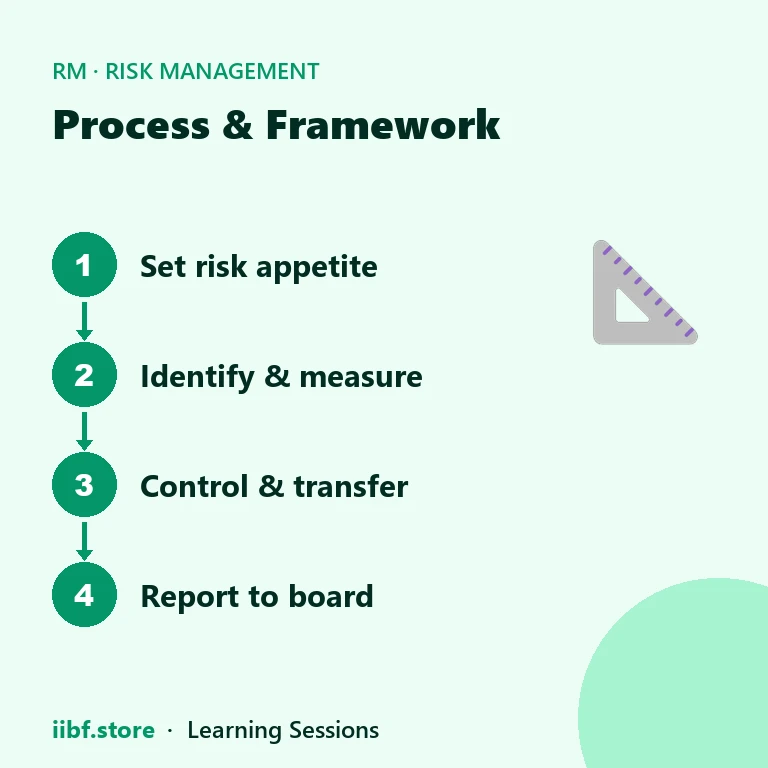
🔄 The ERM Process: Identify, Assess, Respond, Monitor
In practice, an enterprise risk management framework runs as a repeating cycle rather than a one-time project. It starts with identification — surfacing every material risk through workshops, loss data and audit findings — then moves to assessment, where each risk is scored for likelihood and impact.
The self-assessment tools banks use to score operational risks are covered in the chapter on Rcsa and Key Risk Indicators, which pairs a risk-and-control self-assessment with early-warning indicators that flag deterioration before it becomes a loss event.
Next comes response: a bank can accept, mitigate, transfer (through insurance or hedging) or avoid a risk altogether, based on where it sits relative to the board's appetite. Finally, monitoring and reporting closes the loop — dashboards, key risk indicators and periodic board papers keep senior management informed so the cycle can restart with better information.
- Identify — list and categorise every material risk
- Assess — score likelihood and impact, map against appetite
- Respond — accept, mitigate, transfer or avoid
- Monitor — track indicators and report to the board
Banks that treat resilience testing as part of this cycle, not a separate exercise, tend to score better on supervisory reviews — a theme explored further in operational resilience in banks.
⚠️ Common Mistake: Students often treat "risk appetite" and "risk tolerance" as identical. Appetite is the board's broad willingness to accept risk; tolerance is the specific, measurable limit set within that appetite.
🏦 ERM in Indian Banks: Governance and Culture
RBI expects every regulated entity to run an enterprise risk management framework proportionate to its size and complexity, with clear board accountability under the corporate governance norms covered in the chapter on Corporate Governance. A risk committee of the board, an empowered CRO with direct board access, and documented escalation paths are now baseline expectations, not best practice add-ons.
Framework design on paper only works if the organisation actually behaves according to it. That behavioural layer — how staff at every level treat risk limits, escalate concerns and respond to near-misses — is what examiners and regulators mean by risk culture in banks, and it is inseparable from a functioning ERM framework.
Capital adequacy remains the backstop when the framework fails to prevent losses, and CAIIB candidates should note how modern capital rules increasingly constrain internal models — a point covered from the Basel III angle in capital output floor in Basel III. Together, governance, culture and capital form the three pillars that keep an enterprise risk management framework credible rather than cosmetic.
📌 Remember: An enterprise risk management framework is only as strong as its weakest reporting line — a well-designed policy with poor escalation still fails in practice.
🧠 Practice MCQs: Enterprise Risk Management Framework
Q1. Which model is most commonly referenced as the global benchmark for an enterprise risk management framework? (a) Basel I Accord (b) COSO ERM Framework (c) FATF 40 Recommendations (d) IFRS 9
Answer: (b) — The COSO ERM Framework, alongside ISO 31000, is the most widely referenced global model banks adapt for enterprise-wide risk management.
Q2. In the "three lines of defense" model, who forms the second line? (a) Business unit staff (b) Board of Directors (c) Independent risk management function (d) External auditors
Answer: (c) — The independent risk management and compliance function forms the second line, overseeing the risk-taking done by business units in the first line.
Q3. What best distinguishes enterprise risk management from traditional, siloed risk management? (a) Use of more complex mathematics (b) Integration of risk views across business lines (c) Focus only on credit risk (d) Elimination of the need for capital buffers
Answer: (b) — ERM's defining feature is an integrated, bank-wide view of risk rather than separate departmental assessments.
Q4. Risk appetite in an ERM framework is best described as: (a) A single numeric capital ratio (b) The board's broad willingness to accept risk in pursuit of objectives (c) A regulatory penalty schedule (d) The maximum loss a bank has ever recorded
Answer: (b) — Risk appetite is the board-approved level and type of risk the bank is willing to accept, later broken into specific tolerance limits.
Q5. Which of the following is a core stage of the ERM risk cycle? (a) Identification (b) Advertising (c) Recruitment (d) Dividend declaration
Answer: (a) — The ERM cycle runs through identification, assessment, response and monitoring; the other options are unrelated business functions.
Want chapter-wise mock tests with 100+ MCQs? Start practising free →
What is the main goal of an enterprise risk management framework in a bank?
Its goal is to give the bank one integrated view of all material risks — credit, market, operational, liquidity and strategic — so decisions are made against a single risk appetite instead of fragmented departmental judgments.
How is ERM different from traditional risk management?
Traditional risk management handles each risk type separately within its own department. ERM aggregates these views under common governance, so risks that build up across departments at the same time are visible to the board.
Which frameworks do Indian banks typically follow for ERM?
Most Indian banks adapt the COSO ERM Framework or ISO 31000 as their base model, layering on RBI's supervisory expectations around governance, board oversight and proportionality to size and complexity.
Who is ultimately accountable for a bank's enterprise risk management framework?
The board of directors is ultimately accountable, typically acting through a board risk committee and an empowered Chief Risk Officer, even though day-to-day risk-taking sits with individual business units.
An enterprise risk management framework is one of the most exam-relevant and practically important topics in IIBF Risk Management — it connects governance, capital, culture and every individual risk type into a single story. Revisit the chapters linked above, work through the MCQs again until every answer is automatic, and when you are ready, check the latest IIBF exam updates or browse more coverage on the risk management tag hub.
Practice this topic
Take a free mock test, download chapter PDFs, or watch a video class — all included on iibf.store.
Keep reading