Fraud Prevention in Bank Branches: An IIBF Ethics Guide
A teller who ignores a slightly odd cheque, a credit officer who skips a site visit to save time, a branch manager who lets a valued customer's KYC lapse — none of these feel like fraud in the moment. Yet fraud prevention in bank branches lives exactly in these small, everyday judgment calls, not just in headline-making scams. For IIBF's Ethics paper, this is one of the most scenario-heavy topics: examiners test whether a candidate recognises early warning signs and knows the reporting duty that follows, not just textbook definitions.
This article covers the practical framework — early warning signals, red-flagged accounts, the Central Fraud Registry, and the recent shift toward natural justice in fraud classification — that connects branch-level vigilance to the bank's formal fraud risk architecture. We will also place it alongside related ethics topics like ethical audit in banks, since audit findings are often where branch-level fraud first surfaces.
🚩 Early Warning Signals: Catching Fraud Before It Escalates
RBI's fraud risk management framework rests heavily on Early Warning Signals (EWS) — indicators that a loan account may be heading toward fraud long before default happens. Classic EWS include frequent changes in the account's registered address without proper documentation, funds diverted for purposes other than the sanctioned end-use, non-cooperation with a forensic audit, and financial statements that look inconsistent with the industry the borrower claims to operate in.
Branch staff are the first line of defence here, not the last. A relationship manager who notices a borrower's stated turnover doesn't match the pattern of account transactions has a duty to flag it internally — this is where individual ethics and institutional fraud control meet. The chapter on work ethics and the workplace frames this duty as part of everyday professional conduct, not a specialised compliance job.
Once EWS accumulate on an account, banks classify it as a Red Flagged Account (RFA), which triggers closer monitoring and, for larger exposures, a forensic audit before any further exposure is extended.
💡 Exam Tip: Remember the sequence — Early Warning Signals lead to Red Flagged Account classification, which can lead to a forensic audit and, if confirmed, fraud classification. IIBF often tests this order in scenario questions.
🔍 The Central Fraud Registry and Information Sharing
One structural safeguard is the Central Fraud Registry (CFR), maintained by RBI as a searchable repository of fraud cases reported by banks and financial institutions. Before extending fresh credit to a borrower, banks are expected to check this registry so that an entity flagged for fraud at one bank cannot quietly move to another for a fresh loan.
This information-sharing principle extends beyond the CFR. Banks also exchange red-flag information through industry bodies and credit information companies, closing the loop that once let serial defaulters and fraudulent borrowers hop between lenders undetected. The broader shift toward proactive, industry-wide fraud data sharing reflects the changing dynamics of banking ethics, where technology now supports what used to depend purely on individual vigilance.
For frontline staff, the practical takeaway is simple: fraud prevention doesn't end at the branch door. A red flag entered honestly and promptly protects not just one bank, but the wider financial system.
⚖️ Natural Justice: A Key Shift in Fraud Classification
A significant development bankers preparing for current exams must know: following a Supreme Court ruling, RBI revised its fraud classification framework to require that a borrower be given a reasonable opportunity — typically a show-cause notice and a chance to respond — before their account is formally classified as fraud. Earlier, banks could classify an account as fraud based purely on internal findings, without hearing the borrower first.
This matters ethically as much as legally. Due process is itself an ethical principle, not just a procedural technicality — even a genuinely fraudulent borrower is entitled to a fair hearing before the label is applied, since a wrongful classification carries severe civil and reputational consequences.
For exam purposes, treat this as a live example of how court judgments reshape banking ethics practice in real time. This ties directly into the syllabus's discussion of corruption, bribery and white-collar crime, where fair process is treated as a check against arbitrary institutional power.
⚠️ Common Mistake: Candidates often assume RBI's fraud framework is purely punitive toward borrowers. Since the natural-justice reform, the framework explicitly balances fraud control against a borrower's right to be heard — don't answer as if it's one-sided.
🛡️ Internal Controls That Prevent Branch-Level Fraud
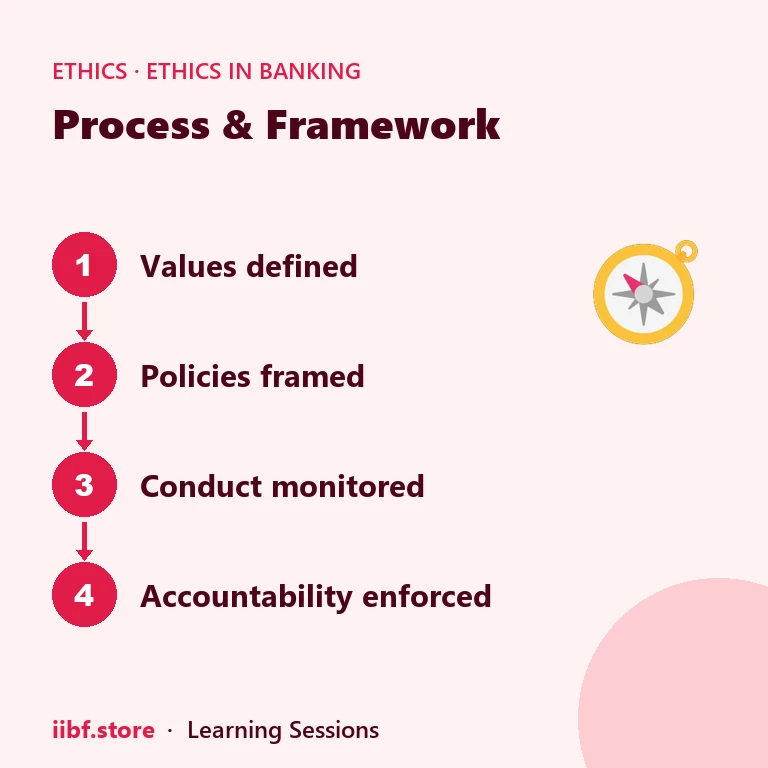
Beyond large-account fraud, day-to-day branch fraud prevention rests on basic internal controls: dual custody of cash and valuables, maker-checker authorisation on transactions, mandatory leave for staff in sensitive roles so irregularities surface while someone else covers the desk, and periodic surprise inspections.
These controls exist precisely because ethical lapses often start small — a bypassed approval here, a shortcut there — and internal controls are what stop a minor lapse from compounding into a major fraud. This is a direct, practical extension of the ideas covered in building an ethical organization: structure, not just individual willpower, is what sustains ethical behaviour at scale.
| Control / Mechanism | Purpose | Applies at Branch Level? |
|---|---|---|
| Maker-checker authorisation | No single employee can complete a transaction alone | ✅ Yes |
| Mandatory leave for sensitive roles | Surfaces irregularities while the desk is covered by another staffer | Yes |
| Early Warning Signals (EWS) monitoring | Flags large-account fraud risk before default | Yes (credit accounts) |
| Central Fraud Registry check | Prevents flagged borrowers moving undetected to a new lender | Yes (pre-sanction) |
| Ignoring red flags to protect a "valued" customer | Undermines every control above | ❌ No — an ethics failure |
📞 Reporting Duty: What a Branch Employee Must Do
Knowing the red flags is only half the job — a banker also has to know what to do next. Most banks require suspected fraud to be reported immediately through an internal fraud-reporting channel or the vigilance function, rather than being informally "handled" at branch level. Delay or informal resolution, even with good intentions, can itself become a governance and disciplinary issue.
This reporting duty overlaps with the protected-disclosure principle discussed in vigilance administration in banks: an employee who raises a fraud concern in good faith is expected to be protected from retaliation, and the reporting channel should route to a level of authority genuinely independent of the persons involved.
Where an investigation confirms proceeds of crime linked to the fraud, enforcement action can extend into anti-money-laundering territory — for instance, assets may be frozen through a PMLA provisional attachment order while the case is pursued.
📌 Remember: "Handling it quietly to avoid embarrassment" is not a reporting option. Every fraud-prevention framework in the syllabus assumes prompt, formal escalation as the baseline expectation.
🌐 Fraud Prevention as an Organisational Ethics Culture
Rules and registries only work if the underlying culture supports them. A branch where raising a red flag is seen as "creating trouble for a colleague" will under-report regardless of how good the framework looks on paper. Building that culture is a leadership responsibility, not just a compliance one.
This connects fraud prevention back to the broader ethical framework covered in ethics: a holistic approach — technical controls, legal process, and organisational culture all have to move together, or gaps appear exactly where they are most costly.
For the regulator's own current guidance on fraud risk management expectations for banks, refer to RBI's official publications on fraud classification and reporting rather than relying on secondhand summaries, since this area has seen genuine regulatory change in recent years.
🧠 Practice MCQs: Fraud Prevention in Bank Branches
Q1. What is the correct sequence in RBI's fraud risk framework for a large borrower account? (a) Fraud classification, then EWS, then forensic audit (b) EWS, then Red Flagged Account classification, then forensic audit if warranted (c) Forensic audit, then EWS, then RFA (d) RFA, then fraud classification, then EWS
Answer: (b) — Early Warning Signals lead to Red Flagged Account classification, which can trigger a forensic audit before any fraud determination.
Q2. What is the purpose of the Central Fraud Registry? (a) To track employee attendance (b) To let banks search reported fraud cases before extending fresh credit (c) To calculate loan interest rates (d) To store customer KYC photographs only
Answer: (b) — It is a searchable repository of reported frauds that banks check before sanctioning new credit, preventing flagged borrowers from moving undetected between lenders.
Q3. Following the Supreme Court's ruling on fraud classification, what must a bank now do before classifying a borrower's account as fraud? (a) Nothing has changed (b) Give the borrower a reasonable opportunity to respond, such as a show-cause notice (c) Immediately report it to the media (d) Wait five years before acting
Answer: (b) — Banks must now follow principles of natural justice, offering the borrower a fair opportunity to respond before formal fraud classification.
Q4. Why is mandatory leave for staff in sensitive roles considered a fraud-prevention control? (a) It reduces the bank's leave liability (b) It allows irregularities to surface while another employee covers the role (c) It is purely a wellness policy with no fraud relevance (d) It only applies to senior management
Answer: (b) — Rotating the role, even temporarily, gives another employee a chance to notice discrepancies that might otherwise stay hidden.
Q5. What is the ethically correct response for a branch employee who suspects fraud in an account they handle? (a) Resolve it quietly with the customer to avoid escalation (b) Wait until year-end review to mention it (c) Report it promptly through the formal internal fraud-reporting or vigilance channel (d) Ignore it if the customer is long-standing
Answer: (c) — Prompt, formal escalation through the designated channel is the baseline expectation across every fraud-prevention framework in the syllabus.
Want chapter-wise mock tests with 100+ MCQs? Start practising free →
Frequently Asked Questions
What are Early Warning Signals in banking fraud prevention?
Early Warning Signals are indicators — such as fund diversion, non-cooperation with audits, or mismatched financial statements — that suggest a loan account may be heading toward fraud, prompting closer monitoring before losses occur.
What is a Red Flagged Account?
It is an account classified for closer scrutiny after accumulating Early Warning Signals, which can lead to a forensic audit and, if fraud is confirmed, formal fraud classification.
Does a bank need to hear a borrower's side before classifying an account as fraud?
Yes. Following a Supreme Court ruling, RBI's revised framework requires banks to give the borrower a reasonable opportunity to respond, typically through a show-cause notice, before classifying an account as fraud.
What should a bank employee do if they suspect fraud at the branch level?
Report it promptly through the bank's formal internal fraud-reporting or vigilance channel rather than attempting to resolve it informally, and expect protection from retaliation for a good-faith report.
Fraud prevention in bank branches is not a separate compliance silo — it is daily ethical practice backed by structural controls: early warning monitoring, registries, fair process, and a culture where raising a flag is safe. For CAIIB and JAIIB Ethics candidates, treat the sequence of controls as core exam material, not background reading. Build your recall with structured CAIIB mock tests on iibf.store, and browse more coverage on the Ethics in Banking tag hub.
Quick quiz on this topic
5 exam-style questions from our free test bank — check yourself before you move on.
Practice this topic
Take a free mock test, download chapter PDFs, or watch a video class — all included on iibf.store.