Foreign Exchange Market Operations in Treasury

For CAIIB Treasury Management candidates, foreign exchange market operations is one of the highest-weightage areas in the paper because it links directly to how a bank's treasury actually earns and hedges. Understanding foreign exchange market operations means knowing how currencies are quoted, how deals settle, who the market participants are, and how the treasury desk stitches spot, forward and swap transactions into a coherent book. This article walks through the mechanics examiners test most often, with an accurate settlement-cycle table, five practice MCQs and four FAQs to lock in the concepts before exam day.
💱 What Are Foreign Exchange Market Operations?
Foreign exchange market operations refer to the buying and selling of one currency against another by banks, corporates, central banks and individuals, executed either in the interbank market or through an Authorised Dealer bank. In India, only Authorised Dealer Category-I banks can deal directly in the interbank forex market; retail customers and corporates route their requirements through these ADs under FEMA, 1999. The market itself has two broad legs — the merchant segment, where banks quote rates to customers for trade and remittance transactions, and the interbank segment, where banks square their own positions with each other or with the Reserve Bank of India. Every deal, however small, involves an exchange rate, a value date and a settlement instruction, and the treasury's foreign exchange market operations desk is responsible for pricing all three correctly. Because currency prices move continuously, timing and rate discovery are central to how this desk is judged — a theme repeatedly tested in scenario-based CAIIB questions on the financial market structure that underlies treasury dealing.
💡 Exam Tip: Remember the settlement hierarchy — Cash, Tom, Spot, Forward, Swap — examiners frequently ask which value date applies to which deal type.
🌐 Key Instruments and Participants in the FX Market
The core instruments in foreign exchange market operations are spot deals, outright forwards, FX swaps, currency futures and currency options. A spot deal settles two business days after the trade date (T+2) and is the reference rate for almost every other instrument. An outright forward locks today's rate for delivery on a future date, letting an importer or exporter hedge a known future cash flow. An FX swap combines a near-leg and a far-leg transaction — typically a spot purchase against a forward sale of the same amount — and banks use it purely to manage short-term liquidity mismatches without taking a fresh currency view. Participants range from Authorised Dealer banks and the RBI, which intervenes to manage rupee volatility, to exporters, importers, FPIs and non-bank financial companies operating under RBI-approved limits. The treasury's treasury function aggregates all these flows into one dealing book, netting exposures before hitting the interbank market, which keeps transaction costs and spreads tight for the bank as a whole.
📈 Exchange Rate Mechanisms and Quotation Methods
India follows the direct quotation method, where the exchange rate is expressed as units of domestic currency per unit of foreign currency — for example, 1 USD = INR 83.20. A cross rate is derived when neither currency in a pair is the domestic currency, calculated through a common third currency, usually the US dollar. Forward rates are quoted as a premium or discount to the spot rate, governed by the interest rate differential between the two currencies under covered interest parity — the currency with the lower interest rate normally trades at a forward premium. FEDAI (Foreign Exchange Dealers' Association of India) prescribes the rounding conventions, merchant rate card timings and value-date rules that Authorised Dealers must follow, ensuring uniformity across the market. The table below summarises how the main deal types differ in settlement and hedging use, a comparison that recurs often in CAIIB objective questions.
| FX Transaction Type | Settlement Period | Rate Fixed At | Used for Hedging? |
|---|---|---|---|
| Cash | Same day (T+0) | Deal date | – |
| Tom | T+1 | Deal date | – |
| Spot | T+2 | Deal date | – |
| Outright Forward | Beyond T+2, fixed future date | Deal date (rate locked) | ✅ |
| FX Swap | Near leg + far leg | Both legs fixed at deal date | ✅ |
⚠️ Common Mistake: Students often confuse a forward premium with currency depreciation. A premium on the dollar simply reflects the interest rate differential under covered interest parity, not a directional market call.
🏦 Role of Treasury in Managing FX Market Operations
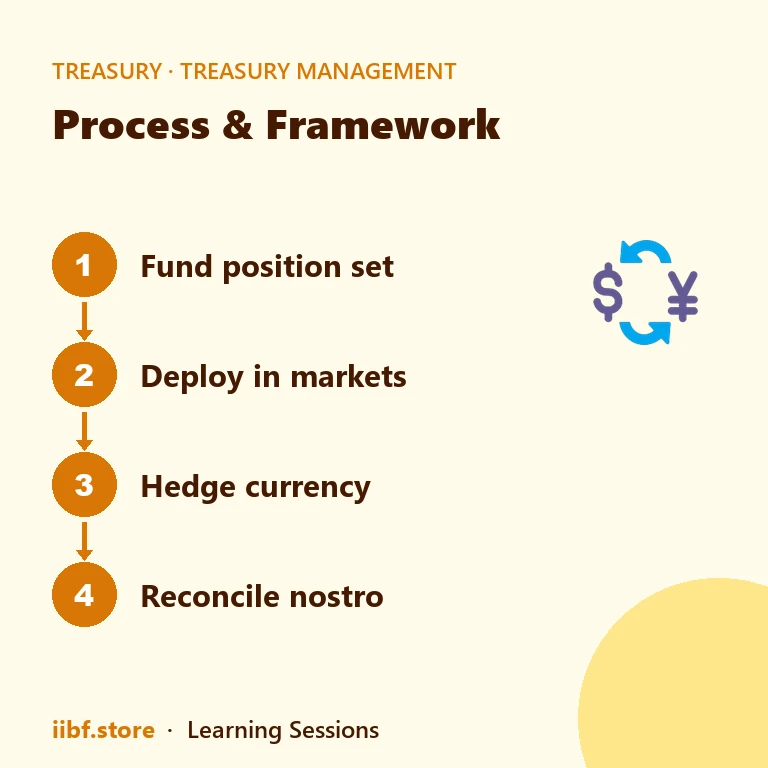
The scope and function of treasury management extends well beyond simple deal execution — the FX desk must maintain intraday and overnight open position limits, report exposures to the mid-office, and reconcile every deal against nostro confirmations before settlement. Positions that remain unhedged past the bank's approved limit attract capital charges, which is why the treatment of open currency positions under the Basel III capital adequacy framework matters even to a desk that never touches credit risk directly. Good governance also depends on clean escalation lines; candidates preparing this topic alongside Treasury Organisation Structure will recognise how the front office (dealers), mid office (risk) and back office (settlements) each own a distinct piece of every FX deal. Where a bank runs a hedging book against interest rate exposure alongside its currency book, the desk often coordinates with colleagues studying interest rate swaps in treasury management, since a currency swap and an interest rate swap frequently sit on the same trading limit. For the full range of exam-ready notes on this paper, browse the treasury management article hub. The Reserve Bank of India sets the overarching regulatory framework for foreign exchange market operations under FEMA, while FEDAI issues the day-to-day market conventions Authorised Dealers must follow for rate rounding, value dates and merchant transaction documentation. Banks must report their Net Open Position and Aggregate Gap Limit daily, and any breach triggers immediate escalation to the mid-office and, where material, to the RBI itself — the same governance thread explored in treasury risk limits and controls. Treasury desks also maintain detailed deal logs reconciling nostro account movements against confirmed trades, since an unmatched entry can indicate anything from a simple booking error to an unauthorised deal. Robust internal controls — segregation of dealer, risk and settlement functions — remain the single biggest safeguard against the kind of large unauthorised forex losses that have periodically embarrassed banks globally. Candidates should treat this regulatory layer as inseparable from the trading mechanics covered earlier, because IIBF questions frequently blend a computation, such as forward rate arithmetic, with a governance question on who must approve or report the deal, in the same case study.
📌 Remember: Every open FX position, however small, must sit within an RBI-approved Net Open Position (NOP) limit — breaching it is a regulatory reporting event, not just an internal risk flag.
🧠 Practice MCQs: Foreign Exchange Market Operations
Q1. As per standard FEDAI market convention, what is the settlement period for a spot foreign exchange transaction? (a) T+1 (b) T+2 (c) T+3 (d) T+0
Answer: (b) — A spot FX deal settles two business days after the trade date (T+2) under standard market convention.
Q2. If the exchange rate is quoted as 1 USD = INR 83.20, this is an example of: (a) Direct quote (b) Indirect quote (c) Cross rate (d) Forward margin
Answer: (a) — A direct quote expresses the exchange rate as units of domestic currency (INR) per unit of foreign currency (USD), which India follows.
Q3. A forward premium on the US Dollar against the Rupee, under covered interest parity, indicates that: (a) The rupee is expected to appreciate against the dollar (b) Interest rates in India are lower than in the US (c) The RBI has intervened to support the rupee (d) The dollar is expected to appreciate against the rupee
Answer: (d) — Under covered interest parity, the lower-interest-rate currency trades at a forward premium, implying it is expected to appreciate over the contract period.
Q4. In the Indian forex market, which participants can deal in foreign exchange only through Authorised Dealers rather than directly in the interbank market? (a) Authorised Dealer Category-I banks (b) Foreign central banks (c) Retail customers and corporates (d) The Reserve Bank of India
Answer: (c) — Retail customers and corporates must route their forex requirements through Authorised Dealer Category-I banks under FEMA regulations.
Q5. The FX market instrument where a bank simultaneously buys and sells the same currency pair for two different value dates, purely to manage liquidity, is called a: (a) Spot deal (b) FX swap (c) Currency future (d) Cross rate deal
Answer: (b) — An FX swap combines a near-leg and far-leg deal in the same currency pair, used mainly to manage short-term liquidity mismatches rather than to take a currency view.
Want chapter-wise mock tests with 100+ MCQs? Start practising free →
Frequently Asked Questions
What is the difference between a direct and an indirect quote in the forex market?
A direct quote expresses the exchange rate as units of domestic currency per unit of foreign currency, such as 1 USD = INR 83.20. An indirect quote does the reverse, expressing units of foreign currency per unit of domestic currency. India has followed the direct quotation method since 1993.
Why do banks use FX swaps instead of two separate spot and forward deals?
An FX swap lets a bank manage a temporary currency liquidity mismatch without taking a fresh view on exchange rate movement, since the near-leg and far-leg rates are both fixed at the deal date. Booking two separate outright deals would expose the bank to an unwanted open position between the two transactions.
Is Treasury Management a core or elective subject in the CAIIB examination?
Treasury Management is offered as an elective subject in the IIBF CAIIB examination, and foreign exchange market operations forms one of its most heavily tested modules alongside money markets and fixed income securities.
What is the role of FEDAI in foreign exchange market operations in India?
The Foreign Exchange Dealers' Association of India (FEDAI) prescribes uniform market conventions for Authorised Dealers, including rate rounding rules, value-date computation and merchant rate card timings, working alongside RBI's regulatory framework under FEMA, 1999.
In summary: foreign exchange market operations sit at the intersection of pricing mechanics, settlement discipline and regulatory compliance, which is exactly why IIBF case studies test all three together. Once you can confidently place a deal on the Cash-Tom-Spot-Forward-Swap spectrum, quote it correctly, and name who must approve or report it, this module stops being a memory exercise and becomes straightforward scoring territory. Reference the RBI's Master Directions on foreign exchange for the latest regulatory text, then reinforce it with timed practice. Enrol in the IIBF CAIIB course to access full-length mock tests covering this and every other Treasury Management topic.
Prefer revising from a printed book?
Chapter-wise books with MCQs after every chapter — minimal pages, complete coverage, delivered anywhere in India. Every book has a free sample to read first.
Learning Sessions · Ashish Sir
132 pages · 225 MCQs
Learning Sessions · Ashish Sir
188 pages · 435 MCQs
Learning Sessions · Ashish Sir
117 pages · 236 MCQs
Learning Sessions · Ashish Sir
Learning Sessions · Ashish Sir
118 pages · 299 MCQs
Learning Sessions · Ashish Sir
Learning Sessions · Ashish Sir
Learning Sessions · Ashish Sir
115 pages · 255 MCQs
Learning Sessions · Ashish Sir
Learning Sessions · Ashish Sir
334 pages · 936 MCQs
Learning Sessions · Ashish Sir
Learning Sessions · Ashish Sir
115 pages · 344 MCQs
Learning Sessions · Ashish Sir
107 pages · 240 MCQs
Learning Sessions · Ashish Sir
90 pages · 150 MCQs
Learning Sessions · Ashish Sir
Learning Sessions · Ashish Sir
131 pages · 672 MCQs
Learning Sessions · Ashish Sir
221 pages · 831 MCQs
Learning Sessions · Ashish Sir
128 pages · 524 MCQs
Learning Sessions · Ashish Sir
107 pages · 445 MCQs
Learning Sessions · Ashish Sir
148 pages · 478 MCQs
Learning Sessions · Ashish Sir
151 pages · 465 MCQs
Learning Sessions · Ashish Sir
148 pages · 375 MCQs
Learning Sessions · Ashish Sir
216 pages · 895 MCQs
Learning Sessions · Ashish Sir
109 pages · 300 MCQs
Learning Sessions · Ashish Sir
104 pages · 360 MCQs
Learning Sessions · Ashish Sir
82 pages · 297 MCQs
Learning Sessions · Ashish Sir
151 pages · 600 MCQs
Learning Sessions · Ashish Sir
98 pages · 282 MCQs
Learning Sessions · Ashish Sir
Practice this topic
Take a free mock test, download chapter PDFs, or watch a video class — all included on iibf.store.