Fund Based vs Non Fund Based Facilities: The JAIIB PPB Guide
Every branch officer has had this conversation. A customer walks in asking for "a limit of fifty lakh," and the first job is not sanctioning anything - it is working out whether the customer actually needs money to leave the bank, or only needs the bank's name behind a promise. That single question splits the entire credit book into two halves: fund based limits on one side, non fund based facilities on the other. It is exactly the split the short below opens with.
JAIIB PPB - fund based + non fund based facilities · Watch on YouTube
If you are preparing for Principles and Practices of Banking, do not memorise the two lists. Understand the cash-flow difference, and the lists write themselves. Fund based limits move real money out of the bank today. Non fund based facilities move only the bank's credit standing today, and money only if something goes wrong later.
What actually separates the two
A fund based facility is an outflow. The moment a cash credit account is drawn, a term loan is disbursed, or a bill is purchased, the bank's cash goes down and an advance appears on the asset side of the balance sheet. Interest starts running. The exposure is real, immediate and funded - hence the name.
Non fund based facilities work differently. When a bank issues a bank guarantee or opens a letter of credit, no money leaves the bank on day one. What the bank sells is its own creditworthiness: it tells a third party, "if our customer does not pay or does not perform, we will." The bank earns commission instead of interest. The exposure sits off the balance sheet as a contingent liability - a liability that crystallises only on a future uncertain event.
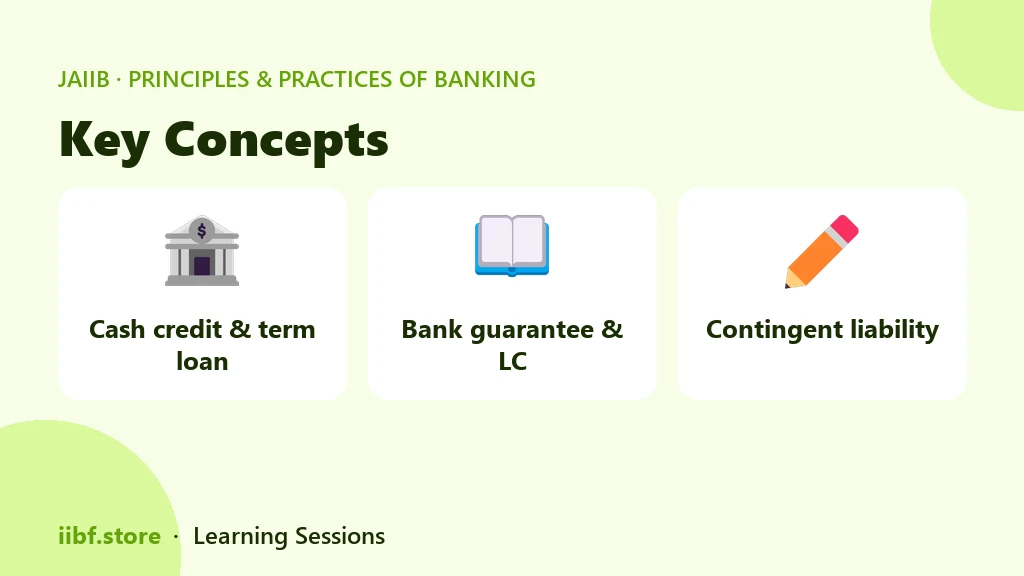
That word - contingent - is the exam word. It is why guarantees are disclosed under contingent liabilities in the notes to accounts rather than as advances, and why they still consume capital under the Basel framework through credit conversion factors. Off the balance sheet does not mean off the risk register.
The two families, side by side
| Point | Fund based | Non fund based |
|---|---|---|
| Cash outgo at sanction | Yes, on drawal | No, only if invoked or devolved |
| Bank earns | Interest | Commission / fee |
| Balance sheet | Asset - advances | Off balance sheet - contingent liability |
| Typical products | Cash credit, overdraft, term loan, bills purchased or discounted, packing credit | Bank guarantee, letter of credit, co-acceptance of bills, deferred payment guarantee |
| Risk trigger | Borrower stops servicing | Invocation of guarantee or devolvement of LC |
| Turns bad when | Overdue beyond 90 days | On devolvement or invocation, if not reimbursed in time |
Why non fund based facilities are not free limits
Branch staff sometimes treat guarantee limits as low-risk because nothing is disbursed. That is precisely how banks get hurt. The day a guarantee is invoked, the bank must pay the beneficiary unconditionally - and only then recover from the customer. An invoked guarantee converts, in a single stroke, into a fund based exposure that was never underwritten as one.
So the assessment discipline is identical. You still examine the borrower's financials, the underlying contract, the track record, the margin and the security. A working rule many banks follow: assess a guarantee limit as though you may one day have to fund it, because occasionally you will.
The same logic runs through letters of credit. When the documents arrive and the customer cannot pay on the due date, the LC devolves. The branch debits the customer's account, and if there is no balance, the amount lands in a forced loan account. Under the income recognition and asset classification norms, that unpaid devolved amount does not sit quietly - it moves toward NPA classification on the usual overdue timeline.
Choosing between them in practice
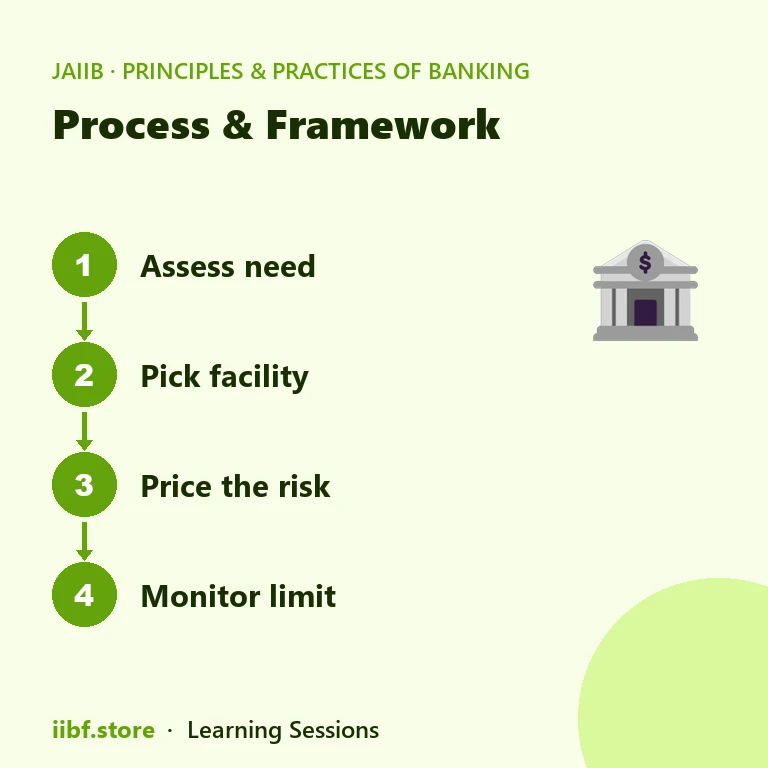
Take a small manufacturer with a Rs 5 crore turnover. He buys raw material domestically on credit, converts it over sixty days and sells on ninety-day terms. The gap between paying suppliers and collecting from buyers is a working capital gap - that is a fund based need, met through cash credit assessed on the turnover method or the MPBF route.
Now the same manufacturer wins a government supply order that demands a performance guarantee of Rs 50 lakh. He does not need Rs 50 lakh of cash. He needs someone credible to stand behind his promise to perform. That is where non fund based facilities fit exactly - a performance guarantee, priced as commission, secured by margin and counter-guarantee, with no disbursement at all.
Get the diagnosis wrong and you either starve a business of cash or hand it a limit it cannot use. That is why the assessment note always separates the two requirements before arriving at a total exposure figure.
The exam angles that repeat
Examiners rarely ask you to define a bank guarantee. They ask which of four listed products is not fund based, or where a particular item is disclosed, or what happens on devolvement. Keep these anchors ready:
- Bills purchased or discounted are fund based; co-acceptance of the same bills is not.
- A deferred payment guarantee is one of the non fund based facilities at issue, even though it covers instalments of a funded purchase.
- Commission income from guarantees is fee income, which is why banks chase it - it earns without consuming funding.
- Contingent liabilities appear in the notes to accounts, not on the face of the balance sheet as advances.
Practise these as questions rather than notes. Our JAIIB mock tests carry full-length PPB papers with this pattern, and the match-the-pair game is a quick way to drill product-to-category mapping before an exam. For a structured revision order, the complete JAIIB course sequences PPB module by module, and the study planner will fit it around your branch hours.
One last habit worth building: whenever you read about a credit product anywhere - a circular, a newspaper report, a sanction letter - ask yourself immediately whether money leaves the bank today. That reflex answers most questions on non fund based facilities faster than any mnemonic will, and it is the same reflex that keeps a credit officer out of trouble on the job.
Frequently asked questions
Are non fund based facilities riskier than fund based ones?
Not inherently, but they are easier to underestimate. Nothing is disbursed at sanction, so the exposure feels smaller than it is. On invocation or devolvement it converts instantly into a funded exposure, so it must be assessed with the same rigour.
Where do guarantees and letters of credit appear in a bank's balance sheet?
They are disclosed as contingent liabilities in the notes to accounts, not as advances. They still attract a capital charge through credit conversion factors under the Basel framework.
What happens when a letter of credit devolves?
The bank has already paid the beneficiary against compliant documents. It debits the customer; if funds are short, the amount sits in a forced loan account and follows the normal overdue and asset classification timeline from there.
Does the bank earn interest on a bank guarantee?
No. It earns commission for the period and amount of the guarantee. Interest arises only if the guarantee is invoked and the resulting payment is not reimbursed by the customer.
Prefer revising from a printed book?
Chapter-wise books with MCQs after every chapter — minimal pages, complete coverage, delivered anywhere in India. Every book has a free sample to read first.
221 pages · 831 MCQs
Learning Sessions · Ashish Sir
131 pages · 672 MCQs
Learning Sessions · Ashish Sir
128 pages · 524 MCQs
Learning Sessions · Ashish Sir
107 pages · 445 MCQs
Learning Sessions · Ashish Sir
148 pages · 478 MCQs
Learning Sessions · Ashish Sir
151 pages · 465 MCQs
Learning Sessions · Ashish Sir
148 pages · 375 MCQs
Learning Sessions · Ashish Sir
216 pages · 895 MCQs
Learning Sessions · Ashish Sir
109 pages · 300 MCQs
Learning Sessions · Ashish Sir
104 pages · 360 MCQs
Learning Sessions · Ashish Sir
82 pages · 297 MCQs
Learning Sessions · Ashish Sir
151 pages · 600 MCQs
Learning Sessions · Ashish Sir
98 pages · 282 MCQs
Learning Sessions · Ashish Sir
132 pages · 225 MCQs
Learning Sessions · Ashish Sir
188 pages · 435 MCQs
Learning Sessions · Ashish Sir
117 pages · 236 MCQs
Learning Sessions · Ashish Sir
Learning Sessions · Ashish Sir
118 pages · 299 MCQs
Learning Sessions · Ashish Sir
Learning Sessions · Ashish Sir
Learning Sessions · Ashish Sir
Learning Sessions · Ashish Sir
115 pages · 255 MCQs
Learning Sessions · Ashish Sir
Learning Sessions · Ashish Sir
334 pages · 936 MCQs
Learning Sessions · Ashish Sir
Learning Sessions · Ashish Sir
115 pages · 344 MCQs
Learning Sessions · Ashish Sir
107 pages · 240 MCQs
Learning Sessions · Ashish Sir
90 pages · 150 MCQs
Learning Sessions · Ashish Sir
Learning Sessions · Ashish Sir
Quick quiz on this topic
5 exam-style questions from our free test bank — check yourself before you move on.
Practice this topic
Take a free mock test, download chapter PDFs, or watch a video class — all included on iibf.store.