RBI Priority Sector Lending Targets: The 2026 Position
Ask ten branch managers what percentage of bank credit must go to agriculture and most will get it right. Ask them what the weaker sections sub-target is now, and the answers start drifting - because the number moved. The Reserve Bank replaced the 2020 priority sector lending framework with fresh directions effective 1 April 2025, and anyone quoting older figures in an exam hall is quoting a superseded rule.
RBI Priority Sector Lending - latest updates · Watch on YouTube
This is one of those topics that pays twice. It appears in JAIIB PPB almost every session, and it decides how a branch is judged internally on its credit mix. Worth getting exactly right.
What counts, and against what
The idea is straightforward. Certain sectors matter to the economy but struggle to attract commercial credit on their own - agriculture, micro and small enterprises, education, housing at the affordable end, renewable energy, social infrastructure, export credit and lending to weaker sections. Priority sector lending obliges banks to direct a defined share of their credit there.
The base is not total advances. Targets are computed on Adjusted Net Bank Credit, or the Credit Equivalent of Off-Balance Sheet Exposure, whichever is higher. That "whichever is higher" phrase is a favourite in objective papers, so fix it now. A bank with a large guarantee and letter of credit book cannot shrink its obligation by keeping exposures off the balance sheet.
The current targets
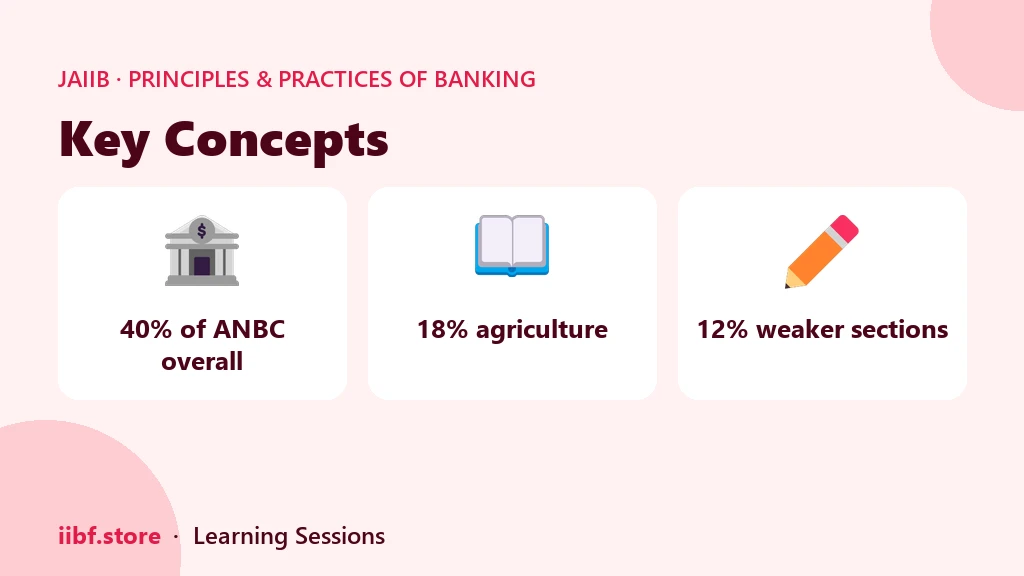
Under the directions issued on 24 March 2025 and effective from 1 April 2025, domestic scheduled commercial banks work to the following, expressed as a percentage of ANBC or CEOBE, whichever is higher.
| Category | Target |
|---|---|
| Total priority sector | 40% |
| Agriculture | 18% |
| Small and marginal farmers (within agriculture) | 10% |
| Micro enterprises | 7.5% |
| Weaker sections | 12% |
The weaker sections figure is the one that trips people up, because it was lower in the previous framework and was raised in phases. Twelve per cent is the number to carry into the exam hall. The full text sits on the RBI Master Directions page, and it is worth opening once so you can see the classification detail behind each line.
Loans already classified under the 2020 directions continue to be eligible until maturity. That transitional protection matters operationally - banks did not have to reclassify existing books overnight - and it occasionally appears as a question in its own right.
Who the targets apply to
Not every bank works to the same sheet. Domestic scheduled commercial banks and foreign banks with twenty branches or more carry the full set of targets and sub-targets. Foreign banks with fewer than twenty branches work to the overall figure with a different internal split. Regional rural banks and small finance banks have their own higher overall obligation, which reflects the customer base they were set up to serve.
Urban co-operative banks are covered as well, on a phased path of their own. The point for an exam is simply that a question naming a bank type is testing whether you noticed the type. Read the stem twice before reaching for the forty per cent figure.
One more detail is worth carrying. Priority sector lending achievement is assessed with reference to the corresponding date of the preceding year rather than a single year-end snapshot. Banks therefore manage the position across the whole year instead of scrambling in March, and that is precisely why a certificate market exists at all.
The district weightage nobody expects
One feature of the current framework rewards banks for lending where credit is scarce. Districts with comparatively lower credit flow attract a 125 per cent weight on incremental lending, while districts already well served carry a 90 per cent weight. The mechanism runs across financial years 2024-25 to 2026-27.
The intent is geographic, not sectoral. Two identical farm loans of Rs 10 lakh can contribute differently to a bank's achievement depending on where the borrower is. For a branch in an underserved district, that is quietly good news - the same effort counts for more.
What happens if a bank falls short
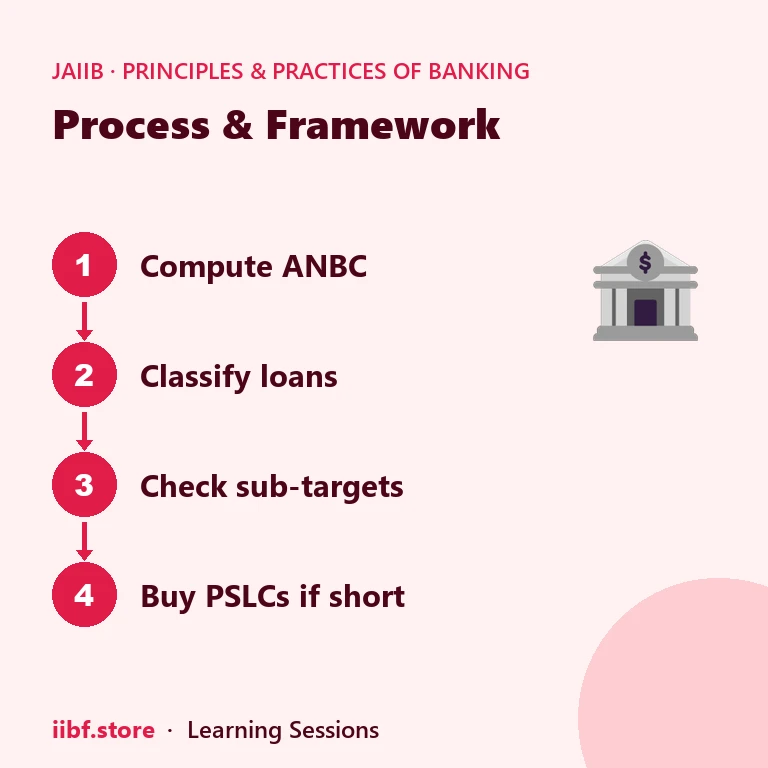
Shortfalls are not free. A bank that misses its obligation is required to contribute to the Rural Infrastructure Development Fund maintained with NABARD, or to such other funds as the Reserve Bank specifies - deployments that earn considerably less than commercial lending. That opportunity cost is the enforcement mechanism.
The market-based alternative is the Priority Sector Lending Certificate. A bank that has overshot in a category can sell certificates representing that excess; a bank that is short can buy them and count the purchase toward its own achievement. The underlying loan and its credit risk stay with the originating bank - only the classification benefit trades. Four categories are traded: agriculture, small and marginal farmers, micro enterprises and general.
This is where practice beats reading. Try questions that mix a shortfall in one sub-target with a surplus in another and ask what the bank should do. Full-length papers on the mock test platform use exactly that pattern, and the JAIIB course covers the classification detail sector by sector. Keep the RBI rates and figures page bookmarked for the numbers that shift, and use the planner to schedule a revision pass close to the exam - regulatory numbers fade fast.
One habit to build: every time you read a priority sector lending update, ask which of the five headline numbers it touches. Most circulars change classification detail rather than the targets themselves, and being able to tell the difference is what separates a confident answer from a guess.
Frequently asked questions
What is the overall priority sector target for domestic banks?
Forty per cent of Adjusted Net Bank Credit or the Credit Equivalent of Off-Balance Sheet Exposure, whichever is higher, under the directions effective from 1 April 2025.
Has the weaker sections sub-target changed?
Yes. It stands at 12 per cent under the current framework, higher than the level in the earlier 2020 directions. Quoting the older figure is a common and avoidable mistake.
What is a Priority Sector Lending Certificate?
A tradable instrument that lets a bank with surplus achievement sell the classification benefit to a bank running short. The underlying loan and its credit risk remain with the originating bank.
What happens to a bank that misses the target?
It must deposit the shortfall in the Rural Infrastructure Development Fund with NABARD or other funds specified by the Reserve Bank, where returns are well below commercial lending rates.
Prefer revising from a printed book?
Chapter-wise books with MCQs after every chapter — minimal pages, complete coverage, delivered anywhere in India. Every book has a free sample to read first.
221 pages · 831 MCQs
Learning Sessions · Ashish Sir
131 pages · 672 MCQs
Learning Sessions · Ashish Sir
128 pages · 524 MCQs
Learning Sessions · Ashish Sir
107 pages · 445 MCQs
Learning Sessions · Ashish Sir
148 pages · 478 MCQs
Learning Sessions · Ashish Sir
151 pages · 465 MCQs
Learning Sessions · Ashish Sir
148 pages · 375 MCQs
Learning Sessions · Ashish Sir
216 pages · 895 MCQs
Learning Sessions · Ashish Sir
109 pages · 300 MCQs
Learning Sessions · Ashish Sir
104 pages · 360 MCQs
Learning Sessions · Ashish Sir
82 pages · 297 MCQs
Learning Sessions · Ashish Sir
151 pages · 600 MCQs
Learning Sessions · Ashish Sir
98 pages · 282 MCQs
Learning Sessions · Ashish Sir
132 pages · 225 MCQs
Learning Sessions · Ashish Sir
188 pages · 435 MCQs
Learning Sessions · Ashish Sir
117 pages · 236 MCQs
Learning Sessions · Ashish Sir
Learning Sessions · Ashish Sir
118 pages · 299 MCQs
Learning Sessions · Ashish Sir
Learning Sessions · Ashish Sir
Learning Sessions · Ashish Sir
Learning Sessions · Ashish Sir
115 pages · 255 MCQs
Learning Sessions · Ashish Sir
Learning Sessions · Ashish Sir
334 pages · 936 MCQs
Learning Sessions · Ashish Sir
Learning Sessions · Ashish Sir
115 pages · 344 MCQs
Learning Sessions · Ashish Sir
107 pages · 240 MCQs
Learning Sessions · Ashish Sir
90 pages · 150 MCQs
Learning Sessions · Ashish Sir
Learning Sessions · Ashish Sir
Quick quiz on this topic
5 exam-style questions from our free test bank — check yourself before you move on.
Practice this topic
Take a free mock test, download chapter PDFs, or watch a video class — all included on iibf.store.