Reverse Mortgage Loan Scheme: A JAIIB RBWM Guide (2026)
For a JAIIB candidate, the reverse mortgage loan scheme is one of those retail banking products that sounds simple on paper but trips up a lot of exam-takers because it inverts the logic of every other loan you have studied. Instead of the customer paying the bank EMIs, the bank pays the customer — using their own house as security. This article walks through the mechanics, eligibility, payout choices, and the tax and regulatory framework you need for RBWM, with side-by-side comparisons and five exam-style MCQs at the end.
🏠 What Is the Reverse Mortgage Loan Scheme?
The reverse mortgage loan scheme (RML) was introduced in India in 2007 to let senior citizens who own a residential property but lack a regular income stream unlock the value of that house without selling it or moving out. Under the scheme, a senior citizen mortgages their self-occupied residential property to a bank or housing finance company, and instead of the borrower repaying the lender, the lender pays the borrower — as a lump sum, periodic instalments, or a combination of both. The borrower continues to live in the house and retains ownership; the loan, along with accumulated interest, becomes due only when the last surviving borrower dies, sells the property, or permanently vacates it.
This flips the standard credit-scoring and repayment-capacity logic that dominates most of the credit scoring and retail liability product chapter — here the bank is underwriting the property's future value and the borrower's life expectancy, not monthly cash flow. It is also a natural extension of the advisory skills covered under mortgage advice, since RML suitability depends heavily on family circumstances, not just financial ratios.
💡 Exam Tip: Remember the core distinction — in a regular home loan, the loan amount decreases over time as EMIs are paid; in a reverse mortgage, the outstanding liability increases over time as interest accrues and is paid out to the borrower.
📋 Eligibility, Loan Quantum and Tenure
To qualify for the reverse mortgage loan scheme, the borrower must be an Indian resident senior citizen, generally aged 60 years or above (for a couple applying jointly, the spouse must be at least 58). The property mortgaged must be a self-acquired, self-occupied residential house or flat in India, with a clear title and a remaining useful life of at least 20 years. NRIs and commercial properties are not eligible under the standard scheme.
The loan quantum depends on the market value of the property, the age of the borrower, and prevailing interest rates — older borrowers are typically eligible for a higher percentage of the property value because the expected loan tenure is shorter. Banks generally cap the maximum tenure at 15-20 years, and RBI guidelines require a periodic revaluation of the property (usually every 5 years) to recalculate the eligible loan amount. This is closely tied to the branch profitability and MIS themes covered under retail banking concepts and branch profitability, since RML is a long-duration, capital-intensive product with a very different risk-return profile than short-tenure retail liability products.
⚠️ Common Mistake: Students often assume the bank can force the sale of the house immediately after the borrower's death. In practice, legal heirs get the first right to settle the loan and retain the property before the bank can proceed to sale.
💰 Payout Options and Tax Treatment
Borrowers can choose from several payout modes: a lump sum (usually capped and permitted only for specified purposes such as medical treatment or home renovation), monthly annuity-style payments, or periodic instalments over a fixed tenure. A variant called Reverse Mortgage Loan enabled Annuity (RMLeA) routes the payout through a life insurance company, converting the loan proceeds into a lifetime annuity so payments continue even beyond the loan tenure cap.
From a tax standpoint, the periodic payments received under a reverse mortgage are treated as a loan disbursement, not income, and are therefore exempt from income tax under Section 10(43) of the Income Tax Act. This is a frequently tested point because students confuse it with the taxability of regular annuity or pension income discussed in the wealth management syllabus — the treatment here is deliberately favourable to encourage senior citizens to use the product. For the broader context of why banks push wealth-oriented retail products at all, revisit the importance of wealth management chapter, which frames RML as one tool among several for retirement income planning.
📌 Remember: RML payouts are tax-exempt under Section 10(43) — but interest that accrues on the outstanding loan is not tax-deductible for the borrower since there is no repayment during their lifetime.
⚖️ Reverse Mortgage vs Regular Home Loan
The table below summarises the practical differences examiners like to test between the reverse mortgage loan scheme and a conventional housing loan.
| Feature | Reverse Mortgage Loan | Regular Home Loan |
|---|---|---|
| Cash flow direction | Bank pays the borrower | Borrower pays the bank |
| Minimum age requirement | ✅ 60 years (58 for co-applicant spouse) | ❌ No minimum senior-age condition |
| Outstanding balance over time | Increases (interest accrues, unpaid) | Decreases (EMI reduces principal) |
| Repayment trigger | Death, sale, or permanent vacation | Fixed EMI schedule |
| Payout tax treatment | ✅ Exempt under Section 10(43) | ❌ Not applicable (borrower pays, doesn't receive) |
| Ownership during tenure | Retained by borrower | Retained by borrower (mortgaged) |
🎯 Risks, Safeguards and Regulatory Oversight
The reverse mortgage loan scheme carries real risks that RBWM candidates should be able to articulate: the compounding interest means the eventual liability can significantly erode the equity legal heirs inherit; property valuation disputes can arise at revaluation dates; and family disagreements are common when heirs discover the mortgage only after the borrower's death. To address these, lenders are required to counsel borrowers and, in many cases, involve family members at the sanction stage, and the National Housing Bank's original 2007 guidelines (later folded into RBI's broader housing finance directions) mandate that the borrower cannot be forced out of the house during their lifetime regardless of the loan balance.
Banks must also ensure the negative amortisation never exceeds the property's realisable value — this is why periodic revaluation and a loan-to-value cap are built into the scheme design. For the official regulatory framework and updates on housing finance directions, refer to the Reserve Bank of India's website at rbi.org.in, which hosts the master directions governing housing finance companies and reverse mortgage-linked products.
From a retail liability and customer relationship standpoint, RML also intersects with the retail banking customer segmentation approach banks use to identify senior citizens as a distinct product-fit segment, and it often gets bundled into estate conversations — see our companion piece on estate planning and trusts for how legal heirs should plan around an existing RML liability. Senior citizens weighing RML against a guaranteed pension product should also compare it with the Atal Pension Yojana, which serves a similar income-security goal through a completely different funding mechanism.
🧠 Practice MCQs: Reverse Mortgage Loan Scheme
Q1. Under the reverse mortgage loan scheme, who is primarily liable to repay the loan? (a) The borrower during their lifetime through EMIs (b) The bank writes off the loan automatically (c) The loan is settled from sale proceeds or by legal heirs after the borrower's death/vacation (d) The government subsidises the repayment
Answer: (c) — Repayment is triggered only on death, sale, or permanent vacation of the property, and is typically settled by legal heirs or from sale proceeds.
Q2. What is the minimum age eligibility for the primary borrower under the reverse mortgage loan scheme? (a) 45 years (b) 55 years (c) 60 years (d) 65 years
Answer: (c) — The primary borrower must generally be 60 years or above; a co-applicant spouse must be at least 58.
Q3. How are periodic payments received by a borrower under RML treated for income tax purposes? (a) Taxed as regular income (b) Taxed as capital gains (c) Exempt under Section 10(43) of the Income Tax Act (d) Taxed at a flat 10% TDS
Answer: (c) — RML payouts are treated as loan disbursements, not income, and are exempt under Section 10(43).
Q4. In a reverse mortgage loan, how does the outstanding loan balance typically behave over the tenure? (a) It decreases steadily like an EMI-based loan (b) It remains fixed throughout (c) It increases as accrued interest is added to the principal (d) It is renegotiated annually to zero
Answer: (c) — Since there is no periodic repayment, interest compounds and the outstanding liability grows over the loan tenure.
Q5. Which of the following properties is generally NOT eligible for a reverse mortgage loan? (a) A self-occupied residential flat with clear title (b) A commercial property used for renting out (c) A self-acquired house with over 20 years of remaining useful life (d) A residential property owned solely by the senior citizen applicant
Answer: (b) — RML is restricted to self-acquired, self-occupied residential property; commercial properties are excluded.
Want chapter-wise mock tests with 100+ MCQs? Start practising free →
❓ Frequently Asked Questions
Can a senior citizen sell the house after taking a reverse mortgage loan?
Yes, but the outstanding loan along with accrued interest must first be repaid to the lender out of the sale proceeds before the transaction can be completed.
What happens to the reverse mortgage loan if the borrower moves to an old-age home permanently?
Permanent vacation of the property is one of the trigger events for loan settlement, just like death or sale, and the lender can then recover dues from the property.
Is the reverse mortgage loan scheme the same as Reverse Mortgage Loan enabled Annuity (RMLeA)?
No. Standard RML pays out directly from the bank over a fixed tenure, while RMLeA routes the loan proceeds through a life insurance company to provide a lifetime annuity even after the loan tenure ends.
Do legal heirs have any right over the property before the bank can sell it?
Yes, legal heirs are given the first opportunity to repay the outstanding loan and retain the property before the lender can proceed to sell it in the open market.
The reverse mortgage loan scheme is a compact but high-yield topic for JAIIB RBWM — examiners like testing the direction of cash flow, tax treatment, and trigger events precisely because they invert intuitions built from regular home loans. For more RBWM exam-ready guides, browse our retail banking and wealth management topic hub, and if you're building a broader financial-system foundation alongside RBWM, this related piece on money market instruments is a useful cross-subject read. When you're ready to test yourself, jump into full-length JAIIB mock tests or explore the complete JAIIB course for structured, chapter-wise prep.
Prefer revising from a printed book?
Chapter-wise books with MCQs after every chapter — minimal pages, complete coverage, delivered anywhere in India. Every book has a free sample to read first.
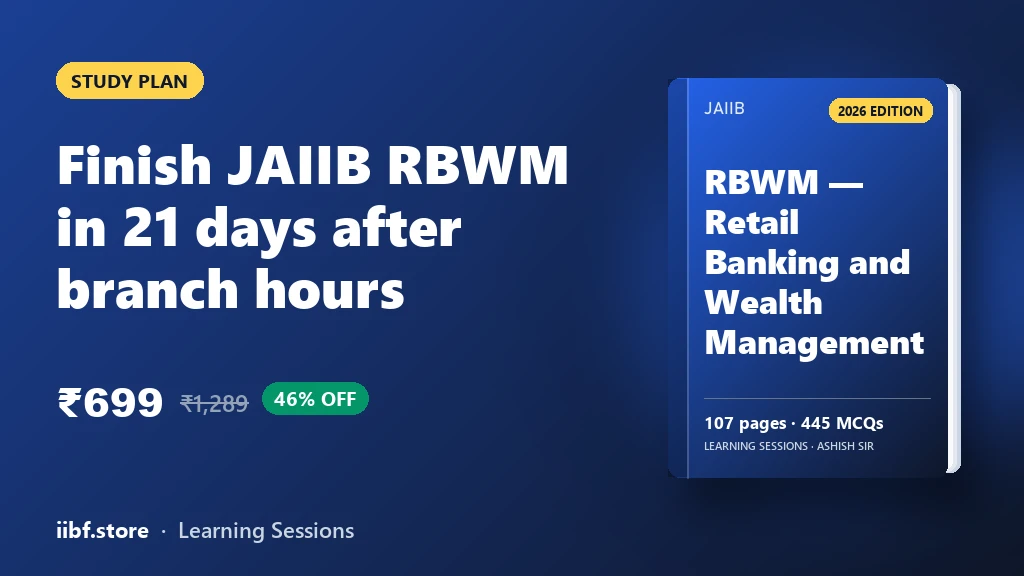
107 pages · 445 MCQs
Learning Sessions · Ashish Sir
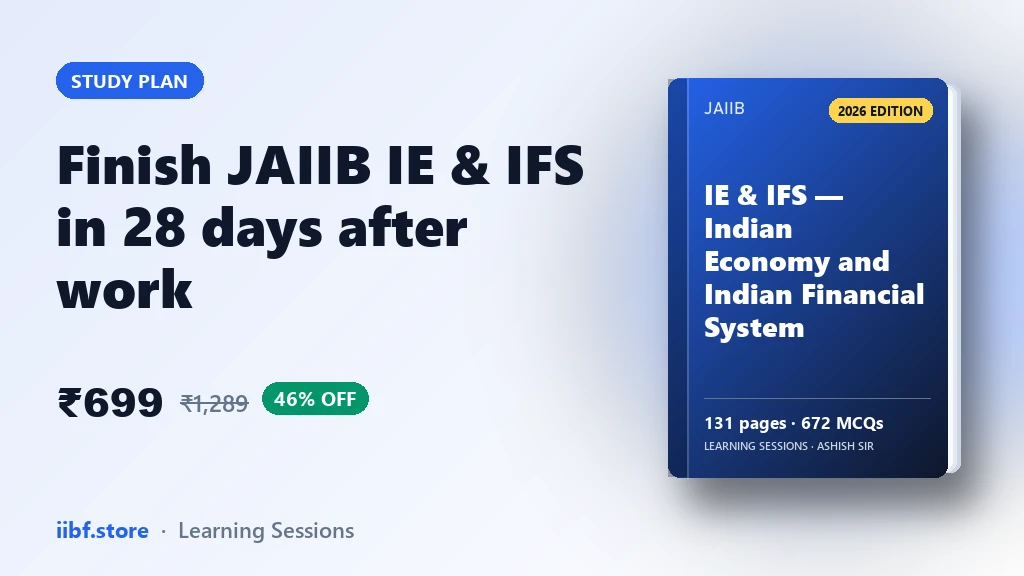
131 pages · 672 MCQs
Learning Sessions · Ashish Sir
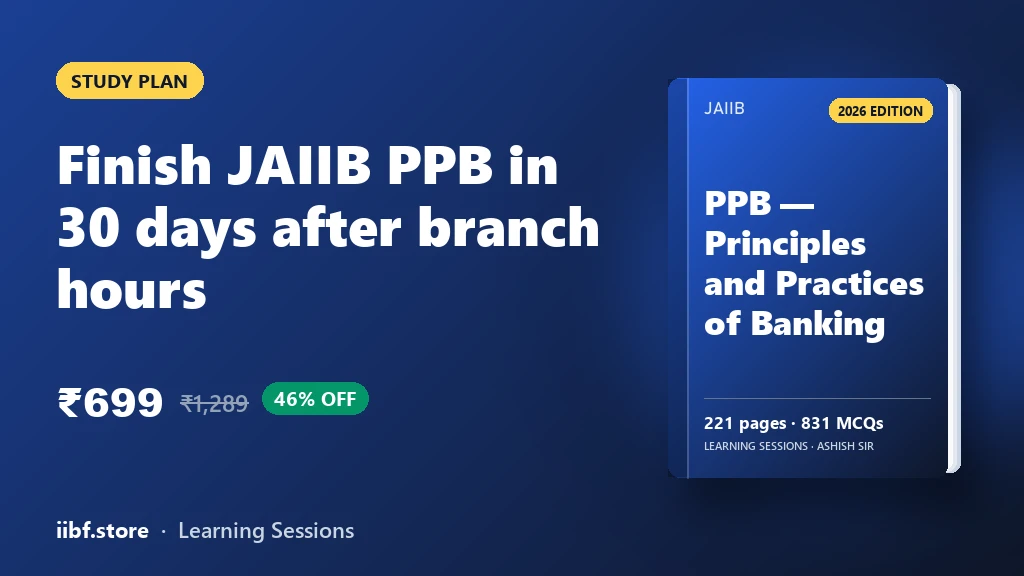
221 pages · 831 MCQs
Learning Sessions · Ashish Sir
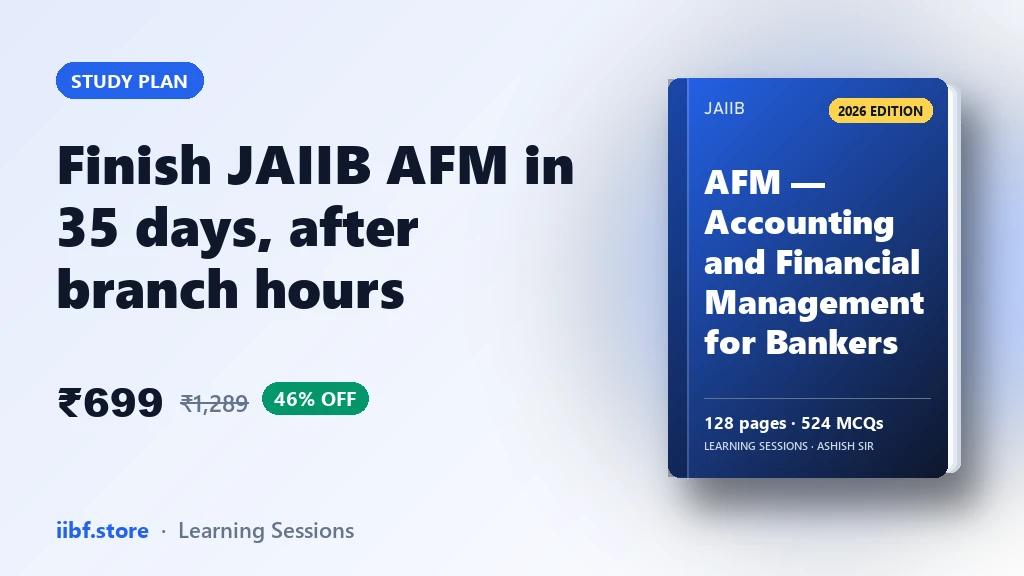
128 pages · 524 MCQs
Learning Sessions · Ashish Sir
148 pages · 478 MCQs
Learning Sessions · Ashish Sir
151 pages · 465 MCQs
Learning Sessions · Ashish Sir
148 pages · 375 MCQs
Learning Sessions · Ashish Sir
216 pages · 895 MCQs
Learning Sessions · Ashish Sir
109 pages · 300 MCQs
Learning Sessions · Ashish Sir
104 pages · 360 MCQs
Learning Sessions · Ashish Sir
82 pages · 297 MCQs
Learning Sessions · Ashish Sir
151 pages · 600 MCQs
Learning Sessions · Ashish Sir
98 pages · 282 MCQs
Learning Sessions · Ashish Sir
132 pages · 225 MCQs
Learning Sessions · Ashish Sir
188 pages · 435 MCQs
Learning Sessions · Ashish Sir
117 pages · 236 MCQs
Learning Sessions · Ashish Sir
Learning Sessions · Ashish Sir
118 pages · 299 MCQs
Learning Sessions · Ashish Sir
Learning Sessions · Ashish Sir
Learning Sessions · Ashish Sir
Learning Sessions · Ashish Sir
115 pages · 255 MCQs
Learning Sessions · Ashish Sir
Learning Sessions · Ashish Sir
334 pages · 936 MCQs
Learning Sessions · Ashish Sir
Learning Sessions · Ashish Sir
115 pages · 344 MCQs
Learning Sessions · Ashish Sir
107 pages · 240 MCQs
Learning Sessions · Ashish Sir
90 pages · 150 MCQs
Learning Sessions · Ashish Sir
Learning Sessions · Ashish Sir
Quick quiz on this topic
5 exam-style questions from our free test bank — check yourself before you move on.
Practice this topic
Take a free mock test, download chapter PDFs, or watch a video class — all included on iibf.store.