Homebuyers and Allottees Under IBC: Financial Creditor Status and Thresholds

For decades, a home buyer who paid a builder in advance and then watched the project stall had almost no seat at the insolvency table. That changed sharply once homebuyers and allottees under IBC were brought within the definition of financial creditors. For CAIIB candidates and practising bankers who deal with real estate exposures, this is one of the most litigated and most examined corners of the Insolvency and Bankruptcy Code, 2016. This article walks through the Section 5(8)(f) explanation, the 100-allottee or 10 per cent filing threshold, the authorised representative mechanism in the Committee of Creditors, the RERA interface, and how allottees are actually treated inside a resolution plan.
🏠 Why Homebuyers Count as Financial Creditors: Section 5(8)(f)
Section 5(8) of the Code defines "financial debt" as a debt disbursed against consideration for the time value of money. Clause (f) of that definition covers any amount raised under a transaction having the commercial effect of a borrowing. Originally, this clause was aimed at instruments like forward sale-purchase arrangements, not at instalments paid to a builder for a flat.
The Insolvency and Bankruptcy Code (Amendment) Act, 2018 inserted an Explanation to Section 5(8)(f). It deems any amount raised from an allottee under a real estate project to have the commercial effect of a borrowing, and it borrows the definitions of "allottee" and "real estate project" directly from the Real Estate (Regulation and Development) Act, 2016. In effect, home buyers' instalment payments were reclassified as financial debt, and every allottee became a financial creditor of the developer, at par in principle with a bank that had lent money to the same project.
The Supreme Court tested this reclassification in Pioneer Urban Land and Infrastructure Ltd. v. Union of India and upheld its constitutional validity, rejecting the argument that homebuyers should remain confined to operational-creditor status or to remedies under consumer and real estate law alone. For exam purposes, remember that the explanation is clarificatory and retrospective in effect, and that it does not create a new debt — it only reclassifies an existing payment obligation for insolvency purposes.
💡 Exam Tip: If a question asks which amendment brought homebuyers into the financial creditor fold, the answer is the Explanation to Section 5(8)(f), inserted by the 2018 Amendment Act — not Section 7 and not Section 21.
📊 The 100-Allottee or 10 Per Cent Filing Threshold
Reclassifying homebuyers as financial creditors created an unintended risk: a single dissatisfied allottee could trigger a full corporate insolvency resolution process against a developer, even where the vast majority of buyers wanted the project completed, not liquidated. Parliament responded through the Insolvency and Bankruptcy Code (Amendment) Act, 2020, which added a proviso to Section 7(1).
Under this proviso, an application under Section 7 by financial creditors who are allottees under a real estate project — or by financial creditors representing any class of creditors under Section 21(6A) — cannot be filed by one person acting alone. It must be filed jointly by not less than 100 such creditors in the same class, or not less than 10 per cent of the total number of creditors in that class, whichever is lower. The threshold is applied project-wise, not developer-wise: where a builder has several separately registered projects, the count of allottees is taken project by project, not pooled across the company's entire portfolio.
The Supreme Court examined this threshold in Manish Kumar v. Union of India and upheld it as a reasonable, proportionate filter rather than a denial of remedy, while also reading in some procedural flexibility for pending cases. Anyone drafting or checking a Section 7 application on behalf of allottees should first pin down the correct RERA-registered project and count the allottee base for that project alone.
| Aspect | Under IBC (as Financial Creditor) | Under RERA |
|---|---|---|
| Can a single homebuyer act alone? | ❌ No — needs 100 or 10% of allottees, project-wise | ✅ Yes — individual complaint permitted |
| Forum | NCLT under Section 7 | State RERA Authority / Appellate Tribunal |
| Primary relief | CIRP, resolution or liquidation of the developer | Refund with interest, compensation, possession order |
| Effect once CIRP is admitted | Moratorium under Section 14 applies | ❌ Fresh/pending proceedings against corporate debtor stayed |
| Voice in creditor decisions | ✅ Voting via authorised representative in CoC | No CoC-equivalent mechanism |
🗳️ Authorised Representative and Voting in the Committee of Creditors
A committee of creditors with hundreds or thousands of individual homebuyers is unworkable in practice, so the Code channels the class through a single authorised representative rather than seating every allottee at the table. Section 21(6A), also inserted in 2018, requires the interim resolution professional to identify an insolvency professional to act as the authorised representative for financial creditors in a class — which, for real estate projects, means the allottees of that project.
The authorised representative attends and votes in CoC meetings on behalf of the entire class. Before major decisions, the representative is expected to seek and factor in the views of the allottees, and casts the class vote in accordance with the decision taken by a majority of the creditors in that class who actually participate, weighted by their respective voting share. This means an individual allottee does not cast a personal vote inside the CoC; influence is exercised through the class mechanism.
Two related chapters are worth revising alongside this topic. The mechanics of how a resolution professional is appointed and how the process is set in motion are covered in Initiation of Corporate Insolvency Resolution Process (CIRP), while the procedural sequence that follows admission is detailed in Commencement of CIRP. For a deeper look at how the committee itself is formed and how it votes more generally, see this article on committee of creditors under IBC.
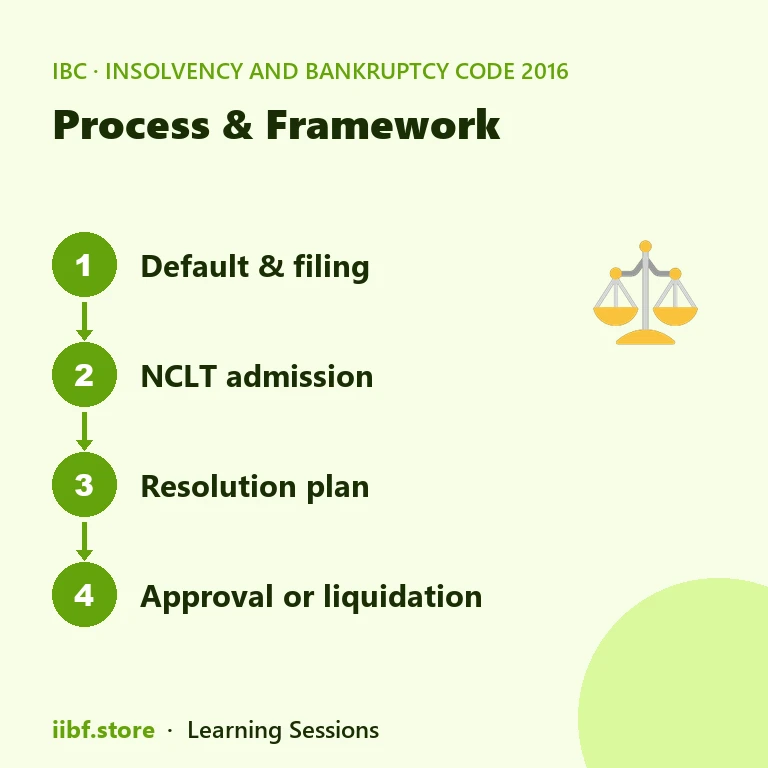
⚠️ Common Mistake: Candidates often flip the threshold rule and say "10 per cent or 100, whichever is greater." It is whichever is less — a smaller, more accessible number, designed to make joint filing realistic without opening the door to single-allottee triggers.
⚖️ RERA and IBC: Which Forum Applies
The Real Estate (Regulation and Development) Act, 2016 and the Insolvency and Bankruptcy Code operate as parallel, not mutually exclusive, remedies. RERA disclosure and registration requirements, along with compensation and refund orders, remain available to an aggrieved allottee at any point. Section 88 of RERA clarifies that its provisions are in addition to, and not in derogation of, other laws currently in force, while Section 238 of the IBC gives the Code overriding effect over anything inconsistent in other statutes for matters within its own domain.
The Supreme Court in Pioneer Urban Land read the two statutes harmoniously: a homebuyer can pursue a RERA complaint, or trigger the IBC route once the joint threshold under Section 7(1) is met, or pursue both simultaneously in principle, but cannot obtain double recovery for the same default. The practical friction point arises after CIRP is admitted. Once the moratorium under Section 14 kicks in, no new suit or proceeding can be instituted, and pending proceedings against the corporate debtor — including RERA actions — stand suspended for the moratorium period, because the corporate debtor's assets and management are now under the control of the interim resolution professional or resolution professional.
For bankers assessing exposure to real estate developers, this interface matters directly: a builder facing scattered RERA orders is not automatically insolvent, but a joint Section 7 filing by 100 or 10 per cent of a project's allottees is a much sharper insolvency-risk signal than an individual RERA complaint. Background on how the Code itself evolved to reach this point is covered in Evolution of Insolvency and Bankruptcy Code, and the broader legal toolkit available to lenders is set out in Credit Recovery Laws for Banks.
📋 Homebuyers Inside the Resolution Plan
Once CIRP is admitted for a real estate developer, the resolution plan submitted under Section 30 must set out how allottees will be treated, alongside secured lenders, unsecured financial creditors and operational creditors. Because allottees are financial creditors, any resolution plan is bound by the minimum payout protections available to that class, tested against what they would receive in a liquidation under the Section 53 waterfall.
In practice, plans for real estate developers typically offer allottees a choice among structured possession of the completed unit, a refund with agreed interest, or an alternative unit, subject to what the resolution applicant is actually proposing to fund. Where a developer runs multiple registered projects, the resolution framework has increasingly allowed project-wise or phase-wise resolution, so that a completed or nearly complete project is not held hostage to the failure of an unrelated project by the same corporate debtor. The authorised representative's vote, cast on behalf of the allottee class, is what ultimately binds individual homebuyers to the approved plan, including any dissenting allottee, subject to the statutory minimum entitlement.
This is a heavily tested overlap area for CAIIB IBC candidates, so it helps to also revise how the process concludes if resolution fails. See Failure of CIRP or Business: Liquidation and Voluntary Liquidation and the role played by the resolution professional throughout in Roles and Duties of IRP and RP. Bankers who also handle promissory notes and cheque-based recovery instruments alongside real estate exposure should cross-reference negotiable instruments act provisions for bankers for the parallel recovery toolkit outside insolvency.
📌 Remember: Homebuyers vote as a class through their authorised representative, and their protection in a resolution plan is measured against the Section 53 liquidation waterfall, not against the full original sale price of the flat.
✅ Key Takeaways for Your IBC Preparation
Three ideas anchor this topic for the exam. First, the Explanation to Section 5(8)(f), inserted in 2018, is what makes an allottee's instalment payment a financial debt, giving homebuyers standing as financial creditors. Second, the Section 7(1) proviso caps who can actually approach NCLT: not less than 100 allottees, or 10 per cent of the allottees in the same real estate project, whichever is less. Third, once inside the process, allottees do not vote individually — an authorised representative under Section 21(6A) speaks and votes for the class in the Committee of Creditors, and the moratorium under Section 14 suspends parallel RERA action against the corporate debtor.
Keep the official regulator's material handy while revising — the Insolvency and Bankruptcy Board of India publishes the Code, regulations and updates at ibbi.gov.in. For a wider map of the statute before drilling into allottee-specific provisions, revisit Chapter 4 - Structure of the IBC and the broader reading list under the Insolvency and Bankruptcy Code 2016 tag. If you want to test yourself on IBBI's role as regulator across the whole process, this companion piece on IBBI as insolvency regulator is a useful next read, and once claims are admitted the process moves into the stage covered by claims verification under IBC.
Ready to lock in these thresholds and provisions before exam day? Practise chapter-wise questions on the full IBC syllabus through the CAIIB course on iibf.store.
🧠 Practice MCQs: Homebuyers and Allottees Under IBC
Q1. Which section of the IBC, along with its Explanation, brought amounts raised from homebuyers within the definition of financial debt? (a) Section 3(11) (b) Section 5(8)(f) (c) Section 7(1) (d) Section 21(1)
Answer: (b) — The Explanation to Section 5(8)(f), inserted by the 2018 Amendment Act, deems amounts raised from allottees to have the commercial effect of a borrowing.
Q2. Under the proviso to Section 7(1), a CIRP application by allottees of a real estate project must be filed jointly by: (a) At least 50 allottees only (b) All allottees of the project (c) Not less than 100 allottees or 10 per cent of the total allottees in the same project, whichever is less (d) Not less than 10 per cent of allottees only, irrespective of numbers
Answer: (c) — The threshold is the lower of 100 allottees or 10 per cent of the total allottees of that same real estate project.
Q3. Who represents homebuyers as a class of financial creditors in the Committee of Creditors? (a) The resolution professional directly (b) An authorised representative appointed under Section 21(6A) (c) The RERA authority (d) Each homebuyer individually with full voting rights
Answer: (b) — Section 21(6A) requires an insolvency professional to be identified as authorised representative to vote on behalf of the allottee class.
Q4. Which Supreme Court judgment upheld the constitutional validity of treating homebuyers as financial creditors under IBC? (a) Swiss Ribbons v. Union of India (b) Pioneer Urban Land and Infrastructure Ltd. v. Union of India (c) Essar Steel case (d) Innoventive Industries case
Answer: (b) — Pioneer Urban Land and Infrastructure Ltd. v. Union of India upheld the 2018 amendment reclassifying allottee payments as financial debt.
Q5. Once CIRP is admitted against a real estate developer, what happens to pending RERA proceedings against that corporate debtor? (a) They continue unaffected (b) They are transferred to NCLT automatically (c) They get stayed as a result of the moratorium under Section 14 (d) They are dismissed permanently
Answer: (c) — The Section 14 moratorium suspends fresh and pending proceedings, including RERA actions, against the corporate debtor during CIRP.
Want chapter-wise mock tests with 100+ MCQs? Start practising free →
Are homebuyers financial creditors or operational creditors under IBC?
Financial creditors. The Explanation to Section 5(8)(f) deems amounts raised from allottees under a real estate project to have the commercial effect of a borrowing, placing homebuyers in the financial creditor class.
Can a single homebuyer file a CIRP application against a builder?
No. The proviso to Section 7(1) requires a joint application by not less than 100 allottees or 10 per cent of the total allottees of the same real estate project, whichever is less.
Does filing under IBC stop a homebuyer from also going to RERA?
A homebuyer can pursue either remedy, and RERA and IBC operate as parallel laws. However, once CIRP is admitted, the Section 14 moratorium stays fresh and pending proceedings, including RERA actions, against the corporate debtor.
How do homebuyers vote in the Committee of Creditors?
Through an authorised representative appointed under Section 21(6A), who casts the class vote based on the decision of the majority of allottees who participate, weighted by their aggregate voting share.
Prefer revising from a printed book?
Chapter-wise books with MCQs after every chapter — minimal pages, complete coverage, delivered anywhere in India. Every book has a free sample to read first.





































Quick quiz on this topic
5 exam-style questions from our free test bank — check yourself before you move on.
Practice this topic
Take a free mock test, download chapter PDFs, or watch a video class — all included on iibf.store.