RBI SPARC Supervisory Framework for Bank Compliance Officers
Every bank compliance officer preparing for the IIBF BCP exam needs a working grasp of the RBI SPARC supervisory framework — the system that now drives how the Reserve Bank rates, monitors and escalates risk at every regulated entity. SPARC (Supervisory Program for Assessment of Risk and Capital) replaced the older CAMELS-style, point-in-time inspection with continuous, data-driven risk-based supervision (RBS). For compliance teams this is not an abstract regulatory concept — it decides how much scrutiny a bank gets, how fast supervisory findings escalate, and where Prompt Corrective Action (PCA) thresholds get triggered. This article walks through what SPARC covers, how the compliance function feeds it, and what to remember for the exam.
🏛️ What the RBI SPARC Supervisory Framework Actually Is
SPARC is the IT-enabled platform through which the Reserve Bank operationalises its Risk-Based Supervision (RBS) approach. Rather than waiting for an annual on-site inspection to assess a bank's health, RBI now builds a running risk profile for each supervised entity using data submitted through the SPARC portal, market intelligence, and continuous supervisory dialogue.
The shift changes the unit of assessment. CAMELS-style ratings were largely a snapshot of capital adequacy, asset quality, earnings and liquidity as on the inspection date. SPARC-driven RBS instead asks a forward-looking question: where is the bank's risk profile heading, and how effective is its own risk management at controlling that trajectory.
For compliance officers, this reframes the job. It is no longer enough to be inspection-ready once a year; the bank's data feeds, governance records and control evidence have to stand up to scrutiny continuously, because that is exactly how SPARC is designed to work.
💡 Exam Tip: If a question asks what SPARC stands for, remember it precisely — Supervisory Program for Assessment of Risk and Capital. Distractors often swap in "Prudential" or "Statutory" to trip you up.
🔍 The Building Blocks of Risk-Based Supervision
Risk-based supervision under SPARC rests on assessing two connected things: the bank's inherent business risk, and the quality of its own risk management response to that risk. Inherent risk is evaluated across major business lines and activities — credit, market, operational, liquidity, and increasingly IT and cyber risk — rather than as one blended number.
Alongside inherent risk sits an assessment of governance and control quality — board oversight, independence of the risk function, and how fast management closes gaps once identified. A bank with high inherent risk in its credit book can still get a moderate outcome if that response is genuinely strong.
These two dimensions are combined into a Composite Risk Score, which becomes the anchor for how intensively RBI supervises that entity going forward — more frequent reviews, deeper thematic reviews, or a lighter-touch cycle. Compliance teams reviewing exposure concentration under the bank's large exposures and exposure norms framework are, in effect, feeding one of the inherent-risk inputs SPARC ultimately draws on.
📋 How the Compliance Function Feeds SPARC
SPARC runs on data, and most of that data originates from returns and disclosures the compliance function is directly responsible for coordinating. Offsite returns, asset quality classifications, exposure statements and governance disclosures all flow through the SPARC portal, and errors or delays in any of them distort the risk picture RBI is building.
This is where compliance work on asset classification becomes supervisory input rather than a back-office exercise. Accurate, timely reporting under the bank's IRAC norms and wilful defaulters processes directly shapes the credit-risk component of the Composite Risk Score. A slippage that is reported late, or a wilful-defaulter classification that is delayed, does not just create an internal audit finding — it means SPARC was working off stale data.
The same logic applies to lending compliance. Restrictions tracked under loans and advances regulatory restrictions — director-related lending, sectoral caps, unsecured exposure limits — are exactly the kind of granular checks that show up as inherent-risk flags when they fail. A well-run compliance function treats these returns with statutory-audit-level discipline, because that is effectively what they have become.
⚠️ Common Mistake: Treating SPARC-linked returns as a routine MIS exercise owned by operations. Compliance must own the accuracy sign-off, because RBI reads these submissions as the bank's own assessment of its risk position.
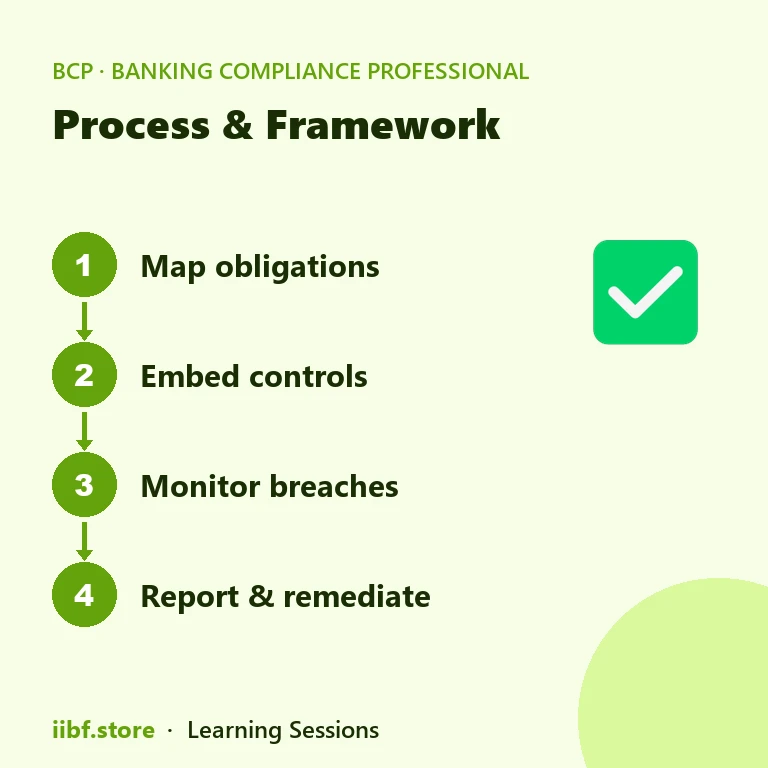
⚖️ From Composite Risk Score to SREP and PCA
The Composite Risk Score generated through SPARC feeds directly into the Supervisory Review and Evaluation Process (SREP) — RBI's structured annual dialogue with each bank's management on capital adequacy, risk trajectory and governance. SREP outcomes are not cosmetic; they shape supervisory expectations on capital buffers, business restrictions, and the intensity of the next inspection cycle.
Where SREP findings point to persistent or worsening risk gaps, RBI typically requires the bank to submit a Risk Mitigation Plan or a Monitorable Action Plan (MAP) setting out specific, time-bound remedial commitments. Compliance functions are usually the custodians of MAP tracking, because missed MAP commitments carry real escalation consequences.
At the far end of that escalation ladder sits Prompt Corrective Action, triggered by breaches of specific capital, asset quality and profitability thresholds rather than the Composite Risk Score directly — but a deteriorating SPARC profile is usually the early warning of drift toward those PCA triggers. Coordinating with teams managing the bank's guarantees, acceptances and finance to NBFCs exposures keeps compliance close to the credit-risk inputs that move that score.

🧭 Where Compliance Teams Typically Get This Wrong
The most common gap is structural rather than technical: compliance teams that own KYC, advertising and product-approval controls well, but treat SPARC-linked offsite reporting as someone else's job. Since SPARC is the primary lens through which RBI now views the bank, that gap leaves compliance blind to how its own control failures are actually being scored.
A second gap is timing discipline. SPARC rewards continuous, accurate data far more than a single well-prepared annual inspection file. Banks that still operate on an "inspection season" mindset — cleaning up records once a year — routinely find their in-year Composite Risk Score tells a less flattering story than their annual audit did.
A third gap is coordination. RBS assessment quality depends on how well the three lines of defence in bank compliance operate together — if compliance and internal audit are not sharing findings in real time, RBI's own risk assessment will surface gaps the bank should have caught first. Building SPARC-readiness into the bank's annual compliance programme calendar, rather than treating it as separate, is what examiners expect of a mature compliance function.
📌 Remember: SPARC scores the bank on data compliance itself is responsible for supplying. Weak compliance data quality does not just fail an internal control test — it directly worsens the bank's supervisory risk rating.
📊 SPARC-Based Supervision vs the Legacy CAMELS Approach
The table below summarises the practical differences bank compliance officers should carry into the exam and into their day job. Financial-statement accuracy also matters here — inputs drawn from a bank's consolidated financial statements of banks feed directly into the earnings and capital dimensions of the risk score, which is why compliance and financial reporting teams increasingly need to coordinate on SPARC submissions rather than working in silos.
| Aspect | Legacy CAMELS-Style Supervision | RBS / SPARC Framework |
|---|---|---|
| Assessment basis | Point-in-time financial ratios | Forward-looking inherent risk + control quality |
| Continuous monitoring | ❌ Periodic, inspection-cycle only | ✅ Ongoing via SPARC portal submissions |
| Data submission | Largely manual, inspection-specific | System-driven, recurring offsite returns |
| Supervisory outcome | CAMELS composite rating | Composite Risk Score feeding SREP |
| Escalation trigger | Inspection report findings | Risk Mitigation Plan / MAP / PCA thresholds |
For the latest supervisory circulars that can shift these thresholds, track RBI's published guidance through iibf.store's regulatory news updates rather than relying on secondary summaries. Exam questions on SPARC tend to test the full form, how it differs from CAMELS-era supervision, and where compliance's own work — asset classification, exposure reporting, governance disclosures — feeds into it. Map it against chapters you already know rather than treating it as a standalone topic. Primary-source reading helps most: RBI's own published material on risk-based supervision and the SPARC framework is the authoritative reference examiners draw from.
🧠 Practice MCQs: RBI SPARC Supervisory Framework
Q1. What does SPARC stand for in RBI's supervisory framework? (a) System for Prudential Analysis and Risk Control (b) Supervisory Program for Assessment of Risk and Capital (c) Statutory Process for Audit and Risk Compliance (d) Structured Programme for Annual Risk Certification
Answer: (b) — SPARC is RBI's Supervisory Program for Assessment of Risk and Capital, the IT platform underpinning risk-based supervision.
Q2. RBI's risk-based supervision (RBS) approach primarily replaced which earlier supervisory model? (a) Basel III capital framework (b) CAMELS-based point-in-time inspection (c) SARFAESI recovery mechanism (d) Prompt Corrective Action framework
Answer: (b) — RBS moved supervision from periodic CAMELS-style ratings to continuous, forward-looking risk profiling; PCA is a separate, outcome-linked escalation framework, not what RBS replaced.
Q3. Under RBS, which output directly feeds into a bank's Supervisory Review and Evaluation Process (SREP)? (a) Composite Risk Score (b) Statutory Liquidity Ratio (c) Priority sector shortfall (d) Base Rate
Answer: (a) — The Composite Risk Score generated through SPARC is the core input that shapes the SREP dialogue between RBI and bank management.
Q4. When a supervisory review flags persistent risk gaps, the bank is typically required to submit which document to the regulator? (a) Board-approved KYC policy (b) Monitorable Action Plan (MAP) (c) Related Party Transaction disclosure (d) CSR expenditure report
Answer: (b) — A Monitorable Action Plan sets out time-bound remedial commitments that RBI tracks for closure.
Q5. Within the compliance function, which activity is MOST directly linked to supporting an accurate SPARC risk assessment? (a) Approving retail loan sanctions (b) Timely and accurate submission of risk-linked offsite returns (c) Negotiating vendor outsourcing contracts (d) Drafting advertising content for new products
Answer: (b) — SPARC's risk scoring is only as good as the offsite data compliance is responsible for submitting accurately and on time.
Want chapter-wise mock tests with 100+ MCQs? Start practising free →
What is the difference between RBS and SPARC?
RBS (Risk-Based Supervision) is RBI's overall supervisory approach; SPARC is the IT-enabled platform through which that approach is executed — data collection, risk scoring and supervisory workflow all run through it.
Does SPARC apply to all banks or only certain categories?
RBI extended risk-based supervision to commercial banks and progressively to other regulated entities as the framework matured, so most compliance officers across bank types now work with some version of it.
How often is a bank's risk profile updated under SPARC?
Unlike the older annual-inspection cycle, SPARC is built for continuous supervisory engagement — offsite returns and risk indicators are assessed through the year rather than at a single point in time.
What happens if a bank's Composite Risk Score deteriorates sharply?
A sharply deteriorating score typically triggers closer supervisory scrutiny, a Risk Mitigation Plan or Monitorable Action Plan, and in serious cases can push the bank toward Prompt Corrective Action thresholds.
The RBI SPARC supervisory framework is now the lens through which every compliance decision a bank makes eventually gets scored. Getting comfortable with how it links to exposure norms, asset classification and escalation paths pays off both in the exam hall and on the job. For more exam-focused reading, browse the full set of Banking Compliance Professional articles, then put your understanding to the test with a timed mock on iibf.store/tests.
Practice this topic
Take a free mock test, download chapter PDFs, or watch a video class — all included on iibf.store.
Keep reading