Investment Fluctuation Reserve in Banks: TIRM 2026 Guide
Every bank that runs an investment book carries a quiet risk: bond prices move, yields swing, and mark-to-market losses can hit profits overnight. The Investment Fluctuation Reserve is the cushion RBI mandates banks to build precisely for this scenario, and it is one of the most exam-relevant, real-world topics in Treasury Investment and Risk Management (TIRM). If you are preparing for the TIRM exam, understanding how the Investment Fluctuation Reserve is built, maintained, and used is essential — not just for the paper, but for reading any bank's annual report with real understanding.
This guide breaks down the concept end to end: what the reserve is for, how banks compute the required transfer each year, how it differs from provisioning for depreciation in investments, and where it sits in the regulatory capital structure. We will also connect it to the broader Financial Markets and Risk Analysis and Control chapters so the concept fits into the bigger TIRM picture.
🛡️ What Is the Investment Fluctuation Reserve and Why It Matters
The Investment Fluctuation Reserve (IFR) is a reserve carved out of a bank's profits specifically to absorb the impact of adverse price movements in its investment portfolio — mainly the Available for Sale (AFS) and Held for Trading (HFT) categories, which are marked to market and therefore exposed to interest rate and credit spread swings. Unlike a general reserve that supports overall solvency, the IFR has a narrow, purpose-built job: when bond yields rise and the market value of the AFS/HFT book falls, the bank has a buffer to draw on instead of the fall hitting reported profits or capital in one shock.
RBI introduced the IFR requirement because banks in India historically carried very large government security (G-Sec) holdings, and a sharp yield spike could otherwise wipe out a year's earnings. By requiring banks to systematically set aside a slice of trading and investment gains into the IFR, the regulator smooths out the cyclicality of treasury income and forces prudent behaviour during good years so the bank is not caught exposed during bad ones.
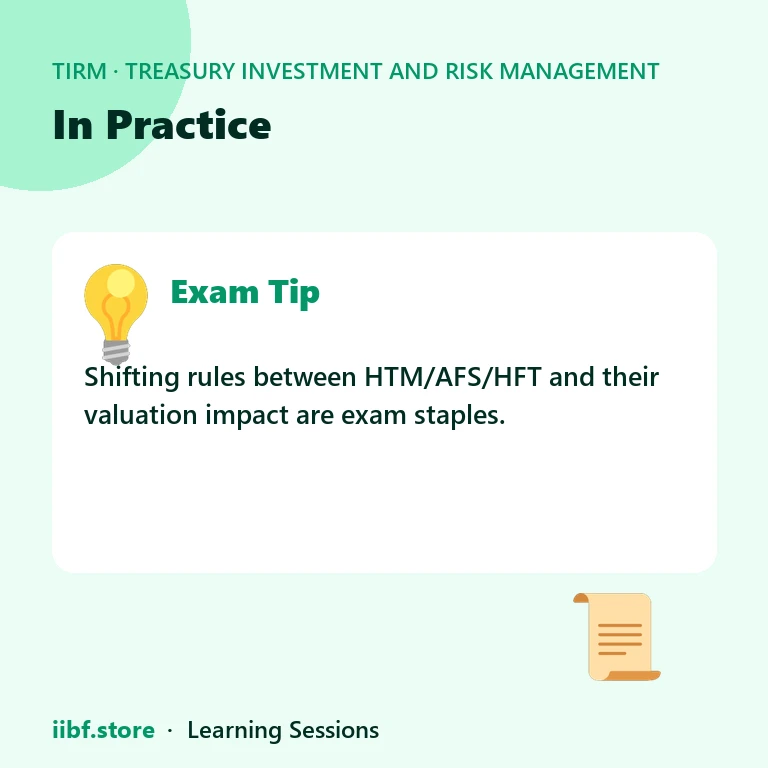
💡 Exam Tip: If a question asks "why does RBI mandate the IFR," the answer is countercyclical buffering of interest-rate risk in the AFS/HFT book — not general capital adequacy.
Banks typically build the IFR from realised gains — profit on sale of investments — rather than from ordinary lending income, which keeps the reserve tied to the very activity that creates the risk it is meant to cover. This is a favourite examiner angle: source of funding for the reserve versus purpose of the reserve.
📐 How Banks Compute and Maintain the Reserve
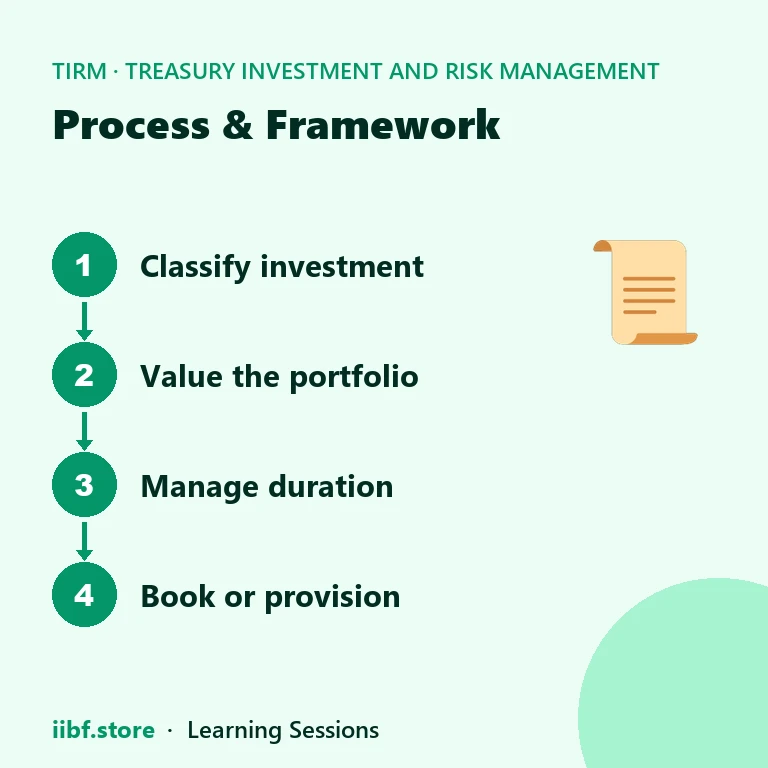
Under RBI's framework, banks are required to build up the Investment Fluctuation Reserve to a prescribed minimum level, expressed as a percentage of the HFT and AFS portfolio, over a defined glide path rather than in one lump sum. Each year, the bank transfers an amount — commonly drawn first from net profit on sale of investments, and if that is insufficient, topped up from the profit and loss account — until the cumulative reserve reaches the target percentage of the applicable investment book.
Once the target level is reached, banks are not required to keep adding indefinitely; the reserve is maintained at or above the floor, and any further gains on investment sales can flow through normal profit appropriation. If, in a particular year, the reserve level slips below the required minimum (for instance after a drawdown to absorb losses), the bank must resume transfers until the floor is restored. This mechanic — build, maintain, draw down when needed, rebuild — is the operational heart of the topic and shows up repeatedly in TIRM numericals.
⚠️ Common Mistake: Students often assume the IFR is computed on the entire investment portfolio including HTM. It is not — HTM securities are held at amortised cost and are excluded from the IFR base since they are not marked to market in the same way.
The Front, Mid and Back Office Operations chapter covers exactly how these transfers are recorded and reconciled between the front office (which books the profit on sale) and the back office (which passes the accounting entries into the reserve), so it is worth revisiting alongside this topic.
⚖️ Investment Fluctuation Reserve vs Provision for Depreciation
A frequent point of confusion in TIRM prep is distinguishing the Investment Fluctuation Reserve from the Provision for Depreciation on Investments. Both relate to falling bond values, but they operate differently. Provision for depreciation is a category-wise, scrip-wise (or classification-wise) charge made when the net value of a category — say, the AFS book — shows a net depreciation at the balance sheet date; it is a direct hit that must be provided for through the P&L in that period, and it is not optional or discretionary.
The Investment Fluctuation Reserve, by contrast, is a forward-looking, self-built cushion accumulated over time out of realised gains, designed precisely so the bank has something to fall back on when a provisioning requirement like the one above actually materialises. Put simply: provisioning is the recognition of an actual loss; the IFR is the pre-funded shock absorber built in anticipation of such losses. Examiners like to test whether students can tell "recognise now" (provisioning) apart from "save for later" (IFR).
📌 Remember: Provision for depreciation reduces profit when losses occur; the Investment Fluctuation Reserve is built during profitable years precisely so future losses don't have to hit profit as hard.
Both concepts sit under the broader compliance umbrella covered in the Regulations, Supervision and Compliance chapter, which frames how RBI supervises banks' investment-related capital buffers as a package rather than in isolation.
📋 Regulatory Placement and Capital Treatment
Where the Investment Fluctuation Reserve sits in a bank's capital structure is another high-yield exam area. Because it is a general reserve built out of appropriated profits and is freely available to absorb unexpected losses, the IFR qualifies for inclusion in Tier II capital under the Basel III capital adequacy framework that Indian banks follow, subject to the overall ceiling applicable to that class of reserves. This gives banks a double benefit: it directly funds losses on the investment book, and it simultaneously strengthens the regulatory capital ratio.
Disclosure is equally important. Banks are required to disclose the balance in the Investment Fluctuation Reserve, and the movements during the year, in the notes to accounts of their published financial statements, so that analysts, auditors and regulators can track whether a bank is keeping pace with the prescribed minimum. A bank that consistently falls short of the required IFR level, or repeatedly draws it down without rebuilding, is a signal supervisors watch closely — precisely the kind of judgment RBI applies during its supervisory review of bank investment portfolios.
For treasury professionals, the practical takeaway is that IFR management is not a once-a-year accounting exercise — it feeds into ALM planning, capital planning, and how aggressively the front office can be allowed to trade the AFS/HFT book in a given year.
💹 IFR, G-Sec Yields, and the Trading Desk
The size and health of the Investment Fluctuation Reserve directly shapes how a bank's treasury desk behaves in the market. A well-funded IFR gives the front office more headroom to actively trade G-Secs and take positions in the HFT book, since any adverse mark-to-market swing has a buffer to absorb it. A thin or depleted IFR, on the other hand, tends to make banks more conservative, shifting incremental purchases toward HTM or trimming HFT positions to reduce the earnings volatility that a rate spike could cause.
This is also where the reserve connects to the primary market: banks that buy heavily at G-Sec auctions for their AFS/HFT books are taking on exactly the price risk the IFR exists to cushion, so treasury desks track live yields — often against RBI's published policy rates — before deciding how much fresh duration to add to a book that already carries a fluctuation-reserve constraint.
🧠 Practice MCQs: Investment Fluctuation Reserve
Q1. As per RBI's investment portfolio norms, banks are required to build up the Investment Fluctuation Reserve to a minimum level expressed as what percentage of the HFT and AFS portfolio? (a) 1% (b) 2% (c) 4% (d) 6%
Answer: (b) — RBI's framework prescribes a minimum IFR of 2% of the HFT and AFS portfolio, to be built up gradually over a defined glide path.
Q2. The Investment Fluctuation Reserve is primarily meant to absorb fluctuation risk in which investment categories? (a) HTM only (b) AFS and HFT (c) HTM and AFS (d) All of HTM, AFS and HFT equally
Answer: (b) — HTM securities are held at amortised cost and generally excluded, so the reserve is built against the marked-to-market AFS and HFT categories.
Q3. How is a transfer to the Investment Fluctuation Reserve typically funded in the first instance? (a) From the capital reserve directly (b) From net profit on sale of investments (c) From the general provisions account (d) From customer deposit income
Answer: (b) — Banks fund IFR transfers primarily out of realised profit on sale of investments, topping up from the P&L if that profit is insufficient.
Q4. How does the Investment Fluctuation Reserve differ from a Provision for Depreciation on investments? (a) They are identical accounting entries (b) IFR recognises actual losses; provisioning is a pre-funded cushion (c) IFR is a pre-funded cushion built from gains; provisioning recognises actual net depreciation (d) Provisioning applies only to HTM securities
Answer: (c) — IFR is built proactively from realised gains; provisioning for depreciation is a reactive charge recognising an actual fall in a category's net value.
Q5. Under Basel III capital adequacy norms as applied by RBI, the Investment Fluctuation Reserve typically qualifies for inclusion in which component of regulatory capital? (a) Common Equity Tier 1 (b) Additional Tier 1 (c) Tier 2 capital (d) It is excluded from regulatory capital entirely
Answer: (c) — Being a general reserve built from appropriated profits, the IFR qualifies for Tier 2 capital, subject to the prescribed ceiling for such reserves.
Want chapter-wise mock tests with 100+ MCQs? Start practising free →
| Investment Category | Marked to Market? | IFR Applicable | Provision for Depreciation |
|---|---|---|---|
| HTM | ❌ No (amortised cost) | ❌ Not applicable | ✅ Only if diminution is other than temporary |
| AFS | ✅ Yes (periodic) | ✅ Required | ✅ On net category depreciation |
| HFT | ✅ Yes (frequent/daily) | ✅ Required | ✅ On net category depreciation |
Before moving on, it's worth cross-checking your understanding of the reserve against the related concept of mark to market valuation of bank investments, since the IFR only exists because of the volatility that mark-to-market accounting introduces into the AFS/HFT book. It also pairs naturally with value at risk in treasury portfolios, since VaR estimates the potential loss that a well-sized IFR is meant to absorb in practice.
What is the Investment Fluctuation Reserve in simple terms?
It is a reserve that banks build out of profits specifically to absorb losses caused by falling bond prices in their AFS and HFT investment books, acting as a buffer against interest-rate driven mark-to-market volatility.
Is the Investment Fluctuation Reserve compulsory for all banks?
Yes, RBI mandates that banks build and maintain the Investment Fluctuation Reserve up to the prescribed minimum level as part of their investment portfolio risk management framework.
Does the Investment Fluctuation Reserve apply to HTM securities?
No, HTM securities are carried at amortised cost rather than marked to market, so they are generally excluded from the base on which the IFR requirement is calculated.
How is the Investment Fluctuation Reserve different from Tier 1 capital buffers?
The IFR is a general reserve typically counted in Tier 2 capital, built from realised investment gains, whereas Tier 1 buffers such as retained earnings and equity capital serve a broader solvency purpose beyond investment-price risk alone.
The Investment Fluctuation Reserve is a small line item with an outsized exam footprint — it links accounting, regulatory capital, and treasury risk management into one testable concept. Revisit the Money Market chapter for how short-term instruments interact with this reserve, browse more IIBF exam guides for related concepts, and check the full set of TIRM exam guides for this subject. When you're ready to test yourself, take a full TIRM mock test to see how well these concepts stick under exam conditions.
Prefer revising from a printed book?
Chapter-wise books with MCQs after every chapter — minimal pages, complete coverage, delivered anywhere in India. Every book has a free sample to read first.
Learning Sessions · Ashish Sir
132 pages · 225 MCQs
Learning Sessions · Ashish Sir
188 pages · 435 MCQs
Learning Sessions · Ashish Sir
117 pages · 236 MCQs
Learning Sessions · Ashish Sir
118 pages · 299 MCQs
Learning Sessions · Ashish Sir
Learning Sessions · Ashish Sir
Learning Sessions · Ashish Sir
Learning Sessions · Ashish Sir
115 pages · 255 MCQs
Learning Sessions · Ashish Sir
Learning Sessions · Ashish Sir
334 pages · 936 MCQs
Learning Sessions · Ashish Sir
Learning Sessions · Ashish Sir
115 pages · 344 MCQs
Learning Sessions · Ashish Sir
107 pages · 240 MCQs
Learning Sessions · Ashish Sir
90 pages · 150 MCQs
Learning Sessions · Ashish Sir
Learning Sessions · Ashish Sir
131 pages · 672 MCQs
Learning Sessions · Ashish Sir
221 pages · 831 MCQs
Learning Sessions · Ashish Sir
128 pages · 524 MCQs
Learning Sessions · Ashish Sir
107 pages · 445 MCQs
Learning Sessions · Ashish Sir
148 pages · 478 MCQs
Learning Sessions · Ashish Sir
151 pages · 465 MCQs
Learning Sessions · Ashish Sir
148 pages · 375 MCQs
Learning Sessions · Ashish Sir
216 pages · 895 MCQs
Learning Sessions · Ashish Sir
109 pages · 300 MCQs
Learning Sessions · Ashish Sir
104 pages · 360 MCQs
Learning Sessions · Ashish Sir
82 pages · 297 MCQs
Learning Sessions · Ashish Sir
151 pages · 600 MCQs
Learning Sessions · Ashish Sir
98 pages · 282 MCQs
Learning Sessions · Ashish Sir
Practice this topic
Take a free mock test, download chapter PDFs, or watch a video class — all included on iibf.store.