Funds Transfer Pricing in Banks: CAIIB BFM Guide (2026)
Ask any treasury head where a bank actually earns its net interest margin, and the honest answer is: nobody knows until you run funds transfer pricing in banks. Funds transfer pricing (FTP) is the internal mechanism that lets a bank buy funds from its deposit-gathering branches and sell funds to its lending desks at a fair internal transfer rate. Without it, a branch that raises cheap CASA and a branch that books a risky term loan both look profitable, and the interest-rate mismatch quietly piles up in nobody's books. For CAIIB Bank Financial Management, FTP sits at the heart of Module B (Treasury) and Module C (ALM), and examiners love testing whether you can split a margin into its true drivers.
📌 What Funds Transfer Pricing Actually Is
FTP is an internal accounting and management tool, not a real cash transaction. A central pool — usually the treasury or the ALM desk — acts as the internal banker. Every liability-generating unit "sells" its funds to this pool and earns a transfer credit; every asset-generating unit "buys" funds from the pool and pays a transfer charge. The transfer rate is the price of money inside the bank.
The genius of the system is that it decomposes the total spread into three clean pieces. The deposit desk keeps the difference between the transfer credit and the actual rate it paid depositors — its liability spread. The loan desk keeps the difference between the loan yield and the transfer charge it paid the pool — its asset or credit spread. Whatever is left, the pure reward (or penalty) for running a maturity mismatch, is parked with the treasury as the interest-rate-risk spread. This is exactly the kind of layered risk view built up in the basic risk management framework that BFM candidates study before treasury topics. FTP therefore turns a single, opaque net interest margin into three measurable performance numbers that the ALCO can actually manage.
🧭 Why Banks Cannot Run Without FTP
Imagine a branch that raises a 1-year fixed deposit at 7% and, on paper, is credited nothing for it. Its manager will chase only high-cost bulk deposits because the branch is never rewarded for cheap, sticky savings balances. Meanwhile a lending unit funding a 10-year home loan at a floating rate feels no cost of the liquidity it is consuming. FTP removes both distortions by charging and crediting each unit the true, tenor-matched cost of funds.
💡 Exam Tip: When a question asks "who bears interest rate risk after FTP is applied?", the answer is almost always the central treasury / ALM pool, never the branch. The branch is left with only credit and liability spreads.
FTP also drives correct product pricing, performance measurement, and capital allocation. A relationship manager can be paid a bonus on true spread rather than on gross volume. Products that look attractive but destroy value once liquidity and term costs are loaded become visible. This links directly to the balance-sheet management themes examiners test alongside the Net Stable Funding Ratio, because both force a bank to price long, illiquid assets for the stable funding they truly demand. Get FTP wrong and every downstream metric — RAROC, branch profitability, even regulatory ratios — inherits the error.

⚖️ The Three FTP Methods Compared
Banks choose among three broad approaches, trading simplicity against accuracy. The single-pool method uses one average cost of funds for the whole book — easy, but it blends short and long money and hides mismatch risk. The multiple-pool method groups assets and liabilities into a few maturity buckets. The gold standard is matched-maturity marginal FTP (MMFTP), where each transaction is assigned a transfer rate read off an FTP curve at its own repricing or maturity tenor, using marginal market rates rather than historical average cost.
| Method | Pricing Basis | Isolates IRR to Treasury? | Complexity |
|---|---|---|---|
| Single Pool | One average cost of funds | ❌ No | Low |
| Multiple Pool | A few maturity buckets | ⚠️ Partial | Medium |
| Matched-Maturity (MMFTP) | Tenor-matched marginal curve | ✅ Yes | High |
⚠️ Common Mistake: Students assume MMFTP uses the bank's average deposit rate. It does not — it uses the marginal market rate (typically a benchmark or swap-linked curve) for the exact tenor, which is why it isolates mismatch risk so cleanly.
MMFTP is the method regulators and modern ALM systems prefer because it makes hedging decisions explicit, much like the tenor-matched thinking behind derivative products used to close gaps.
📈 Building the FTP Curve: Base Rate, Liquidity and Options
A complete transfer rate is not just a single number. It is built in layers. First comes the base transfer rate — the marginal cost of funding for that tenor, drawn from a benchmark curve. On top sits a term liquidity premium, which charges long-dated assets for the cost of locking up funding and rewards long-dated stable deposits for supplying it. Finally, an optionality charge captures embedded options such as loan prepayment or the right of a depositor to break a term deposit early.
Consider a simplified example. If the 5-year benchmark is 7.10% and the bank adds a 40 basis-point liquidity premium and a 15 basis-point prepayment option charge, a 5-year fixed home loan is charged an FTP of 7.65%. The lending desk must earn more than 7.65% to add value; anything less is a subsidy the treasury is silently funding. This term-liquidity thinking is the same discipline examiners connect to the Basel III liquidity standards, and it is one of the most heavily weighted ideas among the most important CAIIB BFM topics for 2026. Building an accurate curve is where most exam numericals hide, so practise reading tenor, premium and option add-ons from a table without confusing them.
🔗 How FTP Ties ALM, IRRBB and Risk Together
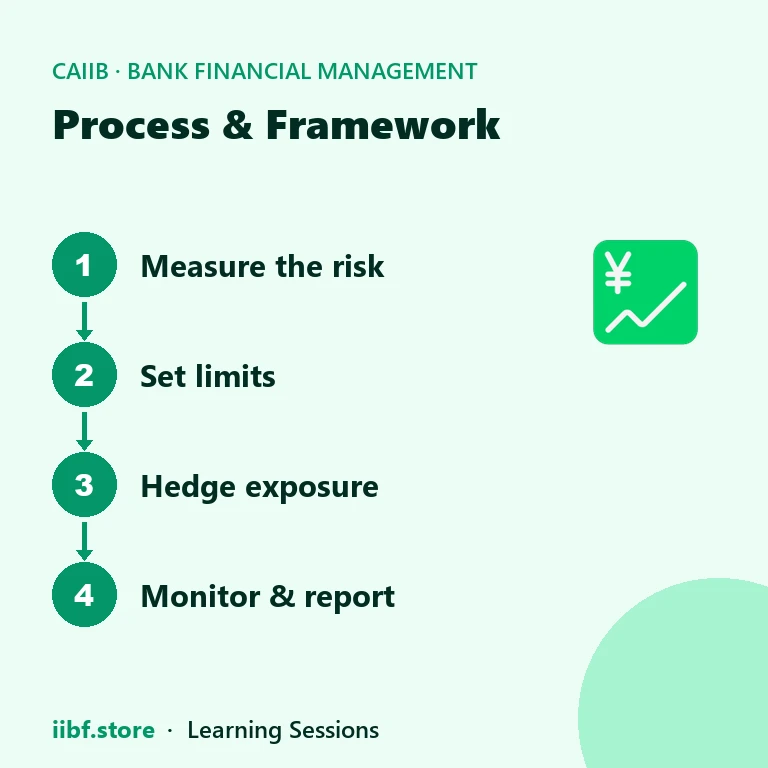
FTP is the bridge between profitability and the whole risk agenda. Once every transaction carries a tenor-matched transfer rate, the treasury can see its residual mismatch book plainly and decide whether to hedge it with swaps, invest in securities, or leave it open within ALCO limits. That mismatch is precisely the interest-rate-risk-in-the-banking-book exposure the RBI expects banks to measure and manage. FTP is also foundational to sound governance because it stops business units gaming their profits by hoarding cheap short-term funding against long assets.
Because the residual book concentrates rate risk in one place, it also concentrates the need for mitigation, which is why FTP dovetails with the credit risk mitigation techniques a bank layers over its exposures, and with the international funding instruments covered under international equity and debt products. For a wider view of how FTP fits the syllabus, browse the full Bank Financial Management topic hub, and pair your reading with a structured CAIIB preparation course.
🎯 Remember: FTP does not create or destroy the bank's total margin — it only reallocates it. The sum of the liability spread, asset spread and treasury mismatch spread always equals the bank's overall net interest margin.

🧠 Practice MCQs: Funds Transfer Pricing in Banks
Q1. Under a funds transfer pricing system, which unit is left holding the interest-rate mismatch risk? (a) the branch raising deposits (b) the loan desk (c) the central treasury/ALM pool (d) the auditor
Answer: (c) — FTP transfers the mismatch to the central pool, leaving branches with only credit and liability spreads.
Q2. The FTP method that assigns each transaction a transfer rate at its own tenor from a marginal curve is called: (a) single pool (b) multiple pool (c) matched-maturity marginal FTP (d) average cost method
Answer: (c) — MMFTP reads a tenor-matched rate off the marginal FTP curve, best isolating mismatch risk.
Q3. A term liquidity premium in the FTP curve mainly charges: (a) short-term deposits (b) long-dated illiquid assets (c) CASA balances (d) fee income
Answer: (b) — Long, illiquid assets are charged for locking up stable funding; long stable deposits are rewarded.
Q4. The sum of the liability spread, asset spread and treasury mismatch spread equals: (a) gross profit (b) the bank's total net interest margin (c) operating expense (d) capital adequacy ratio
Answer: (b) — FTP only reallocates the margin; the three components add back to the overall NIM.
Q5. Which body typically owns and approves the FTP framework in a bank? (a) the RBI directly (b) the branch manager (c) the ALCO/Asset-Liability Committee (d) external auditors
Answer: (c) — The ALCO owns FTP policy as part of its balance-sheet and interest-rate risk mandate.
Want chapter-wise mock tests with 100+ MCQs? Start practising free
❓ Frequently Asked Questions
Authoritative reference: see the latest guidelines on the Reserve Bank of India website and the IIBF syllabus portal.
Is funds transfer pricing a real cash movement between branches?
No. FTP is an internal management accounting mechanism. No cash actually moves; the pool simply credits and charges units at a notional transfer rate to measure true spreads.
Which FTP method does CAIIB BFM treat as best practice?
Matched-maturity marginal FTP (MMFTP), because it assigns each transaction a tenor-matched marginal rate and cleanly isolates interest-rate mismatch risk in the treasury book.
Does FTP change a bank's total net interest margin?
No. FTP only reallocates the existing margin among the deposit desk, the loan desk and the treasury. The three spreads always sum back to the overall NIM.
Who is responsible for the FTP policy in a bank?
The Asset-Liability Committee (ALCO) owns and approves the FTP framework, as it forms part of the bank's balance-sheet and interest-rate risk management mandate.
Master funds transfer pricing and you unlock the logic behind almost every ALM and treasury question in the paper. Lock it in with full-length practice — take a free CAIIB BFM mock test today and see how cleanly you can split a margin under exam pressure.
Prefer revising from a printed book?
Chapter-wise books with MCQs after every chapter — minimal pages, complete coverage, delivered anywhere in India. Every book has a free sample to read first.



































Quick quiz on this topic
5 exam-style questions from our free test bank — check yourself before you move on.
Practice this topic
Take a free mock test, download chapter PDFs, or watch a video class — all included on iibf.store.