Leadership Development in Banks: CAIIB HRM Guide (2026)
Leadership development in banks has moved from an annual training-calendar checkbox to a board-level priority. Regulators and customers alike now expect frontline managers to make sound judgment calls under pressure. For CAIIB HRM (Elective) candidates, understanding how banks identify, groom and deploy future leaders is a recurring exam theme. It blends organisational behaviour, HR strategy and change management into one integrated topic. This article breaks down the frameworks, methods and metrics that banks use to build their leadership bench.
🧭 Why Leadership Development in Banks Matters Now
Two decades ago, a branch manager's job was largely transactional: sanction limits, monitor cash, keep the ledger clean. Today the same role demands more. Branch managers need digital fluency, cross-selling judgment and people-management skill. They must also handle customer escalations that can go viral within hours.
This shift explains why leadership development in banks now sits on the HR committee's standing agenda, not in a once-a-year training nomination form, reinforced by RBI's fit-and-proper expectations for senior bank management and board-level appointees. Banks that treat leadership as a pipeline consistently outperform peers on both retention and customer outcomes. They spot potential early, test it through stretch roles, and coach staff through failure.
Every leadership programme starts with a clear map of roles, spans of control and growth paths. That is exactly why the fundamentals of HRM chapter is prerequisite reading before leadership-specific frameworks. Once the basic HR architecture is clear, banks layer on structured identification. Performance-potential grids, 360-degree inputs and psychometric assessments feed a shortlist. Banks then develop that shortlist through rotational assignments and formal coaching.
💡 Exam Tip: CAIIB HRM examiners often frame leadership-development questions around a scenario. Picture a branch head struggling with a hybrid team, or a regional manager facing a digital-channel migration. Anchor your answer to a named framework — VUCA/BANI, 9-box grid, competency cluster — rather than generic advice.
🌪️ Leading in VUCA and BANI Banking Environments
Most HR textbooks still open with VUCA. The military coined the term first; banks adopted it through the 2010s to describe interest-rate swings, regulatory change and fintech disruption. CAIIB candidates increasingly need to know a newer lens too, one that better captures a post-pandemic, AI-accelerated banking environment:
- VUCA — Volatility, Uncertainty, Complexity, Ambiguity
- BANI — Brittle, Anxious, Nonlinear, Incomprehensible
In a BANI environment, systems that look stable can crack suddenly, and cause-effect relationships stop being predictable. Leadership development in banks now has to build for both realities at once. VUCA-era leaders needed vision and agility. BANI-era leaders additionally need resilience, empathy, and the ability to keep teams functioning through ambiguity — rather than waiting for clarity that may never arrive.
In practice, this means less reliance on rulebook-driven decision trees. Banks instead invest more in scenario simulations, crisis-response drills and psychological-safety coaching. The dedicated chapter on leading in VUCA and BANI scenarios works through this shift in detail. Read it before attempting case-study questions on crisis leadership.
⚠️ Common Mistake: Candidates often treat VUCA and BANI as interchangeable synonyms. They are not. VUCA describes external conditions; BANI describes how people experience those conditions. Conflating the two costs marks in scenario-based questions.
🧩 Core Leadership Competency Frameworks Banks Use
A leadership competency framework is a shared vocabulary for "what good looks like" at each management layer. Indian banks have converged on a fairly consistent set of clusters:
- Strategic and business acumen
- Customer and stakeholder orientation
- People leadership and coaching ability
- Risk and compliance judgment
- Digital and data fluency
- Self-awareness and emotional intelligence
Each cluster breaks down into observable behaviours. This lets appraisal and promotion committees rate candidates consistently, rather than on gut feel.
These frameworks matter for two reasons in the exam context. First, they anchor selection into leadership programmes. Banks typically shortlist high-potential officers using a 9-box grid that plots current performance against future potential; this feeds directly into stretch assignments and job rotation. Second, frameworks anchor development design. A gap in "people leadership" triggers coaching and shadow-management assignments, while a gap in "digital fluency" triggers rotation through a fintech partnership or an analytics project. Job rotation across departments and verticals remains the single most effective tool for building cross-functional leadership exposure — it forces officers to apply the same competencies in unfamiliar contexts.
| Development Method | Best Used For | Suitable for Frontline Officers | Suitable for Senior Management |
|---|---|---|---|
| Job rotation across verticals | Building cross-functional exposure and systems thinking | ✅ | ✅ |
| Formal coaching (goal-focused) | Closing specific, near-term performance gaps | ✅ | ✅ |
| Mentoring (relationship-based) | Long-term career navigation and organisational insight | ✅ | ✅ |
| Action-learning projects | Real business problems solved by high-potential cohorts | ❌ | ✅ |
| Classroom-only lectures | Conceptual induction, not behaviour change | ✅ | ❌ |
🏛️ HR as a Strategic Partner in Building Leaders
The training department alone cannot deliver leadership development. It requires HR to sit at the strategy table, not in the compliance corner. This is the essence of the HR-business-partner model that Indian banks have adopted over the last decade. HRBPs sit embedded within business verticals. They understand the P&L pressures a future leader will face, not just the competency framework on paper. The chapter on HR as a strategic player is directly examinable material for this shift.
Strategic HR also means treating leadership development as an organisation development (OD) intervention, not a standalone training event. HR aligns it with restructuring, culture-change and digital-transformation programmes. This way, newly developed leaders step into roles the organisation actually needs filled. The chapter on organisational effectiveness and organisational development covers the diagnostic tools HR uses to time and target these programmes correctly — climate surveys, force-field analysis, and team interventions.
📌 Remember: Succession pipelines only work when leadership development, performance appraisal and workforce planning are integrated into one HR system. A brilliant coaching programme feeding into a broken promotion process produces frustrated high-potentials, not future leaders.
📈 Measuring Leadership Development ROI and Organisational Effectiveness
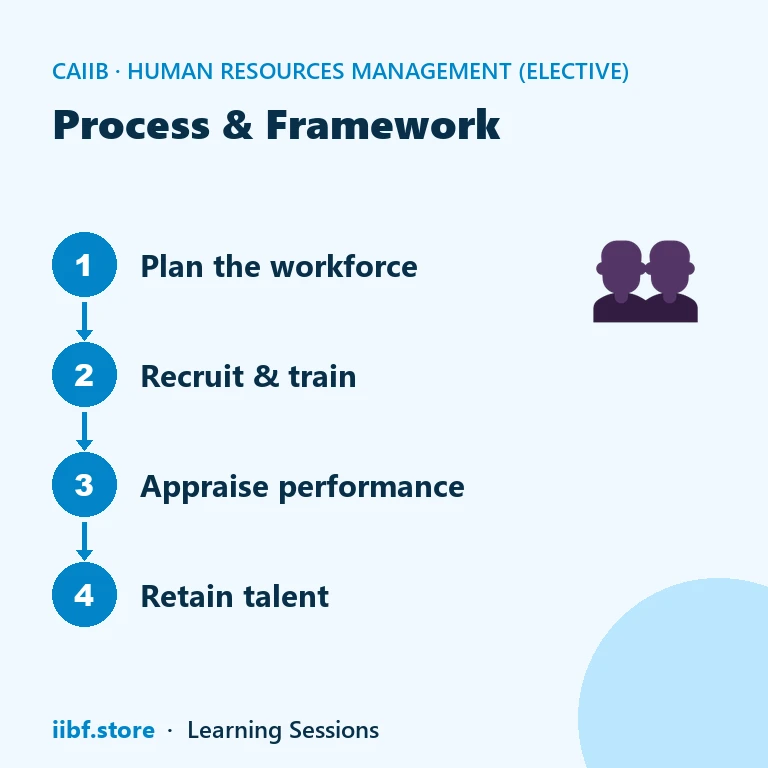
What gets measured gets funded. Bank HR functions increasingly track a standard scorecard:
- Internal-fill ratio — the share of leadership vacancies filled from the internal pipeline versus external hire
- Bench strength / readiness index — how many "ready now" successors exist per critical role
- Post-programme engagement and retention of high-potential cohorts
- Time-to-productivity for officers moved into stretch roles
These metrics increasingly draw on HR information systems and predictive models. Our companion piece on HR analytics in banks covers this in depth, walking through the dashboards HR committees now review every quarter.
Measurement discipline also closes the loop back to recruitment and industrial relations. A bank with weak recruitment and selection in banks practices starves its leadership pipeline five to ten years downstream. Unresolved friction, tracked in industrial relations in banks data, is one of the strongest predictors of high-potential attrition. Examiners like scenario questions that connect these dots. Candidates should trace a leadership-development failure back to its root cause in an upstream HR process, rather than treating it as an isolated training gap.
🧠 Practice MCQs: Leadership Development in Banks
Q1. Which leadership approach is best suited to a BANI (Brittle, Anxious, Nonlinear, Incomprehensible) banking environment? (a) Rigid command-and-control directives issued from Head Office (b) Adaptive, sense-making leadership that empowers frontline teams (c) Strict adherence to legacy SOPs regardless of context (d) Centralising every decision at the top to reduce ambiguity
Answer: (b) — BANI conditions are unpredictable and nonlinear, so leaders need to sense, adapt and empower teams rather than rely on fixed top-down rules.
Q2. In a typical bank leadership competency framework, which of the following is NOT a core competency cluster? (a) Strategic and business acumen (b) Customer and stakeholder orientation (c) People leadership and coaching ability (d) Manual cheque-clearing procedure knowledge
Answer: (d) — Leadership competency frameworks focus on behavioural clusters like strategy, people leadership and digital fluency, not operational procedural knowledge.
Q3. Which development method is most effective for building cross-functional leadership exposure in high-potential bank officers? (a) Job rotation across departments and business verticals (b) Remaining in the same role for the entire career (c) Classroom lectures with no application (d) Avoiding all stretch assignments
Answer: (a) — Job rotation exposes officers to different business contexts and systems, building the cross-functional judgment senior roles demand.
Q4. What is the primary purpose of a leadership pipeline or "bench strength" approach in banks? (a) To fill vacancies reactively only after an officer resigns (b) To proactively identify and prepare successors at each management layer (c) To reduce the overall training budget (d) To replace the performance appraisal system entirely
Answer: (b) — A leadership pipeline is a proactive, continuous process of identifying and developing successors before vacancies occur, unlike reactive hiring.
Q5. How does coaching typically differ from mentoring in a bank's leadership development approach? (a) Coaching is only for freshers and mentoring only for retiring staff (b) Coaching is performance/goal-focused and short-term, while mentoring is relationship-based and long-term (c) The two terms mean exactly the same thing (d) Mentoring requires no interpersonal interaction at all
Answer: (b) — Coaching targets specific, near-term performance gaps; mentoring is a longer-term relationship focused on career and organisational navigation.
Want chapter-wise mock tests with 100+ MCQs? Start practising free →
❓ Frequently Asked Questions
What is leadership development in banks?
It is the structured process banks use to identify officers with leadership potential and prepare them for higher management roles. Banks build this through coaching, mentoring, job rotation, stretch assignments and formal competency-based training — rather than leaving progression to chance or tenure alone.
Why do banks now talk about BANI instead of only VUCA?
VUCA describes volatile, uncertain, complex and ambiguous external conditions. BANI — brittle, anxious, nonlinear, incomprehensible — better captures how employees and customers actually experience a fast-changing, digitally disrupted banking environment. That is why current leadership programmes design for both.
What methods do banks use most often for leadership development?
The most common methods are job rotation across verticals, formal goal-focused coaching, and long-term relationship-based mentoring. Action-learning projects also feature, where high-potential officers solve real business problems. Each method suits a different stage of the leadership pipeline.
Is leadership development part of the CAIIB HRM elective syllabus?
Yes. Leadership development sits within the broader HR-as-strategic-player and organisational-development portions of the CAIIB Human Resources Management elective. It frequently appears in scenario-based questions covering VUCA/BANI leadership and competency frameworks.
🎯 Build Your Leadership Development Edge Before Exam Day
Leadership development in banks is no longer a soft-skills afterthought. It is a measurable, strategy-linked HR discipline. CAIIB examiners test it through scenario questions connecting VUCA/BANI leadership, competency frameworks and organisational effectiveness. If your preparation also covers the ABM elective, revisit consortium and multiple banking arrangements — coordination and governance skills overlap closely with the leadership themes covered here. For the complete set of HRM elective guides, browse the HRM elective tag hub. When you are ready to test yourself against exam-pattern questions, enrol in the CAIIB course for structured, chapter-wise preparation.
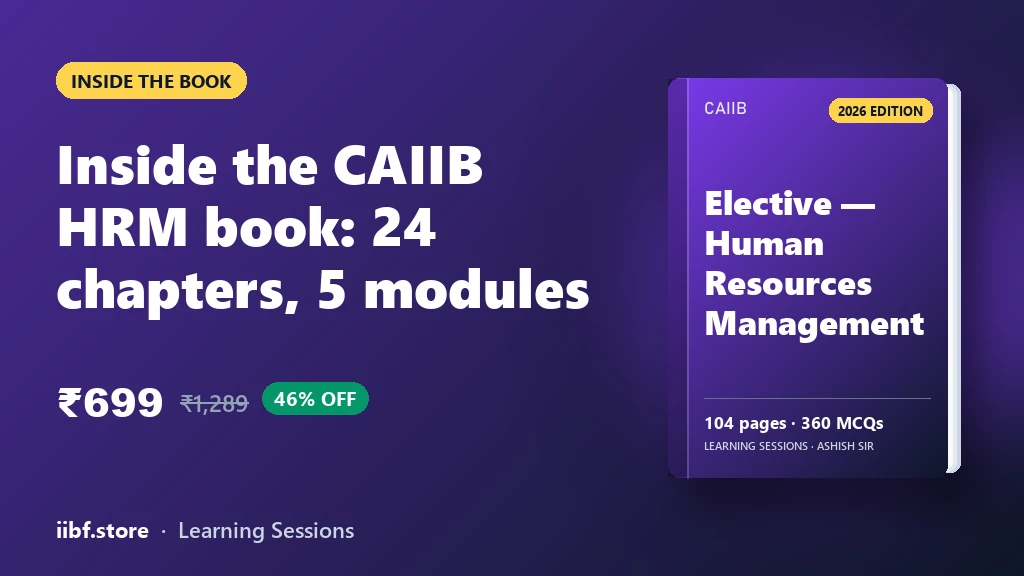
Prefer revising from a printed book?
Chapter-wise books with MCQs after every chapter — minimal pages, complete coverage, delivered anywhere in India. Every book has a free sample to read first.







Quick quiz on this topic
5 exam-style questions from our free test bank — check yourself before you move on.
Practice this topic
Take a free mock test, download chapter PDFs, or watch a video class — all included on iibf.store.