Mark to Market Valuation of Investments: IIBF TIRM Guide 2026
For IIBF TIRM candidates, mark to market valuation of investments is the single most-tested valuation topic in the treasury syllabus, because it decides how a bank's entire investment book — G-Secs, SDLs, corporate bonds, equities — gets priced on the balance sheet every quarter. Get the classification-to-valuation chain wrong in the exam and you will lose marks on questions that look deceptively simple: is a security marked daily or quarterly, does the loss hit P&L or reserves, and which bucket even permits amortisation instead of marking? This article walks through the three portfolio categories, the actual mechanics of periodic revaluation, and where examiners like to plant traps.
📊 HTM, AFS and HFT: The Three-Way Classification
Every investment a bank holds must sit in one of three categories on acquisition: Held to Maturity (HTM), Available for Sale (AFS), or Held for Trading (HFT). The category decides the valuation method, not the other way round. HTM securities — capped as a percentage of a bank's investment portfolio per RBI's Master Direction — are carried at acquisition cost, with premium amortised over the residual maturity; they are not marked to market at all unless a security in the bucket is downgraded below investment grade. AFS securities are the largest bucket in most bank books and must be revalued at least quarterly, group-wise (by classification group such as government securities, other approved securities, shares, debentures and bonds, and so on). HFT is the trading book proper: positions bought with the explicit intent of selling within 90 days, revalued daily, and expected to be sold within that window under the Master Direction's operational discipline. Candidates preparing this chapter alongside Regulations Supervision And Compliance should note that shifting a security between categories is itself a regulated event with disclosure consequences, not a routine bookkeeping choice.
💡 Exam Tip: If a question mentions "sold within 90 days," it is testing HFT. If it mentions "held till redemption, no intention to trade," it is testing HTM. AFS is the residual, default category.
💹 How Mark to Market Valuation Actually Works
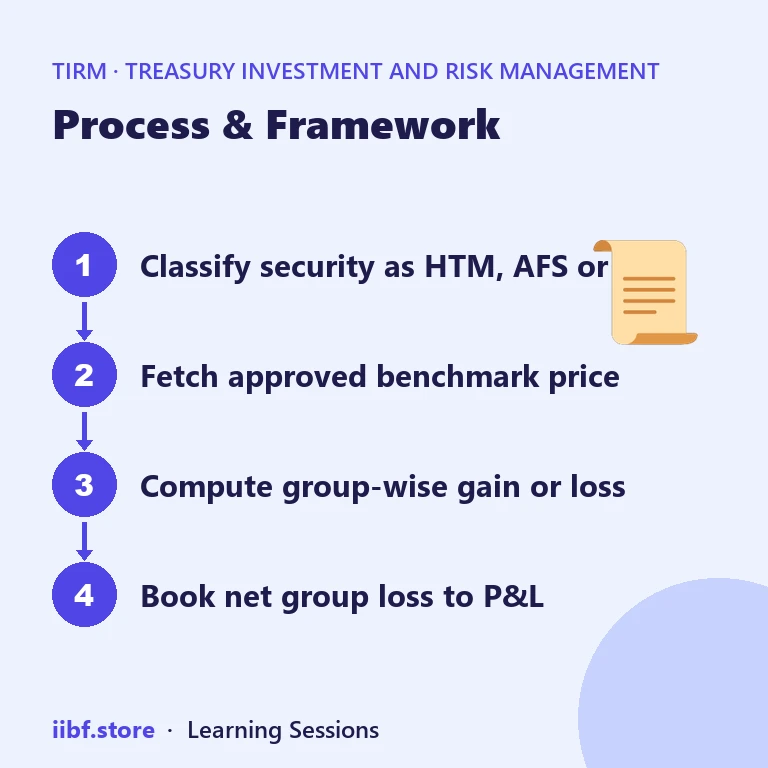
Mark to market valuation of investments means restating a security's book value to its current market price, and recognising any resulting loss (never a net gain, at the aggregate group level) immediately in the profit and loss account. For AFS and HFT securities, banks use prices published by an approved valuation agency — typically FBIL (Financial Benchmarks India Ltd) for government securities — rather than internal estimates, which removes discretion from a process that regulators watch closely. Valuation is done scrip-wise, but the resulting gain or loss is aggregated at the classification-group level: within a group, unrealised gains offset unrealised losses, and only a net loss for that group is charged to P&L; a net gain is ignored, not booked. This asymmetric treatment is deliberately conservative and is one of the most commonly misunderstood rules in the chapter, alongside how banks separately track PV01 and DV01 in treasury exposure once a position is marked, since every mark to market number is ultimately a function of where the applicable benchmark yield curve sits on the valuation date.
For instruments without an active quoted market — certain corporate bonds or illiquid state paper — banks fall back to matrix pricing or spread-over-sovereign-yield methodologies prescribed by the valuation agency, still anchored to the day's benchmark curve rather than management judgment. This is precisely why treasury front, mid and back office segregation matters: the front office cannot be the one certifying its own valuation inputs, a control point covered in Front Mid And Back Office Operations.
🏦 Provisioning, Depreciation and the P&L Impact
When quarterly mark to market valuation of investments throws up a net depreciation for a classification group, the bank must provide for it immediately — this is not optional and not spread over future quarters. The provision reduces net profit in the quarter it arises, which is exactly why treasury desks build cushions ahead of volatile rate cycles. Banks that have set aside adequate buffers can draw on mechanisms explained in the sibling piece on investment fluctuation reserve for banks to smooth the earnings impact of a sharp yield spike, though that reserve itself is built from appropriations, not a substitute for the mandatory mark to market provision.
A related trap in exam questions: depreciation in one classification group cannot be netted against appreciation in another group. A bank holding both a depreciated government securities group and an appreciated "shares and equity" group must still provide fully for the first group's loss; the two groups are never combined. This group-wise, no-cross-netting rule trips up candidates who assume valuation works like a single consolidated portfolio number. It doesn't — it is a sum of independently assessed buckets, each following the same lower-of-cost-or-market discipline within itself.
⚠️ Common Mistake: Students often assume net portfolio gains offset losses across categories. In reality, only intra-group netting is permitted; HTM is excluded from marking altogether, and AFS/HFT groups are never netted against each other.
⚖️ Category Shifts and Regulatory Guardrails
Banks are permitted to shift securities between HTM, AFS and HFT, but only under conditions the RBI Master Direction lays down explicitly — usually once a year with board approval, at the start of the accounting year, and with full disclosure of the depreciation or appreciation booked at the point of transfer. A security moved out of HTM into AFS, for instance, must be revalued on the date of transfer, and any resultant depreciation is recognised immediately rather than deferred. This guardrail exists because category shifting could otherwise be used to dodge mark to market recognition — moving a depreciating security into HTM right before quarter-end would understate losses if left unchecked. Frequent or opportunistic shifting also invites regulatory scrutiny and disclosure requirements under the compliance chapter.
Investment portfolio governance sits at the intersection of treasury operations and technology infrastructure — the valuation engine that prices thousands of scrips daily against benchmark curves is itself a control system, and its design is covered in Role Of Information Technology In Treasury Management. Candidates should also connect this back to how risk limits constrain the AFS and HFT books in the first place, a theme developed in Risk Analysis And Control.
📌 Remember: Category transfers are exceptional, board-approved events with immediate valuation recognition — not a routine tool for earnings management.
🔍 Comparing the Three Portfolio Categories
The table below summarises the operative differences examiners test most often. Keep this comparison sharp — a large share of TIRM MCQs are built directly from these distinctions.
| Feature | HTM | AFS | HFT |
|---|---|---|---|
| Marked to market | ❌ | ✅ (at least quarterly) | ✅ (daily) |
| Holding intent | Till maturity | Neither trading nor HTM | Sale within 90 days |
| Premium amortisation | ✅ | ❌ | ❌ |
| Net group gain booked to P&L | N/A | ❌ (only net loss booked) | ❌ (only net loss booked) |
| Typical share of book | Largest historically, capped | Usually largest active bucket | Smallest, most liquid |

🎯 Exam Strategy for Mark to Market Questions
Most TIRM questions on this topic combine two ideas at once: classification (which bucket) and valuation mechanics (how the number is computed and where it lands in the financials). Build your revision around three anchors — the 90-day HFT sale test, the quarterly-minimum AFS revaluation cycle, and the no-cross-group-netting rule — and you can solve almost any variant thrown at you. It also helps to connect this chapter to adjacent topics such as non-SLR investment norms for banks, since non-SLR paper follows the same HTM/AFS/HFT scaffolding with additional exposure ceilings layered on top. For a broader grounding in where these instruments trade before they ever reach a bank's investment book, revisit the foundational chapters on Money Market and Capital Market.
Outside the treasury syllabus itself, if payments and settlement topics show up as a general banking cross-check in your exam, it is worth a quick refresher on NEFT RTGS IMPS differences — a completely different corner of the syllabus, but one examiners occasionally mix into mixed-topic mock papers. Browse every article tagged under Treasury Investment and Risk Management for the full run of TIRM-focused explainers published this month.
For the authoritative rulebook itself, the RBI's directions on classification, valuation and operation of the investment portfolio of commercial banks are consolidated on the RBI Master Directions page — worth a skim before exam day for the exact thresholds and disclosure formats currently in force.
🧠 Practice MCQs: Mark to Market Valuation of Investments
Q1. Under RBI norms, how frequently must a bank revalue its AFS investment portfolio at minimum? (a) Daily (b) At least quarterly (c) Annually (d) Only on transfer
Answer: (b) — AFS securities must be marked to market group-wise at least once every quarter.
Q2. A bank's HFT portfolio shows a net appreciation in one classification group and a net depreciation in another. How is this treated? (a) Net off across groups and book the net figure (b) Ignore the gain, provide fully for the loss in the depreciated group (c) Carry both forward to next quarter (d) Transfer both to HTM
Answer: (b) — Netting is permitted only within a classification group, never across groups; unrealised gains are not booked, but losses must be provided for.
Q3. Which category of investments is generally exempt from periodic mark to market valuation? (a) HFT (b) AFS (c) HTM, unless a security is downgraded (d) All categories are marked equally
Answer: (c) — HTM securities are carried at acquisition cost (with premium amortisation) and are not revalued unless credit quality deteriorates below investment grade.
Q4. What is the defining holding-intent test for classifying a security as HFT? (a) Held till maturity (b) Intended to be sold within 90 days (c) Held for more than a year (d) Held only for statutory SLR compliance
Answer: (b) — HFT securities are acquired with the intent to trade and sell within 90 days, and are revalued daily.
Q5. When a bank transfers a security from HTM to AFS under RBI's permitted category-shift rules, what must happen on the date of transfer? (a) No valuation adjustment is needed (b) The security is revalued and any depreciation is recognised immediately (c) The transfer is deferred to year-end (d) The security is automatically reclassified as HFT
Answer: (b) — Category shifts require immediate revaluation on the transfer date, with any resultant depreciation recognised at once, not deferred.
Want chapter-wise mock tests with 100+ MCQs? Start practising free →
❓ Frequently Asked Questions
What does mark to market valuation of investments actually mean for a bank?
It means restating the book value of AFS and HFT securities to their current market price on the valuation date, and immediately charging any net loss per classification group to the profit and loss account, while HTM securities remain at amortised cost.
Are HTM securities ever marked to market?
Generally no. HTM securities are carried at acquisition cost with premium amortised over the residual life, and are revalued only if a specific security's credit rating falls below investment grade, at which point provisioning rules apply.
Can gains in one classification group offset losses in another?
No. Netting is allowed only within the same classification group. A net loss in one group must be fully provided for even if another group shows a net gain, since unrealised group-level gains are never booked to P&L.
Who supplies the market prices used for valuing government securities?
Banks generally rely on prices published by an approved valuation agency such as FBIL for government securities, rather than internal desk estimates, to keep the process independent and auditable.
Mastering mark to market valuation of investments is as much about memorising the classification rules as it is about internalising why they exist — conservative, asymmetric recognition of loss protects depositors from a treasury book that could otherwise mask volatility behind discretionary pricing. Lock in the HTM/AFS/HFT distinctions, the group-wise netting rule, and the transfer-day revaluation requirement, then pressure-test your understanding with IIBF TIRM mock tests before exam day.
Practice this topic
Take a free mock test, download chapter PDFs, or watch a video class — all included on iibf.store.