Securitisation by Small Finance Banks: MRR, MHP and Rules
Securitisation by small finance banks has quietly become one of the most important balance-sheet tools in the sector, because an SFB lends long to micro borrowers while funding itself with relatively costly deposits. Pooling those seasoned micro-loans and selling them to investors releases capital, books upfront income and keeps growth running without a fresh equity round. This article explains the RBI framework, the retention and holding-period rules, and the exam points examiners keep returning to.
🏦 Why an SFB Uses Securitisation at All
A small finance bank starts life with a concentrated, high-yield book: joint liability group loans, micro-enterprise credit and small secured loans against property or vehicles. That book grows faster than deposits in the early years, so the bank runs into two constraints at once — capital and liquidity.
Securitisation solves both. The bank sells a pool of standard loans to a special purpose entity, which funds the purchase by issuing securitisation notes to investors. Once the transfer meets the true-sale and de-recognition conditions, the assets leave the originator's books and the risk-weighted assets attached to them fall away.
The commercial logic is sharper for an SFB than for a universal bank. Micro-loan pools are granular, short-tenor and historically well-behaved, so investors price them keenly. The seller keeps the servicing mandate, continues to collect instalments and earns a servicing fee, which means the customer relationship built up through years of field visits is not lost. Understanding how that relationship shapes repayment discipline is exactly what the Consumer Behaviour chapter deals with.
There is a treasury angle too. Cash released from a securitisation is redeployed into fresh lending at a higher yield than the pool being sold, so the return on equity improves even when the spread on the transaction itself looks thin. For banks still building a low-cost deposit base, this is a genuine funding substitute rather than a cosmetic exercise.
💡 Exam Tip: Securitisation is a funding and a capital tool. Questions that ask "primary objective" usually want capital relief plus liquidity, not profit booking.
📜 What the 2021 RBI Directions Permit
The governing law is the Reserve Bank of India (Securitisation of Standard Assets) Directions, 2021, issued on 24 September 2021, read with the companion Transfer of Loan Exposures Directions of the same date. The first covers pools sold to a special purpose entity that issues notes; the second covers plain loan transfers, including direct assignment. Every SFB transaction falls under one of the two.
Only standard assets can be securitised. A stressed or defaulted exposure has to travel through the transfer of loan exposures route to permitted transferees such as asset reconstruction companies, and never through a securitisation structure. The directions are available on the RBI's Master Directions page, which is the primary source you should quote in a descriptive answer.
Three prohibitions are examined repeatedly. Re-securitisation, where securitisation notes themselves become the underlying, is barred. Synthetic securitisation, where credit risk moves through derivatives while the loans stay on the books, is barred. Securitisation of a single asset is not permitted, because the framework is built for granular, statistically predictable pools.
Equally important is what the 2021 framework allowed for the first time. Reset of credit enhancement is now permitted as the pool amortises, so an originator can release excess support once the transaction seasons. A separate category of simple, transparent and comparable transactions carries lighter capital treatment where the structure meets the prescribed disclosure and homogeneity conditions.
Pool documentation must survive audit, which is why the assignment deed, servicing agreement and trust deed follow the same discipline taught in the Documentation chapter.
📊 MRR and MHP: The Two Numbers to Memorise
Minimum retention requirement, or MRR, forces the originator to keep skin in the game so that it does not originate carelessly and sell the consequences. Minimum holding period, or MHP, forces the loan to season on the originator's own books before it can be sold, which stops an SFB from acting as a pass-through origination shop for another lender.
Under the 2021 securitisation directions, the MRR is 5 per cent of the book value of the loans for underlying exposures with original maturity of 24 months or less, and 10 per cent where the original maturity is longer or where the loans carry bullet repayment. Residential mortgage-backed transactions attract 5 per cent. Retention has to be maintained on an ongoing basis and cannot be hedged or sold down.
MHP is measured in instalments actually recovered, not calendar months alone. The standard reading is three monthly instalments for loans with original tenor up to 24 months and six monthly instalments for longer-tenor loans, with the equivalent number of quarterly instalments where repayment is quarterly.
| Parameter | Securitisation (SSA Directions) | Direct assignment (TLE Directions) |
|---|---|---|
| Special purpose entity involved | ✅ Yes | ❌ No |
| Tradable notes issued | ✅ Yes | ❌ No |
| Minimum holding period | ✅ Applies | ✅ Applies |
| Credit enhancement by seller | ✅ Permitted | ❌ Not permitted |
| Seller's retained stake | MRR of 5% or 10% | Minimum 10% pari passu on partial transfer |
| Minimum ticket size for investors | ₹1 crore | Not applicable |
⚠️ Common Mistake: Candidates quote MRR as a share of the notes issued. It is a percentage of the book value of the loans in the pool.
🔁 Choosing Between Securitisation and Direct Assignment
Direct assignment is the simpler cousin. The SFB sells a pool of loans straight to a buying bank or non-banking financial company without any special purpose entity, without notes and without credit enhancement. The buyer takes the credit risk from day one, which is why the pricing is finer and the paperwork lighter.
Because no enhancement is allowed, the seller cannot cushion the buyer against early delinquency. The buyer therefore does its own due diligence on origination standards, field collection quality and the underlying documentation, and it usually insists that the seller retain at least ten per cent of every loan on a pari passu basis so that incentives stay aligned.
Securitisation, by contrast, allows tranching. Senior notes are rated and sold to mutual funds, insurers and banks, while the junior tranche and any cash collateral stay with the originator. That structure lets a smaller SFB reach investors who would never buy a raw micro-loan pool, at the cost of trustee fees, rating fees and a longer execution timeline.
The practical choice turns on the buyer's motive. A universal bank short of its priority sector target prefers direct assignment because the acquired loans count towards its own targets directly. A capital markets investor prefers rated notes. Since much of the pool is micro-enterprise credit, the eligibility tests in Lending to MSME decide which loans qualify, and the enforcement position taught in Recovery Of Loans decides what a buyer can actually realise. Both routes sit alongside the capital planning discussed in our note on capital adequacy norms for small finance banks.
⚠️ Capital, Priority Sector and Compliance Effects
Capital relief is not automatic. The originator gets to remove the pool from its risk-weighted assets only when the transfer is a true sale, the transferor retains no residual control and the de-recognition conditions in the directions are satisfied. Retained tranches, cash collateral and liquidity facilities continue to attract capital, and first-loss support is typically deducted from capital funds.
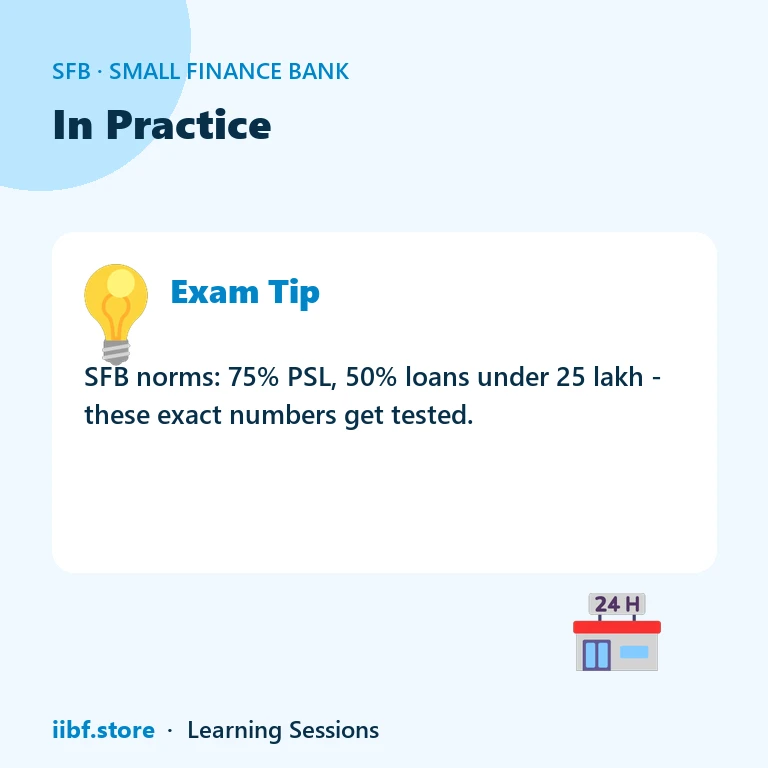
The priority sector effect is the point most often missed. A small finance bank must maintain 75 per cent of adjusted net bank credit in priority sector, so selling down priority sector assets shrinks the numerator of that ratio while the denominator moves more slowly. Treasury must model the target before pricing the deal, and many SFBs securitise their non-priority book first.
Profit recognition follows a strict rule. Gain on sale cannot be taken to the profit and loss account upfront in the way that was once common; it is amortised over the life of the pool, while any loss is recognised immediately. This asymmetry keeps originators from manufacturing quarterly earnings out of repeated pool sales.
Compliance obligations continue after the sale. The bank remains the servicer, so account maintenance, customer communication and complaint handling stay with it, as covered in Maintenance Of Accounts. Every buyer and investor must also clear onboarding checks, which is where sanctions screening in banks becomes relevant to a treasury desk. Institutions that converted from microfinance carry legacy pools too, a theme covered in our piece on mfi to sfb conversion norms. More on this subject sits in the small finance bank blog hub, and the full syllabus map is on the CAIIB course page.
📌 Remember: True sale plus no residual control equals de-recognition. Miss either condition and the pool stays on the balance sheet for capital purposes.
🧠 Practice MCQs: Securitisation by Small Finance Banks
Q1. Under the RBI (Securitisation of Standard Assets) Directions, 2021, the minimum retention requirement for underlying loans with original maturity of 24 months or less is (a) 2% of book value (b) 5% of book value (c) 10% of book value (d) 15% of book value
Answer: (b) — Short-tenor pools carry a 5 per cent MRR; longer-tenor and bullet-repayment loans attract 10 per cent.
Q2. Which of the following is expressly NOT permitted under the 2021 securitisation framework? (a) Reset of credit enhancement (b) Securitisation of residential mortgages (c) Re-securitisation of exposures (d) Retention of the servicing mandate by the originator
Answer: (c) — Re-securitisation and synthetic securitisation are prohibited, while reset of credit enhancement was specifically allowed in 2021.
Q3. In a direct assignment where only part of each loan is transferred, the transferor must retain a minimum of (a) 5% on a subordinated basis (b) 10% on a pari passu basis (c) 20% on a first-loss basis (d) nothing, since risk passes fully
Answer: (b) — The Transfer of Loan Exposures Directions require at least 10 per cent retention, held pari passu with the transferee.
Q4. Credit enhancement provided by the seller is (a) permitted in both securitisation and direct assignment (b) permitted in securitisation but not in direct assignment (c) permitted in direct assignment but not in securitisation (d) prohibited in both
Answer: (b) — Direct assignment must be a clean transfer, so no enhancement is allowed; securitisation structures may carry enhancement subject to capital treatment.
Q5. Gain arising to an originating small finance bank on a securitisation transaction should be (a) recognised fully upfront (b) amortised over the life of the pool (c) credited directly to reserves (d) ignored until the pool matures
Answer: (b) — Gain is amortised over the residual life of the securitised pool, whereas a loss is recognised immediately.
Want chapter-wise mock tests with 100+ MCQs? Start practising free →
❓ Frequently Asked Questions
Can a small finance bank securitise loans it purchased from another lender?
No. Only loans originated on the bank's own books are eligible, and re-securitisation of exposures that are themselves securitisation notes is prohibited. The pool must also consist of standard assets that have completed the minimum holding period.
Does securitisation help an SFB meet the 75 per cent priority sector requirement?
Selling priority sector assets reduces priority sector achievement, so it usually hurts rather than helps. Buying a priority sector pool through direct assignment increases the acquirer's achievement, which is why universal banks are the natural buyers.
What is the minimum investment size in securitisation notes?
The 2021 directions prescribe a minimum ticket size of one crore rupees for securitisation notes. This keeps retail investors out of a product whose credit analysis requires pool-level data and modelling skill.
Who handles collections after the pool is sold?
The originating bank almost always continues as servicer, collecting instalments and passing them to the special purpose entity or assignee for a fee. Customer service, grievance handling and account maintenance obligations therefore remain with the bank.
Bring this into your exam preparation
Learn the two directions as a pair, memorise the retention and holding-period numbers, and be ready to compare the two routes in four lines. Then test yourself on the full chapter bank at iibf.store mock tests.
Practice this topic
Take a free mock test, download chapter PDFs, or watch a video class — all included on iibf.store.
Keep reading