Monetary Policy Transmission Mechanism in India: CAIIB CB Guide

The monetary policy transmission mechanism in India is the chain of events that turns an RBI repo rate decision into an actual change in the interest rate your customer pays on a home loan or earns on a fixed deposit. CAIIB Central Banking examiners love this topic because it sits at the intersection of theory and practice — you need to know the channels through which policy signals travel, why the process is often slow and incomplete, and how RBI has redesigned lending-rate benchmarks over the years to fix exactly that problem. This article walks through the full mechanism, links it to the relevant IIBF chapters, and ends with five exam-style MCQs.
🔄 What Monetary Policy Transmission Actually Means
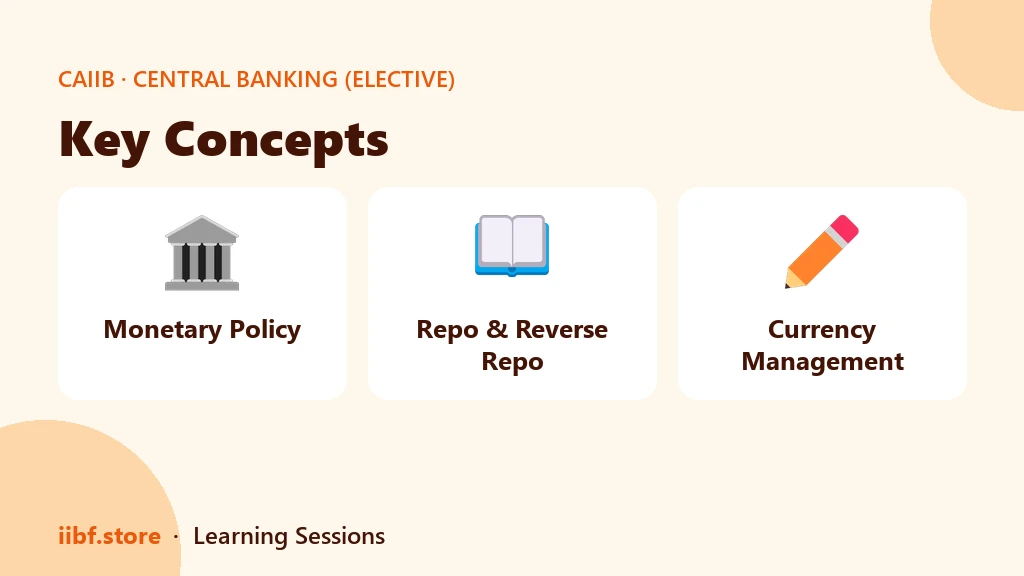
When the Monetary Policy Committee changes the repo rate, it is not directly setting the rate your branch charges on a car loan. It is changing the cost at which banks borrow overnight funds from RBI. Transmission is the process by which that single rate change works its way through the banking system into deposit rates, lending rates, bond yields, and eventually into spending and investment decisions across the economy. The faster and more completely this happens, the more effective monetary policy is at controlling inflation and supporting growth.
This concept sits inside the broader chapter on the theory and practice of central banking, which explains why central banks rely on indirect tools like the repo rate rather than simply ordering banks to lend at a fixed price. It also connects closely to the chapter on functions of central banks, since transmission is really a test of how well a central bank's core monetary function is working in practice, not just in theory.
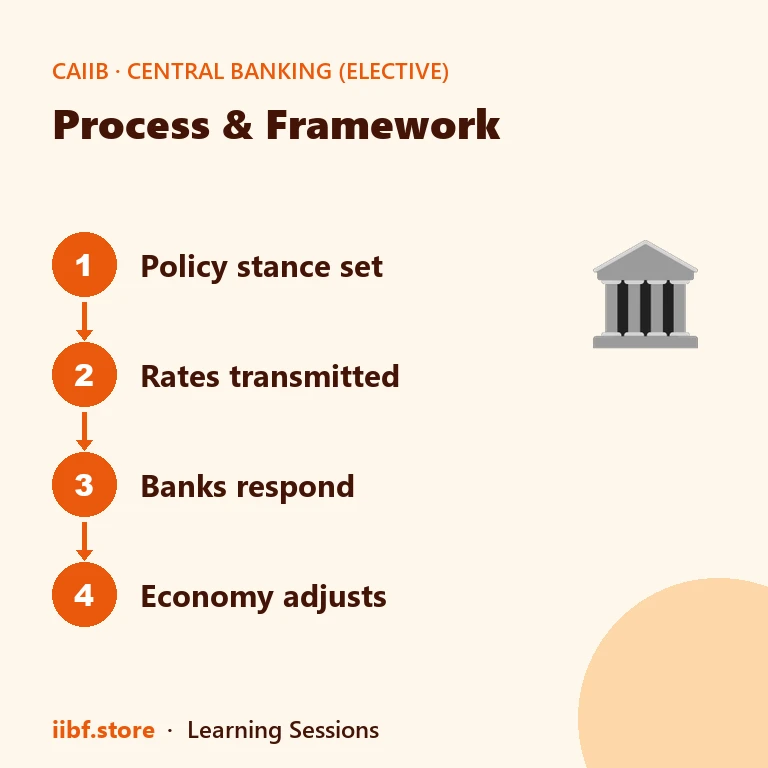
Think of it as a relay race with four runners: the policy rate, the money market rate, the bank's own cost of funds, and finally the rate quoted to the customer. Each handoff can slow the baton down, and a candidate who can name where each handoff typically slows is well placed to answer scenario-based questions on this topic.
🏦 The Four Channels Transmission Travels Through
Textbooks usually describe four main channels. The interest rate channel is the most direct: a lower repo rate reduces banks' cost of funds, which should reduce lending and deposit rates. The credit channel works through bank balance sheets — cheaper funding lets banks lend more freely, especially to smaller borrowers who depend heavily on bank credit rather than capital markets. The asset price channel operates through equity and bond valuations, which rise when rates fall, making households feel wealthier and more willing to spend. The exchange rate channel works through capital flows — a rate cut can weaken the rupee, making exports more competitive but imports costlier.
In India, the interest rate and credit channels dominate because bank credit is still the primary source of external finance for most businesses and households, unlike in economies where bond and equity markets carry a much larger share of financing. Liquidity conditions in the banking system also matter enormously here — the Liquidity Adjustment Facility framework is the operating mechanism through which the repo rate actually gets enforced day to day, and without a well-functioning LAF corridor, transmission through any channel would be far noisier.
💡 Exam Tip: If a question asks you to name transmission channels, list interest rate, credit, asset price, and exchange rate — examiners often expect all four, not just the interest rate channel that comes to mind first.
📉 From BPLR to MCLR to EBLR: India's Benchmark Story
India's lending-rate benchmarks have been redesigned three times specifically to fix weak transmission. The Benchmark Prime Lending Rate era let banks keep official rates high while lending profitably below them through unofficial discounts, so published rates barely moved with policy changes. The Marginal Cost of Funds based Lending Rate improved things by tying rates to a bank's actual cost of funds, but banks still had discretion over the spread and could delay repricing. The External Benchmark Lending Rate, introduced for retail and small business loans, forced banks to link floating rates directly to an external anchor such as the repo rate, with rates resetting at least once every three months.
The table below compares these three regimes on the dimension that matters most for this topic: how quickly and completely a repo rate change reaches the borrower.
| Regime | Rate Basis | Bank Discretion | Transmission Speed |
|---|---|---|---|
| BPLR | Bank-declared prime rate | High | Slow and unreliable |
| MCLR | Marginal cost of funds | Moderate | Improved but still lagged |
| EBLR | External benchmark (repo rate) | Low | ✅ Fast, near real-time reset |
| Deposit rates | Bank-set, less regulated | High | Typically slower than lending side |
Notice that deposit rates still lag behind lending rates in most transmission studies, which is exactly why regulators keep watching this space rather than treating EBLR as the final word on the subject.
⏱️ Why Transmission Still Runs Incomplete
Even with EBLR in place, transmission is rarely instant or full. Banks carry legacy loans priced under older benchmarks that reset slowly. Deposit competition limits how fast banks can cut deposit rates without losing customers to small savings schemes or other banks, which in turn limits how much they can cut lending rates without hurting margins. Structural issues also matter: a high share of non-performing assets makes banks cautious about passing on rate cuts in full, since they need wider margins to absorb credit losses. Global spillovers, such as capital outflows during a US rate-hiking cycle, can also blunt the exchange rate channel regardless of what RBI does domestically.
Banks also manage rate risk through instruments that sit outside their core loan book, and understanding how that risk is measured and capitalised is useful context here — our sister article on off-balance sheet exposures in banks covers that from the BFM syllabus. On the liquidity side, when RBI wants transmission to work faster, it often supplements repo rate signals with durable liquidity infusions; our guide on open market operations by RBI explains that tool in detail.
⚠️ Common Mistake: Students often assume a repo rate cut immediately lowers every loan's EMI. In reality only floating-rate loans linked to an external benchmark reprice quickly; fixed-rate and legacy-benchmark loans can lag by months or longer.

🧭 Why RBI Watches Transmission So Closely
Weak transmission is not just an academic worry — it is a financial stability concern, because it means the tools RBI relies on to cool inflation or support growth are less effective than the headline repo rate change suggests. That is one reason transmission indicators feature in RBI's periodic assessments, alongside the kind of system-wide risk data covered in our article on the RBI Financial Stability Report. The chapter on contemporary issues in central banking is a good companion read here, since transmission lags, NBFC funding stress, and evolving lending-rate rules are all live debates rather than settled history.
For candidates, the exam-safe way to frame this is: RBI sets the policy rate, the LAF corridor enforces it in money markets, benchmark rules like EBLR carry it into retail lending, and structural frictions in bank balance sheets decide how much of that signal actually reaches borrowers. For the primary-source view of how RBI itself frames these issues, the Reserve Bank of India website publishes detailed transmission studies in its monetary policy reports. You can also browse more coverage of this elective through the central banking elective tag page.
📌 Remember: Transmission has two legs — policy rate to money-market rates via LAF, and money-market rates to retail lending and deposit rates via bank pricing behaviour. Weakness in either leg weakens the whole chain.
🧠 Practice MCQs: Monetary Policy Transmission Mechanism in India
Q1. The primary benchmark through which RBI's repo rate changes now reach retail bank lending rates in India is: (a) Base Rate (b) Benchmark Prime Lending Rate (c) External Benchmark Lending Rate (d) a fixed rate set by RBI
Answer: (c) — EBLR links retail and small business floating loan rates directly to an external anchor such as the repo rate, resetting at least quarterly.
Q2. Monetary policy transmission is described as "incomplete" when: (a) banks lag in adjusting deposit and lending rates to policy rate changes (b) RBI stops issuing currency notes (c) the Statutory Liquidity Ratio falls to zero (d) inflation moves exactly to the target
Answer: (a) — Incomplete transmission means bank rates do not fully or promptly reflect the policy rate change.
Q3. Which of the following is NOT one of the standard channels of monetary policy transmission? (a) Interest rate channel (b) Credit channel (c) Exchange rate channel (d) Direct tax channel
Answer: (d) — Direct taxation is a fiscal policy tool, not a monetary policy transmission channel.
Q4. The External Benchmark Lending Rate regime improved transmission mainly by: (a) linking floating retail loan rates directly to an external benchmark like the repo rate (b) eliminating the repo rate entirely (c) fixing lending rates for a five-year period (d) removing RBI's role in setting the policy rate
Answer: (a) — EBLR reduced bank discretion over repricing by mandating a direct link to an external, market-observable benchmark.
Q5. The delay between a repo rate change and its full pass-through into bank lending rates is best described as: (a) transmission lag (b) currency lag (c) reserve lag (d) settlement lag
Answer: (a) — This delay is commonly termed the transmission lag in monetary policy literature.
Want chapter-wise mock tests with 100+ MCQs? Start practising free →
❓ Frequently Asked Questions
What is the monetary policy transmission mechanism in India?
It is the process by which a change in RBI's repo rate passes through money markets and bank pricing decisions into actual changes in deposit rates, lending rates, and eventually spending and investment in the economy.
Why did RBI introduce the External Benchmark Lending Rate?
RBI introduced EBLR because earlier benchmarks like BPLR and MCLR left banks too much discretion over repricing, which meant repo rate changes were not reaching borrowers quickly or fully.
What are the main channels of monetary policy transmission?
The four commonly cited channels are the interest rate channel, the credit channel, the asset price channel, and the exchange rate channel, with the interest rate and credit channels dominating in India.
Is monetary policy transmission an important CAIIB Central Banking topic?
Yes, it connects monetary policy theory to practical banking outcomes and appears frequently in CAIIB Central Banking papers, often through case studies involving lending-rate benchmarks.
Understanding the monetary policy transmission mechanism in India ties together everything else you study in this elective — the policy rate, the LAF corridor, bank pricing behaviour, and financial stability all meet at this one point. Revise the linked chapters, work through the MCQs above, and then test your grasp fully with CAIIB mock tests before exam day.
Quick quiz on this topic
5 exam-style questions from our free test bank — check yourself before you move on.
Practice this topic
Take a free mock test, download chapter PDFs, or watch a video class — all included on iibf.store.
Keep reading