Liquidity Adjustment Facility Framework Explained (2026)
The Liquidity Adjustment Facility Framework, or LAF, is the everyday tool the Reserve Bank of India uses to keep short-term money market rates anchored close to its policy repo rate. Every commercial bank in India touches this framework almost daily, whether it is borrowing cash overnight or parking surplus funds with RBI.
For CAIIB candidates studying Central Banking, the LAF framework is a core topic. It explains why a bank can borrow from RBI on Monday and lend the same cash back to RBI on Tuesday, and why this constant push and pull keeps interest rates stable across the banking system.
💧 What Is LAF and Why Does RBI Use It?
RBI introduced the Liquidity Adjustment Facility, or LAF, in June 2000 as a way to manage short-term liquidity in the banking system on a day-to-day basis. Before LAF, RBI relied on blunter tools that reacted slowly to sudden cash surpluses or shortages in the market.
Under the Liquidity Adjustment Facility Framework, RBI uses two main operations: repo, where banks borrow cash from RBI against government securities, and reverse repo, where banks lend surplus cash to RBI. Both operations happen at rates linked to the policy repo rate set by the Monetary Policy Committee, which you can study in detail through the monetary policy chapter.
Over the years, RBI added two more layers to this corridor: the Marginal Standing Facility for emergency borrowing above the repo rate, and the Standing Deposit Facility for parking funds below it. Together these four instruments form the complete Liquidity Adjustment Facility Framework that keeps the overnight call money rate inside a tight band.
💡 Exam Tip: Remember LAF as the RBI's daily liquidity toolkit — repo and reverse repo are the core operations, while MSF and SDF form the upper and lower boundary of the corridor.
📊 Repo, Reverse Repo, MSF and SDF Compared
A common exam trap is mixing up the four instruments that sit inside the Liquidity Adjustment Facility Framework. Each one serves a different purpose, has a different collateral requirement, and sits at a different point in the interest rate corridor around the repo rate.
The table below lays out the four instruments side by side. Notice that only the Standing Deposit Facility requires no collateral at all, which is precisely why RBI introduced it — to remove the collateral constraint that had started to limit how much surplus liquidity RBI could absorb from banks.
| Instrument | Direction | Collateral Needed | Standing (available daily) |
|---|---|---|---|
| Repo (LAF) | Banks borrow from RBI | ✅ Government securities | ✅ |
| Reverse Repo (LAF) | Banks lend to RBI | ✅ Government securities | ✅ |
| Marginal Standing Facility | Banks borrow from RBI | ✅ Dips into SLR holdings | ✅ |
| Standing Deposit Facility | Banks lend to RBI | ❌ Uncollateralised | ✅ |
Read this table as a corridor: the Standing Deposit Facility rate forms the floor, the Marginal Standing Facility rate forms the ceiling, and the repo rate sits in between as RBI's main policy reference point. Whenever the repo rate moves, the entire corridor shifts with it.
🏦 How the LAF Window Works Every Day
Every business day, banks with a temporary cash shortage approach RBI's LAF window and borrow against government securities at the repo rate. Banks flush with surplus cash do the opposite — they lend that cash to RBI through reverse repo and earn interest on it overnight.
This daily cycle is what allows the LAF framework to smooth out routine mismatches between bank deposits and bank lending. A bank that suddenly sees large withdrawals on a salary day can plug the gap through the repo window instead of scrambling in the open market.
RBI also uses this framework as an early warning system. Sustained heavy borrowing through repo across the banking system signals a systemic cash crunch, while sustained heavy reverse repo parking signals excess liquidity — both of which feed into decisions RBI later documents in its RBI Financial Stability Report.
When liquidity stress becomes severe and ordinary repo limits are not enough, RBI can also step in through its lender of last resort function of RBI, which goes beyond the routine LAF framework to support individual banks facing acute stress.
⚠️ Common Mistake: Students often assume LAF only means the repo rate. In reality, LAF is the entire corridor — repo, reverse repo, MSF and SDF together — not a single rate.
📜 How the LAF Corridor Evolved
The Liquidity Adjustment Facility Framework has not stayed static since 2000. RBI introduced the Marginal Standing Facility in 2011 to give banks an emergency overnight borrowing route when they had already exhausted their normal repo limits, using their statutory liquidity ratio holdings as the buffer.
A more recent change came with the Standing Deposit Facility, introduced in April 2022, which replaced the earlier fixed-rate reverse repo as the main tool for absorbing surplus liquidity. Because SDF needs no collateral, RBI can now absorb far larger sums of surplus cash than the reverse repo window alone ever allowed.
These changes sit within a broader pattern of reform that CAIIB candidates should study through the contemporary issues in central banking chapter, which covers how RBI keeps adapting its tools as the financial system grows more complex. The foundational structure of the central bank itself is covered in the Reserve Bank of India chapter.
Each reform has narrowed the interest rate corridor over time, making this LAF corridor a sharper tool for keeping short-term rates close to the policy repo rate than it was two decades ago.
🎯 Why the LAF Framework Matters for CAIIB Candidates and Bankers
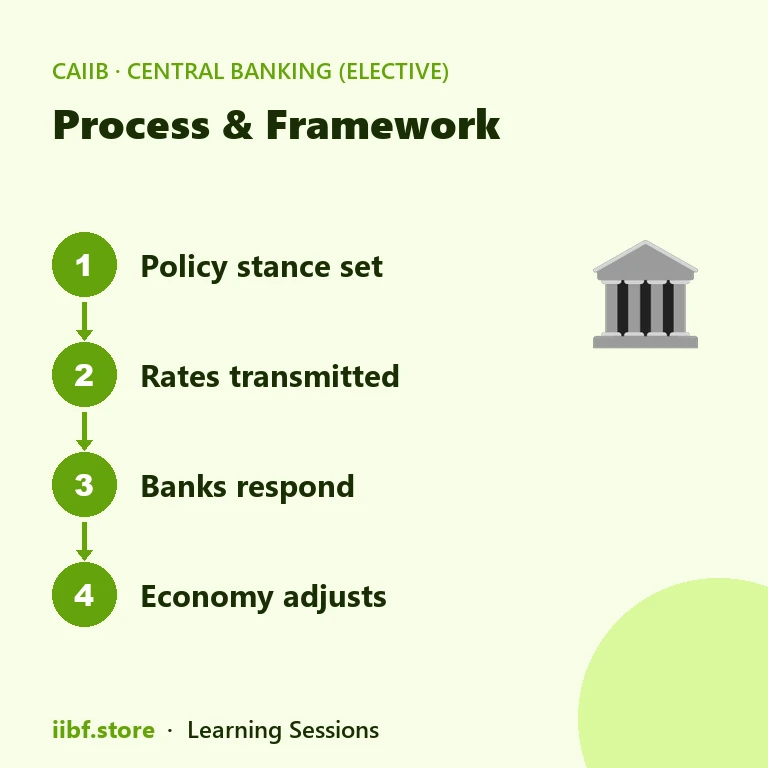
For working bankers, understanding the Liquidity Adjustment Facility Framework is not just an exam requirement — it directly affects treasury operations, fund management, and how a branch's daily cash position eventually rolls up into the bank's overall liquidity strategy.
For CAIIB candidates, LAF questions frequently connect to related governance topics, including how the Monetary Policy Committee structure sets the repo rate that anchors the entire corridor. It is worth studying both topics together rather than in isolation.
Liquidity management also connects to how banks price and manage other balance sheet items. For instance, the securitisation of standard assets covered in Bank Financial Management can free up a bank's balance sheet capacity, which in turn changes how much it needs to borrow through the LAF window on any given day.
Official RBI liquidity data and notifications are published directly at rbi.org.in, and it is worth bookmarking that source for the latest operational details, since exact repo rate levels change with each Monetary Policy Committee meeting.
📌 Remember: LAF is the daily mechanism, while the repo rate itself is only reset periodically by the Monetary Policy Committee — don't confuse the tool with the rate it operates around.
Explore more central banking topics on our Central Banking Elective tag hub, where every article on this subject is collected in one place for quick revision.
🧠 Practice MCQs: Liquidity Adjustment Facility Framework
Q1. What is the primary purpose of the Liquidity Adjustment Facility Framework? (a) To fix long-term lending rates for banks (b) To manage short-term liquidity and keep money market rates near the repo rate (c) To set foreign exchange reserves policy (d) To regulate bank branch licensing
Answer: (b) — LAF exists to smooth day-to-day liquidity mismatches and anchor short-term rates around the repo rate.
Q2. Which instrument under the LAF corridor allows banks to park surplus funds with RBI without offering any collateral? (a) Marginal Standing Facility (b) Repo (c) Standing Deposit Facility (d) Cash Reserve Ratio
Answer: (c) — The Standing Deposit Facility is uncollateralised, unlike repo, reverse repo, and MSF.
Q3. The Marginal Standing Facility allows a bank to borrow overnight from RBI by: (a) Dipping into its statutory liquidity ratio holdings (b) Borrowing unsecured from other banks (c) Issuing fresh equity shares (d) Accessing foreign currency swap lines
Answer: (a) — MSF lets banks borrow against SLR securities even after exhausting their normal repo limit.
Q4. Within the LAF interest rate corridor, which rate acts as RBI's main policy reference point? (a) Bank Rate (b) MCLR (c) Base Rate (d) Repo Rate
Answer: (d) — The repo rate sits in the middle of the corridor, with SDF as the floor and MSF as the ceiling.
Q5. When did RBI introduce the Standing Deposit Facility as part of the LAF corridor? (a) 2000 (b) 2011 (c) April 2022 (d) 2016
Answer: (c) — RBI introduced SDF in April 2022 to replace the fixed-rate reverse repo as the main absorption tool.
Want chapter-wise mock tests with 100+ MCQs? Start practising free →
❓ Frequently Asked Questions
What does LAF stand for in RBI's monetary policy operations?
LAF stands for Liquidity Adjustment Facility, the framework RBI uses to manage short-term liquidity through repo, reverse repo, MSF and SDF operations.
What is the difference between repo and reverse repo under LAF?
In repo, banks borrow cash from RBI against government securities. In reverse repo, banks lend surplus cash to RBI and earn interest on it overnight.
How is the Marginal Standing Facility different from ordinary repo?
MSF is an emergency overnight window banks use after exhausting their normal repo limit, drawing on their statutory liquidity ratio holdings as collateral.
Why did RBI introduce the Standing Deposit Facility?
RBI introduced SDF to absorb surplus liquidity without needing collateral, since the earlier reverse repo window was limited by the government securities RBI held.
The Liquidity Adjustment Facility Framework may look like a small operational detail, but it sits at the heart of how RBI keeps the Indian banking system liquid and stable every single day. Master this corridor for your CAIIB paper, and practise it further with our CAIIB course and topic-wise mock tests.
Prefer revising from a printed book?
Chapter-wise books with MCQs after every chapter — minimal pages, complete coverage, delivered anywhere in India. Every book has a free sample to read first.

































Quick quiz on this topic
5 exam-style questions from our free test bank — check yourself before you move on.
Practice this topic
Take a free mock test, download chapter PDFs, or watch a video class — all included on iibf.store.