Money Multiplier in India: Reserve Money, M3 and JAIIB IE & IFS
You are at the counter, a customer deposits Rs 50,000 in cash, and you post it without a second thought. Yet that single entry is the first link of a chain that economists have a name for: the money multiplier. If you are preparing for JAIIB Indian Economy and Indian Financial System (IE & IFS), the money multiplier in India is one of those topics where the concept is simple but the exam asks it from unexpected angles - a definition, a ratio, a small calculation or a statement-based question on what makes it rise or fall.
This article explains the money multiplier in India the way a senior colleague would: what reserve money is, how it connects to M3, the formula and its determinants, a worked example, and how IIBF frames questions on it.
Why the money multiplier matters to a banker and to the exam
The Reserve Bank of India (RBI) does not directly print the whole money supply you read about in newspapers. It creates a smaller base of money, and the banking system, through deposits and loans, builds a much larger stock of money on top of that base. The ratio between the two is the multiplier. When you understand it, you understand why a change in CRR, a surge in cash withdrawals or a spurt in lending changes the money supply even when the RBI has done nothing else.
For the JAIIB candidate, the topic sits inside the monetary policy and money supply part of the IE & IFS syllabus. It also connects to the RBI's monetary policy tools, which you may already know from our other posts on the free study material page. The money multiplier in India is the mechanism that links those tools to the actual money stock.
What is reserve money (M0)?
Reserve money is also called the monetary base, high-powered money or M0. It is the money that the RBI itself creates, and it forms the base on which the banking system builds deposits. As per the RBI's Reserve Money table in its Weekly Statistical Supplement, it has three components:
- Currency in circulation - notes and coins issued by the RBI that are with the public and with banks (cash in the vault counts here too).
- Bankers' deposits with the RBI - the balances scheduled banks maintain with the RBI, which include the cash reserve they must keep.
- 'Other' deposits with the RBI - small balances of institutions such as certain international bodies and some other agencies.
Reserve money is also described through its sources: the RBI's net credit to the Government, its credit to banks and to the commercial sector, its net foreign exchange assets and so on, less its net non-monetary liabilities. This explains why the RBI buying dollars, conducting open market purchases or lending to banks under repo all push reserve money up.
Why it is called high-powered
One rupee of reserve money does not stay as one rupee of money. A bank that receives it as a deposit can lend a part of it, and that loan comes back as another deposit somewhere else in the system. So one unit of base money supports several units of deposits. That is why it is called high-powered money.
What is M3 (broad money) as the RBI publishes it?
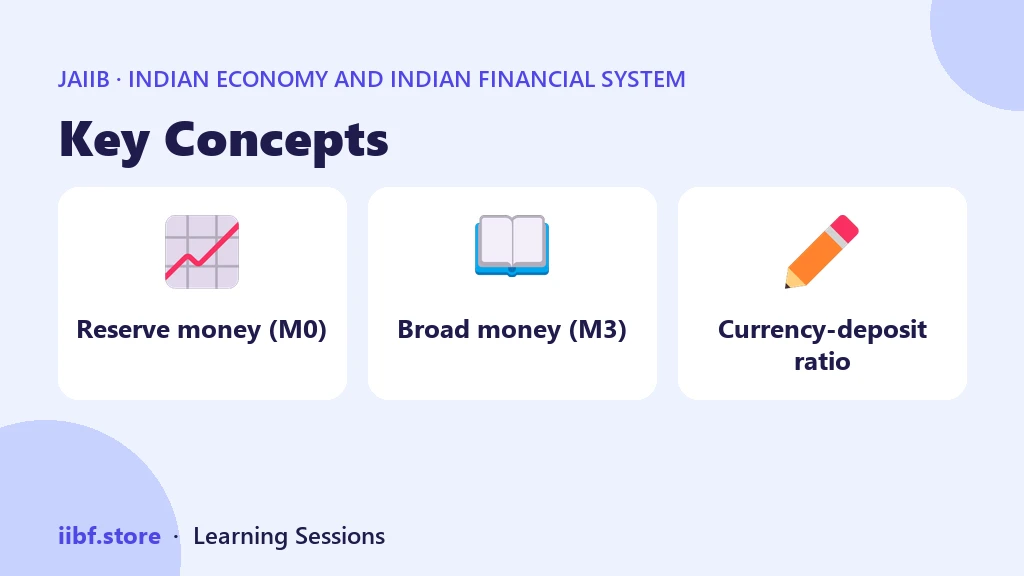
The RBI publishes the money stock as a table called Money Stock: Components and Sources. The components side shows exactly what M3 is made of. On the RBI's own table, M3 is the sum of:
- Currency with the public,
- Demand deposits with banks,
- Time deposits with banks, and
- 'Other' deposits with the Reserve Bank.
You can check this structure yourself in the RBI's Weekly Statistical Supplement extract. The narrow money aggregate M1 is currency with the public plus demand deposits with banks plus 'other' deposits with the RBI, so M3 is M1 plus time deposits with banks. The difference matters in the exam: the multiplier can be computed for narrow money or for broad money, and the question will tell you which one.
The sources side in one line
The same RBI table shows M3 from the sources side: net bank credit to the Government, bank credit to the commercial sector, net foreign exchange assets of the banking sector and other items, less non-monetary liabilities. This is the 'what created the money' view, whereas reserve money is the 'what the RBI created' view. Do not mix the two tables.
The money multiplier formula
In its simplest form, the money multiplier is the ratio of the money stock to reserve money:
Money multiplier (m) = M3 / Reserve money (M0), or equivalently, M3 = m x M0.
Because M3 is much larger than M0, the multiplier is greater than one. It tells you how many rupees of broad money the system carries for each rupee of base money. If you use M1 in the numerator you get the narrow money multiplier, and the answer is smaller.
The behavioural formula
Textbooks derive the multiplier from two behavioural ratios:
- Currency-deposit ratio (c) - how much cash the public prefers to hold compared with bank deposits.
- Reserve-deposit ratio (r) - how much of deposits banks hold as reserves (the statutory CRR plus any excess reserves).
The formula is m = (1 + c) / (c + r). Notice what it says. If the public wants to hold more cash, c rises and the multiplier falls. If banks must keep more reserves, r rises and the multiplier falls. If banks hold less excess cash because they are lending more freely, r falls and the multiplier rises.
The simplified version 1/CRR you may see in school notes is a teaching shortcut. It assumes nobody holds cash and banks keep exactly the required reserve. Real-world money multiplier in India is lower than that simple figure because people hold currency and banks keep other reserves. For the exam, use 1/CRR only if the question clearly says to ignore currency leakage.
How reserve money expands into M3, step by step
Follow the chain the way you would see it on the ground in a branch.
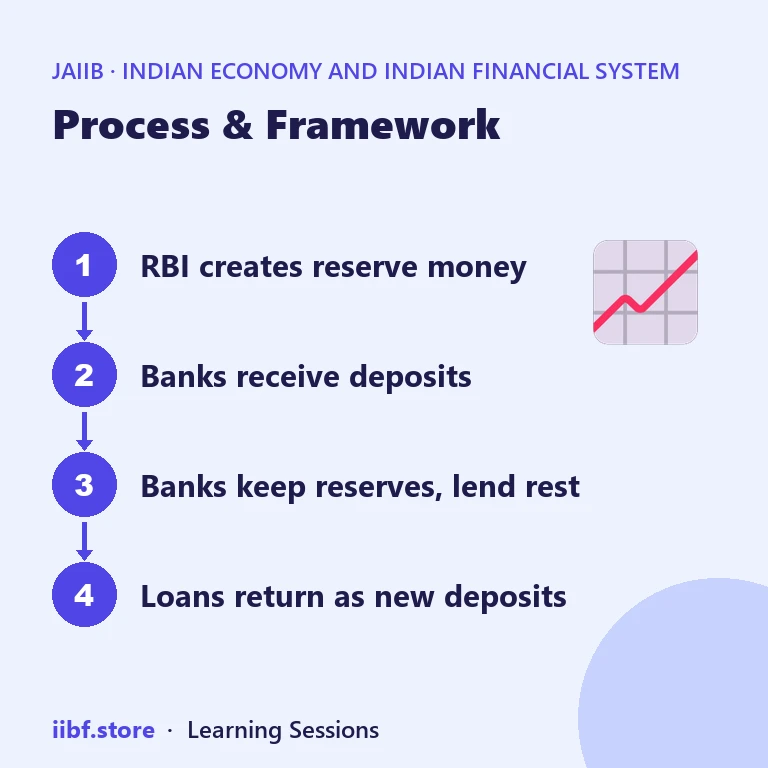
- The RBI adds to reserve money. For example, it buys government securities in an open market purchase or buys foreign currency. New balances reach banks.
- Banks receive deposits. Banks now have extra funds, and customers have extra deposits.
- Banks keep a reserve and lend the rest. They hold the required reserve (CRR) and whatever excess they prefer, and lend or invest the remainder.
- Loans come back as deposits. The borrower pays a supplier, who deposits the cheque in a bank. Deposits rise again.
- The cycle repeats with a leak. Each round is smaller because of cash held by the public and reserves kept by banks, until the total expansion is the multiplier times the original injection.
Worked example: calculating the money multiplier in India
Numbers below are illustrative, made up to practise the method. They are not RBI data.
Suppose reserve money is Rs 100 crore. The public holds currency equal to 15 per cent of deposits (c = 0.15). Banks hold reserves equal to 10 per cent of deposits in total, including CRR and excess (r = 0.10).
- m = (1 + 0.15) / (0.15 + 0.10) = 1.15 / 0.25 = 4.6
- Money stock = 4.6 x Rs 100 crore = Rs 460 crore
Now change one thing. Let the public become more cautious and hold cash equal to 25 per cent of deposits (c = 0.25), with r unchanged. Then m = 1.25 / 0.35, which is about 3.57, and the money stock falls to roughly Rs 357 crore, with no change in reserve money. This is the kind of reasoning the exam rewards: the same base, a different multiplier, a different money supply.
Summary table of what moves the multiplier
Use this table as a revision card for the money multiplier in India.
| Change | Effect on c or r | Effect on multiplier |
|---|---|---|
| Public prefers more cash (festival season, uncertainty) | c rises | Falls |
| RBI raises CRR | r rises | Falls |
| RBI cuts CRR | r falls | Rises |
| Banks keep larger excess reserves (weak credit demand) | r rises | Falls |
| Digital payments increase, less cash held | c falls | Rises |
| RBI injects reserve money (OMO purchase) | Base rises | Money stock rises by multiplier x injection |
Why the actual multiplier is not a fixed number
It is tempting to think of the money multiplier as a constant that the RBI can use like a lever. In practice it moves with behaviour. Cash demand in festival months, a change in CRR, banks' appetite to lend and the share of time deposits in total deposits all change it. That is why monetary policy works through interest rates and liquidity operations, such as the repo rate and the liquidity adjustment facility, and not by trying to hit a money supply target. You will see the same logic in the RBI's present monetary policy framework, where the focus is the policy rate and inflation.
Another subtle point: when the RBI buys foreign exchange, reserve money rises on the sources side. If it then sterilises through open market sales or the liquidity absorption window, reserve money falls back and the expansion is muted. The multiplier applies to whatever base is left.
How the JAIIB IE & IFS exam tests it
The IIBF exam tests concepts, not long derivations, but it likes definition-based and statement-based items. You can check the official scheme on the IIBF website and follow the full JAIIB Indian Economy and Indian Financial System course for the complete module. Typical patterns:
- Definition: which of the following is a component of reserve money?
- Ratio: the money multiplier is the ratio of M3 to which aggregate?
- Direction: what happens to the multiplier if the CRR is raised or the currency-deposit ratio rises?
- Calculation: given c and r, find m or the resulting money supply.
- Statements: which of the statements about M1, M3 and reserve money is correct?
Common traps
- Confusing reserve money (what the RBI creates) with M3 (what the banking system holds as money).
- Forgetting that currency held by banks as vault cash is part of currency in circulation but not part of currency with the public.
- Using 1/CRR when the question gives a currency-deposit ratio.
- Assuming a higher CRR raises the multiplier; it lowers it.
Practice MCQs
Q1. Reserve money consists of currency in circulation, bankers' deposits with the RBI and:
- Time deposits with banks
- 'Other' deposits with the RBI
- Net bank credit to the Government
- Bank credit to the commercial sector
Answer: (b). The three components of reserve money are currency in circulation, bankers' deposits and 'other' deposits with the RBI. Options (c) and (d) are items on the sources side of M3, and time deposits are part of M3 but not of reserve money.
Q2. If the reserve-deposit ratio rises while the currency-deposit ratio remains unchanged, the money multiplier will:
- Rise
- Fall
- Remain unchanged
- Become negative
Answer: (b). In m = (1 + c) / (c + r), a larger r increases the denominator and lowers m. Banks are retaining more of each deposit and lending less, so each round of expansion is smaller.
Q3. With c = 0.20 and r = 0.05, the money multiplier is:
- 4.8
- 5.0
- 20
- 1.25
Answer: (a). m = (1 + 0.20) / (0.20 + 0.05) = 1.20 / 0.25 = 4.8. Option (c) is the trap for those who use 1/r and forget currency leakage.
Quick revision points
- Reserve money (M0) = currency in circulation + bankers' deposits with the RBI + 'other' deposits with the RBI.
- M3 = currency with the public + demand deposits + time deposits + 'other' deposits with the RBI.
- Money multiplier = M3 / M0; behavioural form m = (1 + c) / (c + r).
- Higher c, higher CRR or higher excess reserves lower the multiplier.
- The multiplier is not constant, so the RBI uses rates and liquidity operations rather than a rigid money supply target.
- Practise such numerical items with the JAIIB mock tests and the chapter-wise MCQs in the IE & IFS printed book. Current offers are on the JAIIB offer page.
Frequently asked questions
What is the money multiplier in India?
It is the ratio of broad money (M3) to reserve money (M0). It shows how many rupees of money the banking system supports for each rupee of base money created by the RBI.
What are the components of reserve money?
Currency in circulation, bankers' deposits with the RBI and 'other' deposits with the RBI.
Does raising CRR increase or decrease the money multiplier?
It decreases it. A higher CRR raises the reserve-deposit ratio, so banks can lend less out of each deposit and the expansion is smaller.
Is the money multiplier the same as 1/CRR?
Only in a simplified model with no cash held by the public and no excess reserves. The fuller formula includes the currency-deposit ratio and is always lower than 1/CRR in practice.
Where can I see the RBI's M3 and reserve money data?
In the RBI Weekly Statistical Supplement and the Handbook of Statistics on the Indian Economy, available on rbi.org.in. See the WSS page.
Conclusion
The money multiplier in India is a short topic with a long reach: it links the RBI's balance sheet to the money in your customers' accounts. Remember the two tables (reserve money and the M3 components), the ratio M3 divided by M0, the behavioural formula and the direction of each factor. Work through two or three numerical items, and this part of IE & IFS becomes easy marks. For the official exam schedule, always check the IIBF website for the upcoming exam cycle.
Prefer revising from a printed book?
Chapter-wise books with MCQs after every chapter — minimal pages, complete coverage, delivered anywhere in India. Every book has a free sample to read first.


















































Quick quiz on this topic
5 exam-style questions from our free test bank — check yourself before you move on.
Practice this topic
Take a free mock test, download chapter PDFs, or watch a video class — all included on iibf.store.
Keep reading