Periodic Updation of KYC in Banks: Rules for Promotion Exams
It is the last week of the month, your branch manager forwards a list of 400 accounts whose KYC is overdue, and the head office wants it cleared. If you have ever been the officer handed that list, you already know that periodic updation of KYC in banks is not an academic topic. It is routine branch work, and that is exactly why promotion exams and interviews for PSB and IDBI officer-level posts keep returning to it.
This article explains the concept the way a senior colleague would: what the rule is, who decides how often an account is refreshed, what a branch actually does, and the traps that question-setters use. Keep one point in mind throughout: KYC is not a one-time form filled at account opening. It is a continuing obligation, and RBI wants it kept alive for the whole life of the relationship.
What periodic updation of KYC means
Know Your Customer (KYC) is the process by which a bank identifies a customer, verifies the identity and address, understands the nature of the business and records the information. Customer Due Diligence (CDD) is the wider set of procedures behind it. Periodic updation is the part of on-going due diligence in which the bank goes back to the customer at fixed intervals and checks that the KYC record is still correct and still meets the current standard.
The legal footing is the PML Act and Rules together with RBI's KYC framework. For many years that framework was the Master Direction on Know Your Customer (KYC) Direction, 2016. On 28 November 2025 RBI repealed that single Master Direction and moved to entity-specific Directions; for banks, references to the old Master Direction are now to be read as the Reserve Bank of India (Commercial Banks - Know Your Customer) Directions, 2025. When an exam question says "as per RBI KYC norms", this is the document behind it. The original wording on updation is still readable in the 2016 Master Direction on the RBI website.
The core rule in one line
Banks must follow a risk-based approach: the higher the money-laundering risk of the customer, the more frequently the KYC is refreshed. The cycle is counted from the date of account opening or from the date of the last KYC updation, whichever is later.
Why the exam cares
Questions on this topic are easy marks if you know three things cold: the three cycles, the fact that a self-declaration is enough when nothing has changed, and the due-notice drill. Those are exactly the parts a hurried candidate mixes up.
The risk-based cycle: 2, 8 and 10 years
Every customer is placed in a risk category at onboarding: low, medium or high. The category decides the interval. Under RBI's framework, periodic updation is to be carried out at least once in every two years for high-risk customers, once in every eight years for medium-risk customers and once in every ten years for low-risk customers.
Please verify the current paragraph of the Directions applicable to your own bank type before quoting it in an interview, because small finance banks and co-operative banks have their own Directions with their own paragraph numbers. For banks in the bank-promotion syllabus, the cycle above is the one to carry in your head.
Table: risk category and updation cycle
| Risk category | Minimum frequency of updation | Typical examples |
|---|---|---|
| High risk | At least once every 2 years | Politically exposed persons, customers with complex ownership, cash-intensive or high-risk-country linkages |
| Medium risk | At least once every 8 years | Customers whose profile or activity needs closer watch than a salaried account holder |
| Low risk | At least once every 10 years | Salaried employees, pensioners, ordinary savings account holders with a stable profile |
The examples in the last column are illustrative. The bank's own customer risk-categorisation policy, approved by its Board, decides who goes where. The exam tests the cycle, not the examples.
How updation is done: individuals and entities
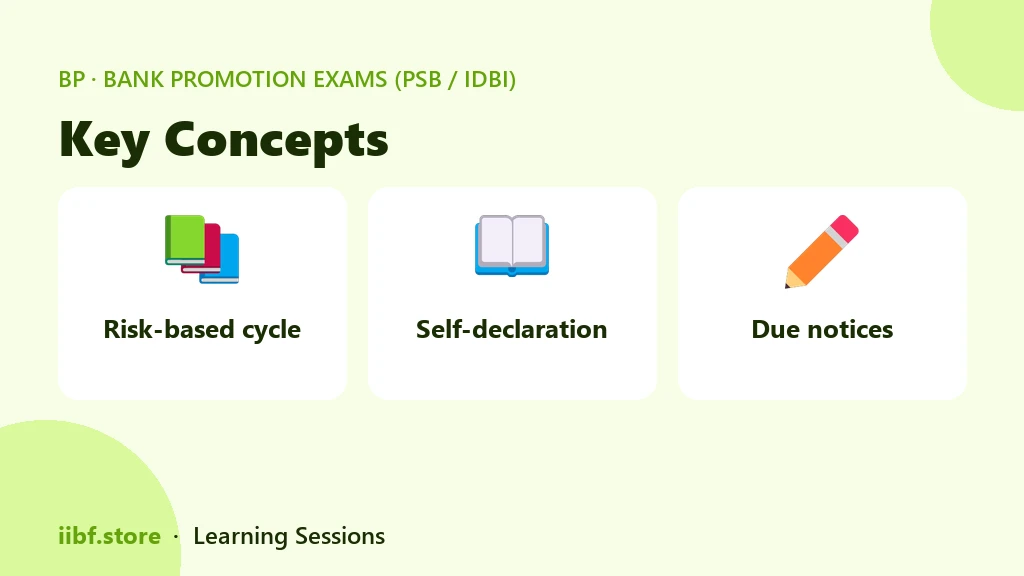
The method depends on whether anything has changed. This is where branch practice and exam theory meet.
Individual customers
- No change in KYC information: a self-declaration from the customer is enough. It can come through the registered email ID or registered mobile number, an ATM, a digital banking channel such as net banking or mobile banking, or a letter. The customer need not walk into the branch with fresh documents.
- Change in address: the customer gives the new address by self-declaration through the same channels, and the bank then verifies it by positive confirmation within two months, for example by an address verification letter or contact point verification.
- Minor who becomes a major: fresh photographs are taken on attaining majority, and the bank checks that the record meets the current CDD standard.
Customers other than individuals
- No change: a self-declaration through the registered email, a digital channel, a letter from an authorised official or a board resolution, together with a check that the beneficial ownership information is accurate and current.
- Change in KYC information: the bank carries out the KYC process equivalent to onboarding a new entity customer.
Two details that are often forgotten
First, during periodic updation the customer is migrated to the current CDD standard. An account opened years ago on older documents is brought up to today's requirements. Second, the bank uploads or updates the customer's KYC data on the Central KYC Records Registry (CKYCR) at the time of updation, or earlier if fresh information is received. If the customer's KYC Identifier can retrieve a complete and valid record from CKYCR, the bank should not insist on documents all over again unless information has changed, the record is incomplete or outdated, the documents have lapsed, or the bank needs them for verification or enhanced due diligence.
Step-by-step process for periodic updation of KYC in banks
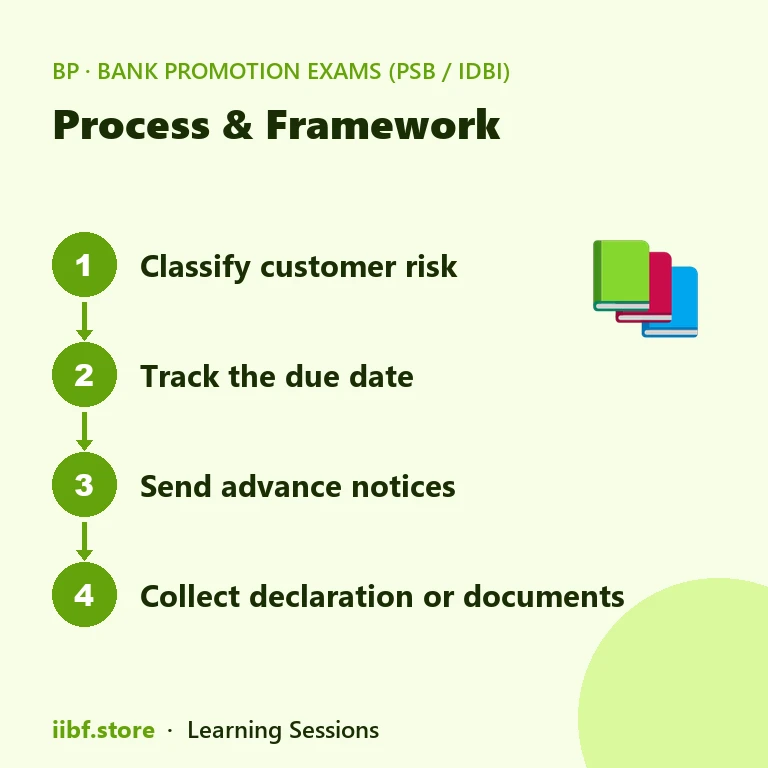
- Classify the customer. The risk category assigned at onboarding, and revised as the account behaves, fixes the cycle.
- Track the due date. Core banking systems flag accounts approaching their due date. The clock runs from account opening or the last updation.
- Send due notices. Before the due date the bank gives at least three advance intimations, including at least one by letter, at appropriate intervals. After the due date, customers who have not complied get at least three reminders, again including at least one by letter. The Directions required this arrangement to be in place from 1 January 2026.
- Collect the declaration or documents. Self-declaration if nothing has changed; fresh documents and verification if something has.
- Update records. Record the date of updation, intimate the customer, move the customer to the current CDD standard and update CKYCR.
Keep an audit trail of every notice. In an inspection, the first thing the auditor asks is not "is the account updated?" but "show me the intimations you sent."
A worked branch example
Take Mrs Meera Sharma, a retired teacher with a pension account opened in 2016 and categorised low risk. Her cycle is ten years, so her KYC falls due in 2026. In the months before the date the branch sends her three advance intimations, one of them by post. She replies from her registered mobile number that nothing has changed. The branch records the self-declaration, updates the date of last KYC updation and uploads the record to CKYCR. She never visits the branch.
Now take Vikram Traders, a cash-intensive firm categorised high risk because of the nature of its business and its transaction pattern. Its cycle is two years. At the second-year mark the branch asks for fresh information. The firm has added a new partner, so the information has changed and the branch must run the full KYC process as for a new entity, including beneficial ownership. The comparison shows the logic: low risk and no change means a light process; high risk and change means a full one.
How promotion exams test this topic
In bank promotion exams and the interviews that follow, periodic updation of KYC in banks shows up in four typical forms. You may see a direct recall question on the three cycles, a scenario in which a customer says nothing has changed and you must pick the correct method, a question on which notices a bank must send, or a statement-based question asking which of two or three statements is correct. The IBPS-style banking awareness section and the professional knowledge papers for PSB and IDBI promotions both draw on KYC and AML.
Common traps
- Reversing the cycles. High risk is the shortest interval (two years), low risk the longest (ten).
- Assuming documents are always required. When there is no change, a self-declaration is enough.
- Forgetting that a change of address needs verification by positive confirmation within two months.
- Mixing up KYC onboarding with KYC updation. Updation is part of on-going due diligence, not account opening.
- Quoting the repealed 2016 Master Direction as the current document. The current source for commercial banks is the 2025 Directions.
Practice MCQs on periodic updation of KYC in banks
Q1. As per RBI's risk-based framework, the minimum frequency of KYC updation for a medium-risk customer is (a) every 2 years (b) every 5 years (c) every 8 years (d) every 10 years.
Answer: (c). Medium risk is the middle tier, with an eight-year cycle. Two years belongs to high risk and ten years to low risk, so options (a) and (d) are the classic distractors.
Q2. An individual customer's KYC is due but nothing has changed. The bank should ordinarily (a) close the account (b) ask for all documents afresh in person (c) accept a self-declaration through registered email, mobile, ATM, digital channel or letter (d) freeze all transactions.
Answer: (c). The Directions allow a self-declaration where there is no change. Closing or freezing the account on this ground alone is not the prescribed response.
Q3. Before the due date of updation, a bank must send at least (a) one SMS (b) two emails (c) three advance intimations including at least one by letter (d) no intimation.
Answer: (c). Three advance intimations with at least one letter, followed after the due date by at least three reminders for non-compliant customers, also including one letter.
Quick revision points
- For periodic updation of KYC in banks, the risk-based cycle is 2 years (high), 8 years (medium), 10 years (low), counted from opening or last updation.
- No change: self-declaration via registered email or mobile, ATM, digital channel or letter.
- Address change: declaration plus positive confirmation within two months.
- Non-individuals: self-declaration or board resolution if unchanged; full onboarding-level KYC if changed.
- Three advance notices and three reminders, at least one of each by letter.
- Migrate to current CDD standard and update CKYCR at updation.
- Commercial banks now follow the Commercial Banks KYC Directions, 2025, which replaced the 2016 Master Direction on 28 November 2025.
If you want this topic inside a complete plan, the bank promotion exam course covers KYC, AML and the other banking-awareness areas chapter by chapter, and the bank promotion printed books give you MCQs to revise on the bus or in the staff room. Check the current bank promotion offer page for what is included right now. When you finish a chapter, attempt the bank promotion mock tests to check that the cycles and notice rules have stuck. For official schedules and notices, always rely on IIBF's website.
Frequently asked questions
How often must a bank refresh the KYC of a customer?
It depends on the customer's risk category: at least once every two years for high-risk, every eight years for medium-risk and every ten years for low-risk customers, counted from account opening or the last KYC updation.
Does a customer have to visit the branch for KYC updation?
Not if nothing has changed. An individual can give a self-declaration through a registered email ID or mobile number, an ATM, a digital banking channel or a letter. If the address has changed, the new address is declared and the bank verifies it by positive confirmation within two months.
What notices must a bank send before KYC becomes due?
At least three advance intimations before the due date, including at least one by letter, and at least three reminders after the due date to customers who have not complied, again including at least one by letter.
Is the 2016 KYC Master Direction still in force?
No. RBI repealed it on 28 November 2025. For commercial banks, references to it are now read as the Reserve Bank of India (Commercial Banks - Know Your Customer) Directions, 2025. Always check the current version on the RBI website before quoting a paragraph.
What happens to the customer's record in CKYCR at updation?
The bank uploads or updates the customer's KYC data on the Central KYC Records Registry at the time of periodic updation, or earlier if updated information is received. The customer is also moved to the current CDD standard.
Conclusion
Periodic updation of KYC in banks looks like routine paperwork, but it is a favourite examination topic because it rewards clean, structured knowledge: three cycles, two methods, a notice drill and a documented audit trail. Learn the risk-based logic first, and the numbers will follow. Revise it once a week alongside AML and customer due diligence, solve a few scenario MCQs, and you will be able to answer it at the written stage and explain it confidently in the interview.
Prefer revising from a printed book?
Chapter-wise books with MCQs after every chapter — minimal pages, complete coverage, delivered anywhere in India. Every book has a free sample to read first.


















































Quick quiz on this topic
5 exam-style questions from our free test bank — check yourself before you move on.
Practice this topic
Take a free mock test, download chapter PDFs, or watch a video class — all included on iibf.store.
Keep reading