NBFC Regulatory Framework in India: CAIIB BRBL 2026 Guide

The NBFC regulatory framework is one of the most frequently tested areas in CAIIB's Banking Regulations and Business Laws paper, because non-banking finance companies now originate a huge share of retail and MSME credit in India. Candidates often confuse NBFC rules with bank regulation under the Banking Regulation Act, but RBI treats the two as distinct regimes with their own registration, capital, and supervisory ladders. This guide breaks down the current scale-based structure so you can answer both direct and applied exam questions with confidence.
🏛️ What the NBFC Regulatory Framework Actually Covers
An NBFC is a company registered under the Companies Act that carries on the business of loans, advances, or acquisition of shares/stocks/bonds, but does not hold a banking licence and cannot accept demand deposits. The legal foundation sits in Chapter IIIB of the RBI Act, 1934, which empowers the Reserve Bank to register, regulate, and if needed wind up NBFCs. Historically NBFCs were regulated more lightly than banks, but after large defaults exposed system-wide contagion risk, RBI moved to a harmonised, risk-based structure that scales obligations with an entity's size and interconnectedness rather than applying one flat rulebook to every player.
This matters for exam purposes because questions frequently test the rationale for differential regulation — you are expected to explain why a small asset-finance NBFC and a systemically important non-deposit-taking NBFC (NBFC-ND-SI) do not face identical compliance burdens, and how that graded approach still preserves financial stability. Understanding the underlying philosophy makes it far easier to recall the specific layers described in the next section, instead of memorising them as an arbitrary list.
📊 Scale-Based Regulation: The Four Layers
RBI's Scale-Based Regulation (SBR) framework organises every NBFC into one of four layers — Base, Middle, Upper, and Top — based on asset size, systemic footprint, and product mix. As an entity moves up a layer, it takes on progressively bank-like obligations: tighter capital norms, board-approved policies, and closer supervisory engagement. The Top Layer is intentionally left empty unless RBI decides a specific NBFC in the Upper Layer poses outsized systemic risk, giving the regulator a deliberate escalation tool rather than a fixed category.
The table below summarises the four layers as they are commonly tested in CAIIB — pay attention to which layer requires stock exchange listing, since that single fact is a favourite one-mark question.
| Layer | Typical Coverage | Regulatory Intensity | Listing Required |
|---|---|---|---|
| Base Layer (NBFC-BL) | Non-deposit taking, asset size below ₹1,000 crore | Light-touch, basic prudential norms | ❌ |
| Middle Layer (NBFC-ML) | Deposit-taking NBFCs and non-deposit NBFCs above the base threshold | Bank-like prudential norms, board oversight | ❌ |
| Upper Layer (NBFC-UL) | Top 25-30 NBFCs identified by RBI on a scoring methodology | Enhanced regulatory requirements, differentiated corporate governance | ✅ |
| Top Layer (NBFC-TL) | Reserved for entities RBI flags as carrying extreme systemic risk | Bank-equivalent regulation | ✅ |
💡 Exam Tip: Only NBFC-Upper Layer entities are mandatorily required to get listed within three years of identification — the Base and Middle Layers are not.
📝 Registration and Compliance Requirements for NBFCs
Every company intending to commence NBFC business must obtain a Certificate of Registration from RBI, which involves minimum net-owned-fund criteria, a fit-and-proper assessment of directors, and a viable business plan. Once registered, an NBFC steps into a continuing compliance chain: maintenance of statutory liquidity in approved instruments where applicable, periodic prudential returns to RBI's XBRL-based reporting platform, adherence to fair practices code for lending, and — depending on layer — a dedicated Risk Management Committee and Chief Compliance Officer.
You can trace how this compliance architecture connects to the broader regulation of banking business chapter, since many prudential concepts — capital adequacy, asset classification, provisioning — are lifted almost directly from bank regulation and adapted for NBFC balance sheets. The chapter on NBFC classification and regulation goes deeper into the category-wise rules (asset finance, investment, infrastructure finance, microfinance, and housing finance companies now also under RBI's NBFC umbrella).
⚠️ Common Mistake: Candidates often assume all NBFCs can accept public deposits — only specifically authorised deposit-taking NBFCs (NBFC-D) may do so, and they need an additional certificate for it.
🔍 NBFC vs Bank: Where the Rules Diverge
Even with SBR narrowing the gap, core differences remain examinable. NBFCs cannot issue cheques drawn on themselves, cannot participate in the payment and settlement system the way banks do, and — critically — are not covered by deposit insurance from DICGC even when they do accept deposits. Capital adequacy is measured for NBFCs too, but the minimum Capital-to-Risk-weighted-Assets Ratio and its calculation nuances differ from the Basel-aligned norms applied to commercial banks.
Another tested divergence concerns resolution. Where a bank's control over organisation of banks chapter covers RBI's moratorium powers, NBFC resolution instead runs mainly through the IBC framework plus RBI's own NBFC resolution regulations — a parallel toolkit, not the identical bank provisions.
⚖️ RBI's Supervisory and Enforcement Powers Over NBFCs
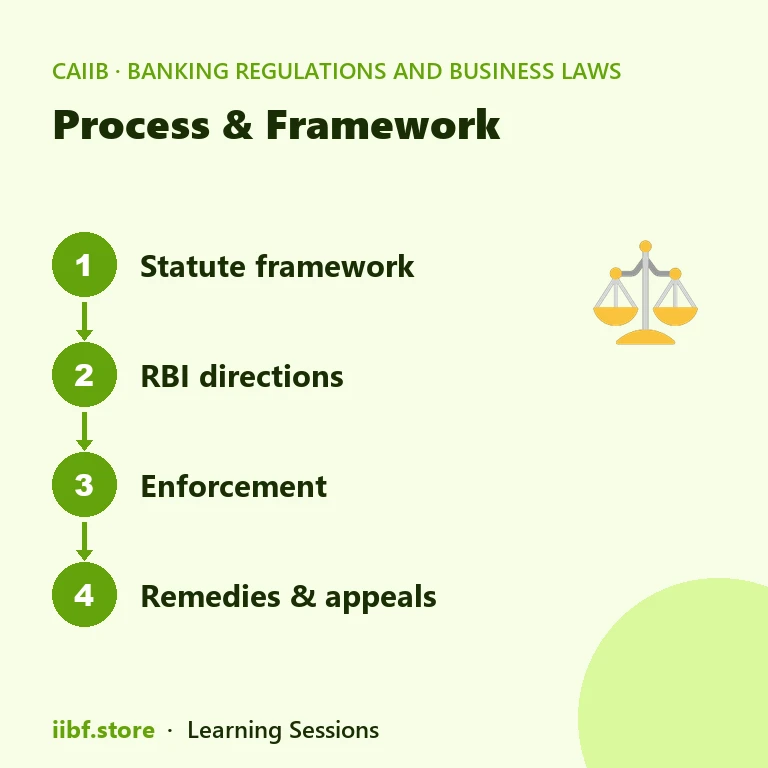
RBI supervises NBFCs through onsite inspections, offsite surveillance based on periodic returns, and market intelligence, with enforcement powers that include cancellation of the Certificate of Registration, restrictions on accepting deposits, monetary penalties, and directions to specific officers. For Upper Layer NBFCs, RBI additionally prescribes a differentiated regulatory framework covering internal capital adequacy assessment and mandatory constitution of specific board committees, mirroring the supervisory rigour applied to banks.
These powers sit alongside the broader architecture in the Financial Sector Legislative Reforms and Financial Stability and Development Council chapter, since FSDC coordinates oversight across RBI, SEBI, and other regulators wherever NBFC activity touches securities or insurance markets. For the exact scope of these powers, see the RBI Master Directions on Non-Banking Financial Companies.
📌 Remember: RBI can supersede an NBFC's board under statutory powers similar to those it holds for banks — this is a recurring true/false question in CAIIB.
Regulators are also increasingly linking NBFC oversight with other digital-first supervisory tools; if you want the connected picture on how technology interfaces are regulated across lending and payments, the API banking in India guide from the IT, Digital Banking and Fintech paper is a useful cross-read before your CAIIB attempt.

🧠 Practice MCQs: NBFC Regulatory Framework
Q1. Under RBI's Scale-Based Regulation framework, which layer is left vacant unless a specific NBFC is identified as carrying extreme systemic risk? (a) Base Layer (b) Middle Layer (c) Upper Layer (d) Top Layer
Answer: (d) — The Top Layer remains conceptually empty and is populated only if RBI moves a specific Upper Layer NBFC into it.
Q2. Which NBFC layer carries a mandatory stock exchange listing requirement within three years of identification? (a) Base Layer (b) Middle Layer (c) Upper Layer (d) None of the above
Answer: (c) — NBFC-Upper Layer entities must get listed within three years of being identified in that layer.
Q3. The legal provisions enabling RBI to register and regulate NBFCs are primarily contained in which statute? (a) Companies Act, 2013 (b) Banking Regulation Act, 1949 (c) RBI Act, 1934 (d) SARFAESI Act, 2002
Answer: (c) — Chapter IIIB of the RBI Act, 1934 gives RBI the power to register, regulate, and act against NBFCs.
Q4. Deposits accepted by an NBFC-D are covered by DICGC deposit insurance. Is this statement correct? (a) Yes, always (b) No, NBFC deposits are not covered by DICGC insurance (c) Only for Upper Layer NBFCs (d) Only for government-owned NBFCs
Answer: (b) — Unlike bank deposits, NBFC deposits are not covered by DICGC insurance regardless of layer.
Q5. Which of the following is NOT typically a supervisory enforcement power available to RBI over an NBFC? (a) Cancellation of Certificate of Registration (b) Monetary penalties (c) Direct issuance of currency notes by the NBFC (d) Restriction on accepting public deposits
Answer: (c) — Currency issuance is an RBI monopoly function; it is never delegated to any NBFC regardless of layer.
Want chapter-wise mock tests with 100+ MCQs? Start practising free →
FAQs
What is the difference between an NBFC and a bank?
An NBFC cannot accept demand deposits, cannot issue cheques on itself, and is not part of the payment settlement system, whereas a bank can do all three under its banking licence.
How many layers does the NBFC regulatory framework have?
RBI's Scale-Based Regulation framework has four layers — Base, Middle, Upper, and Top — with regulatory intensity increasing at each level.
Which NBFCs are required to list on a stock exchange?
Only NBFCs identified in the Upper Layer must get listed on a stock exchange within three years of being placed in that layer.
Are NBFC deposits protected by deposit insurance?
No. Deposits with NBFC-D companies are not covered by DICGC deposit insurance, unlike deposits held with banks.
Mastering the NBFC regulatory framework alongside related topics like Banking Regulation Act 1949, PMLA obligations for banks, and SARFAESI Act 2002 gives you full coverage of CAIIB's Banking Regulations and Business Laws paper. Ready to test yourself? Attempt a full chapter-wise mock at the CAIIB course page and track your readiness before exam day.
Quick quiz on this topic
5 exam-style questions from our free test bank — check yourself before you move on.
Practice this topic
Take a free mock test, download chapter PDFs, or watch a video class — all included on iibf.store.
Keep reading