Nostro and Vostro Account Reconciliation in Treasury Management
Every JAIIB and CAIIB Treasury Management candidate eventually runs into a line item that refuses to match: a credit sitting in the bank's own books with no corresponding entry on the correspondent's statement. This is exactly where nostro and vostro account reconciliation earns its place as one of the most exam-relevant, and most operationally critical, processes in a bank's treasury back office. Reconciliation is not paperwork bolted onto forex dealing — it is the control layer that confirms every cross-border settlement actually happened the way the deal ticket said it would. This article walks through what nostro and vostro accounts are, how daily reconciliation actually runs, the common breaks examiners love to test, and where this data feeds into the wider treasury and ALM framework.
🏦 What Nostro and Vostro Accounts Mean for a Bank's Treasury
A nostro account is a foreign-currency account that a domestic bank maintains with a correspondent bank abroad — literally "our account with you." When an Indian bank needs to settle a US dollar payment, it routes the transaction through its dollar nostro held with a correspondent in New York or London. The mirror image of the same account, viewed from the correspondent bank's ledger, is called a vostro account — "your account with us." A rupee account that a foreign bank maintains with an Indian bank for its INR settlements is a classic vostro example. Understanding this pairing is foundational to the broader study of treasury operations, because almost every cross-border trade, remittance, or forex deal ultimately settles through one of these correspondent relationships.
These accounts sit at the intersection of the dealing room and the back office. The front office negotiates and books the forex deal; the back office instructs settlement through the appropriate nostro; and reconciliation confirms the money actually moved. Candidates preparing for exams should connect this to the wider foreign exchange market chapter, since nostro-vostro plumbing is what makes spot, forward, and swap settlements possible across currencies and time zones.
💡 Exam Tip: Remember the mnemonic — Nostro = "our account, their books, our view"; Vostro = "your account, our books, your view." The same physical account is called differently depending on who is describing it.
📊 The Daily Nostro-Vostro Reconciliation Process
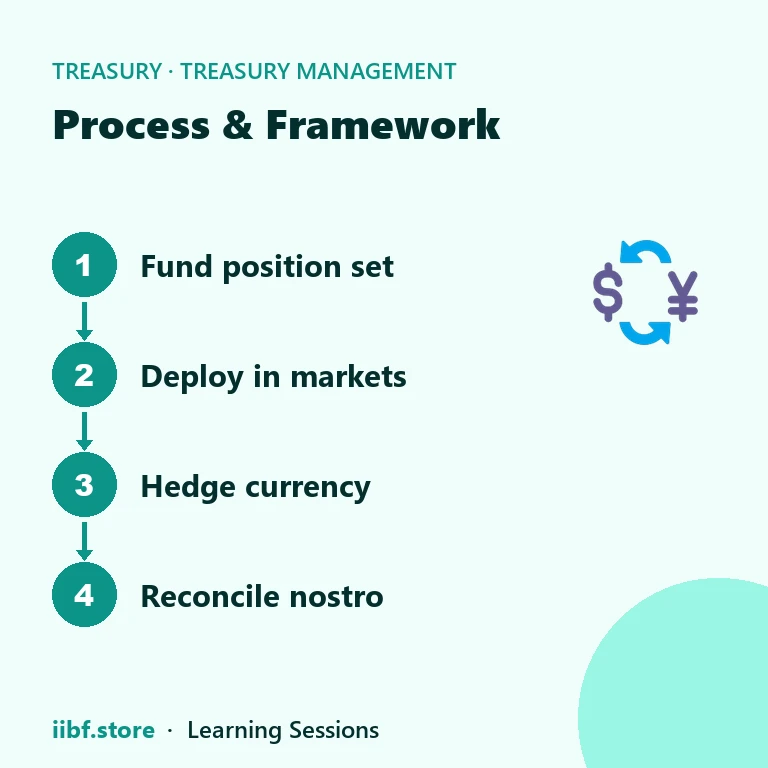
Reconciliation compares two independent records of the same account: the bank's own general ledger entries for that nostro, and the statement (typically a SWIFT MT950 or MT940 message) sent by the correspondent bank. Every debit and credit on one side must find a matching entry on the other, on the same value date, for the same amount. In a modern treasury, this matching is largely automated through a reconciliation system that auto-matches high-confidence pairs by amount, date, and reference number, leaving only genuine exceptions for manual investigation by back-office staff.
Where matching fails, the item becomes an "open" or "outstanding" entry and is aged from the date it first appeared. Ageing buckets typically run same-day, one-to-two days, three-to-seven days, and beyond a week, with each escalating band triggering a higher level of management attention. The Reserve Bank of India's supervisory expectations, reflected in FEMA-linked reporting and internal control guidelines published on the Reserve Bank of India website, require banks to reconcile nostro balances promptly and to report long-outstanding entries through internal control committees, since unexplained old items are a classic early indicator of either operational error or potential fraud.
| Break Type | Typical Cause | Normal Resolution Window | Immediate Escalation Needed? |
|---|---|---|---|
| Value-date mismatch | Correspondent applies a different settlement date than booked | Same day to T+1 | ❌ No |
| Amount mismatch | Currency conversion, rounding, or incorrect deal amount | T+1 to T+2 | ✅ Yes |
| Missing or duplicate entry | Instruction sent twice, or not sent at all | T+1 | ✅ Yes |
| Bank charges/commission difference | Correspondent deducts fees before crediting | Same day, adjustment entry | ❌ No |
⚠️ Common Reconciliation Breaks and How Treasury Controls Them
The most exam-tested break categories are timing differences, amount differences, and missing entries — but the operationally dangerous ones are unexplained old items. A timing difference simply means the two banks recorded the same transaction on adjacent value dates and will self-correct once both statements catch up; these are low risk and rarely need escalation. Amount differences are more serious, since they can point to a wrong exchange rate being applied, a data-entry error in the deal ticket, or a genuine dispute with the correspondent that needs to be raised formally.
Missing or duplicate entries are the riskiest category because they can indicate a fraudulent instruction, a failed SWIFT message, or a broken interface between the treasury's core system and the messaging gateway. Sound treasury control requires strict segregation of duties: the person who books a deal in the front office cannot also be the person who confirms its settlement in reconciliation, and the person investigating a break cannot unilaterally pass the adjusting entry without a second signatory. This three-way separation between dealing, confirmation, and reconciliation is precisely the control discipline examiners expect candidates to describe when asked about treasury operational risk.
⚠️ Common Mistake: Students often assume reconciliation is purely a back-office bookkeeping task. In reality it is a frontline fraud-detection control, and an old unexplained nostro item is treated with the same urgency as a suspicious transaction alert.
🔗 Nostro-Vostro Data in the Integrated Treasury and ALM Interface
Reconciled nostro and vostro balances do not stay confined to the back office — they feed directly into the bank's integrated treasury framework, where domestic and forex operations are managed under one unified risk and funding view. A dealer cannot accurately assess the bank's overnight foreign-currency funding position, or feed a correct number into the Asset-Liability Management interface, unless the nostro balances underlying that position have been reconciled and confirmed for the day. Unreconciled or stale nostro data distorts the liquidity and gap statements that ALM committees rely on, which is why banks insist on same-day reconciliation before end-of-day treasury reporting is finalised.
This is also where reconciliation intersects with day-to-day cash and liquidity planning discussed in our companion piece on treasury liquidity management, and with the settlement discipline covered in treasury back office operations. The dealing decisions that create these nostro flows in the first place are captured at the point of trade, a process detailed in our article on treasury front office operations. Just as equity trades ultimately settle through depositories, a mechanism examined in our JAIIB IEIFS piece on stock exchanges and depositories in India, forex trades settle through the correspondent banking rails represented by nostro and vostro accounts — different market, same underlying idea of a trusted settlement intermediary. For the fundamentals of how these markets connect, revisit our chapter on the financial market.
📌 Remember: Nostro-vostro reconciliation is a daily control, not a periodic audit exercise — every trading day's forex settlements must be confirmed before the treasury's overnight funding and liquidity numbers can be trusted.
🧠 Practice MCQs: Nostro and Vostro Account Reconciliation
Q1. A Nostro account is best described as (a) an account maintained by a bank with its overseas correspondent bank, held in foreign currency (b) an account maintained by a foreign bank with a domestic bank, held in domestic currency (c) an internal suspense account used only for forex trade cancellations (d) a rupee account held abroad by a domestic corporate
Answer: (a) — Nostro literally means "our account with you"; it is the domestic bank's own foreign-currency account held with its overseas correspondent.
Q2. The same account referred to in Q1, when described from the correspondent bank's own books, is termed (a) Nostro (b) Vostro (c) Loro (d) Mirror account
Answer: (b) — Vostro means "your account with us"; it is the correspondent's description of the identical account. Loro is used when a third bank refers to another bank's account held with a correspondent.
Q3. A debit entry recorded in the bank's own nostro ledger that has not yet appeared on the correspondent's statement is classified during reconciliation as (a) a closed and settled item (b) an outstanding or unmatched entry pending confirmation (c) a written-off entry (d) a suspense credit
Answer: (b) — Until both sides show the matching entry, it remains an open, unmatched item that must be tracked and aged.
Q4. The PRIMARY objective of daily nostro reconciliation in a bank's treasury back office is to (a) compute daily profit and loss on equity trades (b) identify unmatched forex settlement entries promptly to control operational and fraud risk (c) fix the overnight call money rate (d) calculate the bank's capital adequacy ratio
Answer: (b) — Daily reconciliation exists chiefly to catch settlement mismatches early, before they can compound into fraud or funding-position errors.
Q5. An unreconciled nostro entry that remains outstanding for an unusually long period without explanation should be escalated primarily through (a) the front office dealing desk alone (b) the treasury middle office/back office reconciliation and internal control process (c) the branch cash department (d) the statutory auditor, once a year during the annual audit
Answer: (b) — Ageing exceptions are an internal control matter that must be escalated through the reconciliation and risk-control chain well before any annual audit cycle.
Want chapter-wise mock tests with 100+ MCQs? Start practising free →
Frequently Asked Questions
What is the difference between a nostro and a vostro account?
They describe the same account from two different viewpoints: nostro is how the account-holding bank refers to its own foreign-currency account abroad, while vostro is how the correspondent bank refers to that same account on its own books.
Why is nostro reconciliation done daily rather than monthly?
Forex settlements happen every business day, and an unmatched entry can indicate a funding shortfall, a booking error, or fraud. Daily reconciliation catches these issues before they affect the bank's overnight liquidity position or compound into larger discrepancies.
What message format do correspondent banks typically use to send nostro statements?
Most correspondent banks send account statements via SWIFT MT950 (statement message) or MT940 (customer statement message), which treasury reconciliation systems ingest and auto-match against internal ledger entries.
Who is responsible for resolving nostro reconciliation breaks in a bank?
Resolution sits with the treasury back office and middle office control functions, kept strictly separate from the front-office dealers who booked the original transaction, to preserve segregation of duties.
Nostro and vostro account reconciliation may look like a purely administrative back-office task, but it is one of the strongest control mechanisms a bank's treasury has against settlement failure and fraud. For CAIIB and JAIIB candidates, mastering how these accounts pair up, how breaks are aged and escalated, and how reconciled data flows into the integrated treasury and ALM process is essential exam ground. Reinforce these concepts with topic-wise practice on our CAIIB course, attempt a full mock test today, or browse the full Treasury Management article archive for related topics.
Practice this topic
Take a free mock test, download chapter PDFs, or watch a video class — all included on iibf.store.