CIRP Timeline Under IBC: Key Deadlines for JAIIB & CAIIB

The CIRP timeline under IBC is one of the most tested areas in the Insolvency and Bankruptcy Code 2016 syllabus, and for good reason. Every stage of the Corporate Insolvency Resolution Process runs against a hard clock, and bankers who miss the numbers in an exam almost always mix up the base period with the outer limit. This article breaks the deadlines down stage by stage, explains what happens when they slip, and gives you five practice MCQs to lock the numbers in before your JAIIB or CAIIB paper.
Before the clock even starts, an applicant — financial creditor, operational creditor or the corporate debtor itself — must first get the Adjudicating Authority to admit the case. That single admission order fixes the insolvency commencement date, and everything downstream is measured from it. Understanding this sequencing is covered in detail in the Initiation Of Corporate Insolvency Resolution Process (CIRP) chapter, and the companion chapter on Commencement Of CIRP walks through exactly how that date gets fixed.
📅 What Is the CIRP Timeline Under IBC
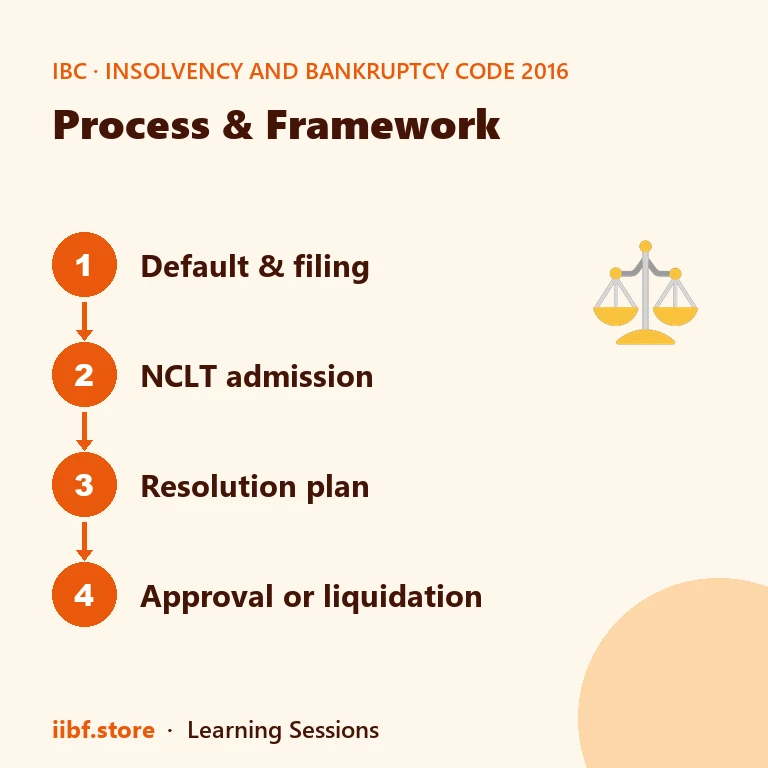
Section 12 of the Code sets the base rule: CIRP must be completed within 180 days of the insolvency commencement date. That period covers everything from the public announcement of the case to the Committee of Creditors approving (or rejecting) a resolution plan. It is not a soft target — the Adjudicating Authority tracks it, and the resolution professional has to report progress against it at every hearing.
The 180 days is not the whole story, though. Parliament built in a one-time extension of up to 90 days, taking the maximum to 270 days, and then the Supreme Court layered an outer limit of 330 days on top of that through the 2019 amendment to Section 12. Students often assume 270 days is the hard ceiling — it is not. The 330-day figure includes any time consumed in litigation, and that distinction is a favourite trap in IIBF question papers.
The structural logic behind these deadlines — why the Code chose a time-bound process instead of the open-ended recovery routes under earlier laws — is explained well in the Chapter 4 - Structure Of The IBC chapter. Reading that alongside the timeline provisions makes the "why" behind each deadline much easier to remember.
⏱️ Stage-by-Stage Breakdown of CIRP Deadlines
Once you separate the process into its component stages, the numbers stop feeling arbitrary. Each stage exists to give a specific stakeholder — the Adjudicating Authority, the creditors, the resolution professional — a fixed window to act, so that no single party can stall the process indefinitely.
The table below lists the stages in the order they occur, with the timeline that applies to each one under the Code and the regulations issued by the Insolvency and Bankruptcy Board of India.
| Stage | Timeline | Extendable? |
|---|---|---|
| Admission/rejection of application by NCLT | 14 days from filing | ❌ No |
| Public announcement of CIRP | Within 3 days of admission | ❌ No |
| Submission of claims by creditors | 14 days from public announcement | Case-specific |
| Constitution of Committee of Creditors | Within 7 days of claim collation | ❌ No |
| Base CIRP completion | 180 days from commencement | ✅ Yes, once |
| One-time extension | Up to +90 days (max 270 days) | ✅ With 66% CoC vote |
| Outer limit including litigation | 330 days total | Only in exceptional cases |
Two things are worth memorising for the exam: the extension beyond 180 days needs a resolution passed by at least 66% of the voting share of the Committee of Creditors, and only the Adjudicating Authority — never the resolution professional on their own — can actually grant it. The roles that sit behind these approvals are explained in the Roles And Duties Of IRP And RP chapter.
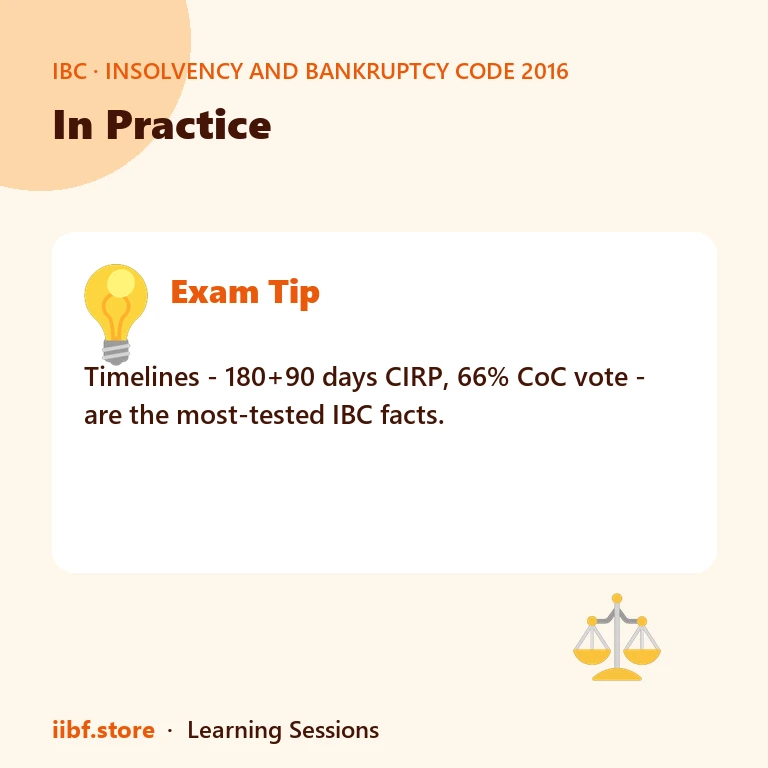
💡 Exam Tip: If a question gives you a scenario with a specific number of days, first check whether it is asking about the base period (180), the one-time extension ceiling (270), or the absolute outer limit (330). These three numbers are tested interchangeably.
⚖️ Extensions, Litigation, and the 330-Day Outer Limit
The 330-day figure did not exist in the original 2016 Code. It was added by the Insolvency and Bankruptcy Code (Amendment) Act, 2019, after courts noticed that resolution processes were routinely dragging on well past 270 days because of appeals, stay orders and procedural challenges filed by promoters or dissatisfied bidders.
The Supreme Court examined this exact issue and held that while 330 days is the general outer limit, it cannot be applied so rigidly that a viable resolution plan gets thrown out purely because litigation ate up the clock. In rare and exceptional circumstances, the Adjudicating Authority can permit CIRP to continue beyond 330 days if doing so genuinely serves the resolution of the corporate debtor rather than its liquidation.
For exam purposes, remember the hierarchy: 180 days is the default, 270 days is the ceiling for a CoC-approved extension, and 330 days is the absolute limit that includes time lost to litigation — breachable only in narrow, judicially recognised exceptions. Getting this sequence right resolves most timeline-based MCQs instantly.
It also helps to connect this to how CIRP begins in the first place, since a delayed admission order eats into the same clock. The Credit Recovery Laws For Banks chapter is a useful companion here, since it places IBC timelines alongside the older recovery mechanisms bankers used before 2016.
⚠️ Common Mistake: Candidates frequently write "CIRP must complete within 270 days" as if that were the statutory limit. 270 days is only the ceiling for the discretionary extension — the real outer limit, including litigation time, is 330 days.
🏛️ What Happens When CIRP Deadlines Are Missed
Missing a CIRP deadline is not a mere technicality — it has real consequences for the corporate debtor and its creditors. If no resolution plan is approved within the applicable timeline, and the Adjudicating Authority does not grant a further exceptional extension, the natural next step under the Code is liquidation of the corporate debtor.
This is exactly why the Committee of Creditors, the resolution professional and prospective resolution applicants treat the clock so seriously. A resolution plan that arrives even a few days late can technically become inadmissible, forcing the process toward value-destructive liquidation instead of a going-concern rescue. Bankers assessing exposure to a stressed account need to track these dates closely, because recovery outcomes for financial creditors differ sharply between a successful resolution and liquidation.
The regulatory framework around this — including how the Insolvency and Bankruptcy Board of India monitors resolution professional compliance with timelines — is publicly available on the IBBI website, which also hosts the Code, regulations and circulars referenced throughout this article.
For students, this is also where the syllabus connects to related concepts you have likely already studied. Committee formation and voting mechanics are covered separately in the sibling article on committee of creditors under IBC, and how creditor claims get collated in the first place — which starts the clock on CoC constitution — is explained in claims verification under IBC.
It is also worth knowing who supervises this entire machinery. The regulator's mandate, powers and oversight role are explained in IBBI as insolvency regulator, which pairs naturally with this timeline discussion since the Board frames the very regulations that fix several of the sub-deadlines listed above.
📌 Remember: 14 days to admit, 180 days as the base period, 270 days as the extended ceiling, 330 days as the absolute outer limit including litigation.
Why Bankers Should Care About These Deadlines
For a banking professional, CIRP timelines are not just exam trivia. Every day a stressed account spends in resolution affects provisioning, recovery estimates and how a bank's credit committee reports exposure. A banker who understands the timeline can flag early whether a case is tracking toward a healthy resolution or drifting toward the 330-day cliff edge — and that judgement genuinely matters for credit risk decisions, not only for passing an IIBF paper.
- Track the insolvency commencement date the moment an account is admitted to CIRP.
- Watch for CoC extension resolutions — they signal the case is already behind schedule.
- Treat any case nearing 330 days as high liquidation risk unless litigation clearly explains the delay.
This kind of practical awareness is also useful outside pure IBC questions — many CAIIB Bank Financial Management and legal-aspects papers test how loan recovery mechanisms interact with guarantor liability. If that overlap interests you, the article on legal position of a guarantor covers the surety-side rules that often get tested alongside CIRP scenarios.
🧠 Practice MCQs: CIRP Timeline Under IBC
Q1. Within how many days must the Adjudicating Authority admit or reject a CIRP application after it is filed? (a) 7 days (b) 14 days (c) 30 days (d) 90 days
Answer: (b) — Section 7/9/10 requires the Adjudicating Authority to record its decision on admission or rejection within 14 days of filing.
Q2. What is the base period within which CIRP must ordinarily be completed from the insolvency commencement date? (a) 90 days (b) 180 days (c) 270 days (d) 330 days
Answer: (b) — Section 12 fixes 180 days as the default CIRP completion period.
Q3. What is the maximum extension the Adjudicating Authority can grant beyond the base 180-day period in one go? (a) 30 days (b) 60 days (c) 90 days (d) 150 days
Answer: (c) — A one-time extension of up to 90 days can be granted, taking the maximum to 270 days.
Q4. What voting threshold of the Committee of Creditors is required to approve a request for extension of the CIRP period? (a) 51% (b) 60% (c) 66% (d) 75%
Answer: (c) — An extension request needs approval by at least 66% of the voting share of the Committee of Creditors before it goes to the Adjudicating Authority.
Q5. The 330-day outer limit for CIRP, including time spent in litigation, was introduced through which amendment? (a) The original 2016 Code (b) The 2018 Amendment (c) The 2019 Amendment (d) The 2021 Amendment
Answer: (c) — The Insolvency and Bankruptcy Code (Amendment) Act, 2019 inserted the 330-day outer limit into Section 12.
Want chapter-wise mock tests with 100+ MCQs? Start practising free →
Is the 270-day extension automatic once a resolution professional applies for it?
No. The Committee of Creditors must first approve the extension with at least 66% voting share, and the Adjudicating Authority must then grant it — it is discretionary at both stages, not automatic.
Does the 330-day outer limit ever get extended further?
Courts have allowed limited exceptions where litigation genuinely delayed the process and a viable resolution plan was close to approval, but this remains a narrow, case-by-case exception rather than a routine extension.
What happens to a corporate debtor if CIRP fails within the permitted timeline?
If no resolution plan is approved and no further extension is granted, the Adjudicating Authority can order liquidation of the corporate debtor under the Code.
Who tracks compliance with CIRP timelines during the process?
The resolution professional reports progress at every hearing before the Adjudicating Authority, while the Insolvency and Bankruptcy Board of India oversees regulatory compliance more broadly.
CIRP timelines look intimidating on first read, but they reduce to three numbers — 180, 270 and 330 — once you separate the base period from the discretionary extension and the litigation-inclusive outer limit. Revise the stage-by-stage table above until the sequence is automatic, then test yourself against real exam-style questions. Explore more IBC and legal-aspects topics on the Insolvency and Bankruptcy Code tag hub, or head straight to a full CAIIB course pack to practise CIRP timeline questions alongside every other legal-aspects topic before exam day.
Quick quiz on this topic
5 exam-style questions from our free test bank — check yourself before you move on.
Practice this topic
Take a free mock test, download chapter PDFs, or watch a video class — all included on iibf.store.