PMEGP Eligibility & Margin Money: How Banks Sanction (2026)
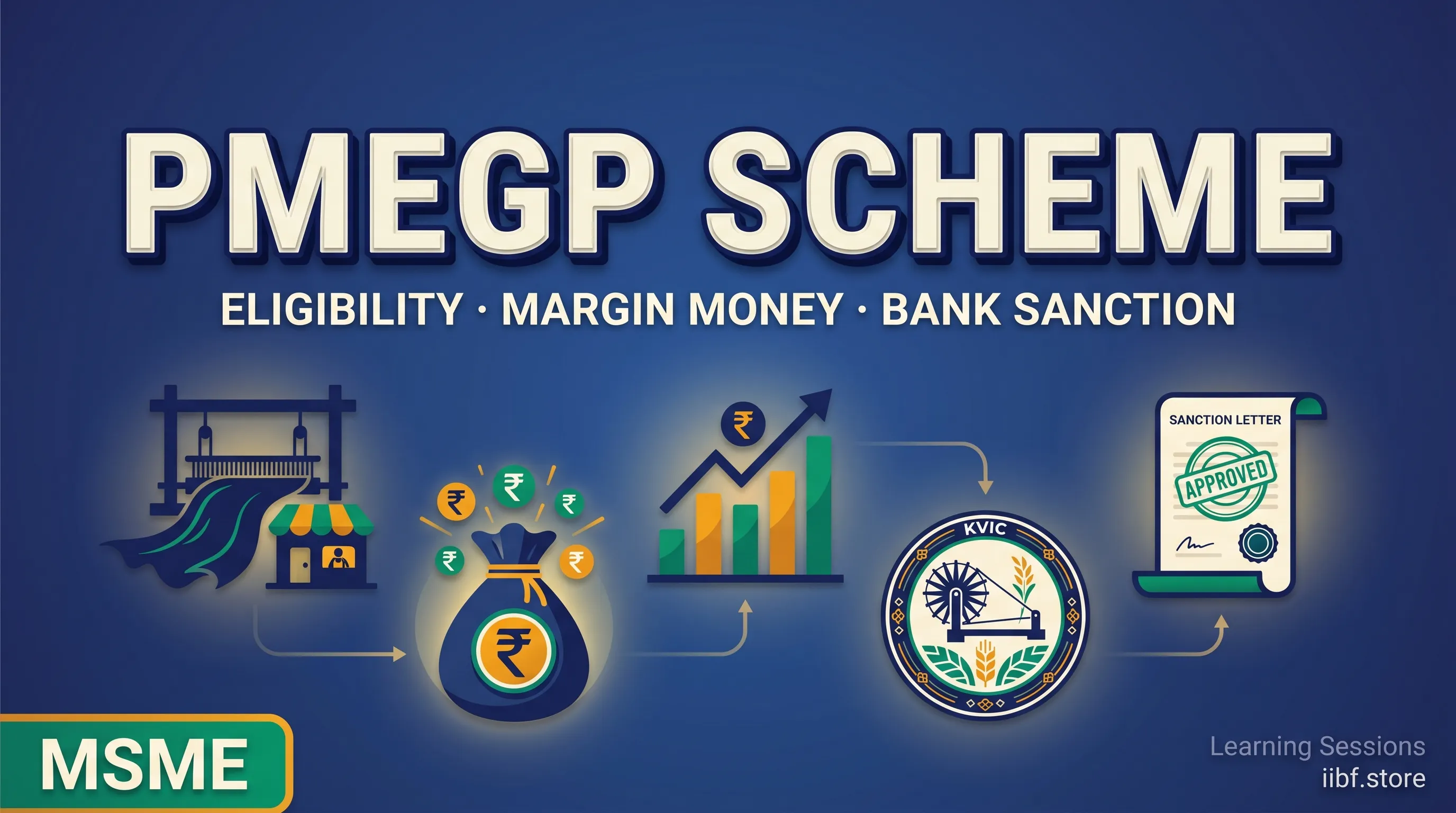
PMEGP eligibility is one of the first things a branch officer checks the moment a first-generation entrepreneur walks in asking about "the Prime Minister's scheme that gives free money." That scheme is the Prime Minister's Employment Generation Programme (PMEGP) — India's largest Government-backed, credit-linked subsidy programme for new micro-enterprises. It is not free money, it is a bank loan with a margin money subsidy bolted on, and understanding exactly who qualifies, how much subsidy applies and how the sanction flows is what separates a clean PMEGP file from a rejected subsidy claim months later.
If you are preparing for the IIBF Certificate Course on MSME, PMEGP is a high-yield, almost-guaranteed topic. If you are a working banker, you will likely see at least one PMEGP application at your branch every month. This guide covers both angles in plain language: the eligibility conditions, the margin money rates, the project-cost ceilings, the step-by-step sanction process, the traps that kill subsidy claims, and a snippet-ready FAQ.
Key takeaways
- PMEGP eligibility starts at age 18 for individuals; a Class 8 pass is required only above the prescribed project-cost threshold.
- It is a credit-linked subsidy, never a grant — the bank lends first, the Government subsidy is adjusted later.
- Margin money subsidy ranges by area and category — broadly higher in rural areas and for special-category applicants.
- EDP training and a 3-year lock-in on the subsidy are non-negotiable and heavily tested.
- Only new projects qualify; refinancing or expanding an existing unit is out of scope.
What PMEGP actually is (and is not)
PMEGP is a credit-linked subsidy scheme, not a cash grant. The Government does not hand the borrower a cheque. Instead, the structure works in three moves that every banker should be able to recite:
- The borrower takes a term loan from a bank under normal credit norms.
- The Government provides a margin money subsidy — a percentage of the project cost — which is routed to the bank and parked as a back-end adjustment after disbursement.
- If the borrower runs the unit satisfactorily through the lock-in, the subsidy is adjusted against the outstanding loan, reducing the borrower's effective cost. If the borrower defaults or exits early, the subsidy is recovered/adjusted accordingly.
The programme is administered by the Khadi and Village Industries Commission (KVIC) as the nodal agency, working alongside State KVIBs and the District Industries Centres (DICs). Eligible activities span manufacturing, service and business/trading lines, which is why PMEGP files at a branch can look very different from one another — a dairy-packaging unit, a tailoring service, a small fabrication shop. To see where PMEGP sits among India's MSME credit schemes, the broader MSME credit schemes overview of CGTMSE, MUDRA and PMEGP is a useful map.
PMEGP eligibility: who can apply
PMEGP eligibility is broader than many first-time applicants assume. The scheme is open to:
- Individuals aged 18 years and above at the time of application.
- Self-Help Groups (SHGs) not already availing benefits under another scheme.
- Registered Co-operative Societies.
- Production-based Charitable Trusts.
- Institutions registered under the Societies Registration Act, 1860.
On top of the applicant type, three conditions decide whether a specific project is eligible:
- Educational qualification: for projects above the prescribed cost threshold in the manufacturing sector, and above the lower threshold in the service/business sector, the applicant must have passed at least Class 8.
- No double subsidy: the applicant must not have availed any other Government subsidy for the same project.
- New projects only: PMEGP cannot refinance an existing unit or fund the expansion of a unit already running under PMEGP.
Because the Ministry of MSME periodically revises cost ceilings and educational thresholds, treat the specific numbers as per the latest released PMEGP guidelines and always confirm on the official IIBF notification and the scheme guidelines before sanction. Many applicants belong to special categories (SC/ST, women, minorities and others), so it is worth cross-reading the dedicated Stand-Up India scheme for SC/ST and women entrepreneurs to avoid steering a borrower to the wrong product.
Project-cost ceilings and margin money rates
PMEGP works within two ticket-size brackets and a grid of subsidy percentages that vary by area (urban vs rural) and category (general vs special). This grid is the single most examined part of the scheme, so commit the shape of it to memory even as you verify the exact figures against current guidelines.
Project cost ceilings:
- Manufacturing sector: maximum project cost up to the higher prescribed ceiling.
- Service / business sector: maximum project cost up to the lower prescribed ceiling.
| Applicant category | Urban (margin money subsidy) | Rural (margin money subsidy) | Borrower contribution |
|---|---|---|---|
| General category | ~15% | ~25% | 10% |
| Special category (SC/ST, women, minorities, ex-servicemen, PH, NER, hilly/border areas) | ~25% | ~35% | 5% |
Read the table this way: rural beats urban, and special category beats general, on subsidy percentage; in return, the borrower's own contribution is lower for special-category applicants (5%) than for general (10%). The bank loan funds whatever is left after the borrower contribution and the margin money subsidy. The percentages above are the most-frequently-cited values across recent cycles — verify the exact rates against the latest scheme guidelines, since the Ministry of MSME notifies them.
The bank sanction process, step by step
Here is how a PMEGP file actually moves through a branch. Each step has an exam hook and a real-world consequence.
- Application reception: most applications come through the PMEGP online portal, which issues a unique reference ID. The bank branch is one of three nodal touchpoints (with the KVIC office and the DIC).
- Initial scrutiny: confirm PMEGP eligibility — age, education where required, project category and no double subsidy.
- Project report appraisal: apply standard MSME credit logic — promoter background, market viability, technical feasibility, cash flow and DSCR. The appraisal discipline is identical to any term loan; our MSME credit assessment field guide to project reports lays out the framework.
- Sanction: the bank sanctions the term loan under its normal terms.
- EDP training: borrowers without prior entrepreneurial experience must complete an Entrepreneurship Development Programme (typically a short structured course) before disbursement, conducted by approved institutions.
- Disbursement: the first tranche is released once the borrower's contribution is in.
- Subsidy claim: the bank uploads sanction and disbursement details on the PMEGP portal to claim the margin money subsidy from KVIC.
- Margin money credit: KVIC remits the subsidy to the bank, which keeps it in a Term Deposit / Reserve Account for a 3-year lock-in.
- Lock-in completion: after three years of satisfactory servicing, the subsidy is adjusted against the outstanding loan, lowering the borrower's effective interest cost.
One nuance worth flagging at sanction: PMEGP funds the term loan only. If the unit needs working capital, that is a separate limit under the bank's normal lending policy — and for eligible ticket sizes, branches often pair the facility with a credit guarantee. The decision of when to lean on a guarantee versus another product is covered in our CGTMSE guarantee scheme explainer on when banks use it instead of MUDRA.
A practical study plan for the MSME exam
PMEGP rewards structured recall over vague reading. Use a tight, three-pass approach in the week before your attempt:
- Pass 1 — the grid: memorise the subsidy matrix (general vs special, urban vs rural) and the borrower-contribution figures. Most direct questions live here.
- Pass 2 — the flow: be able to sequence the nine sanction steps, especially the order of EDP training, disbursement, subsidy claim and lock-in.
- Pass 3 — the boundaries: rehearse the disqualifiers — new projects only, no double subsidy, term loan only, and the 3-year lock-in refund rule.
Then convert reading into retrieval. Run timed questions on the MSME mock tests for the Certificate Course on MSME, and use the quick-fire MSME matching games to lock the scheme-to-feature pairings. For a wider sweep of every guide on this paper, browse all MSME guides and notes, or start from the Certificate Course on MSME hub with its free classes and chapter PDFs.
Common mistakes that kill a PMEGP file
These are the branch-side traps that turn an approved loan into a rejected subsidy claim — and they double as exam distractors.
- Disbursing before EDP training. Releasing funds and "arranging EDP later" is the classic error; the subsidy claim can be rejected outright.
- Approving a second PMEGP file for the same borrower. Double subsidy is the highest-frequency reason for KVIC rejection. A credit-bureau pull at sanction should confirm no existing PMEGP-tagged facility.
- Skipping the Class 8 certificate where the project crosses the threshold. A missing certificate surfaces only at the subsidy-claim stage, months later.
- Sanctioning working capital under PMEGP. The scheme is a term loan product only; working capital is a separate limit.
- Ignoring the 3-year lock-in on early closure. If the borrower repays within three years, the margin money subsidy must be refunded to KVIC. Explain this at sanction so the borrower is not surprised.
Frequently asked questions
What is the basic PMEGP eligibility for an individual applicant?
An individual must be at least 18 years old at the time of application. For projects above the prescribed cost threshold, the applicant must also have passed at least Class 8. The applicant must be setting up a new unit and must not have taken another Government subsidy for the same project.
How much margin money subsidy can a borrower get under PMEGP?
The subsidy depends on area and category — broadly higher in rural areas and for special-category applicants than for urban general applicants. General-category borrowers contribute about 10% of project cost and special-category borrowers about 5%, with the bank loan funding the balance. Confirm the exact percentages against the latest PMEGP guidelines.
Can a borrower combine PMEGP with MUDRA for the same project?
No. The double-subsidy rule prevents a single project from drawing benefits under two Government schemes at the same time. The borrower must declare any other assistance and the branch must verify it at sanction. For how MUDRA stands on its own, see our MUDRA banker guide.
Is collateral required for a PMEGP loan?
The asset financed is always taken as primary security through hypothecation. Whether additional collateral is needed depends on bank policy and ticket size; for amounts within guarantee-cover limits, branches frequently register the loan under a credit guarantee so no third-party collateral is required.
What happens if the project fails within the 3-year lock-in?
The margin money subsidy is adjusted against the outstanding loan before final settlement, and any amount recovered from the borrower further reduces the bank's exposure. The bank cannot simply retain the subsidy if the loan is closed early during the lock-in period.
Can an existing unit expand under PMEGP?
Standard PMEGP funds new units only. A separate provision — a second loan for upgradation under the broader PMEGP umbrella — supports expansion of existing PMEGP-funded units that have repaid satisfactorily. Check the current Ministry of MSME guidelines for the applicable cap and margin money rate.
Final word
PMEGP is the workhorse subsidy scheme for first-generation entrepreneurs in India, and its mechanics — eligibility, margin money percentages, EDP training and the 3-year lock-in — are exactly the kind of crisp, rule-based content the IIBF MSME exam loves to test. Master the subsidy grid and the sanction flow once, and you win on two fronts: a cleaner appraisal at the branch and easy marks in the exam hall. Keep the official figures handy, verify time-sensitive specifics on the official IIBF website, and put your knowledge to the test with a timed MSME mock today.
Related Guides
📚 Free Learning Sessions resources — connect & crack your exam
- 📝 Free mock tests — chapter-wise, exam-pattern, with instant solutions
- 🎮 Matching games — gamified revision of key terms & concepts
- 📄 Study notes & PDFs — downloadable chapter material
- 🎥 Video classes on YouTube — subscribe to @learningsessions
💬 Want the full course? WhatsApp your course name to 8360944207 and our team will set you up.
📱 Study on the go — get our iOS & Android app at iibf.store/app.
Prefer revising from a printed book?
Chapter-wise books with MCQs after every chapter — minimal pages, complete coverage, delivered anywhere in India. Every book has a free sample to read first.
132 pages · 225 MCQs
Learning Sessions · Ashish Sir
188 pages · 435 MCQs
Learning Sessions · Ashish Sir
117 pages · 236 MCQs
Learning Sessions · Ashish Sir
Learning Sessions · Ashish Sir
118 pages · 299 MCQs
Learning Sessions · Ashish Sir
Learning Sessions · Ashish Sir
Learning Sessions · Ashish Sir
Learning Sessions · Ashish Sir
115 pages · 255 MCQs
Learning Sessions · Ashish Sir
Learning Sessions · Ashish Sir
334 pages · 936 MCQs
Learning Sessions · Ashish Sir
Learning Sessions · Ashish Sir
115 pages · 344 MCQs
Learning Sessions · Ashish Sir
107 pages · 240 MCQs
Learning Sessions · Ashish Sir
90 pages · 150 MCQs
Learning Sessions · Ashish Sir
Learning Sessions · Ashish Sir
131 pages · 672 MCQs
Learning Sessions · Ashish Sir
221 pages · 831 MCQs
Learning Sessions · Ashish Sir
128 pages · 524 MCQs
Learning Sessions · Ashish Sir
107 pages · 445 MCQs
Learning Sessions · Ashish Sir
148 pages · 478 MCQs
Learning Sessions · Ashish Sir
151 pages · 465 MCQs
Learning Sessions · Ashish Sir
148 pages · 375 MCQs
Learning Sessions · Ashish Sir
216 pages · 895 MCQs
Learning Sessions · Ashish Sir
109 pages · 300 MCQs
Learning Sessions · Ashish Sir
104 pages · 360 MCQs
Learning Sessions · Ashish Sir
82 pages · 297 MCQs
Learning Sessions · Ashish Sir
151 pages · 600 MCQs
Learning Sessions · Ashish Sir
98 pages · 282 MCQs
Learning Sessions · Ashish Sir
Practice this topic
Take a free mock test, download chapter PDFs, or watch a video class — all included on iibf.store.