Amalgamation of Banking Companies: Sections 44A and 45 (CAIIB BRBL)
The amalgamation of banking companies is one of the most reliably examined blocks in the CAIIB BRBL paper, because it sits exactly where ordinary company law stops and banking law takes over. Two banks cannot merge the way two ordinary companies do. The Banking Regulation Act, 1949 carves out its own code: Section 44A for a voluntary merger driven by the two boards and their shareholders, and Section 45 for a compulsory rescue ordered when a bank is failing.
Examiners love this topic because it is procedural. The marks are not in the definition; they are in the sequence — who proposes, who votes, who objects, and above all who sanctions. Get that sequence straight and you can answer almost any variant the question bank throws at you.
⚖️ Why Banks Are Kept Out of the Ordinary Merger Route
Banking is a licensed activity. No company may carry on banking business in India without a licence from the Reserve Bank under Section 22 of the Banking Regulation Act, 1949. Because entry is regulated, exit and consolidation must be regulated too — otherwise a licence could effectively change hands through a private merger agreement with no regulatory scrutiny of the resulting balance sheet.
So the amalgamation of banking companies is deliberately kept outside the general scheme-of-arrangement machinery of the Companies Act, 2013 that other companies use before the NCLT. For a banking company, the operative event is the sanction of the regulator, not an order of a tribunal. This is the single most common conceptual error in the exam, and it is worth revising alongside the legal framework of regulation of banks chapter.
The same logic explains why a bank cannot simply be dragged into the corporate insolvency resolution process the way a manufacturing company can. Financial service providers are excluded from the ordinary corporate insolvency route under the Insolvency and Bankruptcy Code, 2016; a failing bank is dealt with by the Reserve Bank under Section 45 instead. Depositor money is not ordinary trade credit, and Parliament treated it accordingly.
💡 Exam Tip: If a question names the NCLT as the approving authority for a bank merger, the option is almost certainly a distractor. Section 44A says Reserve Bank; Section 45 says Central Government.
🤝 Section 44A: The Voluntary Route, Step by Step
Section 44A governs a voluntary amalgamation of banking companies where both entities are going concerns and the merger is a commercial decision. The statute lays down a strict order of events.
First, a draft scheme of amalgamation is drawn up and placed before the shareholders of each banking company at a meeting called for that purpose. Notice of the meeting must reach every shareholder in the manner required by the articles, and the section additionally requires publication of the notice in newspapers circulating in the locality, including one in a language commonly understood there.
Second comes the voting threshold you must memorise: the scheme has to be approved by a resolution passed by a majority in number representing two-thirds in value of the shareholders of each banking company, present in person or by proxy at the meeting and voting. Note the double test — heads and value — and note that it applies separately to both banks, not to the two shareholder bodies combined.
Third, the approved scheme is submitted to the Reserve Bank for sanction. Sanction is granted by an order in writing, and once granted the scheme is binding on the banking companies concerned and on all their shareholders — including those who voted against it.
Fourth, the dissenting shareholder's remedy. A shareholder who voted against the scheme, or who gave written notice of dissent to the banking company at or before the meeting, may claim the value of his shares from the company. Crucially, that value is determined by the Reserve Bank while sanctioning the scheme, and that determination is final. The dissenter gets an exit at a regulator-fixed price, not a veto.
On sanction, the property and liabilities of the transferor bank pass to the transferee, and the Reserve Bank may by a further order direct that the transferor bank stands dissolved without any winding-up proceedings. Read this together with the regulation of banking business chapter, since the Reserve Bank applies its Master Direction on Amalgamation of Private Sector Banks when it examines the swap ratio, the valuation and the governance of the merged entity.
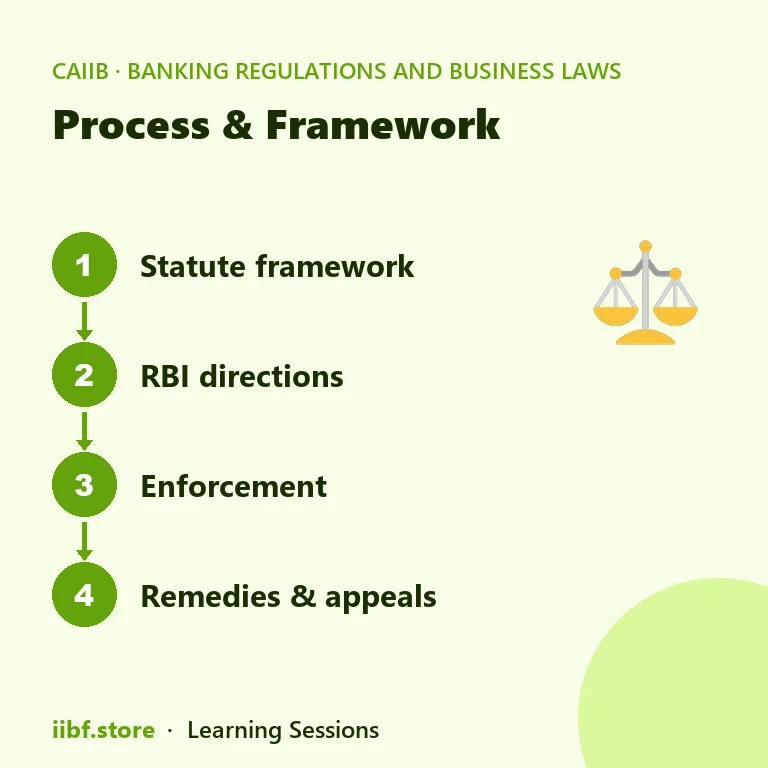
🚨 Section 45: Moratorium, RBI Scheme, Government Sanction
Section 45 is the rescue provision, and here shareholders have no vote at all. The sequence is different at every step.
It begins with the Reserve Bank applying to the Central Government for an order of moratorium in respect of the banking company. The Central Government, if satisfied, makes the order staying the commencement or continuance of actions and proceedings against the bank for a stated period. The total period of moratorium cannot exceed six months. During the moratorium the bank cannot make payments to depositors or discharge liabilities except as permitted by the order — which is why depositors of a bank under moratorium face withdrawal caps.
During that window the Reserve Bank may prepare a scheme — either for the reconstruction of the bank or for its amalgamation with another banking institution — if it is satisfied that this is necessary in the public interest, in the interests of the depositors, to secure the proper management of the banking company, or in the interests of the banking system as a whole. Those four grounds are frequently tested verbatim.
The draft scheme is then sent to the transferor banking company, to the transferee bank and to the Central Government, and notice is given to members, depositors and creditors so that objections and suggestions can be filed within the period the Reserve Bank specifies. After considering them, the Reserve Bank may modify the scheme and places it before the Central Government, which sanctions it with or without further modification. The sanctioned scheme comes into force on the notified date and is binding on the banking company, the transferee, and all members, depositors, creditors and employees.
The scheme itself can do things no ordinary contract could: alter the capital structure, transfer the whole undertaking, reduce or defer the claims of members and creditors, provide for the continuance of employees on their existing terms, and provide that pending suits and proceedings continue against the transferee bank rather than abating. The Reserve Bank publishes the notified schemes on its official site, and reading one alongside the control over organisation of banks chapter is the fastest way to see the section in action — the primary texts are available on the Reserve Bank of India website.
⚠️ Common Mistake: Candidates reverse the sanctioning authorities. Under Section 44A the Reserve Bank sanctions; under Section 45 the Reserve Bank only prepares the scheme and the Central Government sanctions it.
📊 Section 44A vs Section 45: The Comparison Table
This single table compresses most of what the amalgamation of banking companies can be asked about in the objective paper. Learn it row by row rather than reading the sections end to end.
| Parameter | Section 44A (Voluntary) | Section 45 (Compulsory) |
|---|---|---|
| Trigger | Commercial decision of two banking companies | Weak or failing bank; regulatory intervention |
| Shareholder approval needed? | ✅ Majority in number holding two-thirds in value, in each bank | ❌ Not required |
| Moratorium involved? | ❌ No | ✅ RBI applies, Central Government orders, maximum six months |
| Who drafts the scheme | The two banking companies | The Reserve Bank of India |
| Sanctioning authority | Reserve Bank of India | Central Government |
| Dissenting shareholder exit | ✅ Value fixed by RBI, determination final | ❌ No separate exit; rights governed by the scheme |
| Can depositor or creditor claims be scaled down? | ❌ No | ✅ Yes, if the sanctioned scheme so provides |
| Binding on | Both banking companies and all their shareholders | The bank, transferee, members, depositors, creditors, employees |
Two rows deserve extra attention. The dissenting-shareholder row is the classic Section 44A question. The claim-reduction row is the classic Section 45 question, and it is also where the legal risk in banking angle enters: a rescue scheme can lawfully impair contractual claims that would otherwise be enforceable, which is precisely why the process is statutory and not contractual.
🏦 Indian Illustrations and the Traps They Hide
Illustrations make the amalgamation of banking companies memorable, but each one hides a trap.
Under the voluntary route, the standard examples are private bank mergers such as Kotak Mahindra Bank's amalgamation of ING Vysya Bank, HDFC Bank's acquisition of Centurion Bank of Punjab and ICICI Bank's amalgamation of Bank of Rajasthan. All were shareholder-approved schemes sanctioned by the Reserve Bank.
Under the compulsory route, the textbook illustration is Global Trust Bank, amalgamated with Oriental Bank of Commerce after a moratorium. The more recent one is Lakshmi Vilas Bank, amalgamated with DBS Bank India Limited under a Section 45 scheme in 2020. That case is examinable for a specific reason: the transferee was a locally incorporated banking company that happens to be a wholly owned subsidiary of a foreign bank — which is permissible, because Section 45 allows amalgamation with any banking institution.
Trap one: the Yes Bank episode was a reconstruction scheme under Section 45, not an amalgamation. The bank survived as a legal entity; only its capital and board changed. Section 45 covers both outcomes, and the paper often tests whether you noticed.
Trap two: mergers of public sector banks — the consolidation of associate banks into State Bank of India, or of Vijaya Bank and Dena Bank into Bank of Baroda — do not run on Section 44A or Section 45 at all. Nationalised banks are not banking companies for this purpose; their amalgamation happens through schemes framed under the respective nationalisation statutes and notified by the Central Government in consultation with the Reserve Bank.
Trap three: co-operative banks reach Section 45 only through Section 56, which applies the Act to them with modifications. Systemic questions about who watches for these stresses in the first place belong to the financial stability and development council topic, and the post-merger integration questions — staffing, branch rationalisation, culture — map neatly onto the five functions of management you studied in ABFM.
📌 Remember: Section 44A = shareholders vote, RBI sanctions. Section 45 = moratorium first, RBI drafts, Central Government sanctions. Everything else follows from those two lines.
🧠 Practice MCQs: Amalgamation of Banking Companies
Q1. Under Section 44A of the Banking Regulation Act, 1949, a scheme of amalgamation must be approved by a majority in number representing what proportion in value of the shareholders present and voting in each banking company? (a) A simple majority in value (b) Three-fourths in value (c) Two-thirds in value (d) Nine-tenths in value
Answer: (c) — The statutory test is a majority in number representing two-thirds in value of the shareholders of each banking company present in person or by proxy and voting.
Q2. Who sanctions a scheme of voluntary amalgamation under Section 44A? (a) The Reserve Bank of India (b) The National Company Law Tribunal (c) The Central Government (d) The Securities and Exchange Board of India
Answer: (a) — The approved scheme is submitted to the Reserve Bank, which sanctions it by an order in writing; the sanction, not a tribunal order, makes the scheme binding.
Q3. A shareholder who dissents from a Section 44A scheme is entitled to claim the value of his shares as determined by whom? (a) An independent valuer appointed by the transferee bank (b) The Reserve Bank of India while sanctioning the scheme (c) The National Company Law Tribunal (d) The closing price on the stock exchange on the record date
Answer: (b) — The Reserve Bank determines the value payable to the dissenting shareholder when it sanctions the scheme, and that determination is final.
Q4. Under Section 45, what is the maximum total period for which an order of moratorium can remain in force? (a) Three months (b) Six months (c) Twelve months (d) There is no outer limit
Answer: (b) — The Central Government makes the order on the Reserve Bank's application, and the total period of moratorium cannot exceed six months.
Q5. Under Section 45, the scheme of amalgamation or reconstruction prepared by the Reserve Bank takes effect only after sanction by which authority? (a) The Reserve Bank itself (b) The National Company Law Tribunal (c) The Central Government (d) Two-thirds in value of the shareholders
Answer: (c) — The Reserve Bank prepares and modifies the scheme after considering objections, but the Central Government sanctions it and it comes into force on the notified date.
Want chapter-wise mock tests with 100+ MCQs? Start practising free →
❓ Frequently Asked Questions
Is shareholder approval needed for a Section 45 amalgamation?
No. Section 45 is a compulsory route. The Reserve Bank prepares the scheme and the Central Government sanctions it; shareholders of the transferor bank get no vote, though they may file objections on the draft scheme within the period specified.
What happens to employees of the transferor bank?
A Section 45 scheme ordinarily provides for the continuance of employees in the transferee bank on the same remuneration and terms as immediately before the moratorium, with any revision permitted only later and with the Reserve Bank's approval.
Do pending court cases lapse when a bank is amalgamated?
No. The sanctioned scheme provides that pending suits, appeals and other legal proceedings by or against the transferor bank are continued by or against the transferee bank, so nothing abates merely because of the merger.
Are public sector bank mergers covered by Sections 44A and 45?
No. Nationalised banks are not banking companies for this purpose. Their amalgamation is effected by schemes framed under the relevant nationalisation statutes and notified by the Central Government in consultation with the Reserve Bank.
🎯 Revise It Once, Score It Every Time
The amalgamation of banking companies rewards precision, not reading time. Fix three anchors — the two-thirds-in-value vote, the Reserve Bank's determination of the dissenting shareholder's price, and the six-month ceiling on the moratorium — then attach the sanctioning authority to each section. Everything else in the chapter hangs off those anchors.
Now convert it into marks. Work through more BRBL topics on the Banking Regulations and Business Laws tag hub, revise the full syllabus on the CAIIB course page, and then sit a timed chapter test on iibf.store mock tests to confirm you can tell Section 44A from Section 45 under exam pressure.
Quick quiz on this topic
5 exam-style questions from our free test bank — check yourself before you move on.
Practice this topic
Take a free mock test, download chapter PDFs, or watch a video class — all included on iibf.store.
Keep reading