A Practical Guide to beneficial ownership identification in KYC
Every customer due diligence file opened for a non-individual customer turns on one question: which flesh-and-blood person actually owns or controls this entity? That is what beneficial ownership identification in KYC is designed to answer, and it is the single control that Indian banks are pulled up on most often in RBI inspections and FIU-IND assessments. A company, a firm or a trust cannot launder money by itself — a person behind it does.
For IIBF Certificate candidates in KYC, AML and CFT, this topic is a guaranteed scorer because the thresholds are numeric, the fallback rule is mechanical, and the exemptions are short enough to memorise. This guide walks through the statutory chain, the entity-wise thresholds, the senior managing official fallback, documentation and CKYCR obligations, and the red flags that expose a declared owner as a front.
🏛️ What the Law Actually Asks You to Identify
The obligation flows from Section 12 of the Prevention of Money Laundering Act, which requires every reporting entity to verify the identity of its clients and of the beneficial owner, and to maintain those records. The operating detail sits in Rule 9 of the PML (Maintenance of Records) Rules, 2005, which the RBI reproduces and amplifies in its Master Direction on Know Your Customer. The Master Direction is a living document amended several times a year, so always read the version updated to the current date.
A beneficial owner is defined as the natural person who, whether acting alone or together, or through one or more juridical persons, has a controlling ownership interest in the client, or who exercises control through other means. Notice that beneficial ownership identification in KYC therefore runs on two independent tests. Ownership is arithmetic — a percentage of shares, capital or profits. Control is qualitative — the right to appoint a majority of directors, or to control management or policy decisions, including through shareholding, management rights, shareholders' agreements or voting agreements.
Candidates should read this alongside the chapter on KYC customer identification and beneficial ownership, and the statutory framing in legislation at the national level. Failure to identify the beneficial owner is not a documentation lapse alone — it exposes the bank to penalty proceedings by the Director, FIU-IND under Section 13 of the PMLA, and forms the basis of supervisory action by the RBI.
📊 Controlling Ownership Interest: Thresholds Entity by Entity
The percentage thresholds were tightened by amendments to the PML (Maintenance of Records) Rules in 2023, bringing India closer to FATF Recommendations 24 and 25. Several older textbooks and coaching notes still print the pre-amendment figures of 25 per cent for companies and 15 per cent for firms — do not carry those into the exam hall.
| Type of client | Controlling ownership interest threshold | Is BO identification required? |
|---|---|---|
| Company | Ownership of or entitlement to more than 10% of the shares, capital or profits | ✅ |
| Partnership firm | Ownership of or entitlement to more than 10% of the capital or profits | ✅ |
| Unincorporated association or body of individuals | Ownership of or entitlement to more than 15% of the property, capital or profits | ✅ |
| Trust | Settlor, trustees, and beneficiaries with 10% or more interest, plus any natural person exercising ultimate effective control | ✅ |
| Company listed on a recognised stock exchange, or its subsidiary | Not applicable — market disclosure norms already reveal ownership | ❌ |
Two drafting points matter. First, the threshold is more than the stated percentage, so a holder of exactly 10 per cent of a company's shares does not become a beneficial owner on the ownership test alone. Second, holdings are aggregated where persons act together, and are traced through intermediate juridical persons rather than stopping at the first corporate shareholder.
The exemption for listed companies is narrow and frequently over-applied. It covers a company listed on a recognised stock exchange and its subsidiary, not every entity that happens to have a listed shareholder on its cap table. Where a bank applies this exemption, the file should record the exchange, the scrip code and the holding relationship. This threshold discipline should feed directly into your enterprise wide AML risk assessment, because entities whose ownership cannot be resolved to natural persons are inherently higher risk.
💡 Exam Tip: Learn the trio 10 / 10 / 15 — company, partnership firm, unincorporated association or body of individuals. The trust rule is the odd one out: it is a list of categories (settlor, trustees, beneficiaries at 10% or more), not a single percentage.
🧩 Layered Structures, Nominees and the Senior Managing Official Fallback
Real cases rarely present a clean cap table. A current account may be opened by a private limited company owned by two LLPs, each held by an offshore holding entity, with a discretionary trust sitting above. Correct beneficial ownership identification in KYC requires the bank to look through each layer until it reaches natural persons, aggregating indirect holdings along the chain — not to stop at the immediate shareholder because that shareholder is itself a registered entity.
Three structural devices deserve particular attention:
- Nominee shareholders and nominee directors who hold on behalf of an undisclosed principal. The declaration must name the principal, not the nominee.
- Layering across jurisdictions, where each additional country adds an opacity step. Weigh this against the guidance in the chapter on country risk and money laundering.
- Control without ownership — a person with no shares who can appoint the majority of the board under a shareholders' agreement is a beneficial owner even at zero equity.
Only when no natural person is identified under either the ownership test or the control test does the fallback apply: the relevant natural person holding the position of senior managing official is treated as the beneficial owner. That is a last resort, not a convenience. The file must record what enquiries were made and why they failed, otherwise the entry is indistinguishable from a bank that simply never looked.
A useful independent cross-check is the Significant Beneficial Owner regime under Section 90 of the Companies Act, 2013, where companies maintain a register and file returns with the Registrar. Where the SBO disclosure and the customer's KYC declaration name different people, one of the two is wrong — and that discrepancy is itself reportable intelligence.
⚠️ Common Mistake: Treating the senior managing official as a default entry for every company account. If a shareholder crosses the 10 per cent threshold, the fallback simply does not arise, and using it anyway is a straight audit exception.
🗂️ Documentation, CKYCR and Periodic Updation
The evidence trail behind beneficial ownership identification in KYC is as examinable as the definition itself. A complete beneficial owner file typically carries a declaration on the entity's letterhead signed by an authorised signatory, the latest shareholding or profit-sharing pattern, the constitutional documents, and an officially valid document plus PAN for each declared beneficial owner. The beneficial owner must be identified and verified to the same standard as an individual customer — a name on a declaration is not identification.
Records then flow to the Central KYC Records Registry operated by CERSAI, which maintains templates for legal entities alongside individuals and issues a KYC Identifier that other regulated entities can retrieve. Uploading the entity record without the linked beneficial owner records defeats the purpose of the registry, because the very data point that supervisors and other institutions need is the natural person behind the structure.
Updation is risk-based rather than calendar-driven for its own sake. Under the Master Direction, periodic updation is carried out at least once in every two years for high-risk customers, once in every eight years for medium-risk and once in every ten years for low-risk customers, with fresh beneficial ownership declarations obtained whenever ownership or control changes in between. Corporate restructuring, a fresh share issue or a change of trustees are all triggers.
- Obtain a fresh declaration on any change in shareholding pattern, partners or trustees.
- Re-verify the declared beneficial owner where the entity's turnover or transaction profile changes materially.
- Feed beneficial owner names into screening and into transaction monitoring alerts in AML compliance, not just the entity name.
📌 Remember: Identification and verification are two steps. Recording a beneficial owner's name from a declaration without collecting and validating an officially valid document completes only half the requirement.
🚩 Red Flags and What Inspections Keep Finding
A declared beneficial owner who is a front usually leaves a pattern rather than a single defect. Watch for the following in combination:
- A declared owner whose personal financial profile is wholly inconsistent with the scale of the entity's turnover.
- Reluctance to name natural persons, or repeated substitution of one nominee for another during onboarding.
- Multiple unrelated entities declaring the same address, the same authorised signatory or the same mobile number.
- Ownership chains that pass through jurisdictions with weak transparency for no commercial reason.
- Operating instructions given by a person who appears nowhere in the ownership or control records.
- Round-tripping or invoice-driven flows of the kind described in these trade-based money laundering red flags.
These patterns map closely to the techniques set out in the chapter on money laundering methods, where shell and front companies are the classic layering vehicle. The same shell-and-nominee playbook shows up in consumer-facing frauds too, including illegal loan apps and digital lending fraud, where collection entities are deliberately insulated from their real controllers.
Recurring audit and inspection findings on beneficial ownership identification in KYC are remarkably consistent across banks: blank or unsigned beneficial owner declarations accepted at account opening; thresholds applied at the pre-2023 percentages; the listed-company exemption claimed for unlisted subsidiaries of unlisted groups; senior managing official recorded as beneficial owner without any evidence of an ownership enquiry; and beneficial owner records missing from CKYCR uploads. Each of these is a documentation-level failure that a branch can fix, which is precisely why supervisors treat repeat instances as a governance weakness rather than an oversight. Keep track of amendments through IIBF and regulatory updates and the wider KYC, AML and CFT article series.
🧠 Practice MCQs: Beneficial Ownership under KYC
Q1. Under the PML (Maintenance of Records) Rules as amended, the controlling ownership interest threshold for a company client is — (a) 5% of shares (b) more than 10% of shares, capital or profits (c) more than 15% of shares (d) more than 25% of shares
Answer: (b) — The 2023 amendment reduced the company threshold from more than 25 per cent to more than 10 per cent of shares, capital or profits.
Q2. For an unincorporated association or body of individuals, a beneficial owner is a natural person with ownership of or entitlement to more than — (a) 5% of property (b) 10% of property (c) 12.5% of property (d) 15% of the property, capital or profits
Answer: (d) — The threshold for an unincorporated association or body of individuals remains more than 15 per cent, unlike the 10 per cent applicable to companies and partnership firms.
Q3. Where no natural person can be identified under either the ownership test or the control test, who is treated as the beneficial owner? (a) The relevant natural person holding the position of senior managing official (b) The statutory auditor of the entity (c) The largest unsecured creditor (d) The company secretary
Answer: (a) — The senior managing official is a documented fallback of last resort, and the file must record why the ownership and control enquiries did not yield a natural person.
Q4. Identification of the beneficial owner is NOT required where the client is — (a) a partnership firm with three partners (b) a private discretionary trust (c) a company listed on a recognised stock exchange, or a subsidiary of such a company (d) a limited liability partnership
Answer: (c) — Listed companies and their subsidiaries are exempt because ownership is already disclosed under securities market regulations; the exemption does not extend to unlisted group entities.
Q5. In the case of a trust, which of the following is NOT a specified category of beneficial owner? (a) The settlor (b) The bank maintaining the trust's current account (c) The trustees (d) Beneficiaries with 10% or more interest in the trust
Answer: (b) — The banker is a service provider, not a beneficial owner. The categories are the settlor, the trustees, qualifying beneficiaries and any natural person exercising ultimate effective control.
Want chapter-wise mock tests with 100+ MCQs? Start practising free →
❓ Frequently Asked Questions
Does a person with zero shareholding ever qualify as a beneficial owner?
Yes. The control test is independent of the ownership test. A person who can appoint a majority of directors or direct management and policy decisions through a shareholders' agreement, voting agreement or management right is a beneficial owner even with no equity at all.
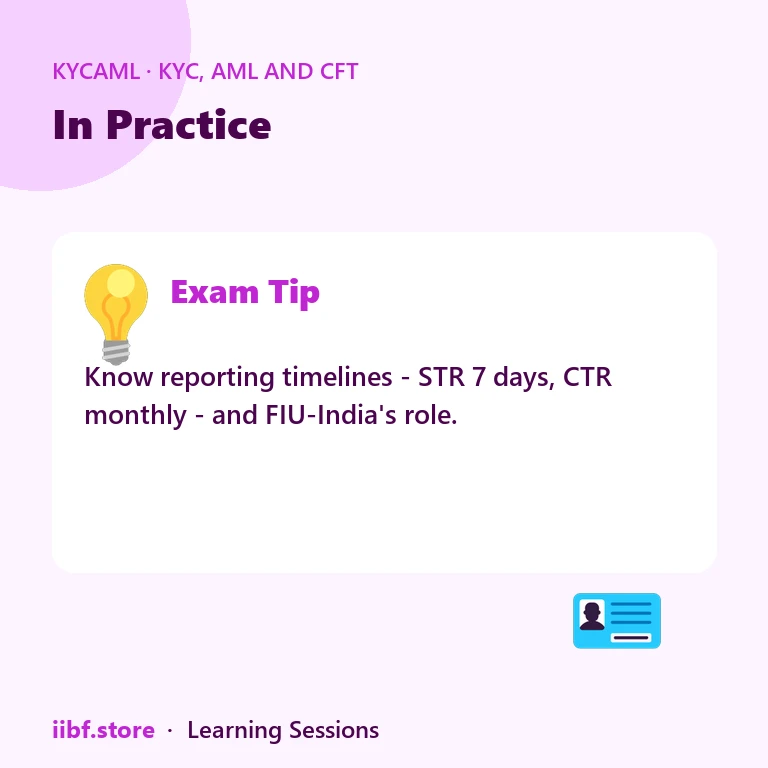
Is the Significant Beneficial Owner under the Companies Act the same as the beneficial owner under the PML Rules?
They are related but separate regimes with different filing requirements and slightly different tests. The Companies Act register is a useful cross-check, but a bank cannot substitute an SBO filing for its own identification and verification obligation under the PML Rules and the RBI Master Direction.
How often must a beneficial owner declaration be refreshed?
At periodic updation — at least once in two years for high-risk, eight years for medium-risk and ten years for low-risk customers — and immediately whenever there is a change in ownership, partners, trustees or control, irrespective of when the last updation fell due.
What happens if the beneficial owner cannot be identified at all?
The bank should not proceed with the relationship on an incomplete basis. It applies the senior managing official fallback only where genuine enquiries have failed, records those enquiries, considers whether the opacity is itself suspicious, and files a suspicious transaction report with FIU-IND where the circumstances warrant it.
Done properly, beneficial ownership identification in KYC is where compliance stops being paperwork and starts being investigation. Learn the 10 / 10 / 15 thresholds, the two-test-then-fallback sequence and the listed-company exemption cold, and you will pick up marks in both the objective and case-study portions of the paper. Test yourself chapter by chapter on IIBF mock tests or work through the full syllabus in the CAIIB and certificate course library.
Quick quiz on this topic
5 exam-style questions from our free test bank — check yourself before you move on.
Practice this topic
Take a free mock test, download chapter PDFs, or watch a video class — all included on iibf.store.
Keep reading