How sanctions screening in banks works: lists to freezing
Every account opened, every remittance released and every LC advised passes through a control that most bankers only notice when it stops something: sanctions screening in banks. It is the process of matching customers, counterparties, beneficial owners, vessels and payment message fields against designated lists issued by the United Nations Security Council, the Ministry of Home Affairs, and — for cross-border business — foreign regulators such as OFAC in the United States and the European Union. Unlike ordinary due diligence, a sanctions hit is not a "risk to be priced". It is a legal prohibition: the funds must be frozen, the transaction stopped, and the authorities informed. For JAIIB and CAIIB candidates writing the KYC/AML paper, this is one of the most reliably examined areas because the rules are prescriptive and the timelines are testable.
🌐 What Sanctions Screening in Banks Actually Covers
A sanctions programme has three moving parts, and questions often turn on which part is being described. First, the lists: the UNSCR 1267 list (the ISIL/Da'esh and Al-Qaida Sanctions List maintained by the 1267 Committee), the designations made domestically in response to UNSCR 1373 obligations, and proliferation-financing lists flowing from resolutions on the DPRK and Iran, which India implements through the Weapons of Mass Destruction Act framework. Second, the data being screened: customer master records, authorised signatories, beneficial owners, guarantors, trade documents, SWIFT payment fields and even free-text remittance narratives. Third, the action: prohibition of dealing, freezing without prior notice, and reporting.
Note what sanctions screening is not. It is not a rating exercise that assigns "high", "medium" or "low" — a listed name cannot be on-boarded with enhanced controls, it simply cannot be on-boarded. It is also not a substitute for identifying who really controls an account; a shell entity can be used precisely because the designated individual sits behind it, which is why beneficial ownership identification in KYC feeds directly into the screening engine. Equally, screening is a preventive control that sits alongside detective controls — the ongoing surveillance covered under transaction monitoring alerts in AML compliance. Sanctions stops a payment before it leaves; monitoring tells you afterwards that a pattern looks wrong. Examiners like this distinction, so fix it early. The statutory backbone for all of it in India is discussed in the chapter on legislation at national level.
💡 Exam Tip: Sanctions obligations are strict liability in character — "we did not know" is not a defence. Risk-based flexibility applies to due diligence, not to a designated name.
⚖️ UNSCR 1267, UNSCR 1373 and the UAPA Section 51A Route
The two Security Council resolutions work differently and that difference is the classic two-mark question. UNSCR 1267 (1999) and its successors created a standing sanctions committee that maintains a consolidated list of individuals and entities associated with Al-Qaida and, later, ISIL. Every member state must apply an asset freeze, travel ban and arms embargo to that single global list. UNSCR 1373 (2001), passed after the September 2001 attacks, does not create a list at all. It obliges each state to build its own machinery for designating persons and freezing terrorist funds. India's answer to UNSCR 1373 is the Unlawful Activities (Prevention) Act, 1967 — organisations are listed in the First Schedule under Section 35 and individually designated terrorists appear in the Fourth Schedule following the 2019 amendment.
Operationally, everything routes through Section 51A of the UAPA, which empowers the Central Government to freeze, seize or attach funds and financial assets of designated persons and to prohibit anyone from making funds available to them. The detailed procedure — who circulates the list, whom the bank must inform, and how a wrongly matched customer applies for de-listing or release — is set out in the Order issued by the Ministry of Home Affairs, which was revised in February 2021, superseding the earlier 2009 order. The RBI's Master Direction on KYC carries the same obligation through to regulated entities and requires them to run the updated designated lists against their databases. Because these orders are amended from time to time, always quote the procedure qualitatively in a descriptive answer and check the latest master direction for exact wording. The international layer above all this is covered in the chapter on international guidelines and standards, which links terrorist-financing controls to the wider work on combating the financing of terrorism.
🔍 Name Screening Versus Transaction Screening
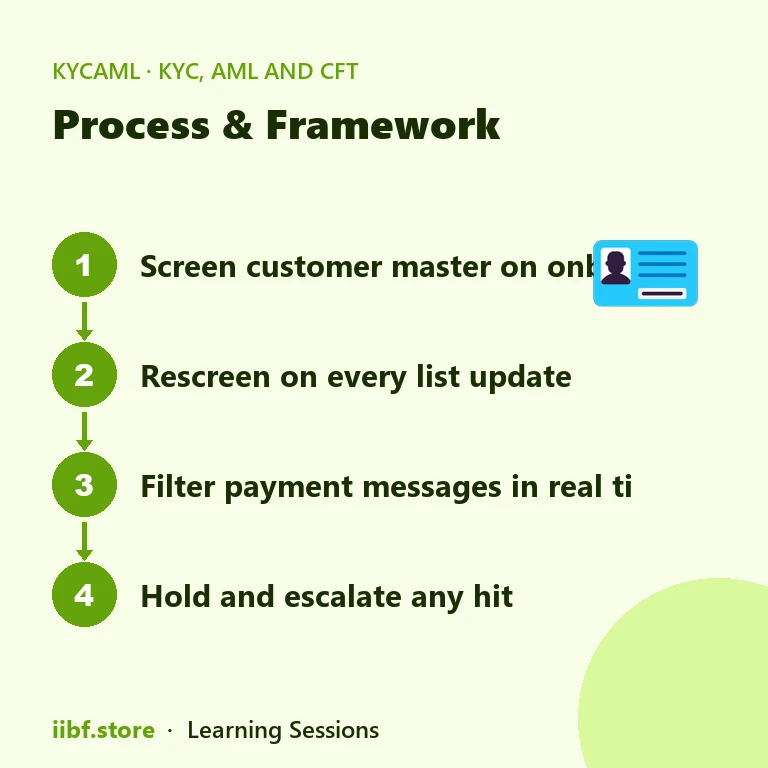
Banks run two engines and confusing them costs marks. Name screening (also called customer or database screening) runs the customer master file against designated lists — at on-boarding, whenever static data changes, and again in batch every time a list is amended. Transaction screening (payment filtering) inspects messages in flight: the ordering customer, beneficiary, intermediary institutions, and narrative fields of a cross-border payment or trade document, in real time, before release. A customer can be perfectly clean and still originate a payment to a designated beneficiary abroad; only transaction screening catches that.
| Feature | Name (customer) screening | Transaction (payment) screening |
|---|---|---|
| What is screened | Customer master, signatories, beneficial owners, guarantors | Payment message fields, trade documents, counterparties |
| When it runs | On-boarding, on data change, and on every list update | Real time, before the message is released |
| Typical output | Potential match for review; account blocked from opening | Payment held in queue pending disposition |
| Catches a clean customer paying a listed party? | ❌ No | ✅ Yes |
| Catches an existing customer newly designated? | ✅ Yes, via rescreening on list update | ❌ Only if that customer transacts |
| Primary failure mode | Stale customer data; missed rescreening | Poorly tuned fuzzy logic; truncated fields |
The practical lesson is that neither engine is optional. A bank that screens only at on-boarding will miss the customer designated three years after the account was opened, which is why every list amendment must trigger a full rescreening of the book rather than a screening of new customers alone.
🎯 Fuzzy Matching, False Positives and Hit Escalation
Designated names arrive transliterated from Arabic, Persian, Russian or Chinese, with aliases, inverted name order, missing middle names and inconsistent dates of birth. An exact-match filter would therefore miss most real hits, so screening engines use fuzzy matching — phonetic algorithms, edit-distance scoring and token rearrangement — calibrated by a match threshold. Lower the threshold and you catch more true hits but drown the team in noise; raise it and the queue is quiet but the control is hollow. Tuning that threshold, and documenting why it was set where it was, is itself an examinable control.
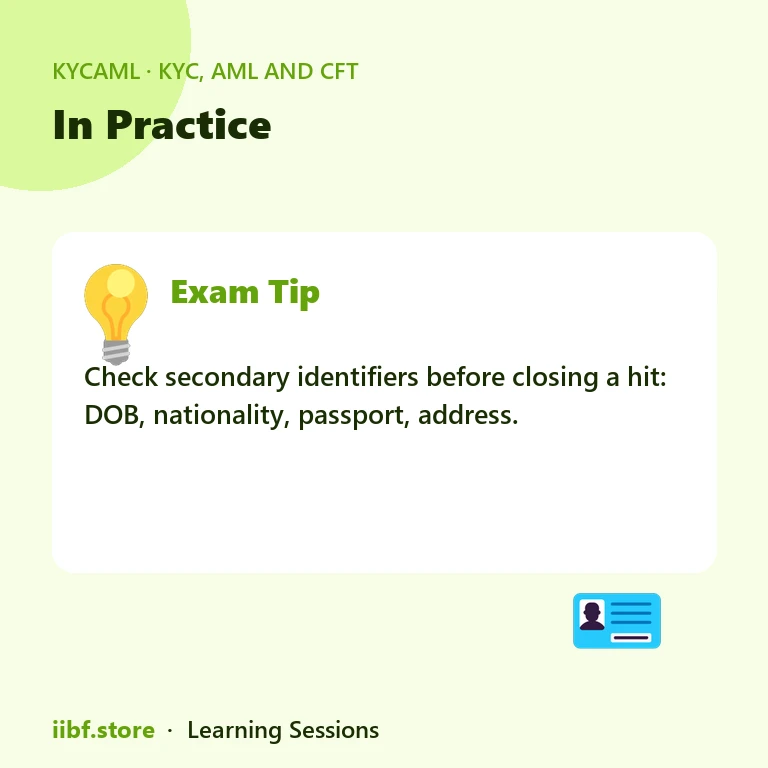
The output is triaged in stages. A false positive is a name that scores high but is a different person once secondary identifiers — date of birth, nationality, passport or PAN, address — are compared; it is discounted, with the reasoning recorded. A true match triggers an entirely different path: the transaction is not completed, the funds are frozen without prior notice to the customer, and particulars are communicated to the designated authority in the Ministry of Home Affairs and to FIU-IND within the short window stipulated in the UAPA procedure, commonly understood as 24 hours. Tipping off the customer that a freeze or report has been made is itself an offence. A "partial" or unresolved match is escalated to the principal officer rather than closed by the first-level analyst. Note that the freeze is an executive act under UAPA and not a lien the branch may lift on request — release comes only through the statutory de-listing or release procedure.
⚠️ Common Mistake: Candidates write that a sanctions hit should be "reported as a suspicious transaction and monitored". Wrong. A confirmed designated-list match must be frozen and reported to the specified authorities — an STR does not discharge the freezing obligation.
🌍 OFAC, EU Lists and Correspondent Banking Exposure
Indian banks are bound by UN and Indian designations, but the moment a payment is routed in US dollars it clears through a US correspondent and becomes exposed to the sanctions administered by OFAC, whose Specially Designated Nationals list reaches far beyond the UN consolidated list. Euro clearing brings EU consolidated list exposure, and sterling brings the UK regime. This is why correspondent relationships carry contractual undertakings on screening standards and why the respondent's programme is diligenced before the account is opened — the subject of the chapter on correspondent banking, which should be read together with country risk and money laundering.
Two exposures deserve attention. The first is nested or downstream correspondent relationships, where an unknown third bank uses your respondent's account and effectively obtains indirect access to the clearing system. The second is evasion typology: stripping identifying details from payment messages, using front companies in permissive jurisdictions, ship-to-ship transfers and disabled vessel transponders in dual-use trade, and increasingly the movement of value through unhosted wallets, a pattern that overlaps with cryptocurrency related cyber crime. The consequences of weak controls are supervisory action, correspondent de-risking and loss of clearing access, which is a commercial death sentence for a trade-finance franchise. Wider reading on the whole syllabus area is collected on the KYC and AML article hub.
📌 Remember: UN lists are mandatory for every member state; OFAC and EU lists bind Indian banks indirectly, through the currency they clear in and the contracts they sign with correspondents.
🧠 Practice MCQs: Sanctions Screening and UAPA Section 51A
Q1. Which resolution created a standing UN sanctions committee maintaining a single consolidated list of Al-Qaida and ISIL linked persons? (a) UNSCR 1267 (b) UNSCR 1373 (c) UNSCR 1718 (d) UNSCR 2231
Answer: (a) — UNSCR 1267 (1999) set up the committee and the global list; 1373 instead obliges each state to designate on its own.
Q2. Freezing of funds of designated persons in India is carried out under which provision? (a) Section 12 of PMLA (b) Section 35 of the Banking Regulation Act (c) Section 51A of the UAPA (d) Section 45 of the RBI Act
Answer: (c) — Section 51A of the Unlawful Activities (Prevention) Act empowers the Central Government to freeze, seize or attach the assets of designated persons.
Q3. A remittance is stopped because the beneficiary abroad appears on a designated list, although the ordering customer is clean. Which control caught it? (a) Name screening of the customer master (b) Transaction or payment screening (c) Periodic re-KYC (d) Cash transaction reporting
Answer: (b) — only payment filtering inspects beneficiary and intermediary fields of a message in flight.
Q4. A high-scoring alert is discounted after date of birth, nationality and passport number all differ from the designated person. This is best described as: (a) A true match requiring freezing (b) Tipping off (c) A de-listing application (d) A false positive closed on secondary identifiers
Answer: (d) — secondary identifiers are exactly what distinguishes a common-name false positive from a genuine match, and the reasoning must be recorded.
Q5. On confirming a designated-list match, the branch should: (a) Inform the customer so that he may clarify (b) Freeze without prior notice and report to the specified authorities within the stipulated time (c) Allow the payment and file an STR later (d) Downgrade the customer to high risk and monitor
Answer: (b) — the freeze is immediate and without prior notice; informing the customer amounts to tipping off.
Want chapter-wise mock tests with 100+ MCQs? Start practising free →
❓ Frequently Asked Questions
Is a sanctions hit the same as a suspicious transaction report?
No. A suspicious transaction report is a disclosure to FIU-IND about activity that appears unusual, and the transaction may still be completed. A confirmed match against a designated list is a legal prohibition: the funds are frozen without prior notice and the prescribed authorities are informed. Filing a report does not discharge the freezing obligation.
Do Indian banks have to follow OFAC and EU lists?
They are not directly bound by foreign designations, but exposure arises through currency clearing and correspondent agreements. A dollar payment clears through a US correspondent, so OFAC exposure is unavoidable, and correspondent contracts routinely require screening against those lists. Breaches invite de-risking and loss of clearing access.
How often should the customer database be screened?
At on-boarding, whenever customer static data changes, and again on every amendment to the designated lists. Screening only new customers is a common audit finding, because an existing account holder can be designated years after the account was opened.
What happens if a genuine customer is frozen by mistake?
The customer applies for release through the statutory procedure laid down under the UAPA order, supported by identity evidence showing he is not the designated person. The branch cannot lift the freeze on its own authority; the decision rests with the designated authority.
🎓 Conclusion and Next Step
Get three things right and this topic is secure: the list architecture (UNSCR 1267 as a global list, UNSCR 1373 as a domestic designation obligation implemented through UAPA), the two screening engines and what each one can and cannot catch, and the disposition path from fuzzy match to false-positive closure or to freezing and reporting without tipping off. Add the correspondent-banking angle for the descriptive question and you have covered the examiner's whole map. Wider institutional risk drivers are covered in our note on enterprise wide AML risk assessment. Ready to test yourself? Work through the full question bank in the CAIIB and certification course or jump straight into chapter-wise mock tests.
Source and further reading: FIU-India and the Indian Institute of Banking & Finance.
Quick quiz on this topic
5 exam-style questions from our free test bank — check yourself before you move on.
Practice this topic
Take a free mock test, download chapter PDFs, or watch a video class — all included on iibf.store.
Keep reading