Privileged Access Management in Banks: IIBF IT Security Guide 2026
Privileged access management in banks is the single control that decides whether a small mistake stays small or turns into a core-banking outage. Every bank runs on a handful of super-powerful accounts — the database sa login, the domain administrator, the root user on the ATM switch server, the SWIFT application owner, the firewall admin. These accounts can read every customer record, move money, and erase the very logs that would prove what happened. For IIBF IT Security candidates, this is one of the highest-yield chapters: it appears in access-control questions, in audit questions, and in incident-response case studies.
This guide explains what a privileged account actually is, how a PAM solution works end to end, what RBI and IIBF expect you to know, and how examiners phrase the tricky questions. Work through it alongside the study chapters linked below and you should be able to answer most access-control MCQs on sight.
🔑 What Counts as a Privileged Account
A privileged account is any identity that can bypass or override normal controls. Candidates often assume this means "the IT head's login", but the exam definition is far broader. In a typical bank the privileged population includes built-in administrator accounts on servers and network devices, database owner accounts, application super-users in CBS, service accounts used by batch jobs and interfaces, emergency "break-glass" IDs kept in a sealed envelope, and vendor or contractor accounts used for remote support.
Two categories cause the most audit findings. The first is shared administrator accounts — several engineers using one admin login, which destroys individual accountability because no log can attribute an action to a person. The second is service accounts, which are non-human, rarely rotated, frequently over-permissioned, and often carry passwords hard-coded into scripts. A bank may have a few hundred human administrators but several thousand service accounts, and the service accounts are usually the ones nobody owns.
The starting point for control is knowing what you have. That is why privileged access work always begins with discovery and with the asset register — you cannot protect an administrator account on a server that is not on your inventory. Revise this link with the chapter on asset classification and controls, because examiners like questions that join asset ownership to access rights.
💡 Exam Tip: If a question describes an account with no named human owner that runs scheduled jobs, the expected answer is "service account" — and the expected control is scheduled credential rotation through a vault, not a periodic password-change reminder to a person.
🧰 How a PAM Solution Actually Works
A privileged access management platform sits between the administrator and the target system. Understanding the five moving parts makes almost every PAM question answerable.
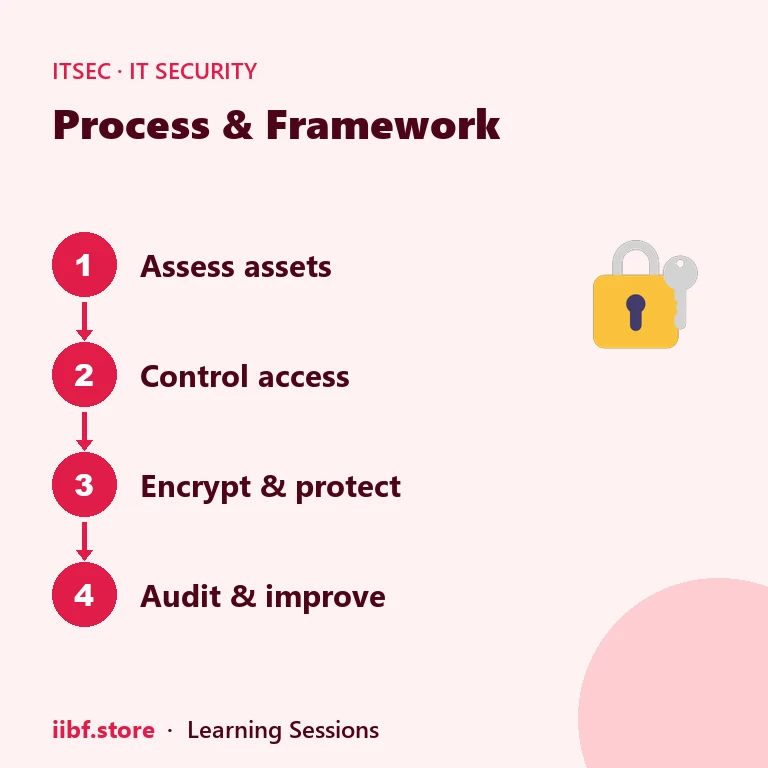
Discovery scans the estate and finds privileged accounts, including ones created outside process. Vaulting moves those credentials into an encrypted store so no engineer knows the actual password. Brokered access means the administrator logs in to the PAM portal with their own named ID plus multi-factor authentication, requests a target system, and the vault injects the credential without ever displaying it. Session management records the resulting session — keystrokes, commands, screen video — and can terminate it live if a dangerous command is typed. Rotation changes the password automatically after each check-in or on a fixed cycle, so a credential captured once is useless later.
Two design ideas sit on top of this plumbing. Least privilege says an identity gets only the rights its role needs — a DBA does not need domain admin. Just-in-time (JIT) access goes further: instead of holding standing administrator rights all year, the engineer is elevated for a defined window against an approved change ticket, and the rights expire automatically. JIT shrinks what security teams call the standing-privilege attack surface, and it is the modern answer whenever a question asks how to reduce risk from always-on admin rights.
PAM is also the enforcement point for zero trust thinking, because every elevated session is authenticated, authorised and logged rather than trusted by network location. If that idea is new, read our companion piece on zero trust security in banking before you attempt scenario questions.
⚖️ Normal User Access vs Privileged Access
Examiners love a comparison. The table below is the one to memorise, because most "which control applies" questions collapse into a row of it.
| Control dimension | Normal user access | Privileged access | MFA mandatory? |
|---|---|---|---|
| Approval to grant | Line manager | System owner + information security | ✅ |
| Credential storage | User remembers / SSO | Encrypted vault, never disclosed | ✅ |
| Duration of rights | Standing, role-based | Just-in-time, time-bound | ✅ |
| Session recording | Not required | Full keystroke and video capture | ✅ |
| Recertification cycle | Annual or half-yearly | Quarterly or more frequent | ✅ |
| Password rotation | Periodic, user-driven | Automatic after every check-in | ✅ |
| Shared IDs permitted | ❌ | ❌ (only break-glass, sealed and logged) | ✅ |
Notice that the answer to "should MFA apply?" is always yes for privileged paths. Notice also that shared IDs are never acceptable as routine practice — the only tolerated exception is a documented break-glass account whose use triggers an alert and a post-facto review within a defined timeframe.
⚠️ Common Mistake: Writing that PAM "prevents insider attacks". It does not prevent them; it limits, detects and evidences them. The correct exam phrasing is that PAM reduces the attack surface and provides accountability and forensic evidence.
🏦 What RBI and IIBF Expect
RBI's supervisory expectations on information technology and cyber security consistently require banks to restrict administrative and super-user privileges, enforce maker-checker and segregation of duties, log privileged activity to a tamper-resistant location, and review such access periodically. The same themes run through RBI's outsourcing and IT governance directions, which extend the requirement to vendors and managed service providers. You can read the current master directions on the RBI official website rather than relying on summaries.
Four practical expectations recur in both regulation and exam papers:
Segregation of duties. The person who builds a change should not be the person who approves it or the person who moves it into production. A developer with production database rights is an audit finding on its own — revise this with the chapter on controls in software development and maintenance.
Independent log custody. Privileged session logs must be forwarded in near real time to a system the administrator cannot edit, typically the SIEM. If an admin can delete their own logs, the control has failed.
Vendor privilege discipline. Third-party remote support must come through the PAM portal, be time-boxed to the support window, and be recorded. Standing VPN accounts for vendors are a classic exam trap.
Periodic recertification. Every privileged entitlement is re-approved by the system owner on a defined cycle, and orphaned accounts belonging to leavers or transferred staff are revoked immediately. Application-layer privilege design is covered further in software security control.
🛡️ Where PAM Fits in the Wider Control Stack
Privileged access is not a standalone product; it is the hinge between several other domains you will be tested on. Almost every serious banking breach follows the same arc: an initial foothold, then privilege escalation, then lateral movement, then data theft or fraudulent transactions. PAM is what breaks the chain at step two.
On the way in, attackers rarely hack a vault — they phish an administrator, so awareness training and email controls matter as much as technology. Study that angle alongside social engineering tactics in banking, which explains how credential-harvesting attacks are actually constructed.
On the way out, an attacker with elevated rights can copy large volumes of customer data, which is why data loss prevention in banks is the complementary control on the exfiltration path. And when something does go wrong, recorded privileged sessions become the primary evidence for containment and root-cause analysis, tying directly into the incident response lifecycle in banks.
For the threat-actor side of the picture — who escalates privilege and why — work through the chapter on IT security threats. More revision material is collected on our IT Security topic hub.
📌 Remember: The exam-ready one-liner is "least privilege, just-in-time, vaulted, recorded, rotated, recertified." Six words, and each maps to a distinct control you can name in a descriptive answer.
🧠 Practice MCQs: Privileged Access Management in Banks
Q1. Which of the following is the primary accountability problem with shared administrator accounts? (a) Weak encryption (b) Actions cannot be attributed to an individual (c) Higher licence cost (d) Slower login
Answer: (b) — A shared credential means logs record the account, not the person, destroying individual accountability.
Q2. Just-in-time privileged access primarily reduces which risk? (a) Network latency (b) Standing privilege being abused or stolen (c) Backup failure (d) Licence non-compliance
Answer: (b) — JIT grants rights only for an approved window, so there is no always-on privilege for an attacker to hijack.
Q3. In a PAM deployment, credential injection means: (a) The password is emailed to the admin (b) The vault supplies the credential to the target without displaying it (c) The password is written into a script (d) The admin types the password twice
Answer: (b) — The engineer never learns the actual password; the vault brokers the session directly.
Q4. Privileged session logs should be forwarded to an independent system mainly because: (a) It saves disk space (b) The administrator could otherwise alter or delete them (c) It speeds up the server (d) Regulators demand daily printouts
Answer: (b) — Log integrity requires custody outside the control of the person being monitored.
Q5. A vendor needs remote access for a two-hour patch window. The best control is: (a) A permanent VPN account (b) Sharing the admin password over phone (c) Time-boxed brokered access through PAM with session recording (d) Disabling logging to improve performance
Answer: (c) — Third-party access must be time-limited, brokered, recorded and revoked automatically.
Want chapter-wise mock tests with 100+ MCQs? Start practising free →
❓ Frequently Asked Questions
Is privileged access management the same as identity and access management?
No. IAM governs the whole workforce identity lifecycle — joiners, movers, leavers, and normal entitlements. PAM is a specialised layer within it that protects the small set of high-power accounts using vaulting, brokering, session recording and rotation.
Are break-glass accounts allowed in banks?
Yes, but only as a documented exception. The credential is sealed, its use raises an automatic alert, and every invocation is reviewed after the fact with the reason recorded. Routine day-to-day use of a break-glass ID is an audit failure.
How often should privileged access be recertified?
More frequently than ordinary user access. Banks commonly recertify privileged entitlements quarterly, with immediate revocation on resignation, transfer or completion of a vendor engagement, rather than waiting for the next review cycle.
How much weight does this topic carry in the IIBF IT Security exam?
Access control is a recurring theme across the access-control, audit and incident-response modules, so questions on privileged accounts, least privilege and segregation of duties appear regularly. Treat it as a high-return topic rather than a niche one.
🎯 Conclusion
Privileged accounts are few in number and enormous in consequence. Control them with a vault, grant them just in time, record every session, rotate every credential, and recertify every entitlement — and you have covered both the regulatory expectation and the bulk of what the exam will ask. Learn the comparison table above cold, keep the six-word one-liner in your head, and pair the concepts with the study chapters linked throughout this guide.
Ready to test yourself under exam conditions? Take a free IIBF IT Security mock test →
Prefer revising from a printed book?
Chapter-wise books with MCQs after every chapter — minimal pages, complete coverage, delivered anywhere in India. Every book has a free sample to read first.
118 pages · 299 MCQs
Learning Sessions · Ashish Sir
132 pages · 225 MCQs
Learning Sessions · Ashish Sir
188 pages · 435 MCQs
Learning Sessions · Ashish Sir
117 pages · 236 MCQs
Learning Sessions · Ashish Sir
Learning Sessions · Ashish Sir
Learning Sessions · Ashish Sir
Learning Sessions · Ashish Sir
Learning Sessions · Ashish Sir
115 pages · 255 MCQs
Learning Sessions · Ashish Sir
Learning Sessions · Ashish Sir
334 pages · 936 MCQs
Learning Sessions · Ashish Sir
Learning Sessions · Ashish Sir
115 pages · 344 MCQs
Learning Sessions · Ashish Sir
107 pages · 240 MCQs
Learning Sessions · Ashish Sir
90 pages · 150 MCQs
Learning Sessions · Ashish Sir
Learning Sessions · Ashish Sir
131 pages · 672 MCQs
Learning Sessions · Ashish Sir
221 pages · 831 MCQs
Learning Sessions · Ashish Sir
128 pages · 524 MCQs
Learning Sessions · Ashish Sir
107 pages · 445 MCQs
Learning Sessions · Ashish Sir
148 pages · 478 MCQs
Learning Sessions · Ashish Sir
151 pages · 465 MCQs
Learning Sessions · Ashish Sir
148 pages · 375 MCQs
Learning Sessions · Ashish Sir
216 pages · 895 MCQs
Learning Sessions · Ashish Sir
109 pages · 300 MCQs
Learning Sessions · Ashish Sir
104 pages · 360 MCQs
Learning Sessions · Ashish Sir
82 pages · 297 MCQs
Learning Sessions · Ashish Sir
151 pages · 600 MCQs
Learning Sessions · Ashish Sir
98 pages · 282 MCQs
Learning Sessions · Ashish Sir
Practice this topic
Take a free mock test, download chapter PDFs, or watch a video class — all included on iibf.store.
Keep reading