Conflict of Interest in Banking: Disclose, Avoid and Manage (IIBF Ethics)
A conflict of interest in banking arises the moment a banker's personal, family or business interest is capable of influencing a decision that should be taken purely in the interest of the customer, the bank or the depositor at large. IIBF's Ethics in Banking paper treats this as the most examinable idea in Module A, because almost every Indian banking failure you can name — a "favour" loan to a connected party, a mis-sold single-premium policy, a leaked mandate, an audit finding that quietly disappeared — reduces to a conflict that was never disclosed, never avoided and never managed.
Examiners rarely ask you to define the term. They give you a situation and ask what the officer should have done. That means you need three things committed to memory: the zones where conflicts typically appear inside a bank, the disclose–avoid–manage hierarchy, and the governance machinery (Chinese walls, recusal, the Audit Committee of the Board) that is supposed to catch what individual judgement misses.
🎯 What Exactly Creates a Conflict of Interest in Banking
A conflict is not a wrongdoing. It is a condition that makes wrongdoing likely and, equally important, makes honest work look dishonest. Four ingredients have to be present:
- A duty owed to another party — fiduciary, contractual or regulatory. A banker owes it to depositors, borrowers, the bank and the regulator simultaneously.
- A competing personal interest — financial, familial, reputational or career-linked. A sales incentive is as much an interest as a shareholding.
- Discretion — the officer must have room to decide. Where a decision is fully rule-bound, the conflict is weaker.
- Non-transparency — the affected party cannot see the competing interest and therefore cannot protect itself.
Remove any one ingredient and the conflict loses its force, which is exactly why the remedies attack them one at a time: disclosure kills non-transparency, recusal removes discretion, divestment removes the personal interest.
IIBF distinguishes an actual conflict (the interest is influencing the decision now), a potential conflict (it could influence a foreseeable future decision) and a perceived conflict (a reasonable outsider would think it is influencing the decision, whether or not it is). Candidates routinely lose marks by treating perceived conflicts as harmless. They are not. Public trust in a bank is a regulatory asset, and the "reasonable observer" test is the standard RBI inspections and internal vigilance apply. The chapter on banking ethics and its changing dynamics explains why the perception standard has tightened as banks moved from pure lending into distribution, wealth advisory and platform tie-ups.
💡 Exam Tip: If a question describes an officer who "did nothing wrong but did not tell anyone about the relationship", the expected answer is almost always non-disclosure of a conflict — not fraud, not misconduct.
🏦 The Seven Conflict Zones Inside an Indian Bank
Rather than memorising abstract categories, map the conflict to the desk it sits on. These seven zones cover the overwhelming majority of case questions.
Related-party and connected lending
Section 20 of the Banking Regulation Act, 1949 bars a banking company from granting loans or advances to its own directors, or to firms and companies in which a director is a partner, manager, guarantor or otherwise interested, subject to narrow carve-outs such as advances against the bank's own fixed deposits, government securities and life policies. RBI's statutory-restrictions framework extends board-level scrutiny to loans to directors of other banks, to relatives of directors and to entities connected with senior officers. The ethical point beneath the rule: credit judgement bends towards people you owe something to.
Staff accounts and self-authorisation
No officer should originate, authorise or pass an entry in an account belonging to themselves, a relative or a firm in which they are interested. Maker–checker collapses when maker and checker share a household.
Third-party product commissions
Banks distribute insurance, mutual funds, NPS and structured deposits. The commission accrues to the bank and, through incentives, to the officer — while the suitability duty runs to the customer. IRDAI's corporate-agency framework limits how many insurers a bank may tie up with in each line of business precisely so that distribution does not become captive selling, and RBI's customer-protection expectations require that the customer be told what is being sold, by whom, and on what commercial terms.
Dual-hatting of control and business
RBI's compliance-function directions are explicit that the Chief Compliance Officer must not be assigned responsibilities that create a conflict — no business targets, no executive-committee roles that require them to approve the very activity they must later test. The same logic isolates the Chief Risk Officer from business verticals and keeps internal audit reporting to the Audit Committee of the Board rather than to management.
Research versus underwriting
Where a group entity runs equity research alongside merchant banking, a "buy" rating can become a marketing document for a live issue. SEBI's research-analyst and merchant-banker regimes force segregation of reporting lines, compensation and physical access.
Gifts, hospitality and outside employment
Service conduct regulations require prior permission for outside employment, directorships and business, and restrict acceptance of gifts beyond a token, board-approved value. A gift from a borrower under appraisal is never token.
Personal trading
Employees with access to unpublished price sensitive information trade only through the code of conduct framed under SEBI's insider-trading regulations — pre-clearance, trading windows and a minimum holding period.
📊 Conflict Zones, Triggers and the Correct Response
Use this grid as your revision sheet. The "disclosure alone enough?" column is where most candidates go wrong: disclosure is a floor, not a cure.
| Conflict zone | Typical trigger | Disclosure alone enough? | Primary anchor |
|---|---|---|---|
| Loan to a director / director's firm | Credit proposal reaches sanctioning authority | ❌ Prohibited outright, with narrow carve-outs | Section 20, BR Act 1949 |
| Loan to a relative of an officer | Application booked at own branch | ❌ Disclose and transfer to a higher/other authority | Bank credit policy + RBI restrictions |
| Operating one's own or a relative's account | Officer passes a voucher or reverses a charge | ❌ Structurally barred; another officer must act | Staff conduct rules, maker–checker |
| Insurance or mutual fund cross-sell | Incentive-linked sale to a deposit customer | ✅ Written disclosure of nature and commission, plus a suitability record | IRDAI corporate agency / RBI customer protection |
| Compliance or audit officer given business targets | Reorganisation merges control and revenue roles | ❌ Structure must be unwound, not disclosed | RBI compliance-function directions |
| Employee trading in a scrip on the restricted list | Bank holds UPSI from a mandate | ✅ Pre-clearance, window closure and holding period | SEBI PIT Regulations code of conduct |
| Gift or hospitality from a borrower | Festival season, account under review | ✅ Declare and surrender/return above the board threshold | Service conduct regulations |
🪜 The Disclose, Avoid, Manage Hierarchy
IIBF expects you to apply a hierarchy, not a single reflex. Read it as escalating severity.
Step 1 — Disclose. Every conflict, including a merely perceived one, must be declared in writing to a defined authority the moment it is known: at appointment through an annual conflict declaration, and again on the specific file. Silence converts an innocent relationship into misconduct. Disclosure is necessary in every case; it is sufficient in almost none.
Step 2 — Avoid. Where the conflict is structural — the officer cannot be made neutral by any safeguard — the bank must eliminate it. Avoidance takes concrete forms: refusing the mandate, declining the deposit relationship, requiring divestment of a shareholding, moving the officer out of the vertical, or simply not doing the transaction. Avoidance is the default answer when the competing interest is financial, material and continuing.
Step 3 — Manage. Only where the conflict is incidental and containable does the bank manage it with controls: recusal from the specific decision, reassignment of the file to an equal or higher authority, independent review, a Chinese wall, enhanced record-keeping, or approval by a committee on which the conflicted person does not vote. Management must be documented — an undocumented control is, for inspection purposes, no control.
Step 4 — Monitor and disclose upward. Conflicts do not stay static. A relative's business grows into a material borrower; a fintech vendor becomes a competitor. Registers of interests are refreshed annually and material items are reported to the Audit Committee. Where a customer is harmed and the grievance is rejected, escalation runs through the bank's internal machinery — the same architecture described in our note on the internal ombudsman in banks — before the customer approaches the RBI ombudsman.
⚠️ Common Mistake: Writing "the officer should disclose and proceed" for a related-party credit decision. Disclosure does not cure a Section 20 prohibition, and it does not cure a structural conflict. Escalate to avoidance.
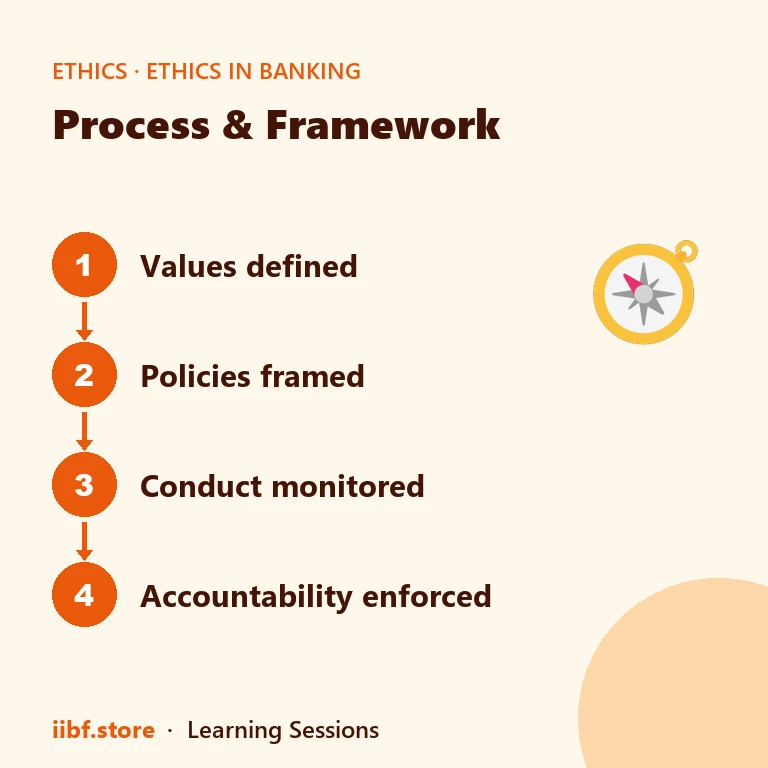
🧱 Chinese Walls, Recusal and Information Barriers
A Chinese wall (information barrier) is the standard device for a bank that must serve two clients whose interests collide, or that holds price-sensitive information on one side of the house while trading or advising on the other.
A working barrier has five components. Physical and logical separation — separate floors or access-controlled zones, separate drives, separate email groups. Separate reporting lines up to a common point far above the deal team. Restricted and grey lists — the restricted list names scrips in which employee and proprietary trading is blocked because the bank holds unpublished price sensitive information; the grey list is a confidential subset known only to compliance. Need-to-know discipline, with wall-crossing permitted only through compliance, logged, and with the crossed individual brought under the same trading restrictions. Surveillance — trade monitoring, communication review and a structured digital database of who received what information and when.
Recusal is the individual-level equivalent. The conflicted officer records the interest, hands the file to another authority, and takes no part in discussion or voting. In a committee, recusal means leaving the room, not merely abstaining — presence itself influences colleagues. The minutes must record both the disclosure and the recusal; if the minutes are silent, the recusal effectively did not happen.
Barriers fail in predictable ways, and questions are built on those failures: a shared printer, an analyst seated next to the deal team, a "quick word" in the lift, a common relationship manager who covers both the acquirer and the target, or a senior executive who sits on both the credit committee and the investment banking committee. The chapter on corporate governance and its ethical dimension links these control failures back to board-level accountability, and the discussion of ethical theories in business ethics explains why a rule-based barrier still needs a virtue-based culture to hold.
🏛️ Board Oversight and Case-Style Examples
Individual honesty does not scale; governance does. The board owns the conflict-of-interest policy, approves the gift threshold and the related-party framework, and receives an annual conflicts register. The Audit Committee of the Board reviews and approves related-party transactions, receives internal audit and compliance reports directly, and has the standing to question management without management in the room. For listed banks, SEBI's listing framework additionally requires shareholder approval for material related-party transactions above the prescribed materiality threshold. The Nomination and Remuneration Committee matters too: an incentive plan that pays entirely on volume manufactures conflicts faster than any policy can absorb them. That is why ethical leadership in banks is examined alongside structure, and why a functioning whistleblower policy in banks is treated as the last line of defence when disclosure and recusal both fail.
Case 1 — The relative's loan
An officer's brother-in-law applies for an MSME limit at the officer's own branch. Right response: record the relationship in writing on the file, do not appraise or recommend, and route the proposal to a different sanctioning authority with the disclosure attached. Rejecting the application outright is also wrong — the borrower is entitled to a fair, unbiased appraisal by someone else.
Case 2 — The single-premium sale
A branch is short of its insurance target; a senior citizen renewing a term deposit is persuaded into a single-premium policy with a long lock-in. Right response: the sale fails the suitability test regardless of disclosure. The officer must document need analysis, disclose that a third-party product is being sold and that the bank earns commission, and offer the deposit on its own terms. The behavioural dimension is covered in the chapter on ethics at the organisational level.
Case 3 — The consultancy offer
A credit officer is offered a weekend consultancy by a borrower's group company. Right response: decline. Outside employment with a borrower is a continuing financial interest; prior permission would not be granted, and accepting it while retaining the relationship crosses into the territory examined in the chapter on corruption, bribery and white-collar crime.
📌 Remember: Recusal in a committee means leaving the room and having it minuted. Abstaining while seated is not recusal, and inspectors treat it as participation.
🧠 Practice MCQs: Conflict of Interest in Banking
Q1. Under which section of the Banking Regulation Act, 1949 is a banking company prohibited from granting loans and advances to its own directors and to firms in which a director is interested? (a) Section 6 (b) Section 17 (c) Section 20 (d) Section 35A
Answer: (c) — Section 20 imposes the statutory restriction on loans to directors and connected firms, with narrow carve-outs such as advances against the bank's own deposits and government securities.
Q2. A branch manager's spouse applies for a car loan at the same branch. The most ethically sound response is to: (a) sanction it since the loan is fully secured (b) disclose the relationship in writing and route the file to a different sanctioning authority (c) reject the application to avoid any appearance of bias (d) sanction it and note the relationship in the branch diary
Answer: (b) — Disclosure plus recusal protects both the bank and the applicant's right to an unbiased appraisal; outright rejection is itself unfair treatment.
Q3. RBI's compliance-function expectations for the Chief Compliance Officer require that the CCO: (a) report to the Chief Financial Officer (b) carry business targets to stay commercially grounded (c) head at least one revenue vertical for context (d) not be assigned any responsibility that creates a conflict, such as business targets or executive roles they must later test
Answer: (d) — The compliance function is a control function; dual-hatting it with revenue responsibility destroys its independence.
Q4. A "restricted list" maintained under a bank's information-barrier policy is used mainly to: (a) block employee and proprietary trading in scrips where the bank holds unpublished price sensitive information (b) list borrowers whose accounts have turned NPA (c) record customers who opted out of cross-selling calls (d) name vendors barred after a fraud
Answer: (a) — The restricted list is a trading-control device tied to UPSI held on the other side of the Chinese wall.
Q5. In the disclose–avoid–manage hierarchy, avoidance is preferred over management when: (a) the conflict has been disclosed to the customer in writing (b) the conflict is structural and no safeguard can make the decision-maker genuinely neutral (c) the transaction is below the board-approved threshold (d) the employee has more than ten years of service
Answer: (b) — Controls can contain an incidental conflict; a structural one has to be eliminated, not documented.
Want chapter-wise mock tests with 100+ MCQs? Start practising free →
❓ Frequently Asked Questions
Is a conflict of interest in banking the same as misconduct?
No. A conflict is a condition, not an act. It becomes misconduct only when it is concealed, or when the officer acts on it despite a duty to disclose, recuse or avoid. This distinction is worth stating explicitly in descriptive answers.
Can a bank lend to a relative of one of its officers?
Generally yes, but never through the officer concerned. The relationship must be declared, the officer must not appraise, recommend or sanction, and the bank's credit policy will usually push the proposal to a higher or independent authority with the disclosure on record.
What is the difference between a Chinese wall and recusal?
A Chinese wall is a structural, ongoing barrier between two parts of an organisation that stops information flowing. Recusal is an individual, transaction-specific withdrawal from a decision. Large banks need both; a wall without recusal leaves conflicted individuals deciding files inside their own side of the wall.
Which committee is primarily responsible for related-party transactions in a bank?
The Audit Committee of the Board reviews and approves related-party transactions and receives internal audit and compliance reports directly. For listed banks, material transactions above the prescribed threshold additionally require shareholder approval under SEBI's listing framework.
Every conflict question in the IIBF Ethics in Banking paper is answerable with the same three-beat structure: name the competing interest, place it in a zone (credit, distribution, control function, information, personal), then apply disclose → avoid → manage and say why the chosen rung is right. Add the governance layer — Audit Committee, conflicts register, information barrier — and you have a full-marks answer.
Work through more material on the Ethics in Banking tag hub, then test yourself with chapter-wise banks on iibf.store mock tests or pick up the structured CAIIB and certificate course material to cover the governance chapters end to end.
Quick quiz on this topic
5 exam-style questions from our free test bank — check yourself before you move on.
Practice this topic
Take a free mock test, download chapter PDFs, or watch a video class — all included on iibf.store.