Restructuring of Stressed Advances: RBI Framework and Bank Practice (CAIIB ABM)
When a borrower account shows early signs of stress, banks turn to restructuring of stressed advances to protect recovery value and give the business a fair chance to revive. RBI's Prudential Framework for Resolution of Stressed Assets, issued on 7 June 2019, is the rulebook every CAIIB ABM candidate must know cold. It replaced the earlier scheme-based circulars with one principle: identify stress early, decide fast, and provision hard if you delay. This article walks through the review period, the inter-creditor agreement, resolution plan implementation conditions, asset classification rules, additional provisioning, and the MSME restructuring window — everything you need for the exam and for the branch desk.
📉 What Triggers Restructuring and the Review Period
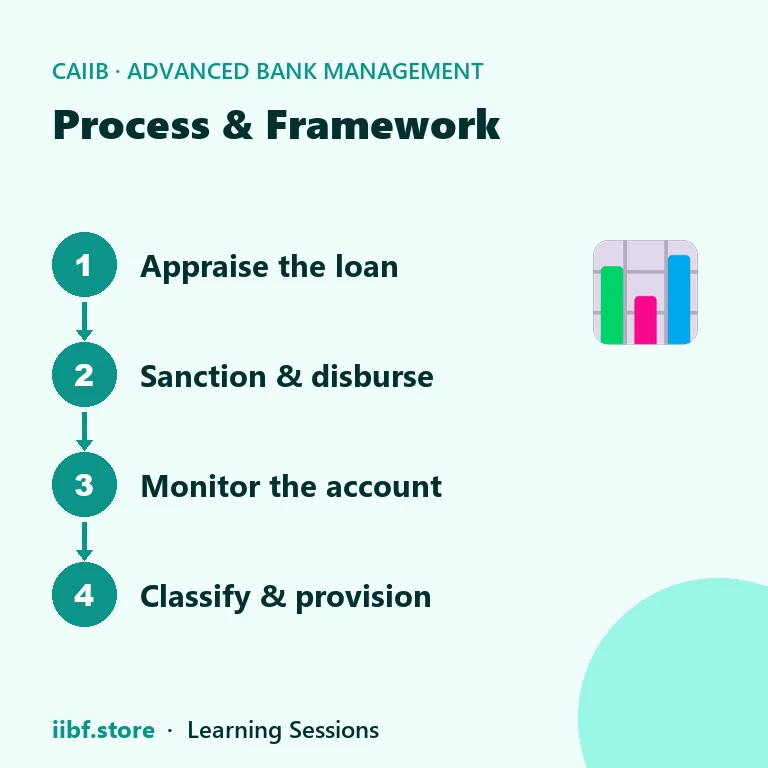
Restructuring of stressed advances begins the moment a borrower shows signs of financial stress. Under RBI's Prudential Framework for Resolution of Stressed Assets, dated 7 June 2019, banks must act the day a loan account slips into default, even for a single day.
The framework applies to banks, all-India financial institutions and larger NBFCs. It replaced the earlier scheme-based circulars, including the one struck down by the Supreme Court in 2019. The new approach is principle-based, not scheme-based.
Once default happens, the lender starts a Review Period. This period runs for 30 days from the date of default. During this window, the lender studies the account and picks one of three paths: rectification, restructuring of stressed advances, or recovery through legal channels.
Rectification means the borrower regularises dues without changing loan terms. Restructuring means the lender changes repayment terms to help a viable business survive. Recovery means the lender moves toward enforcement or insolvency proceedings under the IBC.
Diversion of funds by the borrower often triggers this stress in the first place. If you want the operational side of how one diverted rupee breaks a cash credit account, read our piece on diversion of funds.
💡 Exam Tip: The Review Period is always 30 days from the date of default, not from the date the lender notices the default.
🤝 Inter-Creditor Agreement and Resolution Plan Implementation
Most stressed accounts have more than one lender. When that happens, all lenders must sign an Inter-Creditor Agreement, commonly called the ICA, within 30 days of the Review Period ending.
The ICA is not a formality. It binds every signing lender to the resolution strategy chosen by the majority. Decisions carry weight when lenders holding 75% of the total outstanding exposure by value, and 60% of lenders by number, agree on a plan.
Once that threshold is met, the decision binds all lenders, including those who voted against it or stayed silent. This majority rule stops one small lender from blocking a viable resolution plan for the whole consortium.
A resolution plan is not complete just because lenders sign paper. RBI treats a plan as "implemented" only when three conditions hold together. First, all restructuring documentation and inter-lender agreements are fully executed. Second, the new capital structure or revised terms are reflected in each lender's books. Third, the borrower is not in default to any signing lender on the date of implementation.
Miss any one condition and the plan is treated as not implemented, no matter how much paperwork exists. This is a favourite trap in CAIIB ABM papers.
Strong relationship management with the borrower during this stage decides whether the plan actually sticks. See our guide on customer relationship management in banks for the soft-skills side of recovery.
⚠️ Common Mistake: Candidates assume the ICA needs 100% consent. It only needs the 75%-by-value and 60%-by-number majority to bind everyone.
📊 Asset Classification and Additional Provisioning
Asset classification during restructuring of stressed advances follows a strict clock. A standard account that gets restructured within the Review Period, with the resolution plan implemented on time, can often keep its standard tag, subject to viability and other conditions in the framework.
Delay changes everything. If the resolution plan is not implemented within 180 days of the Review Period ending, banks must set aside additional provisions on top of existing standard-asset or NPA provisioning. If the plan still is not implemented within 365 days of the Review Period ending, the additional provisioning requirement rises further.
This escalating provisioning is the framework's real enforcement tool. RBI does not fine the bank directly. It simply makes delay expensive on the balance sheet, which pushes lenders to move faster.
The table below summarises the milestones every CAIIB ABM candidate should memorise.
| Milestone | Timeline | Standard Classification Preserved? | Additional Provisioning |
|---|---|---|---|
| Review Period completes | 30 days from default | ✅ | None |
| Inter-Creditor Agreement signed | Within 30 days of Review Period end | ✅ | None |
| Resolution plan implemented on time | Within 180 days of Review Period end | ✅ (conditions apply) | None |
| Resolution plan still not implemented | Beyond 180 days | ❌ | Additional provision applies |
| Resolution plan still not implemented | Beyond 365 days | ❌ | Provisioning requirement rises further |
Banks track these timelines using structured monitoring, similar to the sampling checks covered in Sampling methods. Recovery officers also study default patterns using tools from Correlation and Regressions to flag accounts likely to slip further.
📌 Remember: Provisioning is the enforcement mechanism. Classification retention depends on timely implementation, not on intention.
🏭 The MSME Restructuring Window
MSME borrowers get a separate lever outside the June 2019 framework. RBI has, from time to time, permitted a one-time restructuring window specifically for eligible MSME accounts.
Under this window, a standard MSME account can be restructured without an automatic downgrade to NPA, provided the account meets the eligibility conditions RBI sets for that window. Typical conditions include the account being standard as on a specified cut-off date, exposure within a defined ceiling, and the borrower not having used the same relief window before.
This MSME relief is narrower and time-bound compared with the general framework. It exists because MSME units often face working-capital stress that is cyclical rather than a sign of poor viability. CAIIB ABM candidates should never confuse this MSME window with the general Prudential Framework — they run on different rules and different eligibility tests.
Banks also account for restructured exposures differently depending on where the paper sits in the investment book. Restructured debt securities held in the HTM category follow separate valuation rules; if you handle CAIIB BFM too, our note on the HTM category covers that side.
For a wider look at how banks build and monitor loan portfolios before stress ever appears, browse more ABM topics on our Advanced Bank Management tag hub.
🎯 Exam Takeaways and Next Steps
Restructuring of stressed advances rewards candidates who know the clock: 30 days for the Review Period, 30 more days for the ICA, and the 180-day and 365-day provisioning triggers after that.
Keep the three implementation conditions separate from the classification rule, and keep the MSME window separate from the general framework. Examiners love mixing these up in options.
Ready to test yourself? Attempt full-length CAIIB ABM mock tests or continue your structured prep on the CAIIB course page.
🧠 Practice MCQs: Restructuring of Stressed Advances
Q1. As per RBI's Prudential Framework for Resolution of Stressed Assets, the Review Period begins from (a) the date the lender's board approves resolution (b) the date of first default (c) the date the borrower requests restructuring (d) the date the ICA is signed
Answer: (b) — The framework triggers the Review Period from the date of default, not from later administrative steps.
Q2. Under the framework, the Inter-Creditor Agreement must be signed within how many days of the Review Period ending? (a) 15 days (b) 30 days (c) 60 days (d) 90 days
Answer: (b) — Lenders must execute the ICA within 30 days after the Review Period concludes.
Q3. A resolution plan approved by lenders holding what share binds all lenders under the ICA? (a) 51% by value only (b) 75% by value and 60% by number (c) 90% by value and 90% by number (d) unanimous consent
Answer: (b) — This 75%-by-value and 60%-by-number majority binds every signing lender, including dissenters.
Q4. If a resolution plan is not implemented within 180 days of the Review Period ending, banks must (a) close the account immediately (b) make additional provisioning (c) file a fresh loan application (d) restart the Review Period
Answer: (b) — Delay beyond 180 days triggers additional provisioning, the framework's core enforcement tool.
Q5. A resolution plan is treated as implemented only when (a) the borrower verbally agrees to new terms (b) documentation is complete, revised terms are reflected in books, and the borrower is not in default (c) the credit committee notes the file (d) RBI approves the plan in writing
Answer: (b) — All three conditions must hold together; partial completion does not count as implementation.
Want chapter-wise mock tests with 100+ MCQs? Start practising free →
What is the Prudential Framework for Resolution of Stressed Assets?
It is RBI's rulebook, dated 7 June 2019, that governs how lenders identify and resolve stressed loan accounts across banks, financial institutions and larger NBFCs.
Does restructuring always mean the account becomes an NPA?
Not always. If timelines and implementation conditions are met, a standard account can keep its standard classification, subject to the framework's conditions.
Is the Inter-Creditor Agreement compulsory?
Yes. Whenever more than one lender is involved, signing the ICA is mandatory before pursuing restructuring of stressed advances.
How is the MSME restructuring window different?
It is a separate, time-bound relief for eligible MSME borrowers, distinct from the general Prudential Framework rules.
Quick quiz on this topic
5 exam-style questions from our free test bank — check yourself before you move on.
Practice this topic
Take a free mock test, download chapter PDFs, or watch a video class — all included on iibf.store.
Keep reading