Software Security Controls in Banks: IIBF ITSEC Guide 2026
Every bank runs on software, and every line of that software is a potential doorway for an attacker. That is why software security controls in banks sit at the heart of the IIBF IT Security syllabus — they cover the safeguards built into applications, from a teller's core-banking screen to a customer's mobile app, that stop data from being altered, stolen, or destroyed. Candidates preparing for the ITSEC certificate must know not just the definitions but how these controls interact with network defences, encryption, and audit requirements. This guide breaks the topic into exam-ready sections, with a comparison table, practice MCQs, and quick-revision callouts so you can walk into the exam hall confident.
🔐 What Are Software Security Controls in Banks
In simple terms, software security controls in banks are the mechanisms embedded within an application — or wrapped around it — that enforce confidentiality, integrity, and availability of data. Unlike physical security (locks, biometric doors) or network security (firewalls, IDS/IPS), software controls live inside the code and the application logic itself. Examples include input validation routines that reject malformed transaction requests, role-based access modules that decide whether a teller or a manager can approve a loan, and audit-trail functions that log every change to a customer record. Banks implement these controls at multiple layers: at the presentation layer (form validation, session timeouts), the business logic layer (authorization checks, segregation of duties), and the data layer (encryption at rest, checksums for integrity). The Software Security Control chapter walks through each of these layers with worked examples, and is a must-read before attempting mock papers. A well-designed application should fail safely — meaning that when something goes wrong, the software denies the transaction rather than silently allowing it through, a principle examiners frequently test with scenario-based questions.
💡 Exam Tip: When a question describes a control that lives "inside" the application code (validation, access checks, logging), it is a software control — not a network or physical one. Read the location clue carefully.
🛡️ Key Types of Software Security Controls in Banks
The IIBF syllabus groups software security controls in banks into a handful of recurring categories, and examiners love to test the differences between them. Preventive controls stop an incident before it happens — think input sanitisation, strong authentication, and encryption of sensitive fields. Detective controls catch problems as they occur or shortly after — audit logs, intrusion-detection hooks inside an application, and reconciliation scripts that flag mismatched balances. Corrective controls kick in once an incident is detected, such as automatic session termination or rollback of a corrupted transaction. A fourth category, deterrent controls, exists mainly to discourage misuse — for example, a visible on-screen warning that "all activity is monitored and logged" before a user logs into net banking. Version control and change-management discipline also fall under this umbrella: every code change to a banking application must pass through a documented approval and testing cycle before release, so that untested code never reaches production. The Controls In Software Development And Maintenance chapter expands on this lifecycle view, including how banks separate development, testing (UAT), and production environments to prevent an untested patch from breaking a live system.
⚠️ Common Mistake: Students often confuse "detective" and "corrective" controls. A detective control finds the problem (an alert); a corrective control fixes it (a rollback or account lock). The exam frequently tests this exact pairing.
📋 Standards, Secure SDLC, and Governance
No discussion of software security controls in banks is complete without covering the governance frameworks that hold them together. Banks are expected to embed security requirements from the very first stage of the Software Development Life Cycle (SDLC) — requirements gathering — rather than bolting security on after the application is built. This "secure by design" approach means threat modelling during design, static and dynamic code analysis during build, and penetration testing before go-live. Internationally recognised frameworks such as the information security management standard used across the banking sector, along with OWASP's application-security guidance, give institutions a structured checklist to follow. Indian banks additionally align their software controls with RBI's cyber security and IT governance expectations, which require boards to review application-security posture periodically. The Security Standards And Best Practices chapter is the best single source for mapping these standards to exam questions, since it lists which control belongs to which framework — a favourite exam trap.
Governance does not stop at coding standards. Banks must also classify the assets their software touches — customer PII, transaction ledgers, cryptographic keys — so that the right level of control is applied to the right data. This ties directly into the Asset Classification And Controls chapter, where sensitivity labels (public, internal, confidential, secret) determine encryption strength, access restrictions, and retention rules for each software module.
📌 Remember: Secure SDLC means security is designed in from requirements onward — not tested in at the end. Exam questions on "shift-left" security are testing exactly this idea.
🌐 Software Security Controls vs Network Security Controls in Banks
A frequent point of confusion for ITSEC candidates is where software controls end and network controls begin. The table below draws the line clearly, since several MCQs each year hinge on correctly classifying a given control.
| Control Focus | Software Security Controls | Network Security Controls |
|---|---|---|
| Input validation on a loan form | ✅ Applies | ❌ Not applicable |
| Firewall rule blocking a port | ❌ Not applicable | ✅ Applies |
| Role-based access inside an app | ✅ Applies | ❌ Not applicable |
| Intrusion detection on the perimeter | ❌ Not applicable | ✅ Applies |
| Application audit-trail logging | ✅ Applies | ❌ Not applicable |
| Segmentation of the DMZ | ❌ Not applicable | ✅ Applies |
In practice the two layers are complementary, not competing — a bank needs both a locked-down network perimeter and airtight application logic, because an attacker who breaches the network still has to defeat the software controls to reach customer data, and vice versa. For a deeper walkthrough of the perimeter side of this equation, see our companion guide on network security controls in banks, which pairs well with this article for the "controls" section of the ITSEC paper.
🚨 Common Vulnerabilities and Vulnerability Testing
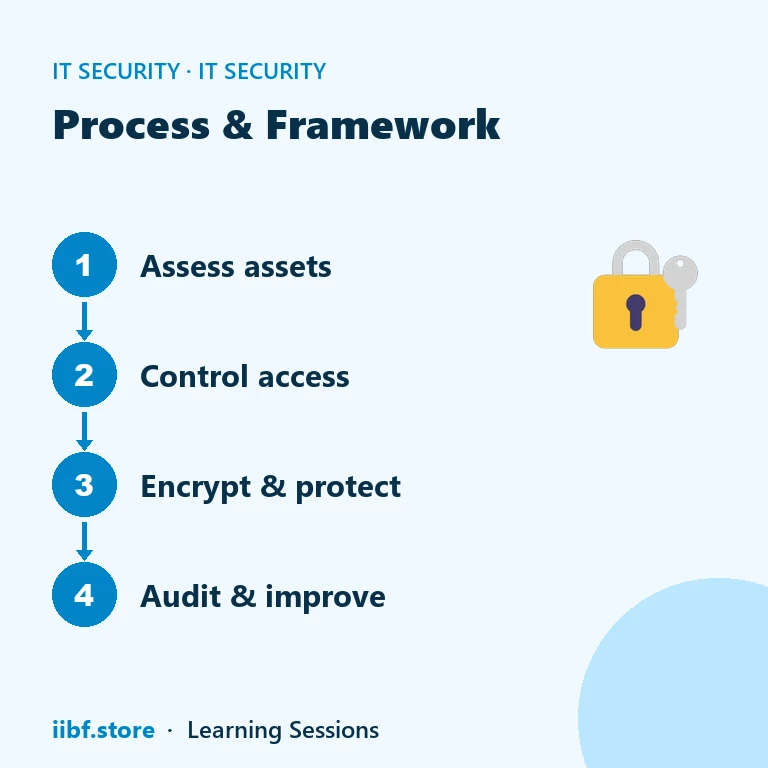
Even well-governed software accumulates vulnerabilities over time — a missed patch, a misconfigured API, or a developer who leaves a debug endpoint enabled. Banks address this through periodic vulnerability assessment and penetration testing of every customer-facing and back-office application, well before regulators or auditors ask for evidence. Typical software-level vulnerabilities the exam tests include SQL injection (unsanitised database queries), broken authentication (weak session management), and insecure direct object references (a user changing a URL parameter to view someone else's account). Physical and environmental factors also interact with software controls — a server room with poor access logging can undermine even the best-coded application if an attacker gains physical console access, a link covered in the Physical And Environmental Security Controls chapter. Meanwhile, encryption of data in transit and at rest — covered in our data encryption in banks guide — is itself a software-enforced control, since the encryption/decryption logic runs inside the application or its supporting libraries. Banks that run a mature Security Operations Centre, as described in our security operations centre article, feed vulnerability-scan output directly into their monitoring dashboards so that a newly discovered software flaw is triaged within hours, not months.
🧠 Practice MCQs: Software Security Controls in Banks
Q1. Which type of control STOPS an incident before it can occur? (a) Detective (b) Corrective (c) Preventive (d) Deterrent
Answer: (c) — Preventive controls (input validation, authentication) act before an incident happens.
Q2. An audit log that flags an unusual fund transfer AFTER it is posted is an example of a: (a) Preventive control (b) Detective control (c) Physical control (d) Network control
Answer: (b) — Detective controls identify issues once they have already occurred.
Q3. Role-based access control restricting a teller from approving high-value loans is classified as a: (a) Network security control (b) Software security control (c) Environmental control (d) Deterrent-only control
Answer: (b) — Access logic enforced within the application is a software security control.
Q4. "Secure by design" in the SDLC means security requirements are addressed: (a) Only during penetration testing (b) After go-live, via patches (c) From the requirements-gathering stage onward (d) Only by the network team
Answer: (c) — Secure SDLC embeds security from the earliest design stage, not as an afterthought.
Q5. A user manually edits a URL parameter to view another customer's account details. This is an example of: (a) A firewall misconfiguration (b) An insecure direct object reference (c) A physical access breach (d) A deterrent control failure
Answer: (b) — This is a classic insecure direct object reference (IDOR) vulnerability at the software layer.
Want chapter-wise mock tests with 100+ MCQs? Start practising free →
What is the difference between software security controls and network security controls in banks?
Software security controls operate inside the application (input validation, access checks, audit logs), while network security controls protect the perimeter and traffic (firewalls, IDS/IPS, segmentation). Both are needed together for full protection.
Why are software security controls in banks important for the ITSEC exam?
The ITSEC syllabus tests candidates on classifying controls correctly, understanding secure SDLC practices, and applying standards like ISO 27001 and OWASP guidance to real banking application scenarios.
What are examples of preventive software security controls?
Input validation, strong password policies, multi-factor authentication, encryption of sensitive fields, and role-based access restrictions are all preventive software security controls used in banking applications.
How do banks test software for vulnerabilities?
Banks run periodic vulnerability assessment and penetration testing, static and dynamic code analysis, and code reviews during the SDLC to catch flaws such as SQL injection or broken authentication before deployment.
Mastering software security controls in banks is not just about memorising a checklist — it is about recognising, in any exam scenario, which layer of defence a described control belongs to and how it fits alongside network, physical, and governance measures. Reference RBI's cybersecurity guidance for banks at rbi.org.in for the regulatory backdrop to this topic. Once you're comfortable with the categories, types, and standards covered above, reinforce your learning with our full IIBF exam-prep blog, revise the related chapters, and then put yourself to the test. 🎯 Ready to check your prep level? Take a full-length ITSEC mock test today, browse more IT Security articles, or explore our CAIIB course track for the complete certification roadmap.
Prefer revising from a printed book?
Chapter-wise books with MCQs after every chapter — minimal pages, complete coverage, delivered anywhere in India. Every book has a free sample to read first.
118 pages · 299 MCQs
Learning Sessions · Ashish Sir
132 pages · 225 MCQs
Learning Sessions · Ashish Sir
188 pages · 435 MCQs
Learning Sessions · Ashish Sir
117 pages · 236 MCQs
Learning Sessions · Ashish Sir
Learning Sessions · Ashish Sir
Learning Sessions · Ashish Sir
Learning Sessions · Ashish Sir
Learning Sessions · Ashish Sir
115 pages · 255 MCQs
Learning Sessions · Ashish Sir
Learning Sessions · Ashish Sir
334 pages · 936 MCQs
Learning Sessions · Ashish Sir
Learning Sessions · Ashish Sir
115 pages · 344 MCQs
Learning Sessions · Ashish Sir
107 pages · 240 MCQs
Learning Sessions · Ashish Sir
90 pages · 150 MCQs
Learning Sessions · Ashish Sir
Learning Sessions · Ashish Sir
131 pages · 672 MCQs
Learning Sessions · Ashish Sir
221 pages · 831 MCQs
Learning Sessions · Ashish Sir
128 pages · 524 MCQs
Learning Sessions · Ashish Sir
107 pages · 445 MCQs
Learning Sessions · Ashish Sir
148 pages · 478 MCQs
Learning Sessions · Ashish Sir
151 pages · 465 MCQs
Learning Sessions · Ashish Sir
148 pages · 375 MCQs
Learning Sessions · Ashish Sir
216 pages · 895 MCQs
Learning Sessions · Ashish Sir
109 pages · 300 MCQs
Learning Sessions · Ashish Sir
104 pages · 360 MCQs
Learning Sessions · Ashish Sir
82 pages · 297 MCQs
Learning Sessions · Ashish Sir
151 pages · 600 MCQs
Learning Sessions · Ashish Sir
98 pages · 282 MCQs
Learning Sessions · Ashish Sir
Practice this topic
Take a free mock test, download chapter PDFs, or watch a video class — all included on iibf.store.