Standing Deposit Facility (SDF) Explained for CAIIB 2026
The Standing Deposit Facility is one of the most exam-tested reforms in modern RBI liquidity management, yet many CAIIB Central Banking candidates only half-remember it as "the new reverse repo." That shortcut costs marks. The Standing Deposit Facility was introduced on 8 April 2022 as a collateral-free tool that lets the RBI absorb surplus cash from banks without pledging a single government security in return, reshaping the floor of the Liquidity Adjustment Facility corridor.
🏦 What Is the Standing Deposit Facility?
At its simplest, the Standing Deposit Facility (SDF) is a window through which banks park excess funds with the RBI overnight and earn interest, without the RBI having to hand over eligible securities as collateral. Before April 2022, the fixed rate reverse repo performed this absorption role, but it required the RBI to maintain an adequate stock of government securities to offer as collateral against every rupee absorbed. As systemic liquidity surpluses grew larger through 2020-2021, that collateral requirement became an operational constraint on the central bank rather than on the banking system. The SDF removed that constraint entirely. Because it needs no collateral, the RBI can absorb any quantum of surplus liquidity through the SDF window, which makes it a far more elastic tool than the instrument it replaced. Participation is voluntary and available to all scheduled commercial banks that hold current accounts with the RBI, and deposits can be placed at any time during the day, not just at the end-of-day window, which gives banks more flexibility in managing intraday cash positions.
📐 How the SDF Rate Is Fixed
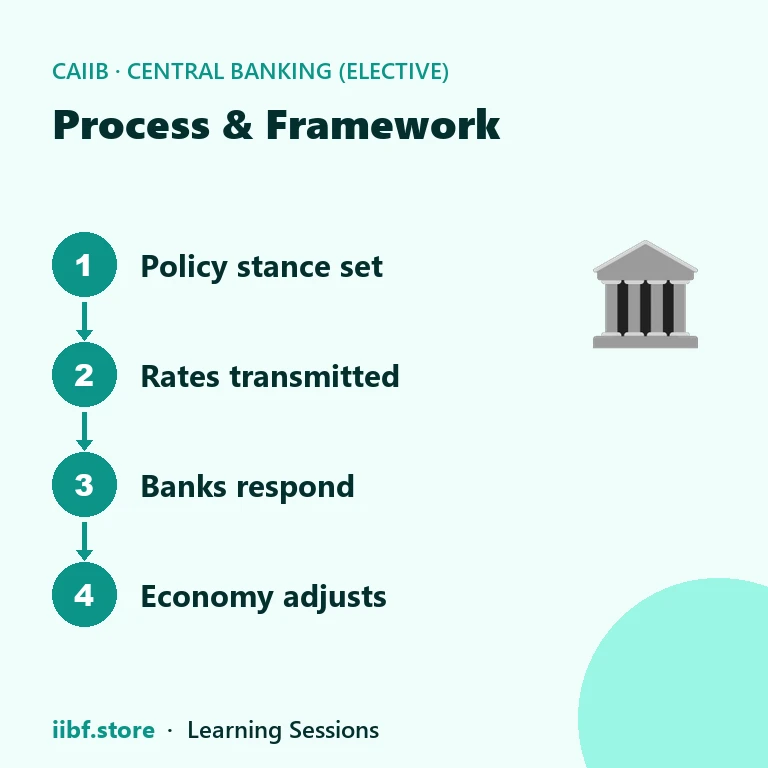
The SDF rate is not set independently; it is anchored to the policy repo rate and sits exactly 25 basis points below it, forming the floor of the Liquidity Adjustment Facility corridor. The Marginal Standing Facility rate sits 25 basis points above the repo rate, forming the ceiling. This symmetric ±25 bps corridor design means that whenever the Monetary Policy Committee changes the repo rate, the SDF and MSF rates move automatically in lockstep, without any separate announcement being required. For CAIIB exam purposes, remember the corridor structure rather than memorising a specific rate figure, since the absolute levels shift with every MPC review while the 25 bps spacing has remained the structural rule since the SDF's launch. Candidates should also note that the SDF is used for absorption operations, while the MSF exists at the opposite end for banks that need emergency overnight funds against collateral when interbank liquidity is tight.
💡 Exam Tip: Pair every SDF question with the corridor picture — SDF at the floor, repo in the middle, MSF at the ceiling, each 25 bps apart.
⚙️ Why RBI Introduced the SDF in 2022
The SDF traces back to the recommendations of the Internal Working Group on liquidity management, chaired by a Deputy Governor of the RBI, which reviewed the operating framework after the extended period of surplus liquidity created by pandemic-era interventions. The group flagged that the collateral-based reverse repo was becoming a binding constraint on absorption capacity, and recommended a collateral-free standing facility as a cleaner, more scalable floor for the corridor. To make this legally possible, Section 17 of the RBI Act, 1922 was amended through the Finance Act, 2018, inserting sub-section (4E), which explicitly empowers the RBI to accept money as deposits repayable with interest from banks or any other institution, without any collateral requirement. That legislative groundwork sat dormant for a few years before the RBI formally activated the SDF as part of the liquidity normalisation cycle in April 2022, replacing the fixed rate reverse repo as the principal absorption tool. Since then, the SDF has operated alongside variable rate reverse repo auctions, giving the RBI both a fixed floor rate and a market-linked route for liquidity absorption depending on prevailing conditions.
| Feature | Standing Deposit Facility | Fixed Rate Reverse Repo | Marginal Standing Facility |
|---|---|---|---|
| Collateral required | ❌ None | ✅ Government securities | ✅ Government securities |
| Position in LAF corridor | Floor (repo − 25 bps) | Formerly the floor | Ceiling (repo + 25 bps) |
| Direction of flow | Bank deposits with RBI | Bank deposits with RBI | RBI lends to banks |
| Absorption capacity | Unlimited (no collateral cap) | Capped by RBI's SLR securities | Not applicable |
| Legal basis | Section 17(4E), RBI Act | Section 17, RBI Act | Section 17, RBI Act |
🔁 SDF, Reverse Repo and the Liquidity Toolkit
It helps to place the SDF next to the other instruments a Central Banking candidate must know cold. Reverse repo, whether fixed or variable rate, still exists in the toolkit for market-linked absorption, and open market operations remain the instrument for durable, longer-term liquidity adjustment through outright purchase or sale of government securities. The SDF's distinguishing feature is that it is a standing facility: banks can access it on their own initiative, at any time, without waiting for the RBI to conduct an auction. This "standing" nature is shared conceptually with the MSF on the lending side, which is why exam questions frequently ask candidates to contrast the two standing facilities against the two auction-based instruments. A related structural point worth remembering is that the SDF sits at the base of a corridor RBI uses to keep the weighted average call rate anchored close to the repo rate, which is the operational target of monetary policy transmission to the broader money market. Examiners also like to test whether candidates can name the instrument category correctly: the SDF and MSF are both "standing" facilities available on tap, whereas repo, reverse repo auctions and open market operations are all discretionary tools that the RBI deploys only when it chooses to conduct them, a distinction that often separates a correct answer from a near-miss in objective-type questions.
⚠️ Common Mistake: Do not describe the SDF as requiring "government securities as collateral" — that description belongs to the reverse repo it replaced, and mixing the two up is a frequent CAIIB error.
🎯 SDF's Role in the LAF Corridor and Exam Relevance
For the CAIIB Central Banking elective, the SDF typically appears in questions testing three things: the legal provision that enables it, its position relative to repo and MSF in the corridor, and the operational reason it replaced the fixed rate reverse repo. A useful memory anchor is "no collateral, no cap, no fixed timing" — the SDF needs no collateral, faces no collateral-driven ceiling on absorption, and is available as a standing option rather than a scheduled auction. Understanding the SDF also reinforces the broader theme running through the Functions of Central Banks and Theory and Practice of Central Banking chapters: modern central banks continuously redesign their operating frameworks in response to structural liquidity conditions rather than relying on a single static instrument for decades. Candidates preparing the Functions of Central Banks chapter should cross-read the Liquidity Management in the System chapter, since the SDF sits at the intersection of both topics, and the Theory and Practice of Central Banking chapter for the historical evolution of RBI's operating framework. It is also worth noting that the SDF does not alter the RBI's inflation-targeting mandate itself; it only changes the plumbing through which the policy rate decided by the Monetary Policy Committee gets transmitted into actual overnight rates in the call money market, which is precisely why exam-setters treat it as an operating-framework topic rather than a monetary-stance topic.
📌 Remember: SDF launch date — 8 April 2022. Corridor spacing — 25 bps on either side of repo. Legal basis — Section 17(4E) of the RBI Act.
Once the corridor mechanics are clear, it's worth widening the lens to the rest of the liquidity toolkit that examiners rotate questions through. Our guides on RBI monetary policy tools: Repo, CRR & SLR and Ways and Means Advances cover the two instruments most commonly paired with SDF questions in CAIIB papers. If your syllabus run also touches digital currency, the Central Bank Digital Currency piece explains how RBI's newest liquidity-adjacent innovation fits alongside these traditional tools. Candidates studying the ITDB elective in parallel may also find it useful to revisit API Banking in India, since both papers examine how RBI-regulated infrastructure is modernised. For the full syllabus map, browse the Central Banking tag hub, and cross-check any rate figures against the RBI's own explanatory note on the Standing Deposit Facility before an exam attempt, since corridor rates change with every Monetary Policy Committee review.
🧠 Practice MCQs: Standing Deposit Facility
Q1. What is the primary operational purpose of the Standing Deposit Facility introduced by the RBI in April 2022? (a) To provide collateral-free absorption of surplus bank liquidity (b) To lend emergency funds to banks against government securities (c) To manage the RBI's foreign exchange reserves (d) To set long-term lending rates for banks
Answer: (a) — the SDF lets RBI absorb surplus liquidity without offering any collateral in return.
Q2. Which body's recommendation led directly to the introduction of the SDF? (a) The Y.V. Reddy Committee (b) The Internal Working Group on liquidity management chaired by an RBI Deputy Governor (c) The Bimal Jalan Committee on economic capital (d) The Urjit Patel Committee on monetary policy framework
Answer: (b) — the Internal Working Group on liquidity management recommended the collateral-free standing facility.
Q3. How does the SDF differ structurally from the fixed rate reverse repo it replaced? (a) It requires banks to pledge additional government securities (b) It absorbs liquidity without requiring the RBI to offer any collateral (c) It is available only to foreign banks (d) It pays a higher rate than the reverse repo did
Answer: (b) — removing the collateral requirement was the SDF's core structural change.
Q4. Where does the SDF rate sit within the Liquidity Adjustment Facility corridor? (a) Above the Marginal Standing Facility rate (b) Exactly equal to the repo rate (c) At the floor of the corridor, 25 basis points below the repo rate (d) At the ceiling of the corridor
Answer: (c) — the SDF forms the floor, symmetrically 25 bps below repo, mirroring the MSF 25 bps above it.
Q5. Which provision of the RBI Act, inserted via the Finance Act 2018, gives the RBI legal power to operate the SDF? (a) Section 17, sub-section (4E) (b) Section 42 on cash reserve maintenance (c) Section 24 on note issue (d) Section 45 on non-banking institutions
Answer: (a) — Section 17(4E) empowers the RBI to accept collateral-free interest-bearing deposits from banks.
Want chapter-wise mock tests with 100+ MCQs? Start practising free →
❓ Frequently Asked Questions
Is the Standing Deposit Facility the same as the reverse repo?
No. Both absorb surplus liquidity, but the SDF requires no collateral from the RBI, while the reverse repo it replaced as the corridor floor required government securities as collateral.
When was the Standing Deposit Facility launched?
The RBI operationalised the SDF on 8 April 2022, following the recommendation of its Internal Working Group on liquidity management.
Can any bank access the SDF?
All scheduled commercial banks that maintain current accounts with the RBI can voluntarily place surplus funds under the SDF, subject to RBI's operating guidelines.
Why does the SDF matter for CAIIB Central Banking?
It tests three linked concepts at once — the legal basis in Section 17(4E), the LAF corridor structure, and the operational shift from collateral-based to collateral-free liquidity absorption — making it a recurring exam theme.
Master the full liquidity management framework with structured practice — explore the CAIIB course pack or jump into chapter-wise tests to lock in these corridor concepts before exam day.
Quick quiz on this topic
5 exam-style questions from our free test bank — check yourself before you move on.
Practice this topic
Take a free mock test, download chapter PDFs, or watch a video class — all included on iibf.store.
Keep reading