Stress Testing Framework for CAIIB Risk Management 2026
Every bank's risk team is judged on one uncomfortable question: what happens when things go wrong? A robust stress testing framework answers that question before a crisis does, by forcing the balance sheet through simulated shocks — a sharp rate move, a real-estate slump, a funding freeze — and measuring the capital and liquidity that survive. For CAIIB Risk Management candidates, this topic sits at the intersection of governance, quantitative modelling and regulatory expectation, which is exactly why examiners keep coming back to it.
📊 What a Stress Testing Framework Actually Tests
At its core, a stress testing framework is a structured process: define plausible adverse scenarios, translate them into risk-factor shocks, run them through valuation and credit models, and report the capital or liquidity impact to the board. It differs from ordinary risk measurement because it deliberately looks beyond "normal" market behaviour captured by models like standard VaR-based approaches, which assume history broadly repeats itself. Stress testing instead asks "what if it doesn't?" A well-designed framework covers credit, market, liquidity and concentration risk in one integrated exercise rather than isolated silos, because real crises rarely respect departmental boundaries — a rate shock triggers defaults, which trigger funding stress, which forces asset fire-sales. Banks typically run this exercise at least annually, with ad hoc versions triggered by emerging risks such as a sudden currency depreciation or a sectoral NPA spike.
💡 Exam Tip: Remember the three pillars examiners expect you to name — sensitivity analysis, scenario analysis and reverse stress testing. Questions often ask you to match a description to the correct pillar.
🏦 RBI Guidance and the Regulatory Backbone
In India, stress testing expectations are anchored in RBI guidance notes and master directions issued to commercial banks, which require boards to approve a stress testing policy, define materiality thresholds, and periodically validate model assumptions. The regulator's stance mirrors the Basel Committee's broader principles on sound stress testing practices, emphasising that results must feed into capital planning and risk appetite decisions rather than sit in a compliance folder. You can review the source material directly on the regulator's site at rbi.org.in's master circulars page — a useful habit for any serious CAIIB aspirant. This regulatory layer connects tightly with the broader risk management framework chapter, since stress testing is one operating arm of enterprise-wide risk governance rather than a stand-alone technique confined to the treasury desk.
🧪 Sensitivity, Scenario and Reverse Approaches
Sensitivity analysis shocks a single risk factor — say, a 200 basis point parallel yield shift — and measures the isolated impact, useful for quick diagnostics but limited because real shocks rarely arrive alone. Scenario analysis is richer: it combines multiple correlated shocks into a coherent narrative, such as a recession scenario pairing falling GDP, rising unemployment and widening credit spreads simultaneously. Reverse stress testing flips the logic entirely — instead of asking "what loss does this scenario cause," it asks "what scenario would cause a loss severe enough to threaten viability," working backward from failure to plausible causes. This backward-looking discipline is particularly prized by supervisors because it surfaces hidden vulnerabilities that forward scenario design might never think to test, including concentration risks that only bite under extreme, low-probability conditions.
⚠️ Common Mistake: Candidates often confuse scenario analysis with sensitivity analysis in the exam. Sensitivity = one factor; scenario = multiple correlated factors moving together.
📈 Scenarios, Models and Capital Buffers
Building a credible scenario means grounding it in real macro-financial linkages: a mild scenario might reflect a modest slowdown, a severe scenario a full-blown crisis comparable to a historical downturn. These shocks then flow through credit, market and liquidity models — the same modelling toolkit examined under credit risk models — to produce projected losses, revised risk-weighted assets and a post-stress capital ratio. The gap between that post-stress ratio and the regulatory minimum defines the capital buffer a bank must hold or raise. Where balance-sheet mismatches are involved, the exercise overlaps heavily with asset liability management, since duration gaps and repricing mismatches determine how sharply a rate shock erodes economic value. Liquidity-side stress scenarios, in turn, borrow directly from the survival-horizon logic used in liquidity risk management, where cash outflow assumptions under stress determine how many days of survival a bank's buffer actually buys.
| Stress Test Type | Risk Factors Shocked | Typical Use | Board-Mandated? |
|---|---|---|---|
| Sensitivity Analysis | Single factor | Quick diagnostic checks | ✅ Yes |
| Scenario Analysis | Multiple correlated factors | Capital planning, ICAAP inputs | ✅ Yes |
| Reverse Stress Testing | Worked backward from failure | Uncovering hidden vulnerabilities | ❌ Often optional |
🎯 Governance, Reporting and Follow-Through
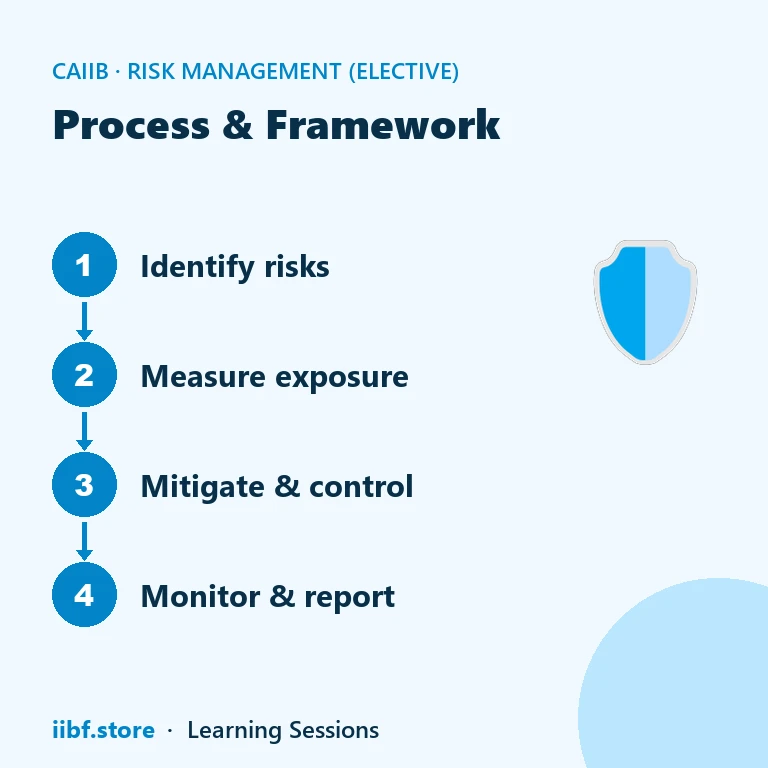
A stress testing framework is only as good as the governance wrapped around it. Results must reach the board or its risk committee in a form that drives decisions — trimming exposure to a vulnerable sector, resizing a capital buffer, or tightening underwriting standards — not merely archiving a report. Independent validation matters too: model owners should not review their own assumptions, and internal audit typically checks that scenarios stay severe-yet-plausible rather than watered down over time. Many banks link their annual capital adequacy assessment directly to stress outputs, feeding post-stress ratios into forward capital planning. This governance discipline is what separates a genuine risk management culture from a box-ticking exercise, and it is precisely the behavioural angle IIBF examiners like to probe alongside the purely quantitative questions.
📌 Remember: Stress testing outputs must feed board decisions and capital planning — a framework that only produces reports without action fails supervisory expectations.
Related enterprise risk topics worth revisiting alongside this one include operational risk management, since operational shocks are increasingly modelled as their own stress scenario, and the AML dimension covered in AML risk management, where regulatory stress on compliance failures is now a recognised reputational risk driver. Technology risk also deserves a mention here — banks increasingly stress-test digital channel resilience the way they once stress-tested only balance sheets, a shift explored in the ITDB elective through API banking in India, where interface failures during peak load are now treated as a genuine operational stress scenario in their own right.
🧠 Practice MCQs: Stress Testing Framework
Q1. What distinguishes scenario analysis from sensitivity analysis in a stress testing framework? (a) Scenario analysis uses only historical data (b) Scenario analysis shocks multiple correlated risk factors together while sensitivity analysis shocks one factor (c) Sensitivity analysis is only used for liquidity risk (d) There is no meaningful difference
Answer: (b) — Scenario analysis combines several correlated shocks into one narrative; sensitivity analysis isolates a single factor.
Q2. Reverse stress testing primarily helps a bank to: (a) Calculate daily VaR (b) Set interest rates on deposits (c) Identify the scenario that would cause failure, working backward from that outcome (d) Replace the ICAAP process entirely
Answer: (c) — Reverse stress testing starts from a failure outcome and works backward to identify plausible causal scenarios.
Q3. Under a stress testing framework, the gap between the post-stress capital ratio and the regulatory minimum represents: (a) The bank's dividend payout (b) The required capital buffer (c) The bank's net interest margin (d) The liquidity coverage ratio
Answer: (b) — This gap defines how much additional capital buffer the bank needs to hold or raise.
Q4. Which governance practice strengthens the credibility of a stress testing framework? (a) Letting the model owner validate their own assumptions (b) Independent validation of scenario severity and assumptions (c) Running the exercise only once every five years (d) Restricting results to the technology team
Answer: (b) — Independent validation ensures scenarios stay severe-yet-plausible and are not diluted over time.
Q5. A severe macroeconomic scenario in stress testing typically combines: (a) A single stable interest rate assumption (b) Falling GDP, rising unemployment and widening credit spreads together (c) Only a currency appreciation (d) No linkage to credit or market risk
Answer: (b) — Severe scenarios combine multiple correlated macro shocks rather than a single isolated variable.
Want chapter-wise mock tests with 100+ MCQs? Start practising free →
What is the main purpose of a stress testing framework in banking?
It measures how a bank's capital and liquidity would hold up under severe but plausible adverse scenarios, so risks can be managed before a real crisis hits.
How is reverse stress testing different from scenario analysis?
Scenario analysis projects losses from a chosen scenario forward; reverse stress testing starts from a failure outcome and works backward to find what scenario could cause it.
Who is responsible for approving a bank's stress testing framework?
The board or its risk committee approves the stress testing policy, materiality thresholds and scenario severity, with independent validation of the underlying models.
How does stress testing connect to ICAAP?
Stress test outputs feed directly into the capital adequacy assessment process, helping the bank size the additional capital buffer it should hold above regulatory minimums.
Ready to turn this into exam-day confidence? Explore the full CAIIB course and pair this reading with the Risk Management topic hub for every related chapter in one place.
Quick quiz on this topic
5 exam-style questions from our free test bank — check yourself before you move on.
Practice this topic
Take a free mock test, download chapter PDFs, or watch a video class — all included on iibf.store.
Keep reading