CRM in retail banking: Delivery Models and MIS for JAIIB
CRM in retail banking has moved from a back-office buzzword to the single biggest driver of branch profitability and customer retention. Every JAIIB candidate preparing Retail Banking and Wealth Management needs to understand not just the theory of customer relationship management but how banks actually deliver it across channels.
This guide walks through the delivery models banks use, how Management Information Systems (MIS) feed CRM decisions, and where credit scoring and technology fit in. We close with exam-style MCQs and an FAQ section so you can self-test before your JAIIB attempt.
🤝 Why CRM Is Central to Retail Banking
Customer relationship management is the set of practices a bank uses to understand a customer's needs, track interactions, and offer the right product at the right time. In retail banking, where a single customer may hold a savings account, a loan, and an insurance policy, CRM stitches these relationships together instead of treating each product as a separate transaction.
A bank branch that practises good CRM knows which customers are due for a home loan top-up, which ones are likely to churn, and which ones are ready for a wealth management conversation. This knowledge does not come from guesswork. It comes from structured data captured at every touchpoint, from account opening to service requests. This structured, data-led approach is exactly what good CRM in retail banking looks like in practice.
For JAIIB candidates, the concept links directly to the chapter on delivery models and customer relationship management, which sets out how banks organise people, processes, and technology around the customer rather than the product.
💡 Exam Tip: When a question asks "why CRM", the safest answer choice is almost always the one about building long-term, profitable relationships rather than one-off sales.
🏦 Delivery Models for Customer Relationship Management
Delivery channels are the practical face of CRM in retail banking, and picking the right mix matters as much as the technology behind it. Banks do not deliver CRM through a single channel. A large retail bank typically blends branch staff, relationship managers, digital apps, and call centres, each suited to a different kind of customer need. A senior citizen renewing a fixed deposit may prefer a branch visit, while a young salaried customer may only ever interact through a mobile app.
The table below compares the main delivery channels used in Indian retail banking CRM. Notice how personalisation and cost move in opposite directions as you go from digital to relationship-manager-led service.
| Delivery Channel | Best Suited For | Personalisation Level | Digital Enabled | Relative Cost to Bank |
|---|---|---|---|---|
| Branch counter service | Cash transactions, KYC, senior citizens | Medium | ❌ | High |
| Relationship manager (RM) | HNI and wealth management clients | High | ❌ | High |
| Mobile and internet banking | Routine transactions, self-service | Low | ✅ | Low |
| Call centre / IVR | Service requests, complaints | Low-Medium | ✅ | Medium |
| Video KYC and video banking | Onboarding, remote advisory | Medium-High | ✅ | Medium |
A bank's branch profitability model, covered in the chapter on the applicability of retail banking concepts and branch profitability, depends heavily on picking the right channel mix. Pushing every customer to a costly RM-led model would erode margins, while pushing every customer to pure digital self-service can hurt retention among customers who value a human relationship.
📊 MIS and Branch Profitability in CRM
Management Information Systems are the engine room behind CRM decisions. Without accurate MIS, a branch manager cannot tell which customers are profitable, which products are underperforming, or which relationships are at risk of moving to a competitor bank.
A well-designed MIS report pulls together account balances, transaction frequency, product holding, and service complaints into a single customer view. This is what allows a bank to score customers by profitability and route the most valuable ones to a dedicated relationship manager rather than a generic call centre queue.
The JAIIB syllabus chapter on Management Information Systems explains how these reports feed both CRM and branch profitability calculations together, since a profitable branch is really a collection of well-managed customer relationships.
⚠️ Common Mistake: Students often treat MIS and CRM as separate exam topics. In practice, MIS is the data layer that makes CRM decisions possible, and IIBF questions frequently test this link.
Regulators also expect banks to maintain sound internal MIS as part of good governance. You can read the Reserve Bank of India's guidance on retail lending and customer service standards on the RBI website for the regulatory backdrop to these practices.
💳 Credit Scoring and CRM-Driven Cross-Sell
Credit scoring is where CRM meets risk management. A bank's CRM system flags a customer as eligible for a top-up loan or a new credit card only after a credit score confirms that the customer can service additional debt safely.
This is covered in depth in the chapter on credit scoring and retail liability products, which explains how banks combine bureau data, income proof, and past repayment behaviour into a single score before approving a fresh facility.
Cross-selling a credit card is a common CRM outcome once a score clears the internal threshold. The mechanics of card issuance, billing cycles, and dispute handling are detailed in the credit card and debit card chapter, which pairs well with this CRM discussion for exam revision.
CRM also extends into protection products. A relationship manager who spots a customer without adequate life cover may route them toward insurance, an area regulated jointly by the insurance and pension authorities discussed in this insurance and pension regulators guide from the Indian Economy and Indian Financial System subject.
💻 Technology, Data and the Future of Retail CRM
Technology has changed CRM from a static customer database into a live decision engine. Core banking systems now feed CRM platforms with real-time transaction data, allowing banks to trigger an alert the moment a customer's salary credit stops or a large withdrawal looks unusual.
Analytics built on this data support securitisation and asset-side decisions too. The chapter on technology in retail banking and securitisation of assets shows how the same customer data that powers CRM also supports a bank's decision to pool and sell loan portfolios.
Digital channels also make CRM measurable in ways branch-only banking never was. Click-through rates on an app offer, response times on a chat query, and app usage frequency all become inputs into the next CRM campaign. This turns customer relationship management into a continuous feedback loop rather than an annual review exercise. Technology is ultimately what makes CRM in retail banking scalable across millions of customers instead of a handful of branch relationships.
For IIBF's own view on how technology standards evolve across member banks, the IIBF website is the authoritative source, and it is worth a periodic check while you prepare for JAIIB.
🎯 Building a Career-Ready CRM Skillset for JAIIB
CRM does not stop at transactional banking. As a customer's wealth grows, the same relationship manager who handled their savings account may guide them toward mutual funds, insurance, or retirement planning. Getting this handoff right requires skills covered in the chapter on the importance of wealth management, and in the related discipline of mortgage advice for customers taking on long-term secured loans.
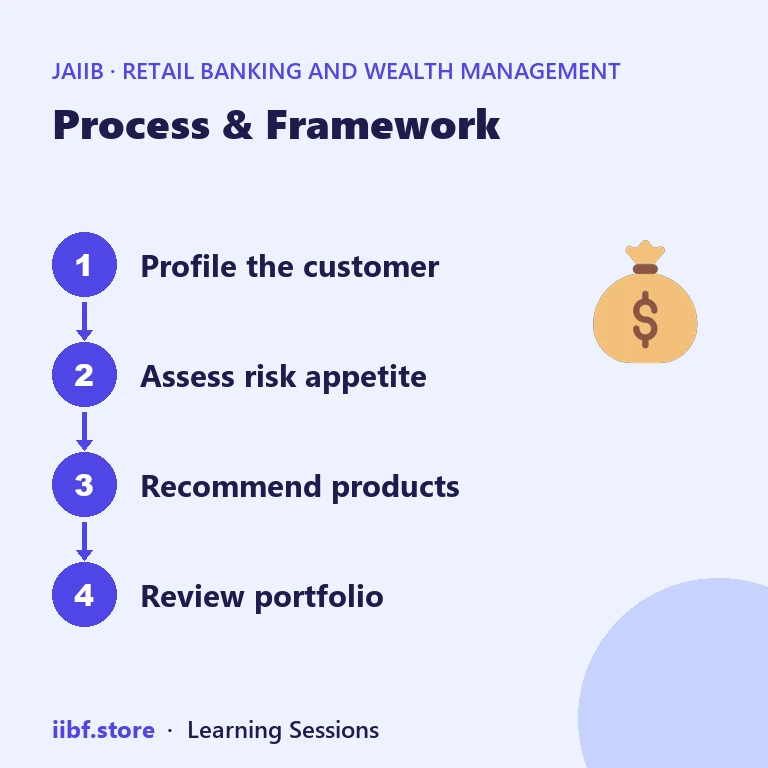
Two allied topics worth revising alongside this one are how banks assess a client's risk appetite, covered in our guide to risk profiling in wealth management, and how that risk appetite then shapes a portfolio, explained in our piece on asset allocation strategies. Banks that sell insurance through branch staff also rely on CRM data, a practice explored in our article on bancassurance in India.
📌 Remember: In the JAIIB RBWM paper, CRM questions rarely stand alone. They are usually linked to branch profitability, MIS, or cross-sell of a specific product, so revise these topics together.
Browse more chapter-linked articles on our Retail Banking and Wealth Management tag hub to build a complete revision map before your exam attempt.
🧠 Practice MCQs: CRM in Retail Banking
Q1. What is the primary objective of implementing CRM in a retail bank branch? (a) Reduce branch staff strength (b) Build long-term profitable customer relationships (c) Increase manual paperwork (d) Replace regulatory reporting
Answer: (b) — CRM exists to build and retain profitable, long-term customer relationships, not to cut costs or add paperwork.
Q2. Which retail banking delivery channel typically offers the highest level of personalised advice? (a) ATM (b) Mobile banking app (c) Relationship manager-led branch service (d) IVR call centre
Answer: (c) — A relationship manager can tailor advice to a customer's specific situation, unlike self-service or automated channels.
Q3. In CRM strategy, Management Information Systems (MIS) mainly help a bank to: (a) Print passbooks faster (b) Track customer profitability and cross-sell opportunities (c) Approve loan waivers automatically (d) Set the repo rate
Answer: (b) — MIS consolidates customer data so branches can identify profitable relationships and cross-sell opportunities.
Q4. A CRM-linked credit scoring model primarily helps a retail bank to: (a) Fix fixed deposit interest rates (b) Assess a customer's repayment capacity before lending (c) Design branch interiors (d) Calculate the cash reserve ratio
Answer: (b) — Credit scoring checks whether a customer can safely service additional debt before a new facility is offered.
Q5. Which statement best describes the role of technology and data analytics in modern retail banking CRM? (a) It replaces the need for compliance checks (b) It helps identify cross-sell and up-sell opportunities from transaction data (c) It sets IIBF exam pass marks (d) It removes KYC requirements
Answer: (b) — Analytics turns raw transaction data into actionable cross-sell and retention signals for CRM teams.
Want chapter-wise mock tests with 100+ MCQs? Start practising free →
❓ Frequently Asked Questions
What does CRM mean in retail banking?
CRM, or customer relationship management, is the practice of tracking a customer's accounts, needs, and interactions so a bank can offer the right product at the right time and build a lasting relationship rather than treating each transaction separately.
How does CRM improve branch profitability?
CRM helps a branch focus its limited staff time on the customers and products that generate the most revenue, while routing routine transactions to lower-cost digital channels, which together raise overall branch profitability.
What role does MIS play in retail banking CRM?
Management Information Systems consolidate account, transaction, and service data into reports that CRM teams use to spot profitable customers, flag churn risk, and identify cross-sell opportunities.
Is CRM knowledge tested in the JAIIB RBWM exam?
Yes, CRM concepts appear in the Retail Banking and Wealth Management paper, usually linked with delivery models, branch profitability, and MIS rather than as a standalone topic, so revise them together.
CRM in retail banking is not a side topic for JAIIB candidates; it is the thread that connects branch profitability, MIS, credit scoring, and wealth management into one syllabus theme. Revise the linked chapters together, then test yourself with a full JAIIB course mock series to see how these concepts show up in exam-style questions.
Prefer revising from a printed book?
Chapter-wise books with MCQs after every chapter — minimal pages, complete coverage, delivered anywhere in India. Every book has a free sample to read first.



























Quick quiz on this topic
5 exam-style questions from our free test bank — check yourself before you move on.
Practice this topic
Take a free mock test, download chapter PDFs, or watch a video class — all included on iibf.store.