Unclaimed Deposits and DEA Fund: 10-Year Rule, UDGAM and Claims
Every bank branch carries a quiet balance sheet item that nobody talks about until an audit or an exam question forces the issue: unclaimed deposits and DEA Fund transfers. For JAIIB PPB candidates this is a compact, high-yield topic, because the rules are precise, the ten-year clock is easy to test, and the examiner can build a question out of a single step in the claim chain. Unclaimed deposits and DEA Fund provisions sit at the meeting point of Section 26A of the Banking Regulation Act, 1949, the RBI-notified Depositor Education and Awareness Fund Scheme, and the customer-service duties your branch owes to a depositor who has simply stopped operating an account. This article walks through what qualifies, how the money moves to RBI, how a depositor gets it back with interest, and what a bank must do to trace people before that stage is ever reached.
🏦 What Counts as an Unclaimed Deposit
A deposit becomes "unclaimed" when the credit balance has not been operated upon or claimed for ten years or more. The word "deposit" is read widely here — it is not restricted to a savings account. The scope of unclaimed deposits and DEA Fund eligibility takes in savings and current account balances, term deposits that matured and were never renewed or withdrawn, and a long list of other credit balances that banks hold on behalf of customers: unpaid demand drafts and pay orders, unreconciled credits in sundry and suspense accounts, margin money against guarantees or letters of credit after the obligation is over, outstanding telegraphic transfers and mail transfers, and undrawn balances of matured deposits belonging to deceased or untraceable customers.
The starting point of the ten-year clock differs by instrument, and that difference is exactly what a multiple-choice question tends to attack. For an operative savings or current account, the clock runs from the date of the last customer-induced transaction. For a term deposit, it runs from the date of maturity, not the date of opening. For a draft or pay order, it runs from the date of issue. Bank-induced entries such as periodic interest credit or a service charge debit do not restart the clock, because they are not customer-induced.
📌 Remember: Ten years of non-operation makes a balance unclaimed; two years of non-operation only makes an account inoperative. The two clocks are different and the exam loves to swap them.
Understanding the underlying products helps here. Balances lying in remittance and collection instruments are covered in the chapter on ancillary services, while the treatment of stale and uncollected instruments is dealt with under payment and collection of cheques. Read those alongside this topic, because the examiner frequently frames an unclaimed-balance question around an unpaid pay order rather than a plain savings account.
📜 Section 26A and the DEA Fund Scheme
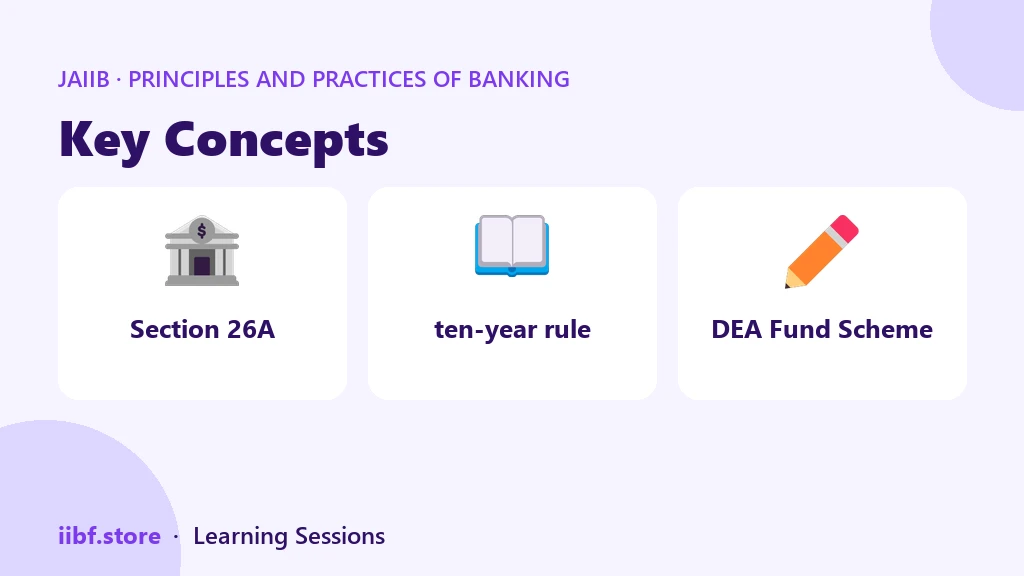
Section 26 of the Banking Regulation Act, 1949 requires every banking company to submit an annual return of all accounts in India that have not been operated upon for ten years. Section 26A, inserted by the Banking Laws (Amendment) Act, 2012, took the next step: it empowered the Reserve Bank to establish the Depositor Education and Awareness Fund and obliged banks to credit into it every eligible unclaimed amount. The operating detail sits in the DEA Fund Scheme notified by RBI in 2014, and this pairing of statute plus scheme is the single most quoted fact about unclaimed deposits and DEA Fund administration.
Banks transfer eligible balances to the Fund shortly after the ten-year period is completed, following the periodicity and cut-off prescribed in the Scheme, and they continue to report the transferred amounts. The Fund itself is maintained by RBI, which invests the corpus; the income is used to promote depositor interests and depositor awareness and education. Crucially, the transfer is an accounting movement, not an extinguishment. The depositor's right survives in full, and the bank's liability to the customer continues for ever.
| Type of balance | Ten-year clock starts from | Goes to DEA Fund? | Claimable later? |
|---|---|---|---|
| Savings / current account balance | Date of last customer-induced transaction | ✅ Yes | ✅ Yes, with interest if interest-bearing |
| Term deposit (not renewed) | Date of maturity | ✅ Yes | ✅ Yes, with interest |
| Unpaid demand draft / pay order | Date of issue of the instrument | ✅ Yes | ✅ Yes, but no interest |
| Margin money after obligation is over | Date the underlying obligation ended | ✅ Yes | ✅ Yes, interest only if it was interest-bearing |
| Locker rent or safe custody articles | Not a credit balance | ❌ No | Governed by separate locker rules |
⚠️ Common Mistake: Candidates assume the DEA Fund "absorbs" the money and the customer loses the claim. It does not. Section 26A expressly preserves the depositor's right to claim from the bank at any time.
🔍 UDGAM Portal and the 100 Days 100 Pays Campaign
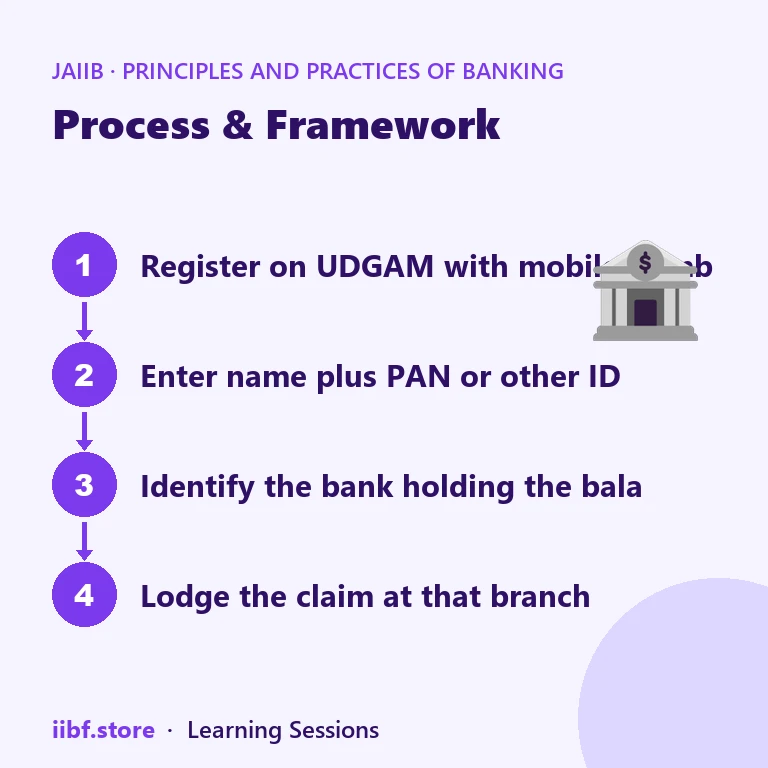
Until recently a depositor or legal heir hunting for an old account had to visit each bank's website separately, because every bank publishes its own list of unclaimed accounts. RBI closed that gap with UDGAM — Unclaimed Deposits Gateway to Access inFormation — a centralised web portal launched in 2023 that lets a member of the public search for unclaimed deposits across participating banks from one screen. The user registers with a mobile number, enters the account holder's name plus one identifier such as PAN, voter ID, driving licence, passport or date of birth, and gets a bank-wise result set showing where a possible match exists. UDGAM does not pay the money; it tells you which bank to approach, and the claim is then lodged with that bank in the normal way.
Alongside the portal, RBI ran the "100 Days 100 Pays" campaign, under which every bank was asked to trace and settle the top 100 unclaimed deposits of each bank in every district of the country within 100 days. The campaign mattered less for the money it released and more for the operating discipline it forced on branches: pulling out the oldest balances, verifying addresses, contacting nominees and legal heirs, and closing the file. Together, the portal and the campaign are the customer-facing face of unclaimed deposits and DEA Fund policy, and they are common one-line questions.
💡 Exam Tip: Fix the two names in memory as a pair — UDGAM is the search tool, 100 Days 100 Pays was the settlement drive. Questions usually ask you to identify one from its description.
If you are revising customer-protection topics as a block, read this along with protection to paying and collecting banker, since a delayed or rejected unclaimed-deposit claim is a grievance that can travel up the complaint ladder in exactly the same way as a wrongly paid instrument.
💰 Claiming a Refund from the DEA Fund, With Interest
The claim process is deliberately simple for the customer and slightly more involved for the bank, and this asymmetry is the heart of most application-based questions on unclaimed deposits and DEA Fund refunds. The depositor, or the nominee or legal heir, approaches the bank branch where the account was held. The branch completes fresh KYC and satisfies itself about identity and entitlement, re-activates the account or settles the claim, and pays the customer out of its own funds. Only after paying does the bank lodge a claim with RBI for reimbursement out of the DEA Fund. The customer never deals with RBI directly and is never asked to wait for RBI's refund.
Interest is payable on the refund, but not on everything. It runs on deposits that were interest-bearing in nature, at the simple rate notified by RBI from time to time, and it accrues for the period the amount lay with the Fund. Non-interest-bearing items — a current account balance, an unpaid draft, a stale pay order — carry no such interest. Because the notified rate has been revised more than once, quote it in the exam only if the question supplies it; otherwise state the rule qualitatively and check the current figure in the latest RBI notification before your attempt.
Documentation follows normal deposit practice: identity and address proof, the old passbook or deposit receipt if available, a death certificate and succession documents in the case of a deceased depositor, and an indemnity where records are incomplete. For an account in the name of a body corporate, the mandate and board resolution requirements described in accounts of limited companies in banks apply to the claim as well. Where the balance has been frozen by an attaching authority, the rules on garnishee order and attachment order continue to bind the bank even after transfer to the Fund.
🧭 Bank Duties: Tracing Depositors Before the Ten-Year Mark
Transfer to the DEA Fund should be the exception, not the routine. RBI's master direction on inoperative accounts and unclaimed deposits places a positive duty on banks to find the customer long before the ten-year line is crossed. Branches are expected to carry out an annual review of accounts with no customer-induced transaction for an extended period, and to make contact through SMS, email, letters to the recorded address, and, where those fail, through the introducer or nominee. The reason for non-operation has to be recorded — the customer may have shifted city, opened a salary account elsewhere, or died without the branch knowing.
Operationally, banks must display an updated list of unclaimed accounts on their website with a search facility, feed the same data to UDGAM, and offer a simple activation route. Activation and KYC updation must be free of charge, no penal charge may be levied merely because such an account fell below the minimum balance, and interest on savings deposits continues to accrue as usual. Segregating these accounts to prevent fraudulent operation is expected, but the segregation must never become a barrier for a genuine customer who walks in with valid identification.
For the exam, connect this to the wider customer-service and outreach framework you study under financial inclusion, and to the reconciliation discipline that surfaces stale credits in the first place — the same skill you practise when preparing a bank reconciliation statement in AFM. More PPB revision notes on deposits, customer relations and negotiable instruments are collected on the Principles and Practices of Banking tag hub.

🎯 Conclusion: How to Lock This Topic Down
Reduce the whole subject to one chain and you will not lose a mark on it: ten years of non-operation makes a balance unclaimed, Section 26A plus the DEA Fund Scheme moves it to RBI, UDGAM helps the public find it, the branch pays the claimant first and recovers from the Fund afterwards, and interest follows only where the deposit was interest-bearing. Everything else — instrument types, the clock start dates, the annual review duty — hangs off that chain. Because the rules on unclaimed deposits and DEA Fund refunds are updated periodically, cross-check the current interest rate and any procedural change against the primary source at rbi.org.in before your attempt. Then test yourself: work through chapter-wise questions in the JAIIB course and take a timed paper on iibf.store mock tests until the ten-year clock and the claim sequence come back automatically.
🧠 Practice MCQs: Unclaimed Deposits and the DEA Fund
Q1. Under Section 26A of the Banking Regulation Act, 1949, a credit balance becomes eligible for transfer to the DEA Fund when it has remained unclaimed or not operated upon for at least — (a) 5 years (b) 10 years (c) 8 years (d) 12 years
Answer: (b) — The statutory period is ten years of non-operation or non-claim, counted from the relevant starting date for that instrument.
Q2. Which RBI initiative allows a member of the public to search for unclaimed deposits across several banks from a single web portal? (a) CRILC (b) SACHET (c) UDGAM (d) DAKSH
Answer: (c) — UDGAM is the centralised search gateway; CRILC is a credit information repository, SACHET handles unauthorised deposit schemes and DAKSH is a supervisory platform.
Q3. A depositor claims a term deposit whose balance has already been transferred to the DEA Fund. The correct course for the bank is to — (a) pay the depositor first and then seek reimbursement from the DEA Fund (b) refuse, since the liability stood extinguished on transfer (c) ask the depositor to apply to RBI directly (d) pay only after RBI credits the bank
Answer: (a) — The bank settles the claim from its own funds after due verification and then lodges a refund claim with RBI; the customer never approaches RBI.
Q4. Interest on a refund out of the DEA Fund is payable — (a) on every transferred balance including current accounts (b) on unpaid demand drafts only (c) at the rate applicable to the bank's base rate on the date of claim (d) only on balances that were interest-bearing in nature, at the rate notified by RBI
Answer: (d) — Non-interest-bearing items such as current account balances and unpaid drafts are refunded without interest.
Q5. The RBI drive requiring banks to trace and settle their top 100 unclaimed deposits in every district within a fixed window was named — (a) 90 Days 90 Pays (b) 100 Days 100 Pays (c) Depositor First (d) Claim Setu
Answer: (b) — The "100 Days 100 Pays" campaign asked each bank to settle the top 100 unclaimed deposits of every district within 100 days.
Want chapter-wise mock tests with 100+ MCQs? Start practising free →
Does money transferred to the DEA Fund belong to the government?
No. The Fund is maintained by the Reserve Bank of India and its income is used for depositor education and awareness, but the underlying amount continues to belong to the depositor. The bank's liability to pay the customer or the legal heir survives the transfer without any time limit.
Do I have to apply to RBI to get my old account balance back?
No. You approach the bank branch where the account was maintained, complete fresh KYC and submit proof of entitlement. The bank pays you and then claims reimbursement from the DEA Fund. You have no direct dealing with the Reserve Bank at any stage of the claim.
Can I search for an old account of a deceased relative on UDGAM?
Yes. A legal heir or nominee can search using the account holder's name together with an identifier such as PAN, voter ID, passport, driving licence or date of birth. UDGAM only shows where a possible match exists; the claim, with the death certificate and succession documents, is lodged at the identified bank.
Is interest paid for the years the money stayed with the DEA Fund?
Interest is paid only where the deposit was interest-bearing, such as a savings balance or a term deposit, at the simple rate notified by RBI from time to time and for the period the amount remained with the Fund. Current account balances, unpaid drafts and similar non-interest-bearing items are refunded without interest.
Quick quiz on this topic
5 exam-style questions from our free test bank — check yourself before you move on.
Practice this topic
Take a free mock test, download chapter PDFs, or watch a video class — all included on iibf.store.
Keep reading