Video KYC Guidelines for Banks: A Complete IIBF Guide
Every branch that opens accounts remotely must follow the video KYC guidelines for banks laid down by the Reserve Bank of India under the Master Direction on KYC. Video-based Customer Identification Process, or V-CIP, lets a bank complete full KYC without the customer ever visiting a branch, using a live video call with a trained bank official. For IIBF JAIIB and CAIIB candidates, this topic sits at the intersection of technology and compliance, and examiners like testing whether you can tell V-CIP apart from Aadhaar e-KYC and old-style in-person verification.
This article walks through what these rules actually require, how the V-CIP process runs step by step, and where banks most often slip up. Keep it handy before you attempt questions from the KYC Specific Requirements chapter, because examiners frequently mix V-CIP conditions with plain paper-based KYC rules.
🎥 What Is Video KYC (V-CIP) and Why Banks Use It
Video KYC, formally called the Video-based Customer Identification Process, is a method that lets a bank verify a customer's identity through a live, consent-based video call instead of a physical branch visit. A trained bank official conducts the call, views the customer's original documents on camera, and confirms that the person on screen matches the photograph on their identity proof.
RBI added V-CIP as an accepted route for customer identification under the Master Direction on KYC to widen financial inclusion and reduce the friction of branch-only onboarding. It fits inside the broader customer identification and beneficial ownership framework covered in the customer identification and beneficial ownership chapter, since the underlying goal is unchanged: know exactly who you are dealing with before money moves.
Unlike a phone-based OTP check, video KYC keeps a human decision-maker in the loop. The bank official can ask follow-up questions, watch for hesitation or coaching from someone off-screen, and reject the session on the spot if something looks wrong. That human judgement is exactly why regulators still treat V-CIP as a higher-assurance channel than a pure digital handshake.
🧾 RBI's Video KYC Guidelines for Banks: Key Requirements
The video KYC guidelines for banks rest on a few non-negotiable conditions. The session must be live and continuous, not a recorded clip the customer uploads later. The bank's own application must capture the video, not a generic conferencing app the customer already has open, and the sequence of steps cannot be predictable enough for a fraudster to script in advance.
The official-valid-document must be shown on camera in real time and cross-checked against the details the customer entered earlier in the onboarding form. Liveness checks, such as asking the customer to say a random number or blink on request, confirm a real person is present rather than a photograph or a deepfake video played back.
💡 Exam Tip: If a question describes a "video call recorded and submitted later" as valid KYC, mark it false. Video KYC guidelines for banks require the session to be live, not pre-recorded.
Banks must also geotag the call to record where it took place, retain the video and audit trail as part of their record-keeping obligations, and route it through officials who have been specifically trained for V-CIP, not just general branch staff. You can read more about official readiness in the KYC training and awareness chapter. For the primary source language on these conditions, refer to the Master Direction published on rbi.org.in.
🔍 Video KYC vs In-Person KYC vs Aadhaar e-KYC vs Offline XML
JAIIB and CAIIB papers love comparison-style questions on identification methods. Here is how the four common routes stack up against each other for a quick revision pass.
| Method | Live Human Verification | Physical Branch Visit Needed | Best Suited For | Typical Turnaround |
|---|---|---|---|---|
| Video KYC (V-CIP) | ✅ Yes | ❌ No | Remote individual onboarding | Same day |
| In-person KYC (branch) | ✅ Yes | ✅ Yes | Complex or high-risk accounts | Same day |
| Aadhaar OTP e-KYC | ❌ No | ❌ No | Low-risk, small-value accounts | Instant |
| Offline XML/Aadhaar Paperless | ❌ No | ❌ No | Customers avoiding biometric OTP | Instant to same day |
Notice the trade-off: methods without live human verification are faster but generally reserved for lower-risk relationships, while video KYC and in-person KYC both keep a trained person in the decision loop, which is why regulators allow them for a wider range of account types.
⚙️ Step-by-Step: How the Video KYC Process Works
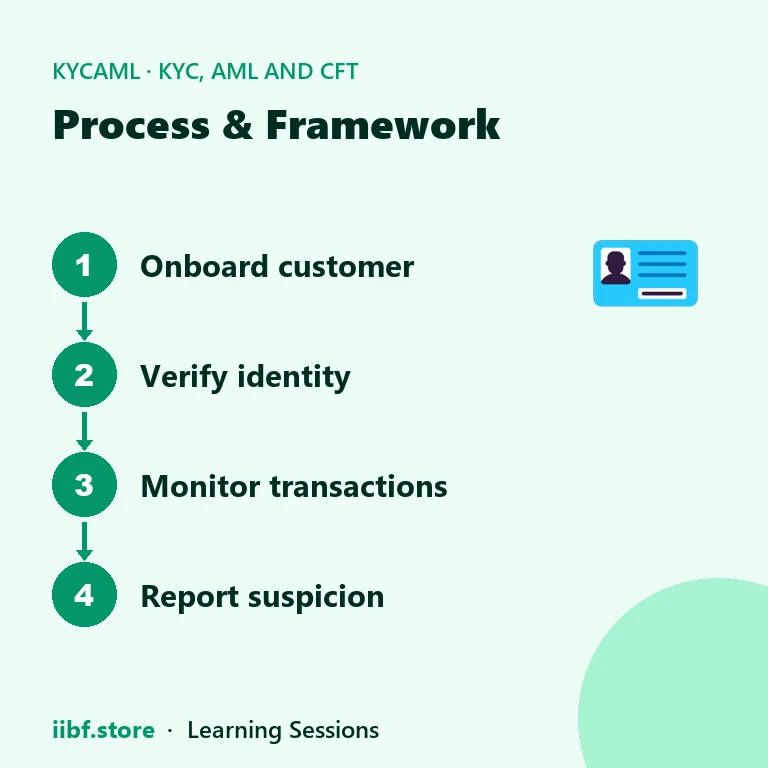
A typical V-CIP session follows a fixed sequence, and exam questions often test whether you know the correct order. First, the customer applies through the bank's app or website and consents to a video call, usually after basic details and an initial OTP check.
Second, the system routes the customer to a trained official, who confirms the customer's location through geotagging and asks them to display the original official-valid-document, most commonly Aadhaar or PAN, on camera. Third, the official performs a liveness check, comparing the live face against the photo on the document and against any photo already on record.
Fourth, the official captures a screenshot of the customer holding the document, notes the date, time, and geolocation, and records the entire interaction for the bank's audit trail. Fifth, the system runs the captured details through the bank's usual verification and risk-scoring checks before the account is activated.
⚠️ Common Mistake: Students often assume video KYC skips risk categorisation entirely. It does not — V-CIP only changes how identity is verified, not whether the account still gets classified and monitored like any other relationship.
If any step fails, such as a blurry document image or a mismatched face, the official must discontinue the session and ask the customer to redo the process rather than force it through with weak evidence.
🚩 Common Pitfalls Banks Must Avoid in Video KYC
Poor call quality is the most frequent operational failure. If audio or video freezes at the exact moment a document is shown, the official cannot honestly claim to have verified it, and the session should be discontinued rather than approved on a best-guess basis.
A second pitfall is treating V-CIP as a lower-scrutiny shortcut. Fraud rings have tried to exploit weak video-KYC controls the same way they exploit other channels, using borrowed documents or coached individuals sitting off-camera. The patterns look similar to techniques described in the money laundering methods chapter, where identity misuse is a recurring theme across both physical and digital onboarding.
A third pitfall is inconsistent geotagging. If the recorded location repeatedly does not match the customer's declared address or branch jurisdiction, that mismatch itself becomes a red flag worth escalating rather than a technical detail to shrug off. Banks that treat V-CIP as a pure IT checklist, without training staff to notice these behavioural cues, end up with weaker controls than a well-run branch counter.
📌 Remember: Video KYC guidelines for banks exist to replace the physical visit, not the judgement of the person doing the verification.
🌍 Video KYC and the Bigger AML/CFT Picture
Video KYC is only the identification step of a much larger compliance chain. Once an account is opened through V-CIP, it still needs ongoing monitoring, risk-based re-verification, and timely escalation if transaction behaviour turns suspicious, exactly like any account opened at a branch counter.
Candidates should connect this chapter to related topics rather than studying it in isolation. Re-verification cycles are covered in our note on periodic KYC updation rules, while the centralised record that stores identity data across banks is explained in our piece on the Central KYC Records Registry. If you want the foundational picture of how illicit funds move through an account once it is opened, our explainer on the three stages of money laundering is a useful companion read.
Digital onboarding controls do not exist in a silo either. Weak video verification and weak card-channel controls are often exploited by the same fraud operators, which is why it is worth also reading our guide on card skimming fraud detection to see how identity misuse and channel-level fraud connect across a bank's overall risk framework. For more chapter notes on this subject, browse the KYC, AML and CFT tag hub.
🧠 Practice MCQs: Video KYC Guidelines for Banks
Q1. Video-based Customer Identification Process (V-CIP) is best described as: (a) a recorded video the customer emails to the branch (b) a live, consent-based video call used to verify identity remotely (c) an SMS-based OTP verification (d) a biometric fingerprint scan at an ATM
Answer: (b) — V-CIP is a live interactive video call, not a recorded submission or OTP method.
Q2. Which of the following would violate the video-based identification process rules for banks? (a) a trained official conducting the call (b) real-time capture of the original document (c) accepting a pre-recorded video sent in advance by the customer (d) geotagging the call at the time it occurs
Answer: (c) — A pre-recorded video defeats the live-verification purpose and is not permitted under V-CIP.
Q3. During a V-CIP session, geotagging primarily helps the bank to: (a) calculate the customer's credit score (b) confirm the physical location from which the customer is connecting (c) generate the account number automatically (d) replace the need for a PAN card
Answer: (b) — Geotagging records the customer's location as part of the identity and audit evidence for the session.
Q4. If video or audio quality is too poor to clearly verify a document during V-CIP, the official should: (a) approve the account and verify later (b) discontinue the session and ask the customer to redo it (c) accept a screenshot from the customer's gallery instead (d) skip the liveness check and proceed
Answer: (b) — Weak evidence should never be accepted; the session must be redone once quality is acceptable.
Q5. Video KYC (V-CIP) as an identification method is primarily governed under: (a) the Companies Act (b) the Banking Regulation Act provisions on branch licensing (c) the RBI Master Direction on KYC (d) the Negotiable Instruments Act
Answer: (c) — V-CIP is incorporated as an accepted identification route within the RBI Master Direction on KYC.
Want chapter-wise mock tests with 100+ MCQs? Start practising free →
❓ Frequently Asked Questions
What is video KYC (V-CIP) in simple terms?
It is a way for a bank to verify a customer's identity through a live video call with a trained official, instead of requiring an in-person branch visit.
Do the video KYC guidelines for banks apply to every type of account?
No. V-CIP is generally used for individual customer onboarding at lower to moderate risk. Complex relationships, such as certain legal-entity or high-risk accounts, typically still need additional verification beyond a video call.
Can a bank store the video KYC recording?
Yes, banks retain the video call and the audit trail as part of their standard record-keeping practice, so the verification can be reviewed later if a question arises.
What happens if a customer fails the liveness check during video KYC?
The official discontinues the session rather than approving it, and the customer is asked to attempt the video KYC process again once the issue is resolved.
Video KYC guidelines for banks are a high-yield topic precisely because they blend technology, process, and judgement in a way examiners enjoy testing. Once you can walk through the live-call requirement, the step-by-step sequence, and how V-CIP compares with Aadhaar e-KYC, this chapter stops being a memory exercise and becomes straightforward logic. Build on it with our full JAIIB course and chapter-wise practice sets to lock in the concepts before exam day.
Prefer revising from a printed book?
Chapter-wise books with MCQs after every chapter — minimal pages, complete coverage, delivered anywhere in India. Every book has a free sample to read first.


































Quick quiz on this topic
5 exam-style questions from our free test bank — check yourself before you move on.
Practice this topic
Take a free mock test, download chapter PDFs, or watch a video class — all included on iibf.store.