Working Capital Assessment Methods: A CAIIB ABFM Guide (2026)
Every bank credit officer eventually has to answer one practical question: how much short-term finance does a borrowing unit actually need? That is exactly what working capital assessment methods are designed to answer, and for CAIIB ABFM candidates this topic sits at the intersection of accounting, credit appraisal, and RBI-era lending discipline. Unlike long-term capital budgeting decisions, working capital assessment is a recurring, cyclical exercise that every branch-level and corporate-credit officer performs before sanctioning a cash credit or overdraft limit — which is exactly why examiners test it so heavily.
📐 Why Working Capital Assessment Methods Matter for Bank Credit
A firm's operating cycle — raw material to work-in-progress to finished goods to receivables to cash — creates a permanent funding gap that cannot be financed entirely from long-term sources. Banks bridge this gap through cash credit, overdraft, and working capital demand loans, but the sanctioned limit must be scientifically assessed, not guessed. This is where working capital assessment methods come in: they translate a borrower's projected turnover, current assets, and current liabilities into a defensible maximum permissible bank finance (MPBF) or drawing limit.
Historically, Indian banks used the same rigour they apply to capital investment decision and capital budgeting appraisal — the same discipline covered in our guide to capital budgeting techniques — projected cash flows, margin norms, and lending caps — but applied to a much shorter time horizon. Getting the assessment wrong in either direction is costly: under-financing starves the unit of operating liquidity and triggers delays across the production cycle, while over-financing lets a borrower divert bank funds into unrelated long-term uses, defeating the purpose of the sanction.
💡 Exam Tip: ABFM questions often frame working capital assessment as "which method would the bank use for a borrower with X turnover" — memorise the eligibility thresholds, not just the formulas.
🧮 The Traditional Route: MPBF Under the Tandon Committee
The Tandon Committee (1975) gave Indian banking its enduring framework for working capital lending. It proposed three methods of computing MPBF, all built around the idea that a borrower must fund a minimum margin of current assets from long-term sources (net working capital) rather than lean entirely on the bank.
- Method I: MPBF = 75% of (Current Assets − Current Liabilities other than bank borrowing). Working capital gap financed 75:25 by bank and borrower.
- Method II: The borrower must first provide 25% of total current assets (not just the gap) from long-term sources, tightening the margin requirement further.
- Method III (Chore Committee refinement): Excludes core current assets from the computation, pushing borrowers toward an even higher own-margin contribution.
These norms were later made largely advisory rather than mandatory, giving banks discretion in fixing their own working capital assessment methods through internally approved loan policies — but the underlying logic (a fixed margin on current assets, tested against turnover) still anchors most bank credit models today.
⚠️ Common Mistake: Students often confuse "current ratio" as computed under Method I (which yields roughly 1.33:1) with a general accounting benchmark. It is a lending-specific minimum, not a universal solvency rule.
Sound short-term liquidity planning of this kind is really an extension of the basic of management and planning principles introduced early in the CAIIB ABFM syllabus — see Basic of Management & Planning for the foundational planning concepts that working capital assessment builds on.
📊 Turnover Method vs MPBF: A Side-by-Side View
For small and medium borrowers, the elaborate Tandon-style computation was simplified in 1997 on the recommendation of the Nayak Committee into the turnover method, which pegs working capital finance directly to projected annual sales rather than a detailed current-asset build-up. Choosing the right one of the working capital assessment methods for a given borrower is itself an exam-favourite decision point.
| Feature | Turnover Method | MPBF (Tandon) Method |
|---|---|---|
| Basis of computation | 20% of projected annual turnover | 75% of working capital gap |
| Typical eligibility | MSE / small borrowers | Larger borrowers with detailed financials |
| Borrower's minimum margin | 5% of turnover | 25% of current assets or gap |
| Data-intensive appraisal required | ❌ No | ✅ Yes |
| Suitable for seasonal/volatile cash flows | ❌ Limited | ✅ With cash budget overlay |
Note that the borrowing entity's broader financing choices — including how leverage and capital structure decisions are made at the balance-sheet level — still shape which of these working capital assessment methods a bank will insist on, since highly leveraged borrowers typically attract tighter margin scrutiny.
💧 Cash Budget Method for Seasonal and Project-Linked Borrowers
Neither the turnover method nor classic MPBF computation copes well with businesses whose cash needs swing sharply across the year — sugar mills, construction contractors, and seasonal traders being classic examples. For these, banks use the cash budget method: a month-by-month projection of cash inflows and outflows (collections, payments, wages, taxes) that reveals the peak deficit the bank actually needs to fund, rather than an annualised average.
This approach is also the natural tool for assessing working capital needs of project-linked borrowers once a facility moves from construction to commercial operation, and it dovetails with how special cases are appraised — see the syllabus discussion under special cases of valuation for parallel treatment of non-standard financing situations.
📌 Remember: Cash budget method finance is sanctioned against the peak deficit month, not the average monthly requirement — a frequent trap in numerical questions.
Interestingly, the same discipline of matching short-term funding to actual cash cycles shows up outside ABFM too. Even NBFCs assessed under the NBFC scale based regulation framework apply comparable liquidity-gap thinking when structuring working capital lines for their corporate borrowers, underlining how consistent this logic is across RBI-regulated lending.
Banks calibrate all of the above against RBI's broader prudential lending framework; the official reference point for working capital and related credit norms is maintained on the RBI Master Directions page, which every credit officer should bookmark alongside the CAIIB syllabus.
🔗 Where Working Capital Assessment Fits in the Bigger ABFM Picture
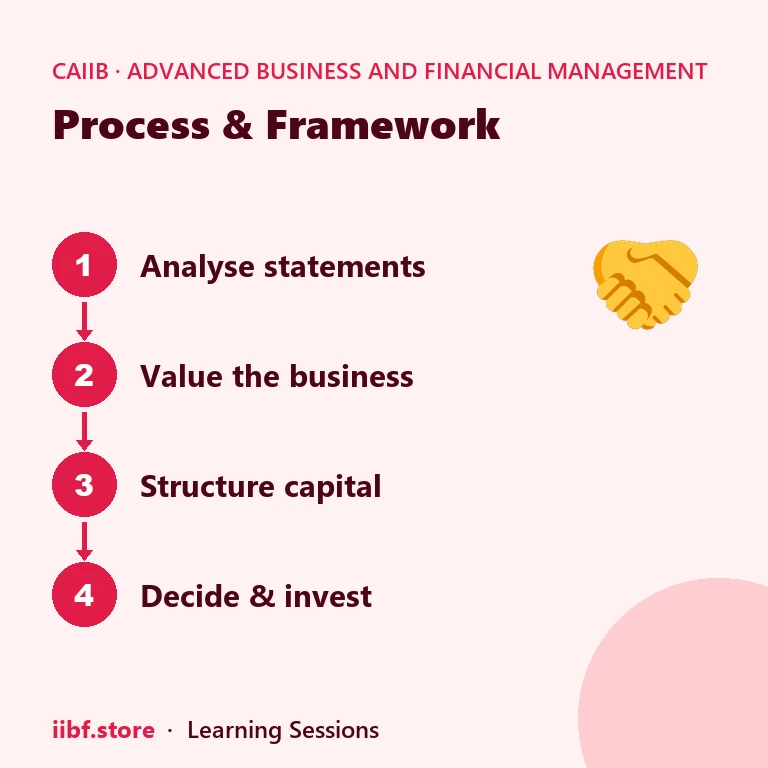
Working capital assessment methods rarely appear in isolation on the CAIIB ABFM paper — they are usually cross-tested alongside capital budgeting techniques for the long-term investment side of the same borrower's balance sheet, and against economic value added once profitability and capital-charge questions enter the picture. A borrower who looks efficient on a turnover-method working capital limit can still destroy value if its long-term capital structure is wrong, which is why examiners like to combine these threads in case-study questions. For a deeper dive into related valuation angles, the chapter on special cases of valuation is worth revisiting once the working capital fundamentals are locked in.
If you want a wider map of how ABFM topics connect — from EVA to leverage to project finance — the CAIIB ABFM article hub collects every guide in one place, and the CAIIB course page lays out the full paper structure if you're planning your study schedule.

🧠 Practice MCQs: Working Capital Assessment Methods
Q1. Under the Tandon Committee's Method I of MPBF computation, what percentage of the working capital gap can be financed by the bank? (a) 100% (b) 75% (c) 60% (d) 50%
Answer: (b) — Method I permits the bank to finance 75% of the working capital gap, with the borrower funding the remaining 25% from long-term sources.
Q2. The turnover method for assessing working capital finance was introduced on the recommendation of which committee? (a) Tandon Committee (b) Chore Committee (c) Nayak Committee (d) Narasimham Committee
Answer: (c) — The Nayak Committee (1991, implemented 1997) recommended the simplified turnover method, mainly for small and medium borrowers.
Q3. In the turnover method, working capital finance is typically computed as what percentage of projected annual turnover? (a) 10% (b) 20% (c) 25% (d) 33%
Answer: (b) — 20% of projected annual turnover is provided as working capital finance, with the borrower contributing a 5% margin.
Q4. Which working capital assessment method is best suited to a seasonal sugar mill with sharply fluctuating monthly cash needs? (a) Turnover method (b) MPBF Method I (c) Cash budget method (d) MPBF Method II
Answer: (c) — The cash budget method projects month-by-month cash flows and sanctions finance against the peak deficit, making it ideal for seasonal or cyclical borrowers.
Q5. Under the Chore Committee's refinement (Method III), what happens to core current assets in the MPBF computation? (a) They are financed entirely by the bank (b) They are excluded from the computation, raising the borrower's margin burden (c) They are ignored entirely (d) They are financed at 90% by the bank
Answer: (b) — Method III excludes core current assets from the working capital gap computation, effectively requiring a higher long-term margin contribution from the borrower.
Want chapter-wise mock tests with 100+ MCQs? Start practising free →
❓ Frequently Asked Questions
What is the main difference between the turnover method and MPBF for working capital assessment?
The turnover method computes working capital finance as a flat percentage (typically 20%) of projected annual turnover, mainly for small borrowers, while MPBF under the Tandon Committee builds a detailed current-asset and current-liability picture and applies a margin to the resulting working capital gap.
Is MPBF still mandatory for Indian banks?
No. RBI made the Tandon Committee's MPBF norms advisory rather than mandatory, giving banks discretion to design their own working capital assessment methods through board-approved loan policies, though most banks still retain the core margin logic.
When would a bank use the cash budget method instead of MPBF or turnover method?
Banks use the cash budget method for borrowers with seasonal or highly fluctuating cash flows — such as sugar mills, construction contractors, or project-linked units — because it sanctions finance against the actual peak monthly deficit rather than an annual average.
Why do CAIIB ABFM questions combine working capital assessment with other topics like capital budgeting or EVA?
Because in practice a borrower's short-term liquidity health and long-term investment and value-creation decisions are linked — a unit can have an efficient working capital limit yet still destroy shareholder value through poor capital structure or investment choices, so examiners like to test both threads together.
Working capital assessment methods are a recurring, high-weightage ABFM topic precisely because they combine formula recall with judgment about which method fits which borrower. Lock in the Tandon Committee methods, the turnover method thresholds, and the cash budget approach, then pressure-test your understanding with full-length CAIIB mock papers before exam day.
Prefer revising from a printed book?
Chapter-wise books with MCQs after every chapter — minimal pages, complete coverage, delivered anywhere in India. Every book has a free sample to read first.
148 pages · 375 MCQs
Learning Sessions · Ashish Sir
148 pages · 478 MCQs
Learning Sessions · Ashish Sir
151 pages · 465 MCQs
Learning Sessions · Ashish Sir
216 pages · 895 MCQs
Learning Sessions · Ashish Sir
109 pages · 300 MCQs
Learning Sessions · Ashish Sir
104 pages · 360 MCQs
Learning Sessions · Ashish Sir
82 pages · 297 MCQs
Learning Sessions · Ashish Sir
151 pages · 600 MCQs
Learning Sessions · Ashish Sir
98 pages · 282 MCQs
Learning Sessions · Ashish Sir
131 pages · 672 MCQs
Learning Sessions · Ashish Sir
221 pages · 831 MCQs
Learning Sessions · Ashish Sir
128 pages · 524 MCQs
Learning Sessions · Ashish Sir
107 pages · 445 MCQs
Learning Sessions · Ashish Sir
132 pages · 225 MCQs
Learning Sessions · Ashish Sir
188 pages · 435 MCQs
Learning Sessions · Ashish Sir
117 pages · 236 MCQs
Learning Sessions · Ashish Sir
Learning Sessions · Ashish Sir
118 pages · 299 MCQs
Learning Sessions · Ashish Sir
Learning Sessions · Ashish Sir
Learning Sessions · Ashish Sir
Learning Sessions · Ashish Sir
115 pages · 255 MCQs
Learning Sessions · Ashish Sir
Learning Sessions · Ashish Sir
334 pages · 936 MCQs
Learning Sessions · Ashish Sir
Learning Sessions · Ashish Sir
115 pages · 344 MCQs
Learning Sessions · Ashish Sir
107 pages · 240 MCQs
Learning Sessions · Ashish Sir
90 pages · 150 MCQs
Learning Sessions · Ashish Sir
Learning Sessions · Ashish Sir
Quick quiz on this topic
5 exam-style questions from our free test bank — check yourself before you move on.
Practice this topic
Take a free mock test, download chapter PDFs, or watch a video class — all included on iibf.store.