1930 Cyber Crime Helpline: How India's Reporting Portal Works
Every IIBF candidate preparing the Prevention of Cyber Crime module eventually meets one exam-favourite fact: the 1930 cyber crime helpline is the single fastest lever a victim or a bank official can pull to freeze stolen money before it disappears into a chain of mule accounts. Yet most study notes only mention the number in passing. This article breaks down how the helpline and its parent portal actually function, how banks plug into the system, and why examiners keep testing the "golden hour" concept around it.
📞 What Is the 1930 Cyber Crime Helpline?
The 1930 cyber crime helpline is a toll-free number operated under the Indian Cyber Crime Coordination Centre (I4C), Ministry of Home Affairs, dedicated specifically to financial cyber fraud — unauthorised debits, UPI scams, card-not-present frauds, and account takeovers. It replaced the earlier 155260 number and is now integrated directly with the National Cyber Crime Reporting Portal so that a single call can trigger a "lien" request across the payment ecosystem: banks, wallets, and payment aggregators are alerted almost simultaneously to hold the disputed funds. For IIBF candidates, the important distinction is that 1930 is a fraud-freeze mechanism, not a general grievance line — general banking complaints still route through a bank's own customer service or the Banking Ombudsman.
💡 Exam Tip: Questions often ask which authority operates 1930 — remember it is I4C under the Ministry of Home Affairs, not RBI or a bank consortium.
🖥️ Filing a Complaint on the National Cyber Crime Reporting Portal
Once a victim calls 1930 or visits the portal directly, the complaint is logged with transaction IDs, timestamps, and beneficiary account details. The system automatically routes the alert to the relevant bank's nodal cyber cell, which can place a hold on the receiving account even before a formal FIR is filed. This mechanism sits alongside the broader set of channels of cyber crimes that candidates must know — email compromise, SMS spoofing, and fake investment apps all eventually funnel into this same reporting pipeline. Candidates should also understand how the portal separates women/child safety complaints from financial fraud complaints, since the exam sometimes probes this categorisation. Official guidance and the live complaint form are published at cybercrime.gov.in, which remains the authoritative government source for procedure updates.
🏦 How Banks Escalate Complaints Internally
On the banking side, a complaint received via 1930 does not simply sit in an inbox — it must move through a defined internal escalation chain, closely tied to the bank's broader incident management process. A designated nodal officer verifies the alert, checks the beneficiary account, and applies a temporary debit freeze pending investigation. This links directly to weaknesses examined under computer insecurity in banking, since poor endpoint hygiene or unpatched core-banking interfaces are frequently the entry point that let the fraud occur in the first place. RBI's supervisory circulars require banks to maintain a board-approved cyber crisis management plan and a named grievance/nodal contact reachable around the clock — details candidates can verify at rbi.org.in.
⚠️ Common Mistake: Students often assume 1930 itself reverses a fraudulent transaction. It only requests a hold/lien — actual reversal still depends on the bank's internal investigation and, ultimately, on whether funds have already been withdrawn downstream.
⏱️ The Golden Hour and Why Speed Decides Recovery
Banking exam setters love the phrase "golden hour" because it captures a hard truth: recovery odds fall sharply once stolen money crosses two or three mule accounts. This is why the 1930 cyber crime helpline is designed for immediacy rather than paperwork — a verified alert placed within the first hour can freeze funds at the very first hop. The concept overlaps with related chapters such as computer fraud protection and electronic card frauds, both of which stress early detection triggers — unusual geolocation, velocity checks, and OTP-mismatch alerts — that feed the same escalation pipeline. It is also worth revising how liability shifts once a delay occurs, a theme covered in depth in our note on customer liability for unauthorised transactions, and in the mobile-specific variant discussed under SIM swap fraud prevention, where a hijacked SIM often precedes the very transaction that 1930 is later used to freeze.
| Reporting Channel | Contact Point | Best Suited For | Can Freeze Funds? |
|---|---|---|---|
| 1930 Helpline | Toll-free national call | Ongoing financial fraud, urgent freeze | ✅ Yes |
| cybercrime.gov.in Portal | Online complaint form | Detailed evidence and document upload | ✅ Yes (via linked alert) |
| Bank's Own Helpline/App | Phone, branch, mobile app | Immediate card or account block | ✅ Yes |
| Local Police FIR | Police station | Legal prosecution and chargesheet | ❌ No, indirect only |
Building genuine institutional resilience is not only about the fraud-response layer, though — it also depends on how securely the bank's own digital channels were engineered in the first place, a governance theme explored in SDLC in banking IT projects, where testing and change-control gaps are shown to be just as exploitable as a careless customer clicking a fraudulent link. A frozen account under 1930 only becomes a successful prosecution once the evidence trail behind it is handled correctly, which is exactly why examiners pair this topic with the forensic and legal follow-through side of the syllabus.
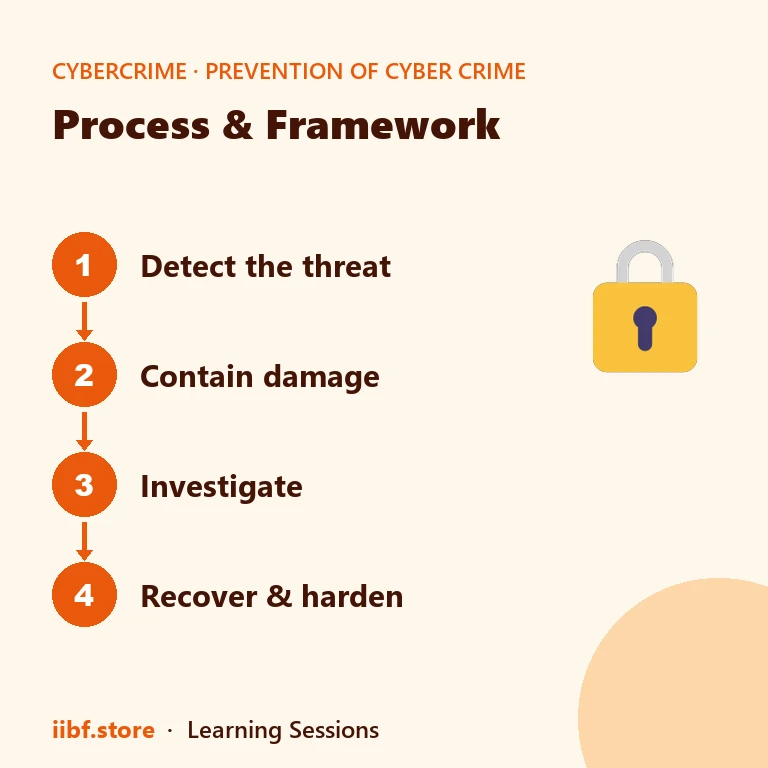
📌 Remember: 1930 → portal alert → bank nodal officer → temporary freeze → formal investigation. Each arrow is a separate, testable step.
🧠 Practice MCQs: 1930 Cyber Crime Helpline
Q1. The 1930 cyber crime helpline in India is primarily operated under which body? (a) Reserve Bank of India (b) Indian Cyber Crime Coordination Centre (I4C) (c) Securities and Exchange Board of India (d) Banking Codes and Standards Board of India
Answer: (b) — I4C, under the Ministry of Home Affairs, runs the National Cyber Crime Reporting Portal and the 1930 helpline.
Q2. What is the primary function of a call made to the 1930 helpline immediately after a fraudulent transaction? (a) Filing an income-tax complaint (b) Requesting a permanent account closure (c) Triggering a hold/lien on funds across the payment chain (d) Issuing a new debit card
Answer: (c) — The call is designed to trigger an urgent freeze request before funds move further downstream.
Q3. Which of the following best describes the "golden hour" concept in cyber fraud recovery? (a) The hour a bank branch opens (b) The narrow early window in which frozen funds can still be recovered before dispersal (c) A mandatory cooling-off period before refund (d) The RBI's daily cyber reporting deadline
Answer: (b) — Recovery odds fall steeply once stolen funds cross multiple mule accounts, so speed after the fraud is critical.
Q4. A bank's internal escalation for a 1930-linked complaint is typically handled first by: (a) The branch security guard (b) A designated nodal/grievance officer (c) The RBI Governor's office (d) The customer's mobile network operator
Answer: (b) — Banks must maintain a nodal contact reachable round the clock to action such alerts per RBI's supervisory expectations.
Q5. Which statement about the 1930 helpline and fund recovery is correct? (a) It guarantees full and immediate reversal of any fraudulent transaction (b) It only enables a temporary hold; actual recovery depends on further investigation (c) It applies only to corporate accounts (d) It replaces the need to file a police FIR entirely
Answer: (b) — The helpline enables a temporary freeze; whether funds are fully recovered depends on how far they have already moved and on subsequent investigation.
Want chapter-wise mock tests with 100+ MCQs? Start practising free →
❓ Frequently Asked Questions
Is the 1930 cyber crime helpline free to call?
Yes, it is a toll-free number available across India, dedicated to reporting financial cyber fraud for an urgent freeze on suspicious transactions.
Does calling 1930 replace the need to inform my own bank?
No. Candidates should note that victims are still advised to separately alert their bank's helpline or app so the account-specific block is actioned without delay.
What happened to the earlier 155260 helpline number?
It has been consolidated into 1930, which now works in tandem with the National Cyber Crime Reporting Portal for a unified complaint and freeze process.
Can 1930 be used for non-financial cyber complaints?
The portal does accept other categories such as crimes against women and children, but 1930 itself is positioned specifically for financial fraud reporting and urgent fund freezes.
For anyone appearing in the IIBF Prevention of Cyber Crime paper, the 1930 cyber crime helpline is one of those rare topics that blends real operational relevance with predictable exam value — know the operating body, the freeze mechanism, and the golden-hour logic, and you cover most of what examiners ask. Explore the complete set of related notes on our Prevention of Cyber Crime blog hub, then sharpen your recall with a timed mock at iibf.store/tests before exam day.
Prefer revising from a printed book?
Chapter-wise books with MCQs after every chapter — minimal pages, complete coverage, delivered anywhere in India. Every book has a free sample to read first.
132 pages · 225 MCQs
Learning Sessions · Ashish Sir
188 pages · 435 MCQs
Learning Sessions · Ashish Sir
117 pages · 236 MCQs
Learning Sessions · Ashish Sir
Learning Sessions · Ashish Sir
118 pages · 299 MCQs
Learning Sessions · Ashish Sir
Learning Sessions · Ashish Sir
Learning Sessions · Ashish Sir
Learning Sessions · Ashish Sir
115 pages · 255 MCQs
Learning Sessions · Ashish Sir
Learning Sessions · Ashish Sir
334 pages · 936 MCQs
Learning Sessions · Ashish Sir
Learning Sessions · Ashish Sir
115 pages · 344 MCQs
Learning Sessions · Ashish Sir
107 pages · 240 MCQs
Learning Sessions · Ashish Sir
90 pages · 150 MCQs
Learning Sessions · Ashish Sir
Learning Sessions · Ashish Sir
131 pages · 672 MCQs
Learning Sessions · Ashish Sir
221 pages · 831 MCQs
Learning Sessions · Ashish Sir
128 pages · 524 MCQs
Learning Sessions · Ashish Sir
107 pages · 445 MCQs
Learning Sessions · Ashish Sir
148 pages · 478 MCQs
Learning Sessions · Ashish Sir
151 pages · 465 MCQs
Learning Sessions · Ashish Sir
148 pages · 375 MCQs
Learning Sessions · Ashish Sir
216 pages · 895 MCQs
Learning Sessions · Ashish Sir
109 pages · 300 MCQs
Learning Sessions · Ashish Sir
104 pages · 360 MCQs
Learning Sessions · Ashish Sir
82 pages · 297 MCQs
Learning Sessions · Ashish Sir
151 pages · 600 MCQs
Learning Sessions · Ashish Sir
98 pages · 282 MCQs
Learning Sessions · Ashish Sir
Practice this topic
Take a free mock test, download chapter PDFs, or watch a video class — all included on iibf.store.