Cyber Forensics in Banking Fraud: Evidence and Chain of Custody
Cyber forensics in banking fraud investigation is the discipline that turns scattered digital traces — server logs, SWIFT messages, mobile app sessions, ATM camera feeds — into evidence a court will actually accept. For JAIIB and CAIIB candidates studying the Prevention of Cyber Crime module, this is where technology meets law: a bank can detect an intrusion within minutes, but proving it in a criminal trial takes disciplined evidence handling, proper certification under the Indian Evidence Act, and an unbroken chain of custody. This article walks through how banks collect, preserve and present digital evidence, why Section 65B certificates matter, and where investigations commonly go wrong.
🔍 What Cyber Forensics in Banking Fraud Actually Covers
Cyber forensics is the application of scientific methods to identify, preserve, analyse and present digital data so that it holds up in a legal proceeding. In a bank, this is broader than the incident-response work covered under incident management: incident response focuses on containing an attack and restoring services, while forensics focuses on building a defensible evidentiary record of what happened, who did it, and how.
The scope typically includes core banking system logs, firewall and intrusion-detection alerts, ATM and card-switch transaction trails, mobile and internet banking session records, CCTV footage from branches and ATM kiosks, and communication records such as emails or chat logs used in a fraud. Because attackers exploit weaknesses described in modules like computer insecurity, a forensic examiner must first understand how the compromise likely occurred before deciding which systems to image and in what order.
Banks generally maintain (or engage) a dedicated forensic capability, distinct from the general IT security team, because forensic work follows stricter documentation standards than routine troubleshooting. Every action taken on a device — even a simple file listing — can alter timestamps or metadata, so forensic examiners work on copies, never on the original media, and log every step they take.
🧾 Digital Evidence Sources Banks Must Identify and Preserve
Not all digital evidence behaves the same way, and investigators must know which sources decay fastest. Live RAM and active network connections on a compromised server can vanish the moment power is lost, while transaction logs on a database server usually persist for months. Getting the order of collection wrong — for instance, rebooting a suspect server before capturing its memory — can destroy the very evidence needed to prove the fraud.
The table below summarises common evidence sources encountered in banking fraud cases, their volatility, and whether a certificate under Section 65B of the Indian Evidence Act, 1872 is generally required before they can be produced in court as secondary electronic evidence.
| Evidence Source | Typical Location | High Volatility | Section 65B Certificate Needed |
|---|---|---|---|
| Core banking transaction logs | Core banking application servers | ❌ No | ✅ Yes |
| Server RAM / running processes | Compromised application or web server | ✅ Yes | ✅ Yes |
| ATM and branch CCTV footage | Local DVR or cloud archive | ❌ No | ✅ Yes |
| Mobile/internet banking session data | App backend and device | ✅ Yes | ✅ Yes |
| Email headers and mail server logs | Mail gateway/server | ❌ No | ✅ Yes |
| Signed paper account statement | Branch physical records | ❌ No | ❌ No (not electronic) |
💡 Exam Tip: "Order of volatility" — collect data that disappears fastest (RAM, network sessions) before data that persists (disk images, backups, printed logs).
⚖️ Section 65B and the Admissibility of Electronic Records
Under the Indian Evidence Act, 1872, an electronic record — a server log printout, a CDR, a transaction extract — is treated as a "document," but it is not automatically admissible just because it looks authentic. Section 65B lays down the conditions under which such a computer output can be admitted as evidence without needing to produce the original electronic device itself in court every time.
The section requires that the computer producing the output was in regular use, that the information was fed into it in the ordinary course of activities, that the computer was operating properly during the relevant period, and that the output accurately reproduces the information. Crucially, this must be supported by a certificate — signed by a person occupying a responsible official position in relation to the device, such as a bank's IT or systems officer — describing how the record was produced and confirming these conditions were met.
Indian courts, including the Supreme Court, have repeatedly held that this certificate is a mandatory precondition for admitting secondary electronic evidence, not a mere formality that can be waived after the fact. For a bank fraud investigator, this means the certificate must be arranged at the time evidence is extracted, not months later when the matter reaches trial — by which time the original custodian may have left the bank or the system may have been decommissioned.
This is one reason banks build Section 65B certification into their standard forensic collection checklist rather than treating it as a legal afterthought, and why staff studying computer fraud protection are expected to know the certificate requirement, not just the technical detection controls.
🔗 Chain of Custody: From Seizure to Courtroom
Chain of custody is the documented, unbroken trail showing who handled a piece of evidence, when, why, and what was done to it, from the moment it is identified until it is presented in court. If any link in that chain is missing or disputed, opposing counsel can argue the evidence was tampered with — regardless of how strong the underlying fraud case is.
In practice, a bank's forensic team follows a consistent sequence: identify the affected system and photograph its state before touching it; create a forensic image (a bit-for-bit copy) rather than working on the live system; generate a cryptographic hash value of both the original and the copy so any later alteration can be mathematically detected; label, seal and log the physical media in a secured evidence room with restricted access; and record every transfer of custody with a signature, date and purpose.
Analysis is then performed only on the verified copy, using write-blocking hardware so the source cannot be modified. When the matter goes to court, the examiner must be able to account for every hour the evidence was in someone's possession and produce the matching hash values to prove the copy analysed is identical to what was originally seized.
⚠️ Warning: Powering on a suspect device, opening files "just to check," or skipping the hash-verification step can break the chain of custody and make otherwise strong evidence inadmissible.
🕵️ The Investigation Lifecycle in a Bank Fraud Case
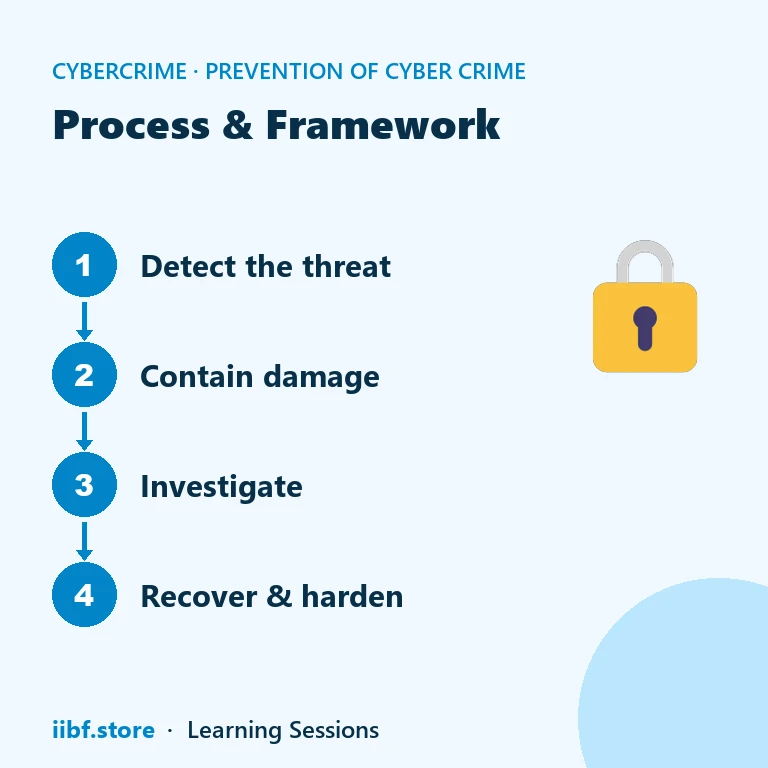
A typical case moves through five broad stages. First, detection: an alert from monitoring systems, a customer complaint, or a reconciliation mismatch flags a possible fraud, often linked to the attack routes described under channels of cyber crimes. Second, preliminary triage: the security team scopes the incident without altering logs or systems, deciding whether a full forensic response is warranted.
Third, evidence preservation and imaging, as described above, ideally supervised by a trained examiner and, where the case is serious, coordinated with law enforcement and sector regulators as required by prevailing directions. Fourth, analysis: examiners reconstruct the sequence of events — how access was gained, what data or funds moved, and which accounts or devices were involved — cross-referencing multiple evidence sources rather than relying on a single log file.
Fifth, reporting and testimony: the findings are compiled into a forensic report accompanied by the Section 65B certificate, submitted to the bank's fraud risk management committee and, where a police complaint or FIR is filed, to the investigating agency. The examiner may later be called to testify and defend the methodology used.
Throughout this lifecycle, documentation discipline matters as much as technical skill. A brilliant forensic finding that cannot be explained clearly, with an intact chain of custody, is of limited use to a prosecutor or an internal disciplinary panel.
📌 Quick Recap: Detect → Preserve → Image with hashing → Analyse → Report with a Section 65B certificate. Miss any step and the evidence weakens. See more on the Prevention of Cyber Crime tag hub.
📌 Key Takeaways
- Cyber forensics in banking fraud begins the moment an incident is suspected — volatile evidence disappears within minutes if systems are rebooted.
- Identification, preservation, collection, examination, analysis and reporting form the standard sequence in cyber forensics in banking fraud investigations.
- Hash values and a documented chain of custody are what allow digital evidence to survive cross-examination.
- Section 65B certification converts a computer output into admissible evidence; without it, even sound cyber forensics in banking fraud work can collapse in court.
Incident-handling directions for Indian entities are published by CERT-In.
🧠 Practice MCQs: Cyber Forensics in Banking Fraud
Q1. Under Section 65B of the Indian Evidence Act, an electronic record such as a server log printout is admissible in court only if: (a) it is notarised by a public notary (b) it is accompanied by a certificate meeting the conditions specified in the Act, signed by a responsible official (c) the bank manager verbally confirms it (d) no certificate is needed if the printout looks genuine
Answer: (b) - A Section 65B certificate confirming how the record was produced is a mandatory precondition for admitting such secondary electronic evidence.
Q2. In digital forensics, the "order of volatility" principle means investigators should: (a) list evidence alphabetically (b) collect the most easily lost data, such as RAM, before more persistent data like disk backups (c) follow the court's hearing schedule (d) question suspects in seniority order
Answer: (b) - Volatile data such as active memory and network sessions can vanish within moments, so it must be captured before persistent data.
Q3. The primary purpose of maintaining a chain of custody for digital evidence is to: (a) speed up branch reconciliation (b) prove the evidence was not altered or tampered with between seizure and its presentation in court (c) reduce evidence storage costs (d) meet capital adequacy norms
Answer: (b) - An unbroken chain of custody protects evidence integrity and prevents it from being challenged as tampered or unreliable.
Q4. A cryptographic hash value generated during forensic imaging is primarily used to: (a) encrypt customer PINs (b) verify that a forensic copy is identical, bit-for-bit, to the original evidence (c) calculate interest on a loan account (d) compress large log files for storage
Answer: (b) - Matching hash values before and after imaging prove that the copy examined has not been altered from the original.
Q5. When a compromised banking server is first discovered, forensic best practice is to: (a) immediately reboot it to clear any malware (b) let branch staff keep using it as normal (c) isolate the system and preserve volatile data before it is lost, without altering the original media (d) delete suspicious files right away
Answer: (c) - Isolating the system and preserving volatile evidence first protects both the data and the chain of custody.
Want chapter-wise mock tests with 100+ MCQs? Start practising free
What is cyber forensics in banking fraud investigation?
It is the structured process of identifying, preserving, analysing and presenting digital evidence — such as transaction logs, server data, and session records — related to a suspected bank fraud, in a manner that can withstand legal scrutiny.
Is a Section 65B certificate always mandatory for electronic evidence?
Indian courts have held that a certificate under Section 65B is generally required before secondary electronic evidence (such as a printout or extracted copy) can be admitted, unless the original device itself is produced and proved in court.
Who typically signs the Section 65B certificate in a bank?
A person occupying a responsible official position in relation to the operation of the relevant device or system — commonly a bank's IT administrator or systems officer familiar with how the record was generated.
What happens if the chain of custody is broken during an investigation?
Opposing counsel can argue the evidence may have been altered, which can lead a court to reduce the weight given to that evidence or exclude it altogether, weakening the fraud case even when the underlying facts are strong.
Cyber forensics in banking fraud cases succeeds or fails on discipline: knowing what to preserve first, documenting every step, and lining up the Section 65B certificate before the trail goes cold. Related concepts such as introduction to cyber crimes and detection controls covered under intrusion detection systems in banks are worth revising alongside this topic, since prevention and forensic readiness go hand in hand. For deeper coverage of related exam themes, see the guides on Cyber Crime and Fraud Management study material, cyber incident reporting timelines, and customer liability for unauthorised transactions.
Ready to test yourself on this and the rest of the Prevention of Cyber Crime syllabus? Attempt a free mock test or explore the full CAIIB course to structure your revision.
Prefer revising from a printed book?
Chapter-wise books with MCQs after every chapter — minimal pages, complete coverage, delivered anywhere in India. Every book has a free sample to read first.
132 pages · 225 MCQs
Learning Sessions · Ashish Sir
188 pages · 435 MCQs
Learning Sessions · Ashish Sir
117 pages · 236 MCQs
Learning Sessions · Ashish Sir
Learning Sessions · Ashish Sir
118 pages · 299 MCQs
Learning Sessions · Ashish Sir
Learning Sessions · Ashish Sir
Learning Sessions · Ashish Sir
Learning Sessions · Ashish Sir
115 pages · 255 MCQs
Learning Sessions · Ashish Sir
Learning Sessions · Ashish Sir
334 pages · 936 MCQs
Learning Sessions · Ashish Sir
Learning Sessions · Ashish Sir
115 pages · 344 MCQs
Learning Sessions · Ashish Sir
107 pages · 240 MCQs
Learning Sessions · Ashish Sir
90 pages · 150 MCQs
Learning Sessions · Ashish Sir
Learning Sessions · Ashish Sir
131 pages · 672 MCQs
Learning Sessions · Ashish Sir
221 pages · 831 MCQs
Learning Sessions · Ashish Sir
128 pages · 524 MCQs
Learning Sessions · Ashish Sir
107 pages · 445 MCQs
Learning Sessions · Ashish Sir
148 pages · 478 MCQs
Learning Sessions · Ashish Sir
151 pages · 465 MCQs
Learning Sessions · Ashish Sir
148 pages · 375 MCQs
Learning Sessions · Ashish Sir
216 pages · 895 MCQs
Learning Sessions · Ashish Sir
109 pages · 300 MCQs
Learning Sessions · Ashish Sir
104 pages · 360 MCQs
Learning Sessions · Ashish Sir
82 pages · 297 MCQs
Learning Sessions · Ashish Sir
151 pages · 600 MCQs
Learning Sessions · Ashish Sir
98 pages · 282 MCQs
Learning Sessions · Ashish Sir
Practice this topic
Take a free mock test, download chapter PDFs, or watch a video class — all included on iibf.store.