Is a Banking Career Still Worth It for Gen Z in 2026?

Ask a room of twenty-two-year-olds to rank careers by how interesting they sound, and banking lands somewhere near the bottom. It is not seen as bad. It is seen as beige. And that perception is the single biggest reason a banking career gets skipped by people it would actually suit — not because they compared it with something and chose the other thing, but because they never put it on the list at all. Worth asking, then, what exactly is being rejected.
Bankers are not cool · Watch on YouTube
What the word "boring" is actually measuring
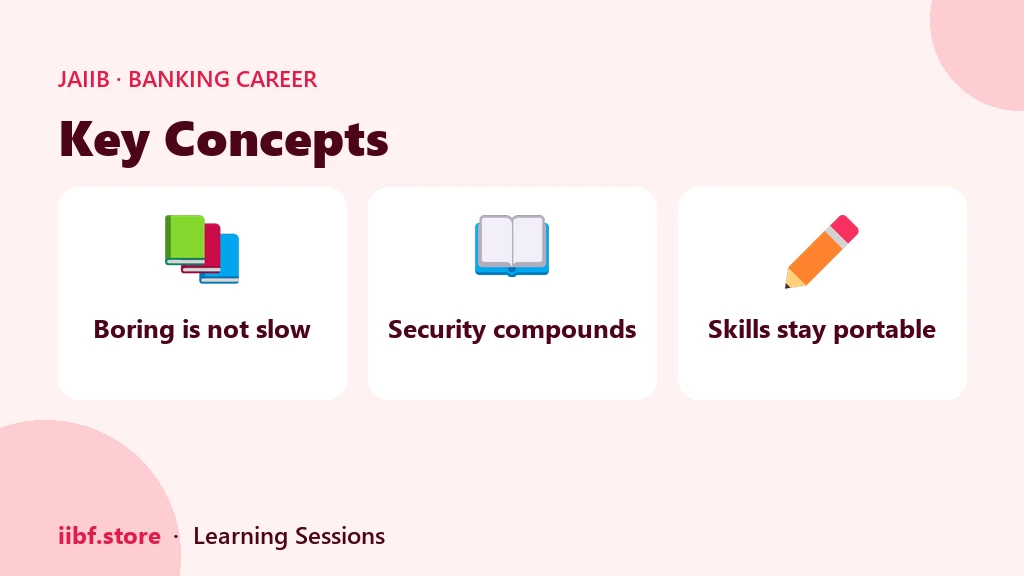
When a job gets called boring, the thing being measured is almost never the work. It is the visibility. Roles look exciting when their output is public — an app people use, a video people watch, a brand people recognise. Banking's output is almost entirely private: a loan that let someone finish a shop extension, a fraud attempt caught before the money left, a family that got their deposit back on time.
That invisibility is real, and if external validation is what you want from work, it is a genuine reason to choose something else. But it should be named accurately. It is a statement about how much credit the job earns you in public, not about how much substance it contains.
The second thing "boring" often means is "predictable", and here the assumption is simply out of date. The last decade of Indian banking has been unusually turbulent — a digital payments revolution, a complete rebuild of the KYC and fraud-prevention machinery, new lending frameworks arriving almost yearly. An officer who joined ten years ago has already had to relearn large parts of the job twice.
The part that is genuinely rare
Strip away the image question and one structural feature stands out: in banking, the route upward is written down and open to anyone. Most industries promote through a mixture of visibility, timing and whoever your manager happens to be. Banking has those too, but it also has a formal, public, examinable channel running alongside them.
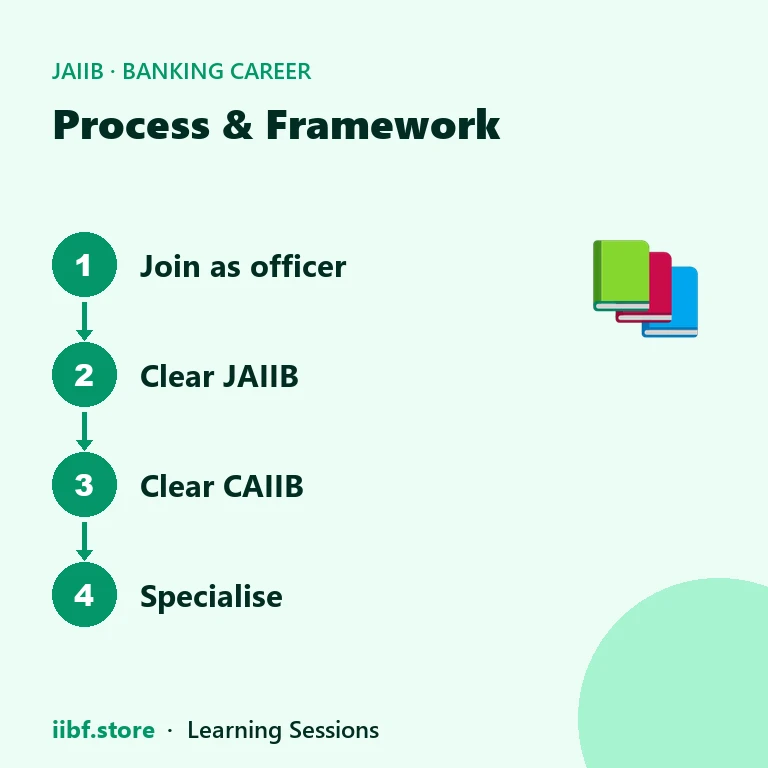
That channel is the professional qualification path run by the Indian Institute of Banking and Finance: JAIIB, then CAIIB, then specialised certifications. At most institutions these feed directly into increments and promotion eligibility. The syllabus is published. The pass mark is fixed — 50 out of 100 in a subject, or 45 in each with a 50% aggregate in one sitting. There is no negative marking. Credits for cleared subjects are retained until your time limit expires.
Consider what that means for someone starting out with no network and no pedigree. There is a documented path where the only input is study, the standard is identical for everyone, and the result is portable across the entire industry. Very few sectors offer that. It is the least glamorous advantage imaginable and probably the most valuable one.
| The perception | The structure underneath |
|---|---|
| Nothing ever changes | Payments, KYC and lending frameworks have been rebuilt repeatedly in the last decade |
| Promotions are about waiting | A published exam route sits alongside seniority and postings |
| The skills are narrow | Credit, compliance and risk transfer across banks, NBFCs and fintechs |
| No room to specialise | Treasury, risk, IT, compliance and rural banking are distinct tracks |
Where the skills actually travel
A common worry is that banking traps you — that ten years in means ten years of experience nobody else wants. The opposite is closer to true, and it is worth being specific about why.
What a bank teaches you is how to assess whether a business will repay, how to read a set of accounts sceptically, how regulation constrains a product, and how to spot a transaction that does not fit its pattern. Those four things are exactly what lending fintechs, NBFCs, payment companies and audit practices hire for. The people who move out of banks with the least friction are the ones who took the credit, compliance and risk sides seriously early — not the ones who optimised only for the branch.
There is also the option of not leaving. Treasury, credit, risk, IT, compliance, rural and agricultural banking are separate specialisations with their own depth, and the certification route is how you signal a move into one. A banking career is far less monolithic from the inside than it appears from the outside.
Deciding honestly
None of this argues that everyone should join a bank. The trade-offs are real: transfers, targets, long days in audit season, and work that stays largely invisible. If the invisibility is the dealbreaker, that is a legitimate answer — and it is a better answer than drifting away on the vague sense that the job is not cool.
But make the comparison on the actual terms. A banking career offers unusual security, skills that stay useful across a working lifetime, and a promotion ladder whose rules are public and whose entry price is study rather than connections. Against that, weigh how much you need your work to be legible to strangers. That is the real question, and it has different answers for different people.
If the answer leans yes, the first move is small and cheap: look at what the JAIIB syllabus actually contains, because it is a fair sample of what the job is about. Try a few questions in the practice tests to see whether the material holds your attention, and if it does, put a rough schedule into the planner and look at where CAIIB leads afterwards. That is a couple of hours spent finding out something real — which is more than any amount of arguing about whether bankers are cool will ever get you.
Is banking still a good career choice in 2026?
For anyone who values employment security, transferable technical skills and a published promotion route, yes. The main trade-offs are mobility, sales targets and work that is not publicly visible — so the decision turns on how much those matter to you personally.
Do banking skills transfer if I leave later?
Credit assessment, compliance and risk skills are directly sought by NBFCs, lending fintechs, payment companies and audit firms. Officers who engage seriously with those areas early tend to find exits far easier than those who focus only on branch operations.
What is JAIIB and why does it matter so much?
JAIIB is the flagship entry qualification from the Indian Institute of Banking and Finance, covering four papers. At most institutions it feeds directly into increments and promotion eligibility, which makes it the standard first milestone in a banking career.
Can I specialise, or is every bank job the same?
Treasury, credit, risk management, IT, compliance and rural banking are distinct tracks with their own depth and their own certifications. The generalist branch role is the starting point, not the whole picture.
Prefer revising from a printed book?
Chapter-wise books with MCQs after every chapter — minimal pages, complete coverage, delivered anywhere in India. Every book has a free sample to read first.
131 pages · 672 MCQs
Learning Sessions · Ashish Sir
221 pages · 831 MCQs
Learning Sessions · Ashish Sir
128 pages · 524 MCQs
Learning Sessions · Ashish Sir
107 pages · 445 MCQs
Learning Sessions · Ashish Sir
148 pages · 478 MCQs
Learning Sessions · Ashish Sir
151 pages · 465 MCQs
Learning Sessions · Ashish Sir
148 pages · 375 MCQs
Learning Sessions · Ashish Sir
216 pages · 895 MCQs
Learning Sessions · Ashish Sir
109 pages · 300 MCQs
Learning Sessions · Ashish Sir
104 pages · 360 MCQs
Learning Sessions · Ashish Sir
82 pages · 297 MCQs
Learning Sessions · Ashish Sir
151 pages · 600 MCQs
Learning Sessions · Ashish Sir
98 pages · 282 MCQs
Learning Sessions · Ashish Sir
132 pages · 225 MCQs
Learning Sessions · Ashish Sir
188 pages · 435 MCQs
Learning Sessions · Ashish Sir
117 pages · 236 MCQs
Learning Sessions · Ashish Sir
Learning Sessions · Ashish Sir
118 pages · 299 MCQs
Learning Sessions · Ashish Sir
Learning Sessions · Ashish Sir
Learning Sessions · Ashish Sir
Learning Sessions · Ashish Sir
115 pages · 255 MCQs
Learning Sessions · Ashish Sir
Learning Sessions · Ashish Sir
334 pages · 936 MCQs
Learning Sessions · Ashish Sir
Learning Sessions · Ashish Sir
115 pages · 344 MCQs
Learning Sessions · Ashish Sir
107 pages · 240 MCQs
Learning Sessions · Ashish Sir
90 pages · 150 MCQs
Learning Sessions · Ashish Sir
Learning Sessions · Ashish Sir
Quick quiz on this topic
5 exam-style questions from our free test bank — check yourself before you move on.
Practice this topic
Take a free mock test, download chapter PDFs, or watch a video class — all included on iibf.store.