CBCP Exam 2026: Eligibility, Pattern, Fees and Passing Marks
Compliance has quietly become one of the better career bets in banking, and the certification that goes with it confuses people more than it should. So here is the CBCP exam laid out properly. Who can sit it, what the paper looks like, what it costs, and the part everyone forgets about until it is too late.
The short below is the quick version. The detail underneath comes from the Institute's own rules and syllabus for 2026.
Compliance in Banking certification from IIBF · Watch on YouTube
Who can actually apply
This is where most people stop before they start, because the gate is narrower than for the usual IIBF certificates.
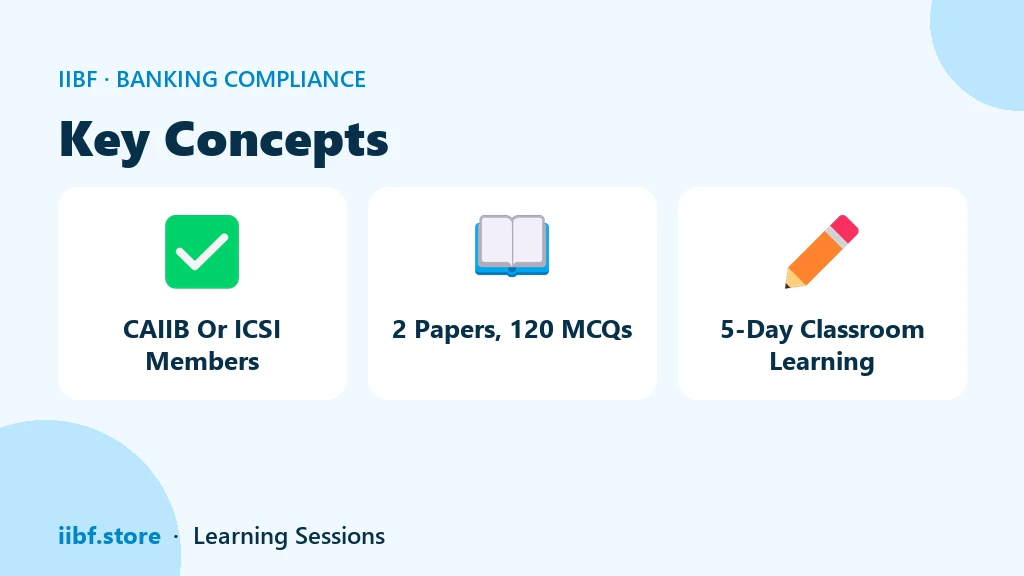
The examination is open to members of IIBF who have passed CAIIB and are working in banks, and to members of ICSI who have passed the final CS course. That is the full list. If you have not cleared CAIIB yet, that is the first job. The compliance certification comes after it, not instead of it.
The narrow gate is deliberate. The course was developed with the International Compliance Association and offered jointly with ICSI, so that banks get compliance staff who already carry both the banking grounding and the governance grounding.
Two papers, and what is in them
The certification has two subjects of examination.
Paper I is Risk, Regulation and Governance. It runs through risk definition and the risk process, asset liability management and ALCO techniques, risk measurement and control, capital adequacy and prudential norms, credit risk under Basel, operational risk, market risk and the Basel III guidelines.
Paper II is Compliance in Banks. This is the heart of it. The need for regulation and the regulatory framework, the compliance programme and compliance policy, compliance governance structure, compliance risk and independent testing, building a compliance culture including whistle blower mechanisms, regulatory compliances around disclosures and exposure norms, computation of CRR and SLR, KYC and anti money laundering, statutory restrictions on loans and advances, foreign currency operations under FEMA, and customer service guidelines.
The paper itself
| Item | Detail |
|---|---|
| Mode | Online, multiple choice |
| Questions | 120 objective type questions |
| Marks | 100 marks per subject |
| Duration | 2 hours |
| Negative marking | None |
| Medium | English only |
Two points are worth pausing on. There is no negative marking, so a blank answer simply throws away a chance. And 120 questions in 120 minutes means one minute each. The paper includes case study based questions, which eat time, so speed on the recall questions is what buys you room for the cases.
Passing marks, and the second route
The minimum for a pass in a subject is 50 out of 100. But there is a second route people miss. A candidate securing at least 45 marks in each subject with an aggregate of 50 per cent across all subjects in a single attempt is also declared to have completed the examination.
So a 46 and a 55 in one sitting is a pass. A 46 and a 55 spread across two sittings is not. The aggregate route only works within a single attempt.
Credit for a subject already passed is retained until the time limit expires. That limit is two years, which means four consecutive attempts, counted from the date of application for the first block whether or not you actually appeared. Miss the window and you re-enrol afresh, with no credit for what you had already passed.
The part everyone forgets: classroom learning
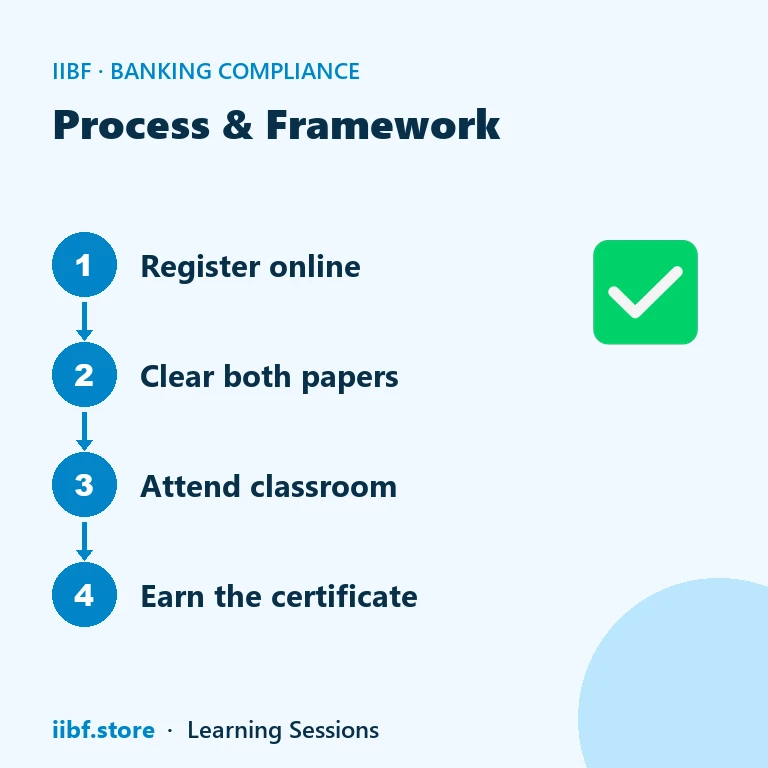
The CBCP exam is not the whole certification. The course has two components and you have to clear both.
After passing the written examination, candidates must complete five days of classroom learning at IIBF or ICSI centres. Total marks for classroom learning are 50, and the passing mark is 25. Marks are awarded by faculty on business participation, analytical skills and discussion ability on compliance case studies.
The deadline matters. Classroom learning has to be completed within 15 months from the date the online examination result is declared. Clearing the papers and then letting the classroom slot drift is the single most common way people fail to finish this course.
Fees and exemptions
The first attempt fee is Rs 6,000 for members of IIBF and the same for members of ICSI. Each of the second, third and fourth attempts is Rs 2,000, plus convenience charges and taxes as applicable. Registration is per attempt, and the fee is not refunded or adjusted.
There is a useful exemption. Candidates who have passed CAIIB along with the Diploma in Treasury, Investment and Risk Management, or the CAIIB elective in Risk Management, or the Certificate in Risk in Financial Services, are exempted from Paper I on Risk, Regulation and Governance. The exemption is not automatic. You have to request it with your transaction details and result advice. Candidates granted an exemption are considered only for a pass class, not for first class or distinction.
One more planning note. The Institute applies a cut off date for regulatory developments. For examinations conducted between March and August, guidelines issued up to 31 December of the previous year are examinable. For the September to February block, the cut off is 30 June. Anything after the cut off is out of scope, which is a genuine relief when the regulator has had a busy quarter.
A minimum of three months' study of the courseware is envisaged, and the Institute warns openly that the courseware alone is not enough. Banking regulations change, so master directions and current developments are fair game. If you are still working toward the eligibility gate, the CAIIB course is where to start, with foundations in the JAIIB course. Build a schedule on the study planner, drill questions in the practice tests, and check the current rules on the IIBF website before you register.
Frequently asked questions
Who is eligible for the CBCP exam?
Members of IIBF who have passed CAIIB and are working in banks, and members of ICSI who have passed the final CS course. There is no separate graduate plus experience route.
What are the passing marks?
A minimum of 50 out of 100 in each subject. Alternatively, at least 45 in each subject with an aggregate of 50 per cent in a single attempt also counts as completing the examination.
How many attempts are allowed?
Four consecutive attempts within a time limit of two years, counted from the date of application for the first block whether or not you appeared. After that you re-enrol afresh with no credit retained.
Is classroom training compulsory?
Yes. Five days of classroom learning carrying 50 marks with 25 to pass, to be completed within 15 months of the online examination result being declared.
Prefer revising from a printed book?
Chapter-wise books with MCQs after every chapter — minimal pages, complete coverage, delivered anywhere in India. Every book has a free sample to read first.
Learning Sessions · Ashish Sir
132 pages · 225 MCQs
Learning Sessions · Ashish Sir
188 pages · 435 MCQs
Learning Sessions · Ashish Sir
117 pages · 236 MCQs
Learning Sessions · Ashish Sir
Learning Sessions · Ashish Sir
118 pages · 299 MCQs
Learning Sessions · Ashish Sir
Learning Sessions · Ashish Sir
Learning Sessions · Ashish Sir
Learning Sessions · Ashish Sir
115 pages · 255 MCQs
Learning Sessions · Ashish Sir
Learning Sessions · Ashish Sir
334 pages · 936 MCQs
Learning Sessions · Ashish Sir
Learning Sessions · Ashish Sir
115 pages · 344 MCQs
Learning Sessions · Ashish Sir
107 pages · 240 MCQs
Learning Sessions · Ashish Sir
90 pages · 150 MCQs
Learning Sessions · Ashish Sir
131 pages · 672 MCQs
Learning Sessions · Ashish Sir
221 pages · 831 MCQs
Learning Sessions · Ashish Sir
128 pages · 524 MCQs
Learning Sessions · Ashish Sir
107 pages · 445 MCQs
Learning Sessions · Ashish Sir
148 pages · 478 MCQs
Learning Sessions · Ashish Sir
151 pages · 465 MCQs
Learning Sessions · Ashish Sir
148 pages · 375 MCQs
Learning Sessions · Ashish Sir
216 pages · 895 MCQs
Learning Sessions · Ashish Sir
109 pages · 300 MCQs
Learning Sessions · Ashish Sir
104 pages · 360 MCQs
Learning Sessions · Ashish Sir
82 pages · 297 MCQs
Learning Sessions · Ashish Sir
151 pages · 600 MCQs
Learning Sessions · Ashish Sir
98 pages · 282 MCQs
Learning Sessions · Ashish Sir
Practice this topic
Take a free mock test, download chapter PDFs, or watch a video class — all included on iibf.store.
Keep reading