CCO Reporting Line in Banks: What RBI Actually Mandates
A compliance function is only as independent as the person running it, and independence is not a personality trait. It is a structure. That is why the CCO reporting line is written into regulation rather than left to each bank to design for itself.
The short below makes the point in under a minute. Underneath it is what the Reserve Bank actually says, quoted where the exact wording matters.
IIBF Compliance: the CCO reporting line · Watch on YouTube
Where the rule comes from
The governing instruction is the RBI circular on compliance function in banks and the role of the Chief Compliance Officer, dated 11 September 2020. It applies to all scheduled commercial banks other than regional rural banks, and to all local area banks, small finance banks and payment banks.
Get the date right. Candidates routinely place this circular in 2019, and there is a separate, later instruction covering NBFCs. If a question names the entity type, the entity type is doing work.
The reporting line itself
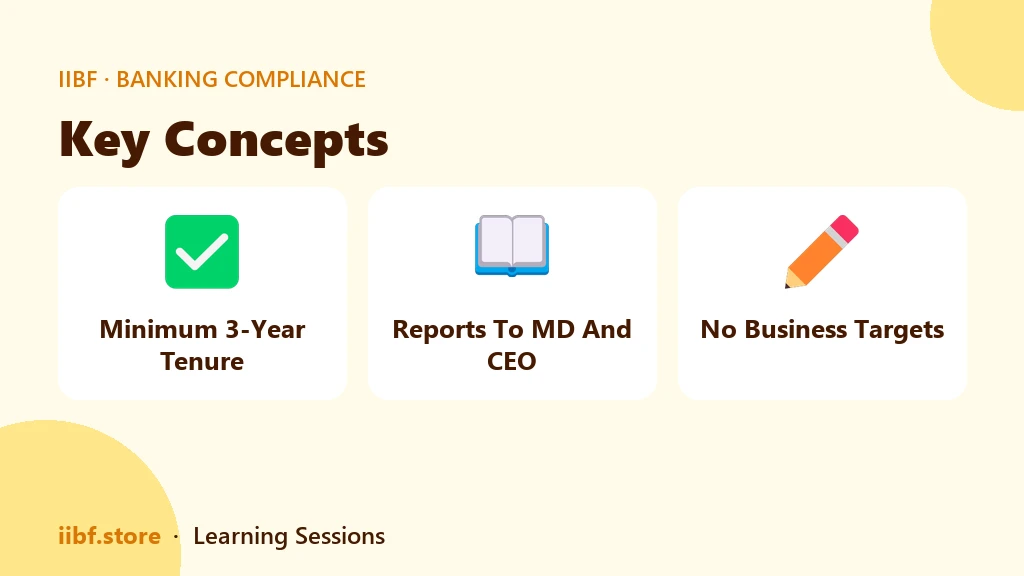
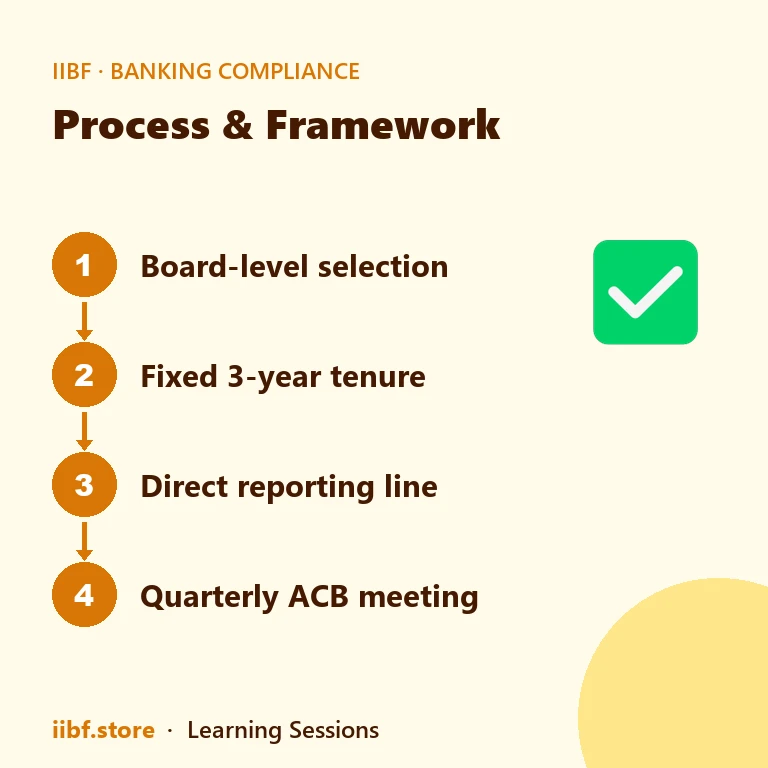
The circular is direct about it. The CCO "shall have direct reporting lines to the MD & CEO and/or Board/Board Committee (ACB) of the bank."
Read the "and/or" carefully, because it creates a conditional the exam likes. A bank may route the CCO to the MD and CEO. But if it does, a safeguard kicks in: "In case the CCO reports to the MD & CEO, the Audit Committee of the Board shall meet the CCO quarterly on one-to-one basis, without the presence of the senior management including MD & CEO."
That quarterly meeting is the whole design in miniature. If the CCO reports into executive management, then executive management has to leave the room four times a year so the board can hear what the CCO would not otherwise say. The CCO reporting line is not a box on an organogram. It is a guaranteed channel to the board that no executive can close.
Tenure, and why three years is the number
"The CCO shall be appointed for a minimum fixed tenure of not less than 3 years."
A fixed tenure is a job security rule doing a governance job. An officer who can be moved next quarter has every incentive to avoid an uncomfortable report this quarter. Three years is long enough to outlast the discomfort a genuine escalation causes.
The protection is reinforced at the exit. The CCO "may be transferred / removed before completion of the tenure only in exceptional circumstances with the explicit prior approval of the Board after following a well-defined and transparent internal administrative procedure." Note the two conditions stacked together. Exceptional circumstances, and explicit prior board approval. Management on its own cannot do it.
Who can be appointed
The seniority and experience conditions are the other half of the independence question. A junior officer with a protected reporting line is still a junior officer.
| Condition | Requirement |
|---|---|
| Rank | Preferably General Manager or equivalent, not below two levels from the CEO |
| Age | Not more than 55 years at appointment |
| Overall experience | At least 15 years in banking or financial services |
| Specialist experience | Minimum 5 years in audit, finance, compliance, legal or risk management |
| Minimum tenure | Not less than 3 years |
Selection runs through a well defined process conducted by a senior executive level committee constituted by the board, which recommends candidates in order of merit. The board makes the final call. Performance appraisal is reviewed at board or audit committee level, not by line management.
The conflict of interest bar
The last piece closes the obvious loophole. You could give a CCO a protected reporting line and a fixed tenure, and then quietly hand them a sales portfolio.
The circular blocks it. The CCO "shall not have any reporting relationship with the business verticals of the bank and shall not be given any business targets." It goes further on committee membership. The CCO "shall not be member of any committee which brings his/her role in conflict with responsibility as member of the committee".
The logic is simple. A compliance head carrying a revenue number now has a reason to prefer the revenue generating reading of an ambiguous rule. Regulation removes the reason rather than trusting the individual to ignore it.
What examiners do with this
Most questions here are precision questions rather than concept questions. The concept is easy. The numbers are what separate answers.
Watch four traps in particular. First, the year, which is 2020 and not 2019. Second, the tenure, which is a minimum of three years and not a maximum. Third, the age ceiling of 55, which candidates confuse with the experience requirement of 15 years. Fourth, the quarterly one to one, which is a conditional obligation triggered when the CCO reports to the MD and CEO, not an unconditional one.
If a case study asks whether a particular arrangement is compliant, test it against those four points in order. In practice the flaw is usually in the CCO reporting line, or in a business target that should never have been set.
For the wider picture, our guide to the compliance function and the role of the CCO covers the surrounding framework. Foundations sit in the JAIIB course and the advanced treatment in the CAIIB course, with applied questions in the practice tests. The circular itself is on the RBI website.
Frequently asked questions
To whom does the CCO report in a bank?
The CCO has direct reporting lines to the MD and CEO and/or the Board or the Audit Committee of the Board. Where the CCO reports to the MD and CEO, the Audit Committee must meet the CCO quarterly on a one to one basis without senior management present.
What is the minimum tenure of a Chief Compliance Officer?
Not less than three years. Premature transfer or removal is allowed only in exceptional circumstances, with the explicit prior approval of the board after a well defined and transparent internal procedure.
Can a CCO be given business targets?
No. The CCO must not have any reporting relationship with the business verticals and must not be given business targets, nor sit on any committee that would put the role in conflict.
What rank and experience does a CCO need?
Preferably General Manager or equivalent and not below two levels from the CEO, aged not more than 55, with at least 15 years in banking or financial services including a minimum of 5 years in audit, finance, compliance, legal or risk management.
Prefer revising from a printed book?
Chapter-wise books with MCQs after every chapter — minimal pages, complete coverage, delivered anywhere in India. Every book has a free sample to read first.
Learning Sessions · Ashish Sir
132 pages · 225 MCQs
Learning Sessions · Ashish Sir
188 pages · 435 MCQs
Learning Sessions · Ashish Sir
117 pages · 236 MCQs
Learning Sessions · Ashish Sir
Learning Sessions · Ashish Sir
118 pages · 299 MCQs
Learning Sessions · Ashish Sir
Learning Sessions · Ashish Sir
Learning Sessions · Ashish Sir
Learning Sessions · Ashish Sir
115 pages · 255 MCQs
Learning Sessions · Ashish Sir
Learning Sessions · Ashish Sir
334 pages · 936 MCQs
Learning Sessions · Ashish Sir
Learning Sessions · Ashish Sir
115 pages · 344 MCQs
Learning Sessions · Ashish Sir
107 pages · 240 MCQs
Learning Sessions · Ashish Sir
90 pages · 150 MCQs
Learning Sessions · Ashish Sir
131 pages · 672 MCQs
Learning Sessions · Ashish Sir
221 pages · 831 MCQs
Learning Sessions · Ashish Sir
128 pages · 524 MCQs
Learning Sessions · Ashish Sir
107 pages · 445 MCQs
Learning Sessions · Ashish Sir
148 pages · 478 MCQs
Learning Sessions · Ashish Sir
151 pages · 465 MCQs
Learning Sessions · Ashish Sir
148 pages · 375 MCQs
Learning Sessions · Ashish Sir
216 pages · 895 MCQs
Learning Sessions · Ashish Sir
109 pages · 300 MCQs
Learning Sessions · Ashish Sir
104 pages · 360 MCQs
Learning Sessions · Ashish Sir
82 pages · 297 MCQs
Learning Sessions · Ashish Sir
151 pages · 600 MCQs
Learning Sessions · Ashish Sir
98 pages · 282 MCQs
Learning Sessions · Ashish Sir
Practice this topic
Take a free mock test, download chapter PDFs, or watch a video class — all included on iibf.store.
Keep reading